

On November 4, China's central bank cut the interest rate on its stock-buyback loans from 1.25% to 1%. An interest rate is the price a borrower pays to use money, shown as a share of the loan each year. A share is a small unit of ownership in a company. In a stock buyback, a company buys back its own shares.
That day, the Shanghai Composite rose 2.16% and the Shenzhen Component rose 4.22%. Both are stock indexes, scores that track the prices of a group of shares.
The People's Bank of China (PBOC) is China's central bank. It is the state body that sets the price of money. The PBOC launched the buyback loan program in 2024 as a temporary measure. On November 2, the PBOC and two regulators said the program would become a long-term arrangement. One regulator, the National Financial Regulatory Administration, supervises banks. The other, the China Securities Regulatory Commission, supervises the stock market.
The PBOC uses the program to steer cheap money toward one use: buying shares of Chinese companies. Readers can follow the chain one step at a time. It shows one way a state can support its stock market.
The loan, step by step
Officials call the program a relending facility. In relending, the central bank lends to commercial banks, the ordinary banks that serve firms and households. Those banks lend the money on to a third party. Here, the third party is a listed company, meaning one whose shares trade on a stock exchange. It can also be one of that company's large shareholders.
The chain has three links:
- The PBOC lends to commercial banks at 1%.
- The banks lend that money to listed companies and their big shareholders.
- The borrowers use the loans to buy the company's shares on the market.
A company that buys its own shares is doing a share buyback. The company spends cash, and fewer shares stay in public hands. A big shareholder who buys more shares is making a stake purchase. A stake is the part of a company that one owner holds. In both cases, borrowers send new buy orders to the stock exchange and pay with borrowed money.
The central bank buys no shares itself. Commercial banks hold the loans and pick the borrowers. Each borrower decides when to place its orders. The state sets the cost of the first link, and that cost shapes the choices that follow.
Two changes on November 4
The first change is the price. The PBOC cut the rate by 0.25 percentage points, to 1%. A percentage point is one whole unit of an interest rate. A cut of 0.25 points takes the rate from 1.25% to 1%. Banks that pay less for their funding can offer cheaper loans to the companies they serve.
The second change is time. Under a temporary program, borrowers face the risk that the cheap money stops. The PBOC removed that end date by making the program long-term. A company that plans buybacks over several years can count on the loan program staying in place.
Both changes serve one aim. The PBOC made it cheaper for companies and their owners to borrow and buy their own stock. It also made that borrowing easier to plan.
The size of the program
Banks have signed about 440 billion yuan of loans for buybacks and stake purchases, according to the November 2 statement reported by Beijing Review. The yuan is China's currency. The banks have paid out more than 280 billion yuan.
The two numbers belong to different stages of a loan. A signed loan is a promise of credit, money a borrower can draw on when needed. A paid-out loan is cash in the borrower's account, ready to spend on shares. The signed total is the buying power companies have lined up. The paid-out total is the part that has reached them.
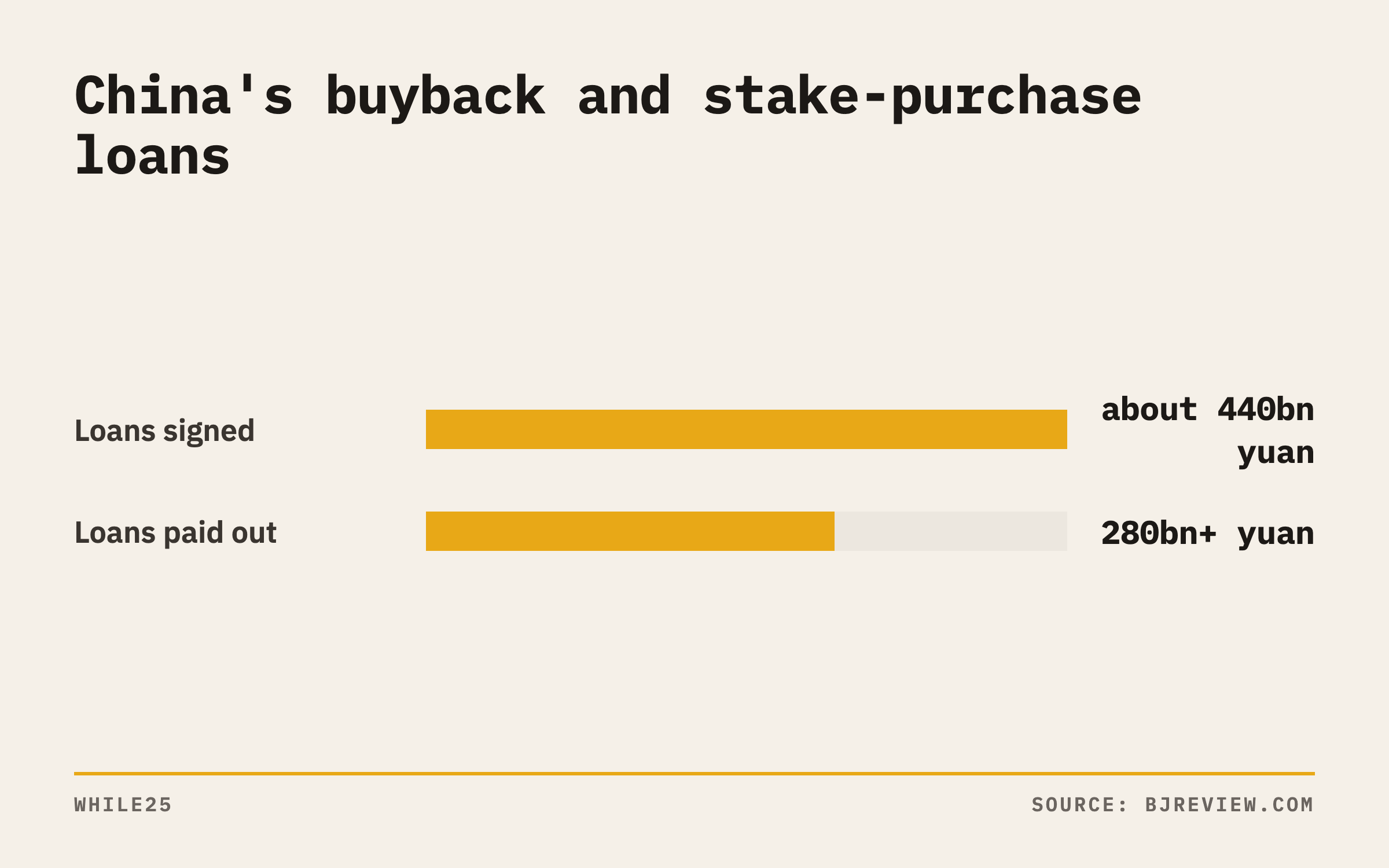 Bar chart comparing about 440 billion yuan of buyback loans signed with more than 280 billion yuan paid out
Readers should watch the gap between the two bars. Borrowers have signed for that credit and not drawn it, so its buying power has not reached the market. Companies can draw on it at a future date, for example after their share price falls.
A second tool for brokers, funds and insurers
The PBOC aims the buyback loans at companies and their owners. It runs a separate program, called a swap facility, for financial firms. These firms include securities brokers, which buy and sell shares for clients. They also include insurance companies and fund managers, which invest pooled money for savers.
In a swap, a firm hands the central bank assets it holds. In return, the firm receives top-rated paper, such as government bonds. A bond is a loan that an investor makes to a government or company. Top-rated paper is debt with the lowest risk of going unpaid. Lenders accept that paper as collateral, the security a borrower pledges against a loan. The firm can pledge it to raise cash, and use the cash to buy stocks.
The PBOC scheduled the third operation of this swap facility for November 3. That was the day before the new loan rate took effect. With the two tools, the PBOC reaches both the companies and the institutions that invest savers' money.
The day the cut took effect
On November 4, investors in Asia moved in two directions. In the November 3 US midterm elections, Democrats won majorities in both houses of Congress. During Asian trading hours, investors sold AI-related shares across the region.
Japan's Nikkei 225 is a main index of Japanese shares. It fell more than 4% during the session, to its lowest level since May. A session is one trading day. The index closed 1.42% lower at 62,188.63. Reports tied the slide to concern that Democratic gains could bring stricter US rules for data-center projects. Data centers are large computer sites that run AI services.
Chinese stocks moved the opposite way. The Shanghai Composite, the main index of the Shanghai exchange, rose 2.16% to 3,686. The Shenzhen Component tracks leading companies on the Shenzhen exchange. It rose 4.22% to 11,335.
In Hong Kong, the Hang Seng index rose 1.67%. The Standard, a Hong Kong newspaper, linked those gains to Beijing's latest market support measures. Shares of chipmaker Hua Hong Grace Semiconductor rose 15.7%, and SMIC shares rose 8.9%.
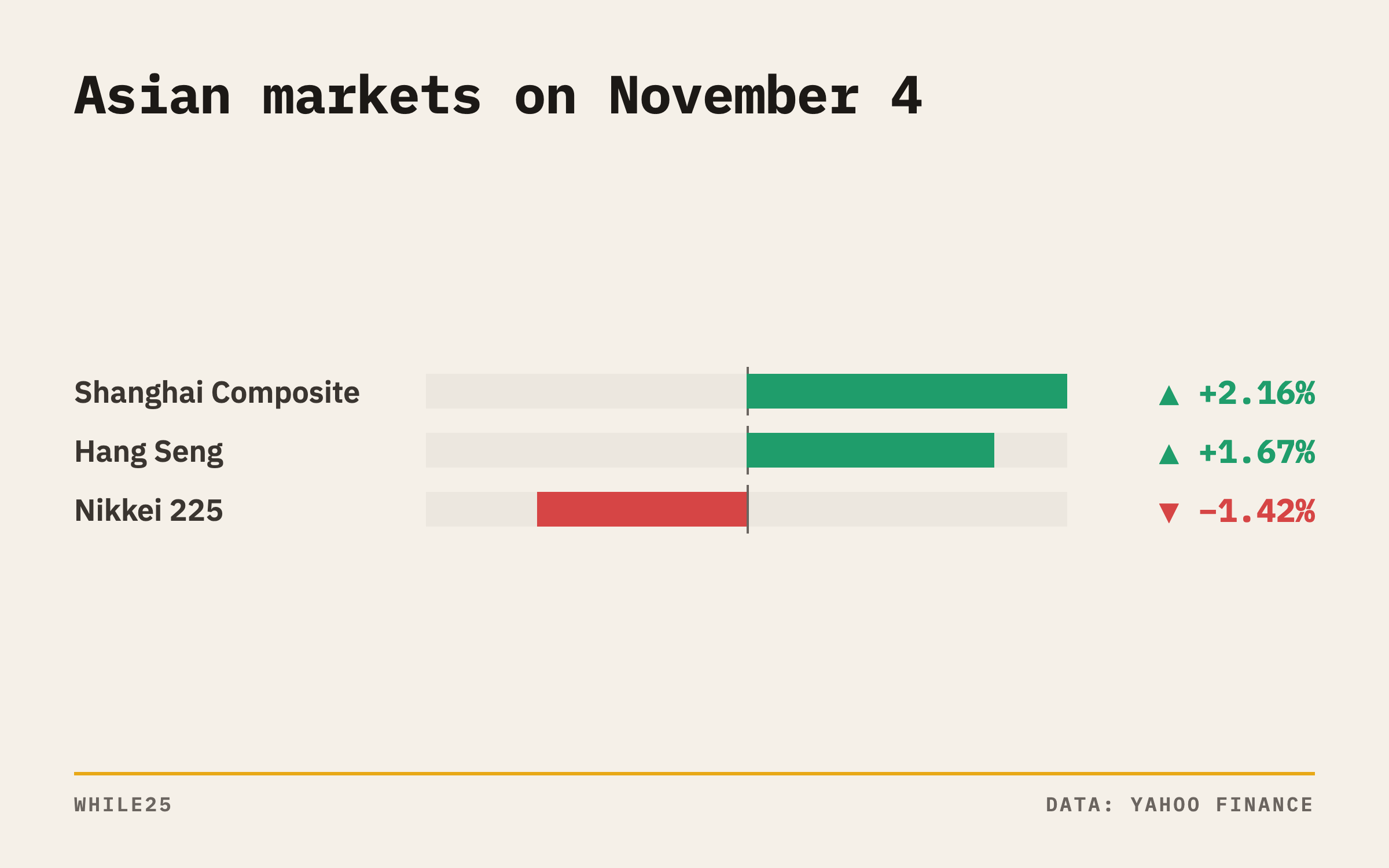 Day change on November 4: Shanghai and Hong Kong rose while Japan's Nikkei fell
A single day of trading cannot show the cause of its own moves. Investors also reacted to other news on November 4, including a weaker US dollar. The buyers in each market differed. Traders in Tokyo acted on worry about US policy. In China, local buyers had cheap state loans behind them.
A floor under stocks
Stock prices fall if sellers outnumber buyers at the current price. Traders use the word "floor" for a price level that has held up under selling pressure. A floor forms at a price where enough buyers wait to take on the selling.
Companies with buyback loans form that waiting demand. A company with a signed loan can step in after its share price drops. At a lower price, each yuan of the loan buys more shares. Borrowing at 1% makes that buying cheap to fund.
Investors should note two effects on prices. The first effect is extra buying in a sharp drop. Sellers find a buyer with state-backed funding on the other side of the trade.
The second effect concerns the business itself. A buyback spreads the same profit across fewer shares. A loan-funded buyback adds debt that the company must repay with interest.
A floor has limits. Over the month to November 4, the Shanghai Composite was down 3.30%. Over the last five sessions, it was up 0.13%. Companies with cheap loans can add buying, and sellers can keep selling.
For your portfolio
You may own Chinese stocks through a fund or in your own account. Part of the buying behind those stocks traces back to the central bank. That buyer reacts to policy as well as to company results.
Investors should treat changes to the loan rate or the program's size as market news. Those changes matter in the same way as an earnings report, a company's update on its profits.
The lesson applies beyond China. A central bank can support its stock market without holding a single share. It cuts the price of money for one purpose and lets banks and companies place the orders. To read a market like this, track two things: what its companies earn and what its policy makers make cheap.
Sources
Not investment advice.