
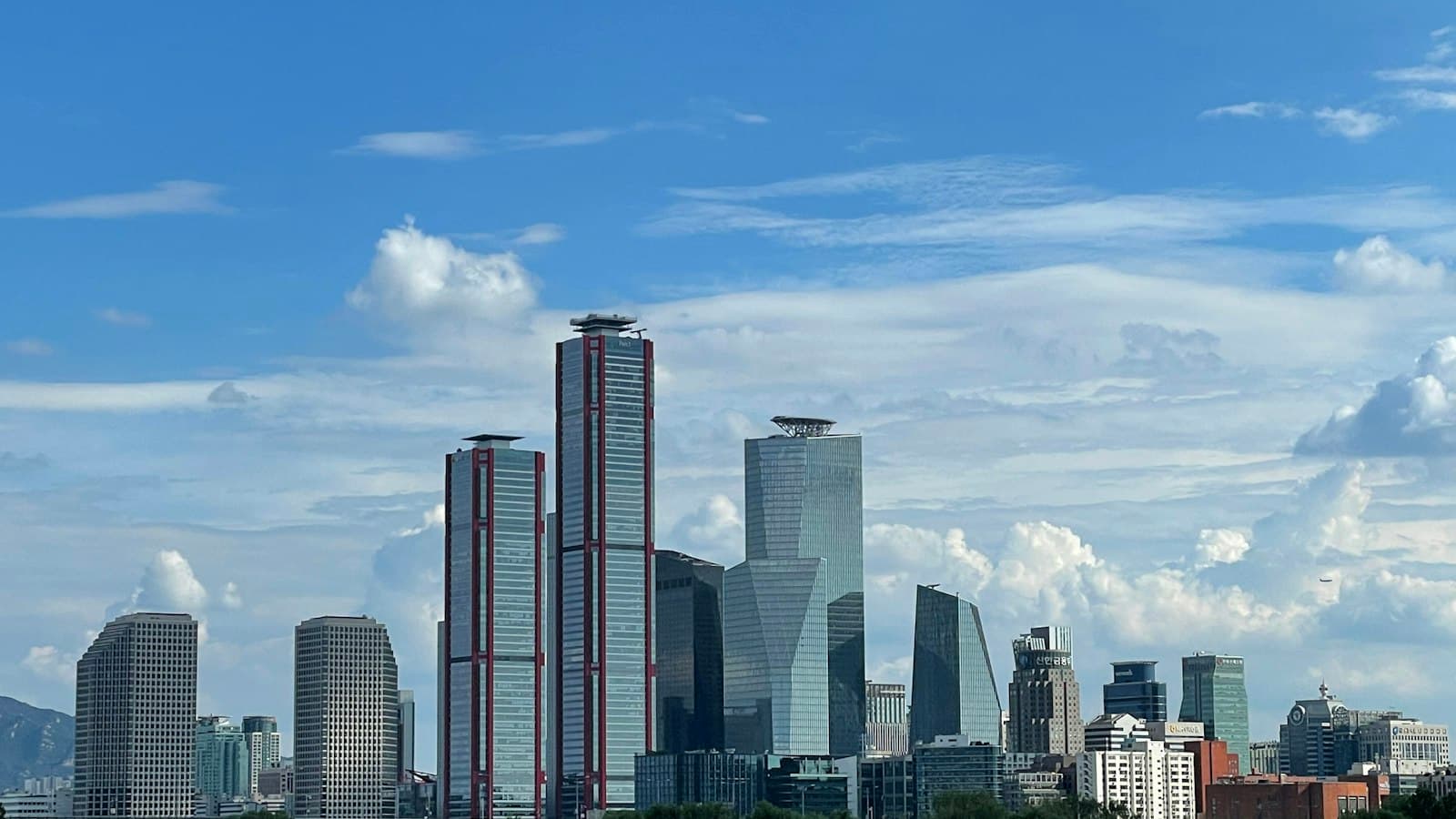
South Korea's KOSPI, the country's main stock index, closed at 6,012.44 on October 28. That was a gain of 6.63% and its first close above 6,000. SK hynix, a Korean maker of memory chips, led the gain. The company reported a record quarterly profit. It plans to return about 100 trillion won to shareholders in 2026.
Japanese chip stocks rose with it. European stocks made small moves. US stock futures, contracts that let traders bet on future stock prices, made small moves too. Traders were waiting for the Federal Reserve, the US central bank, to announce its interest rate decision at 2 p.m. ET.
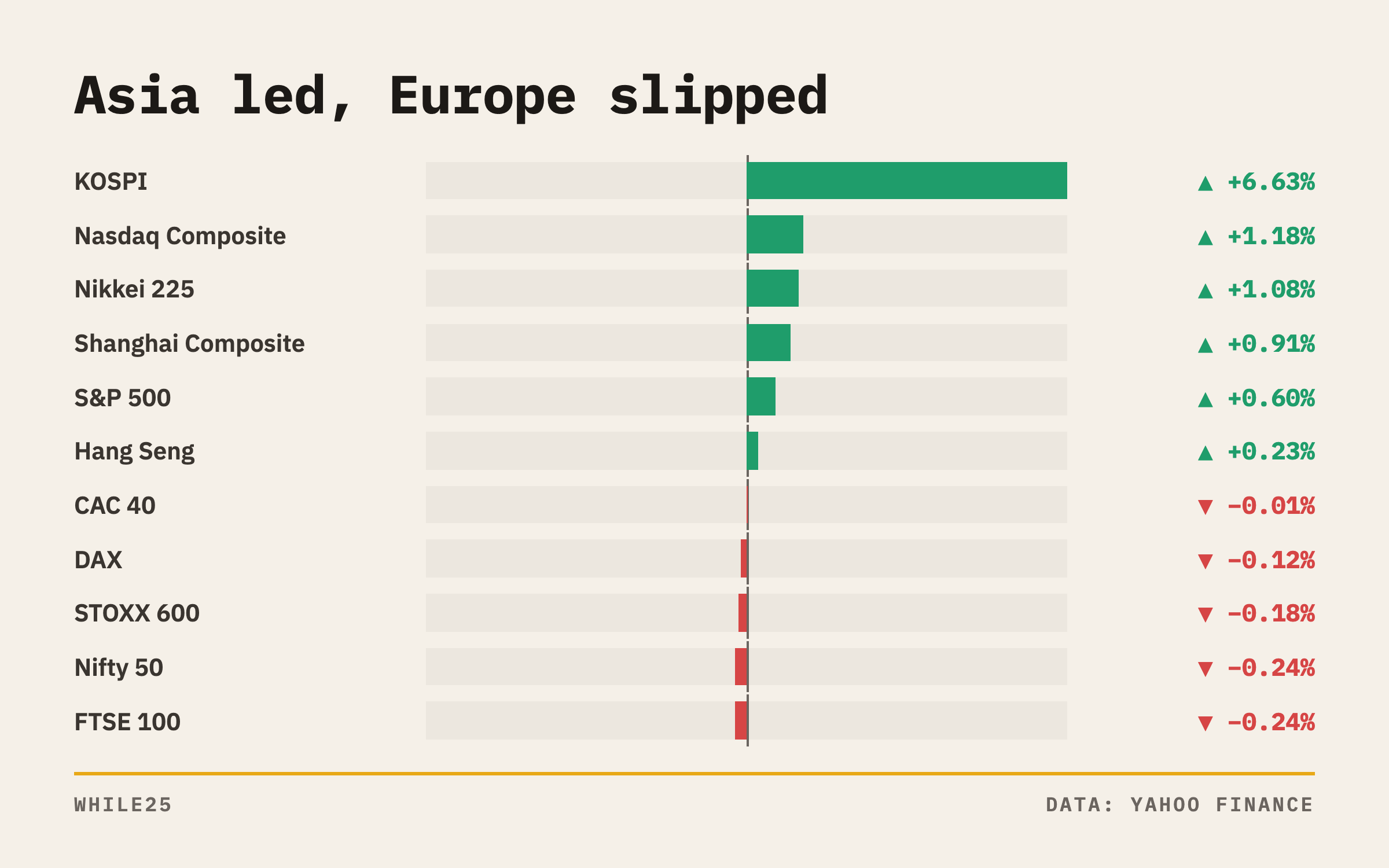 Day change for major stock indexes: the KOSPI led with a 6.63% gain while European indexes closed slightly lower
SK hynix earned more than expected and set out a payout plan
SK hynix makes memory chips. These parts store data inside the servers that run AI software. The company reported third-quarter operating profit of about 83 trillion won. Operating profit is what a company earns from its main business before interest and taxes.
Analysts are researchers who forecast company results. The ones LSEG tracks had expected about 77 trillion won. Revenue, the company's total sales, came in at about 105 trillion won. Analysts had expected about 98 trillion won.
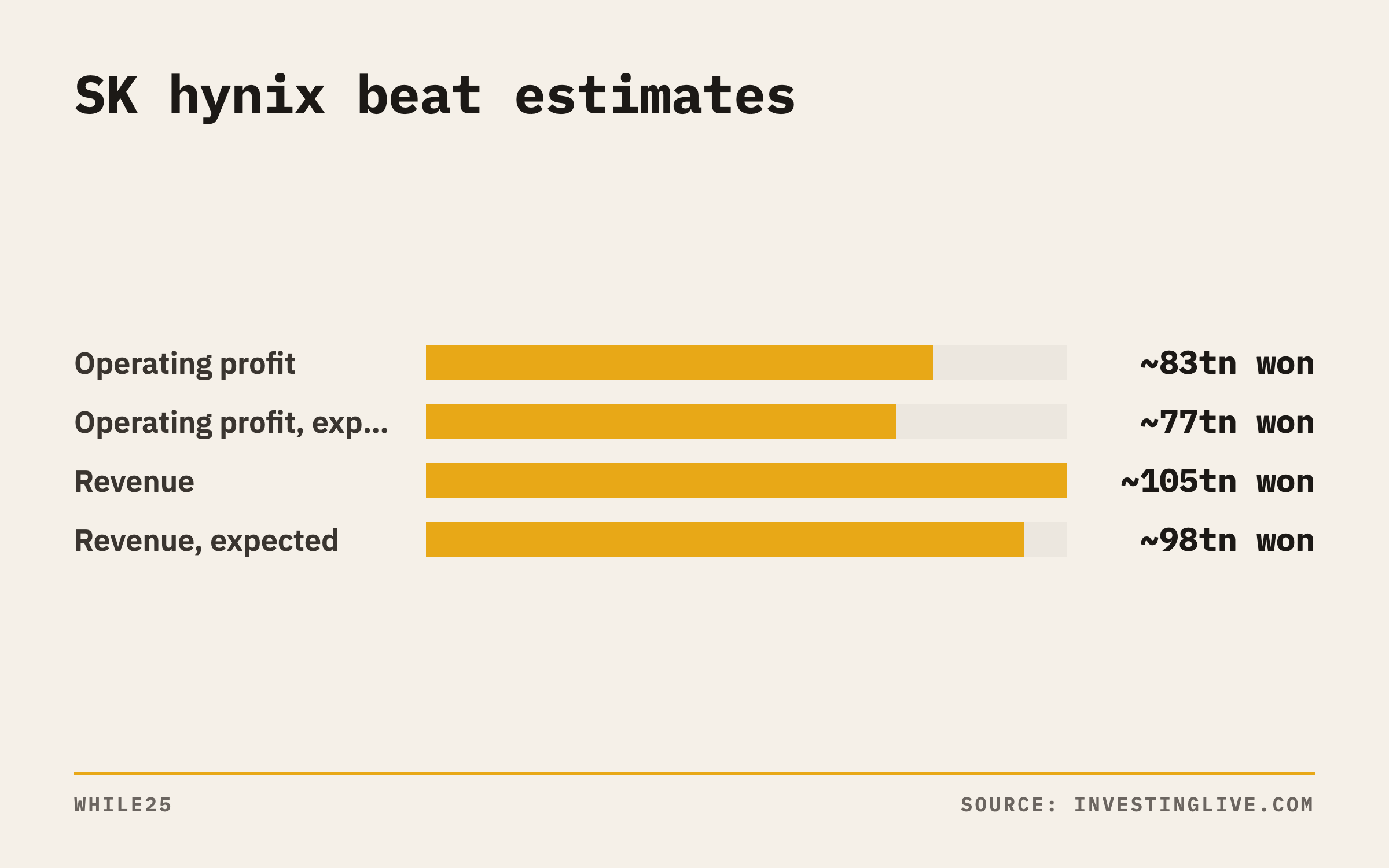 SK hynix third-quarter operating profit and revenue compared with LSEG estimates, in trillion won
One figure fell short. Net profit, the amount left after all costs, was about 40 trillion won. Analysts had expected about 55 trillion won.
The company paired the results with a plan for 2026. SK hynix plans about 100 trillion won of shareholder returns. Shareholder returns are money a company pays back to the people who own its stock. SK hynix will pay more than 30 trillion won as cash dividends, which are direct cash payments to shareholders. It will spend more than 60 trillion won to buy back its own shares and cancel them. Cancelling shares gives each remaining share a bigger slice of future profits. The SK hynix board approved a 20 trillion won buyback as part of the plan.
SK hynix stock rose 11.41% to 1,494,000 won. Samsung Electronics, the other big Korean memory maker, rose 9.12% to 242,500 won. Gains in those two stocks pushed the KOSPI past 6,000.
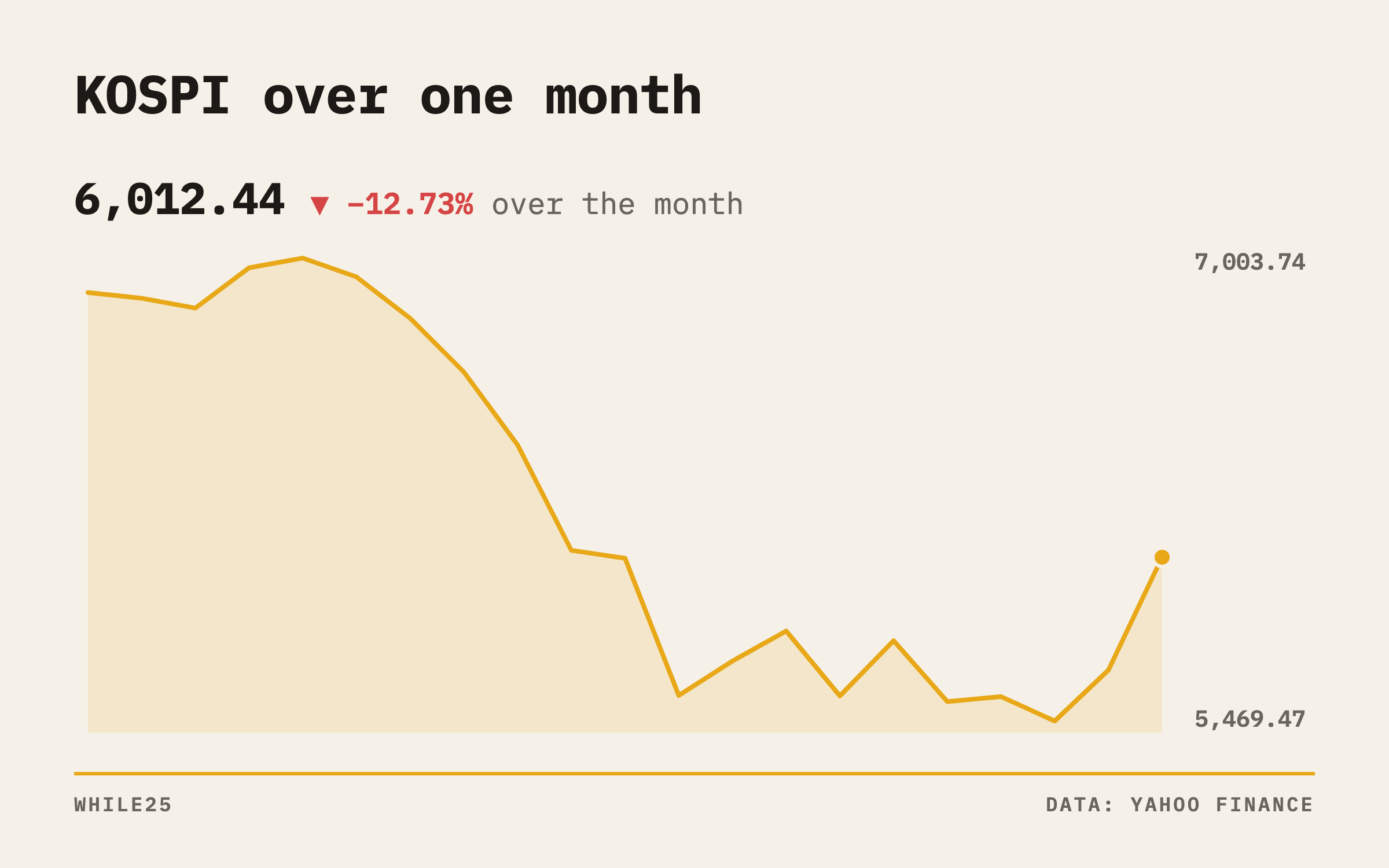 The KOSPI over the past month, with the October 28 jump coming after a steep slide
The record comes after a steep fall. Over the past five sessions, or trading days, the KOSPI rose 4.83%. Over the past month, it is down 12.73%. That figure includes the October 28 jump. The new high in points came after a sharp drop, and one strong day did not erase it.
The gains spread to Tokyo
Japan's Nikkei 225, an index of 225 large Japanese companies, gained 1.08%. Kioxia rose 13.76%. Kioxia is a Japanese memory maker, and SK hynix holds an investment in it. SoftBank shares rose 4.65%.
SK hynix's dividend reflects its Kioxia stake. The company declared a dividend of 20,000 won per share for the third quarter. Of that, 10,000 won is a special payout tied to its Kioxia investment.
Other Asian markets moved less. China's Shanghai Composite index rose 0.91%. Hong Kong's Hang Seng index rose 0.23%. India's Nifty 50 index slipped 0.24%. Shares of Infosys, an Indian software company, fell 3.98% at the open, the start of the trading day. Other Indian software stocks fell with it.
The spark came from Wall Street
The Asian gains followed a rise in US chip stocks on October 27. That day, Bank of America, Blackstone, Citi and Morgan Stanley announced $63 billion in financing. The money will pay for Broadcom AI chips and networking gear. A special company for the deal will own the equipment. It will lease, or rent, the equipment to Anthropic, the maker of the Claude AI models.
Anthropic filed on October 26 to list its shares on the Nasdaq under the symbol ANT. A listing lets the public buy and sell a company's shares on a stock exchange.
The Nasdaq Composite, an index that leans toward tech stocks, rose 1.18% on October 27. The S&P 500, which tracks 500 large US companies, gained 0.60%. The Russell 2000 index of smaller companies rose 1.16%. The Dow Jones Industrial Average, another index of large US companies, edged up 0.03%.
Boeing went the other way. The planemaker reported an adjusted loss of 34 cents a share. Companies leave some one-time items out of adjusted figures. Analysts had expected a loss of 21 cents.
Boeing said it expects $3 billion of free cash flow next year. Analysts had projected $5.5 billion. Free cash flow is the cash a business keeps after paying for its operations and equipment. Boeing shares were down 9.6% at $170.23 in afternoon trading.
Europe and the US waited on central banks
Central banks set the main interest rates for their economies. The STOXX 600, which tracks 600 large European companies, slipped 0.18%. Bank results were mixed. Deutsche Bank shares rose 3.5% in early trading. The bank's third-quarter profit grew 2% and came in above estimates. Shares of Santander, the Spanish bank, fell 2.9% in early trading after its results. Germany's DAX fell 0.12% and Britain's FTSE 100 fell 0.24%. France's CAC 40 closed flat.
The Fed's benchmark rate, the main rate it sets, sits at 3.75% to 4.00%. The Fed raised it by 25 basis points in September. A basis point is a small unit, and 100 basis points make one percentage point.
In a Reuters poll, 94 of 100 economists expected the Fed to hold rates on October 28. Holding means leaving them unchanged. Traders bet on future rate levels through contracts called futures. CME FedWatch, a tool that reads those prices, shows about an 80% chance of at least one more rate rise by December.
Bonds, currencies and oil
The 10-year Treasury yield closed at 4.993% on October 27. This yield is the interest rate the US government pays to borrow for 10 years. It rose 0.7 basis points that day. Over the past month it fell 24.7 basis points.
The euro fell 0.42% to $1.1127. Investors renewed their worries about French government debt on October 27. France's 10-year bond yield, the rate France pays to borrow for 10 years, stood near 4.97%. The US dollar index, which measures the dollar against other major currencies, was flat at 102.38. One dollar bought 157.70 yen.
The two main oil benchmarks split. A benchmark is a standard price that traders use as a reference. Brent fell 2.60% to $110.92 a barrel. WTI, the US benchmark, rose 1.59% to $101.49.
Both prices come from futures contracts, which are deals to buy oil at a set price on a later date. The price feed shows both moving to new contracts this week. Part of each daily change comes from that switch. The split followed a statement from Yemen's Houthis on October 27. They said they had targeted a Saudi oil refinery with a ballistic missile.
Gold slipped 0.12% to $4,069.90 an ounce. Bitcoin rose 0.72% to $81,386.
The calendar for the rest of the week
- October 28, 2:00 p.m. ET: Federal Reserve rate decision. Chair Kevin Warsh holds a press conference after it.
- October 28, after the US close: Microsoft and Alphabet report quarterly results.
- October 29: European Central Bank (ECB) meeting. First estimate of US third-quarter GDP, the total value of goods and services the economy produced. September PCE inflation, a measure of price changes in what households buy. Amazon and Intel results.
- October 30: Bank of Japan meeting. ING expects the Bank of Japan to hold its rate at 1.25%. First estimate of third-quarter GDP for the eurozone, the countries that use the euro. Tokyo October inflation figures.
The takeaway for your portfolio
On October 28, investors reacted to one company's results and pushed a whole country's stock index higher. Gains in SK hynix and Samsung Electronics took the KOSPI to a record close.
Some funds track Korea, Asia or emerging markets, meaning developing economies. If you own one, a few chip makers supplied much of that day's gain. The same index is down 12.73% over the past month. A fund that holds it has seen large swings in both directions.
The chip rally started with a US financing deal for AI hardware. That deal ties chip stocks in Seoul and Tokyo to news from Wall Street. The Fed, the ECB and the Bank of Japan all meet by October 30. Microsoft, Alphabet, Amazon and Intel report in the same stretch. Those meetings and reports will bring new information about interest rates and AI spending.
Sources
- tradingkey.com
- investinglive.com
- anthropic.com
- ksl.com
- investing.com
- newsquawk.com
- finance.yahoo.com
- globalbankingandfinance.com
- fxstreet.com
- malaymail.com
- christophe-barraud.com
- indiatvnews.com
Not investment advice.