
Democrats won majorities in both the US Senate and the House on November 3. After the vote, investors in Tokyo sold AI stocks. These are shares of companies that build or supply artificial intelligence. The Nikkei 225 tracks 225 large Japanese companies. It fell more than 4% during trading on November 4. It closed 1.42% lower at 62,188.63.
Investors put money into Chinese chipmakers, European banks, wind-power stocks and gold. Gold futures are contracts to buy gold at a set price on a later date. They rose 2.70%.
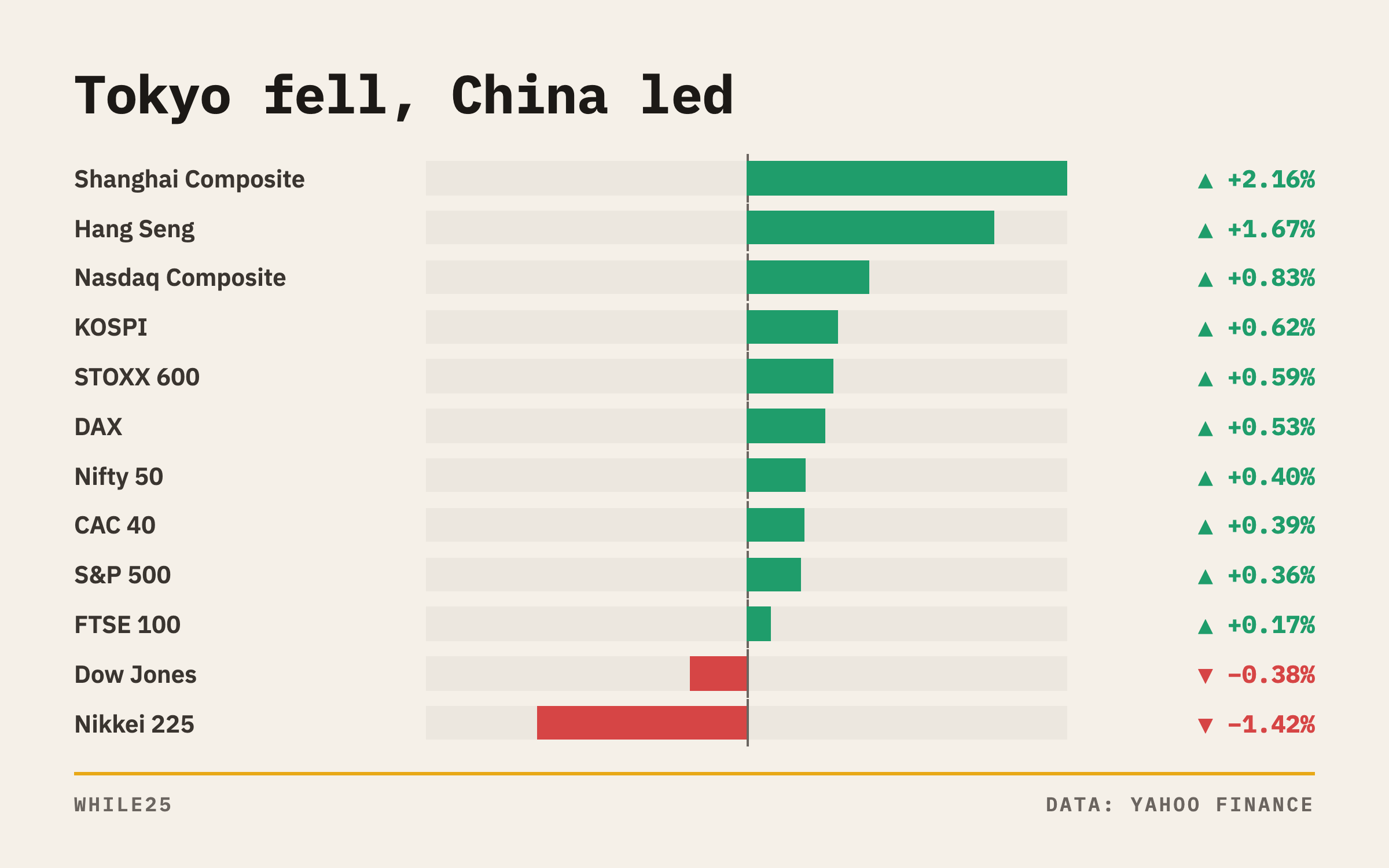 Day change for major stock indexes: Tokyo fell while Shanghai and Hong Kong led gains; US figures are November 3 closes
The Texas vote and chip stocks
Texas provides the link to AI spending. The Associated Press declared Democrat Gina Hinojosa the winner of the governor's race at 11:17 p.m. ET on November 3. She becomes the state's first Democratic governor since 1990.
A data center is a large building full of computers that train and run AI models. Hinojosa campaigned on a pause in new data-center construction. She pledged stricter rules on water and power use. She pledged to end the tax breaks that lower data centers' tax bills.
In 13 states, voters decided at least 50 local ballot measures on data centers. A ballot measure is a question that voters settle at the polls.
Makers of chips, chipmaking tools and power cables depend on orders from new data centers. Wells Fargo says Texas holds about 27% of US data-center gigawatts. A gigawatt is a unit of electric power. Here it measures the power those buildings use. If Texas slows construction with new rules, those suppliers could get fewer orders.
Selling started in Tokyo
Many of those suppliers are based in Japan. Investors started selling there. By 0150 GMT, the Nikkei was down 3.1% at 61,127.9. Shares of cable maker Fujikura fell 8.2%. Furukawa Electric, another cable maker, fell 9%. At that point, 130 of the 225 companies in the index were down.
The biggest AI stocks stayed down through the end of trading. Shares of Disco, which makes chipmaking tools, dropped 10.19%. Tokyo Electron fell 7.04%. SoftBank, a large investor in AI companies, lost more than 8%. At its lowest point of the day, the Nikkei hit its lowest level since May.
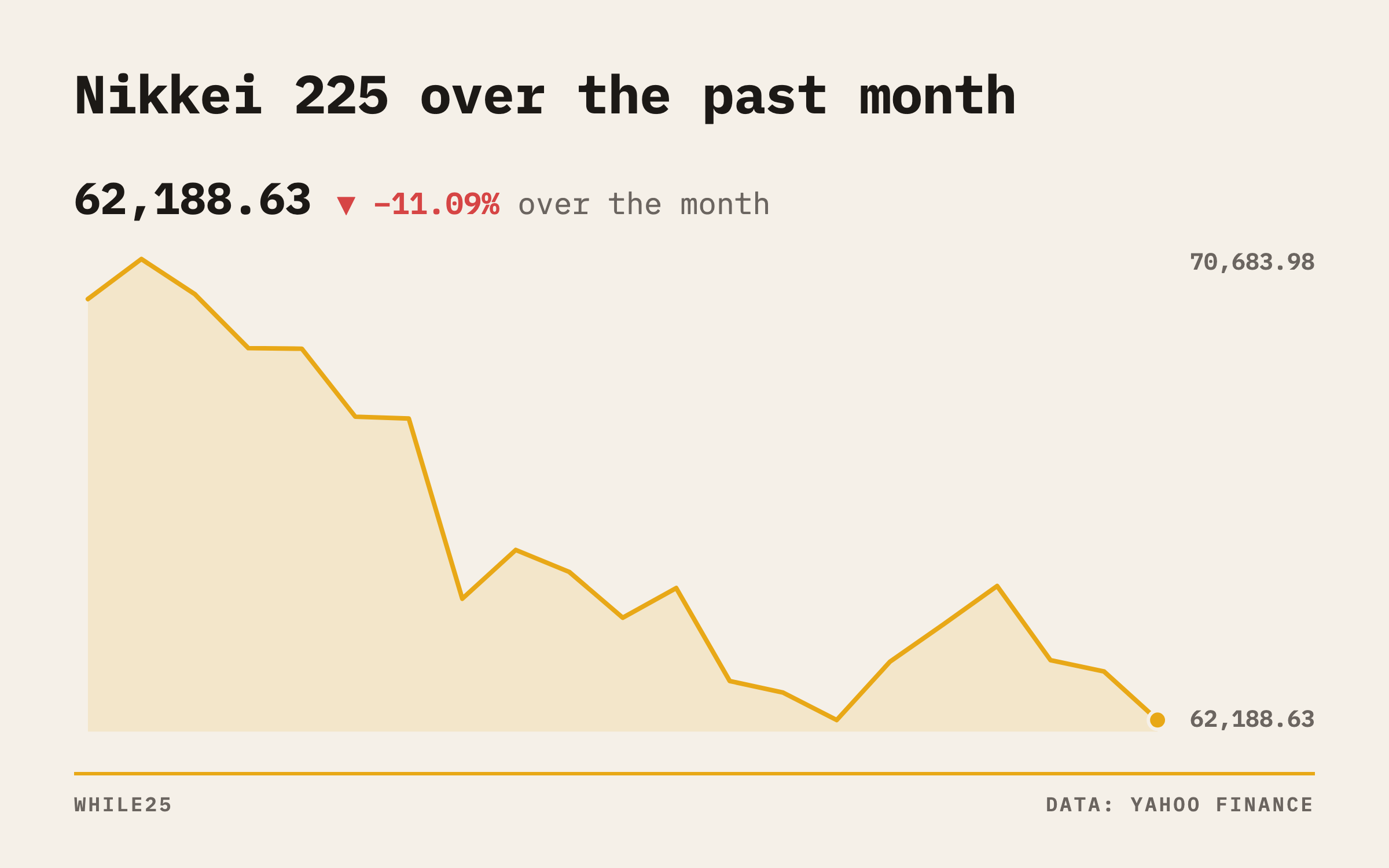 Nikkei 225 closing levels over the past month, showing a sustained decline
Over the past month, the Nikkei has fallen 11.09%.
In Seoul, traders pushed prices up and down. The KOSPI, South Korea's main stock index, traded between 5,828.13 and 5,421.72. It closed up 0.62% at 5,683.80. Foreign investors sold 2.51 trillion won ($1.87 billion) more Korean shares than they bought. The KOSPI has fallen 18.12% over the past month.
Chinese stocks rose
Beijing gave investors in China a reason to buy. The People's Bank of China is the country's central bank, the government bank that sets interest rates. It lends money to banks that fund company share buybacks. In a buyback, a company purchases its own stock. The central bank cut the interest rate on those loans to 1% from 1.25%, starting November 4.
The central bank and two regulators announced the change on November 2. Regulators are the agencies that oversee financial firms. Officials started the program in 2024 as a temporary measure. They will make it a long-term arrangement. Lenders have signed about 440 billion yuan of these loans. They have paid out more than 280 billion yuan.
With cheaper loans, companies pay less to buy back their stock. The Shanghai Composite, an index of stocks traded in Shanghai, rose 2.16% to 3,686. The Shenzhen Component, an index of stocks traded in Shenzhen, gained 4.22%. Hong Kong's main index, the Hang Seng, rose 1.67%.
In Hong Kong, chipmakers posted the biggest gains, the opposite of Tokyo. Hua Hong Grace Semiconductor jumped 15.7%, and SMIC rose 8.9%. Gold miner Zijin Mining gained 7.6% as gold climbed and the dollar lost value.
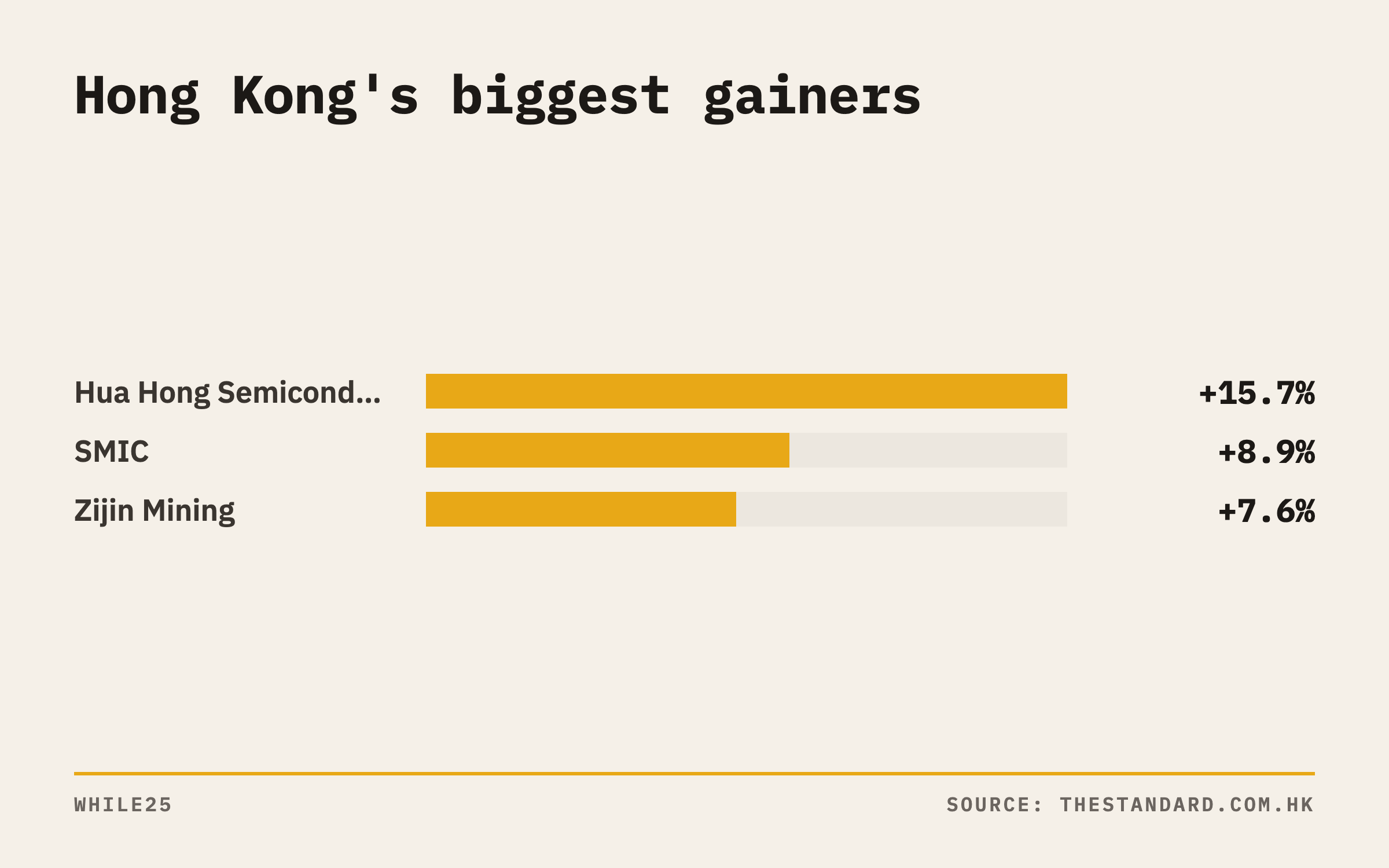 Biggest Hong Kong gainers on November 4: Hua Hong, SMIC and Zijin Mining
In India, the Nifty 50, an index of large Indian companies, rose 0.40%. Australia's central bank raised its main interest rate to 4.85% from 4.60% on November 3. Six board members voted for the increase. Three voted to keep the rate unchanged.
Europe: banks and wind power rose
Stock futures are contracts tied to a stock index. Investors use them to trade before the market opens. European stock futures fell as much as 1.4% early in the day. By the end of trading, the STOXX 600, an index of large European companies, was up 0.59%.
Bank stocks rose more than 2%. Investors bought clean-energy shares after Democrats won both chambers of Congress. Wind-farm developer Orsted gained 7%. Turbine maker Vestas rose 5%, and Nordex added 4.7%.
Novo Nordisk shares rose 4.6% on company news. The drugmaker reported third-quarter profit above expectations. It raised its forecasts for full-year sales and profit.
Germany's main index, the DAX, gained 0.53%. France's CAC 40 rose 0.39%, and London's FTSE 100 added 0.17%.
US futures fell and recovered
US stocks ended election day higher. On November 3, the S&P 500, an index of 500 large US companies, rose 0.36% to 7,568.92. The Nasdaq Composite, an index weighted toward tech companies, gained 0.83%. The Dow, an index of 30 large US companies, fell 0.38%.
Index futures let investors trade these indexes overnight. Traders bought and sold them as the results came in. By 11:57 p.m. ET, S&P 500 futures were down 1.3%. Nasdaq-100 futures, tied to 100 large Nasdaq stocks, were down 2.2%.
Before trading opened on November 4, both had turned positive. S&P 500 futures were up 0.2%. Nasdaq-100 futures were up 0.3%.
Two companies helped the recovery with their results. AMD reported adjusted earnings per share of $2.09. Earnings per share is a company's profit divided by its number of shares. An adjusted figure leaves out some costs the company treats as separate from normal business. Analysts, who forecast company results, had expected $1.95.
Arista Networks sells networking gear for data centers. Revenue is the money a company takes in from sales. Arista forecast fourth-quarter revenue above the $3.60 billion analysts had expected. Arista shares rose 12%.
In overnight trading, investors sold some stocks tied to the election. Trump Media dropped more than 7%. Tesla lost more than 4%, and SpaceX lost more than 6%.
Dollar down, gold up
The US dollar index tracks the dollar against a group of major currencies. It fell 0.53% to 101.326. The euro rose to $1.1251. The dollar gained 0.20% against the yen, to 158.226 yen.
A bond is a loan that investors make to a borrower. A Treasury is a bond issued by the US government. The yield is the interest rate the government pays on that loan. Treasury yields eased in overnight trading.
The 10-year Treasury yield is the rate the US government pays to borrow for 10 years. It closed November 3 at 4.952%. During the night it fell 6 basis points to 4.906%. One hundred basis points make one percentage point.
Gold pays no interest. With bond yields lower, gold owners give up less interest by holding it. Spot gold is the price for immediate delivery. It rose 2.64% to $4,031.98 an ounce by 3:37 a.m. ET. Gold futures closed up 2.70% at $4,046.90. Spot silver rose 4.17%. Gold remains down more than 7% this year.
Oil prices edged up. Brent crude, the main international oil price, rose 0.55% to $104.17 a barrel. WTI, the main US oil price, gained 0.53% to $96.6. Bitcoin, a digital currency, rose 1.35% to $78,386.
The VIX measures how much traders expect US stocks to swing over the next month. It draws on options prices. Options are contracts that give the right to buy or sell later at a set price. The VIX fell 8.45% to 19.07.
Dates to watch
- November 4: The ISM services survey for October, a monthly poll of US service businesses.
- November 5, 12:00 GMT: The Bank of England's interest-rate decision. The bank also publishes its Monetary Policy Report, a review of the UK economy.
- November 6, 8:30 a.m. ET: The US jobs report for October. Traders call it nonfarm payrolls, a count of jobs outside farming.
- November 17, 5 p.m. ET: Nvidia's call with investors on results for its fiscal third quarter. A fiscal quarter follows the company's own business calendar. This one ended October 25.
For your investments
Within hours of a state governor's race, investors moved chip prices in Tokyo, Seoul and Hong Kong. AI stock prices depend on sales and profits. They depend on local rules for power, water and land as well.
An index fund buys the stocks in a market index. If you own funds that track Japan, Korea or the Nasdaq, part of your money sits in companies that supply data centers. Investors abroad can react to a vote in Texas before US markets open.
On November 4, investors moved money to Hong Kong chipmakers, European banks and gold.
Sources
- investing.com
- foxbusiness.com
- cnbc.com
- finance.yahoo.com
- brecorder.com
- ajupress.com
- bjreview.com
- thestandard.com.hk
- devdiscourse.com
- cnbc.com
- rba.gov.au
- nordfx.com
- financecalendar.com
- thriveinmarkets.com
- nvidianews.nvidia.com
Not investment advice.