

On November 16, the US Commerce Department issued a new rule on advanced chips. A license is written permission from the US government. Under the rule, companies need one to ship these chips to Indonesia, Malaysia, Singapore, Thailand and Brazil. Chip stocks, meaning shares in chip companies, fell the same day. Micron and Intel shares each lost more than 7%. Nvidia shares fell 4.1%.
Commerce added a second part with a wider reach. This part covers large data centers anywhere in the world. A data center is a building full of computers. Their operators now need a license to let companies headquartered in China use their chips over the internet.
The gap the rule addresses
Export controls are government limits on what companies may sell abroad. Under earlier export controls, the US barred Chinese firms from buying the most advanced chips. The owner of a chip abroad can rent out its computing power. A company in China can log in to a data center in another country. From there, it can run its software on chips it does not own. The industry calls this remote access. Some Chinese firms used remote access to reach top chips they could not buy.
The Bureau of Industry and Security (BIS) wrote the new rule. BIS is the Commerce agency in charge of export controls. In the rule, BIS addresses two routes: shipping the chip and renting out its computing power.
Part one: five countries need a license
Semiconductors is the formal name for chips. Under the rule, a company needs a license to export, reexport or transfer advanced semiconductors to the five named countries. Exporting means shipping goods out of the US. Reexporting means sending US chips from one foreign country to another. An in-country transfer means selling them to a new owner inside the same country.
In the rule, BIS uses the phrase "a higher-than-normal risk of diversion" for the five countries. Diversion means goods end up with someone other than the buyer on the paperwork. The Commerce Secretary can add more countries to the list.
Part two: remote access needs a license too
The second part covers chips after they arrive. Operators of large data centers need a license to give China-headquartered companies access to their chips. The requirement holds anywhere in the world. An operator in Europe faces the same requirement as one in Malaysia.
Operators with existing clients of this kind get a grace period, meaning extra time to follow the rule. These operators have 90 days from the effective date to obtain a license. The effective date is the day the rule takes force.
A partial pass for US companies
An end user is the buyer that puts the chips to work. The rule gives some end users a carve-out, which is an exception to a rule. The carve-out covers end users headquartered in the US or owned by a US-headquartered company. These buyers skip the new shipment license.
A cloud company rents computing power to other businesses over the internet. A US cloud company can buy chips for its own data center in Singapore without the new shipment license.
The carve-out has a limit. US-owned buyers must follow the remote access limits. A US-owned data center needs permission to rent chips to a China-based company.
Fortune named Microsoft, Oracle and Amazon as likely to gain from the carve-out. All three run large cloud businesses.
A rule that took effect on day one
Most US rules start as a proposal. An agency publishes a draft and collects public comments. Then it writes the final version. Commerce skipped the draft stage here.
Commerce issued this one as an "interim final rule." A rule of this type takes effect before the agency collects comments. This one takes effect the moment it appears in the Federal Register. The Federal Register is the US government's daily journal of new rules. Affected companies had no draft to comment on.
Officials' statements
BIS said the rule came "by and at the direction of" two other bodies. The two are the Treasury Department and the White House National Security Council. The National Security Council is the president's staff for security and foreign policy. BIS issued the rule under its own name.
Treasury Secretary Scott Bessent spoke about chip exports on CNBC's "Squawk Box." Megaspeed is a company based in Singapore. The entity list names foreign firms that need a special license to receive US technology. Bessent blamed Commerce for leaving Megaspeed off its entity list.
Separate rules cover sales straight to China. Under current policy, Nvidia can sell its H200 chips to approved Chinese customers. Reuters reported that about 600,000 H200s sit in Hong Kong. The chips wait for China to approve their import.
The market reaction
Shares of chip and hardware companies fell the most on November 16. Hardware means physical computer equipment, such as servers. A server is a computer that runs programs for many users over a network. Micron and Intel each fell more than 7%. Sandisk fell about 8%, and Dell fell almost 7%. AMD fell 5%, and Oracle fell about 5%. Nvidia fell 4.1%.
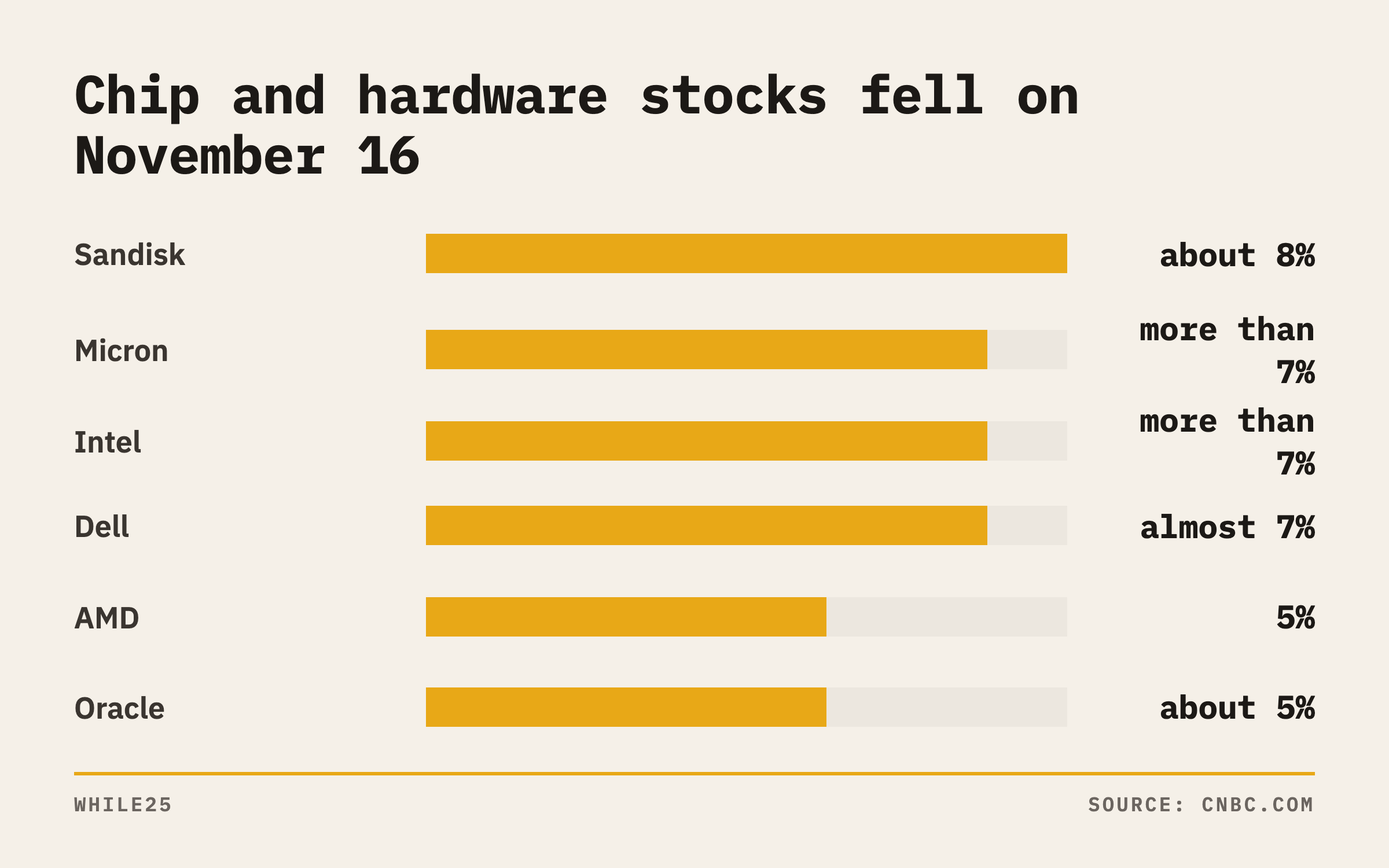 Bar chart of November 16 declines: Sandisk about 8%, Micron and Intel more than 7%, Dell almost 7%, AMD 5% and Oracle about 5%
Stocks across the wider market fell the same day. An index tracks a group of stocks as a single number. The Nasdaq Composite, an index heavy in technology stocks, dropped 2.49%. The S&P 500, an index of 500 large US companies, fell 1.92%. The VIX is a gauge of how much traders expect S&P 500 prices to swing over the coming month. The VIX rose 18.7%.
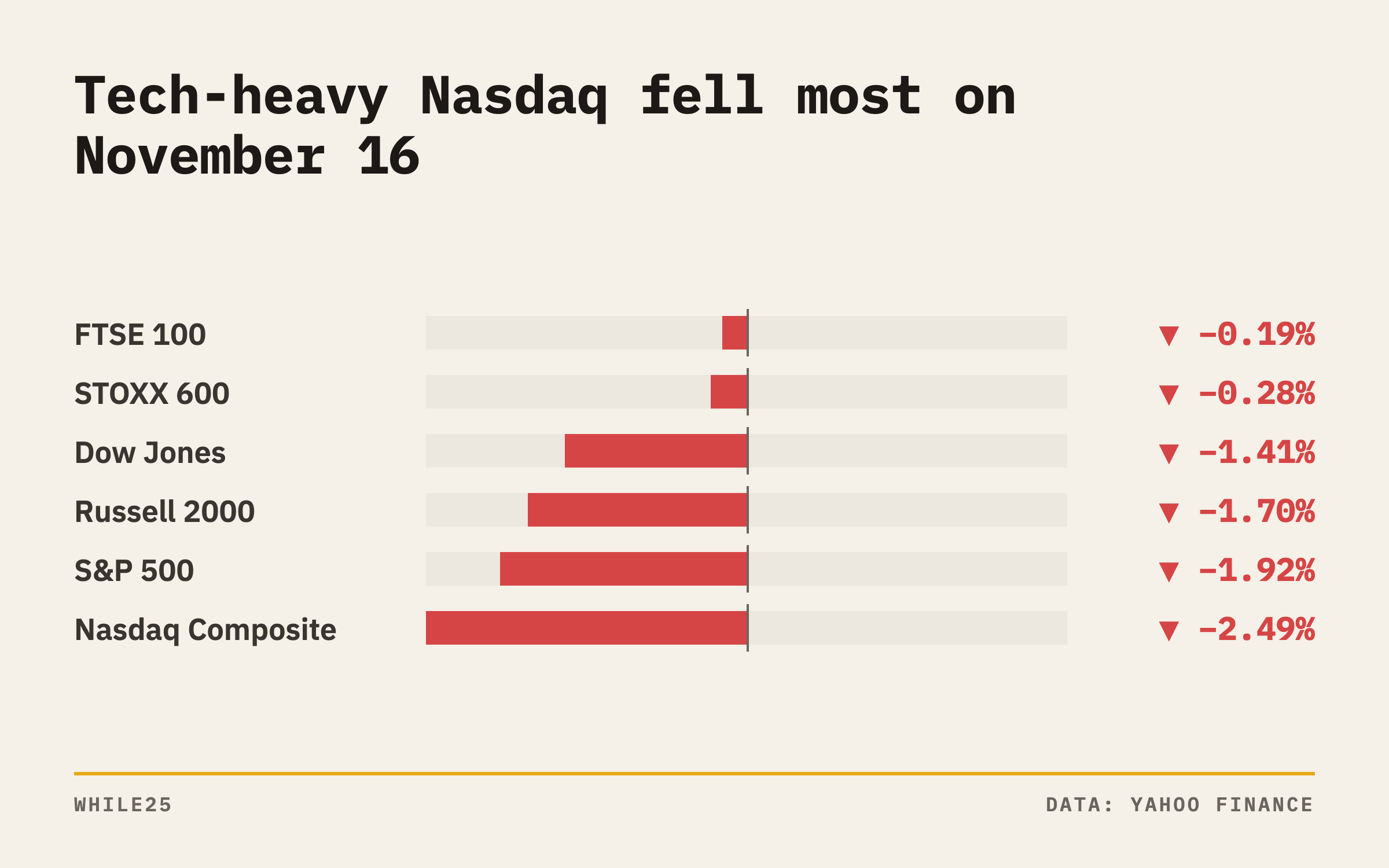 Day change on November 16 for major US and European stock indexes, with the Nasdaq Composite falling the most
Investors had other chip news to weigh. A filing is an official document a company sends to regulators. According to a filing dated November 12, Jensen Huang resigned as Nvidia's chief executive. Nvidia has an interim, or temporary, chief executive in his place. Nvidia reports quarterly results on November 17. Quarterly results show a company's sales and profit for the past three months. The news reports name no single cause for the selling.
The link between export rules and chip stocks
A chip company's sales depend on who may buy its chips. With a license requirement, the government steps in between an order and a shipment. Getting a license takes time. The government can refuse one. Investors judge a stock's worth from the sales they expect. A new hurdle in five markets can lead them to redo that math.
The remote access part covers a second group. These companies buy chips and rent out the computing power. Dell sells servers to these operators. Oracle rents out cloud computing. Through the license, Commerce gets a say over part of their customer lists. Existing contracts face a 90-day deadline.
That group splits in two under the US carve-out. US-owned buyers skip the shipment license. Foreign-owned buyers in the five countries need one.
Some readers own chip stocks or a broad tech index fund. An index fund owns the stocks in an index and tracks its moves. For these readers, the speed of the process matters. With an interim final rule, the government can change who may buy a product on the day it publishes the rule. The Commerce Secretary can add more countries. Changes like these hit chip makers and chip buyers. Their share prices can move the same day.
Sources
Not investment advice.