
Alphabet reported free cash flow of negative $9.1 billion for the third quarter of 2026. The company spent more on equipment than its business brought in as cash. Its shares fell 10% in after-hours trading on October 28. After-hours trading is buying and selling that takes place after the regular 4 p.m. Eastern close. Alphabet lost close to $400 billion of market value in that drop. Market value is the share price multiplied by the number of shares the company has issued.
Microsoft reported results the same evening. Its shares rose 3% after hours. Both companies spend large sums on artificial intelligence, or AI. Investors treated them differently because of one line in the cash flow statement. That statement is the report of the cash a company takes in and pays out.
Free cash flow in plain words
Free cash flow starts with operating cash flow. Operating cash flow is the cash a company collects from running its business. The figure counts what remains after the company pays staff, suppliers and taxes.
From that figure, subtract capital expenditures, or capex for short. Capex is money spent on buildings and on equipment such as servers and chips. These assets last for years. The cash left over is free cash flow.
A company uses that leftover cash for dividends, share buybacks and debt repayment. Dividends are cash payments to shareholders. In a buyback, a company purchases its own shares from investors. A company with positive free cash flow can fund its plans from its own pocket. A company with negative free cash flow must raise the money from outside.
Alphabet's quarter, line by line
Alphabet's revenue, the money it took in from sales, reached $127.6 billion. That was 25% more than in the same quarter last year. Operating cash flow was $42.3 billion.
Capex was $51.4 billion, up from $24.0 billion in the same quarter last year. Much of that money went into data centers. These are warehouse-sized buildings full of servers that train and run AI models.
Subtract capex from operating cash flow, and Alphabet's free cash flow comes to negative $9.1 billion. In the second quarter, the figure was negative $5.9 billion. For two quarters in a row, Alphabet spent more on equipment than its business generated in cash.
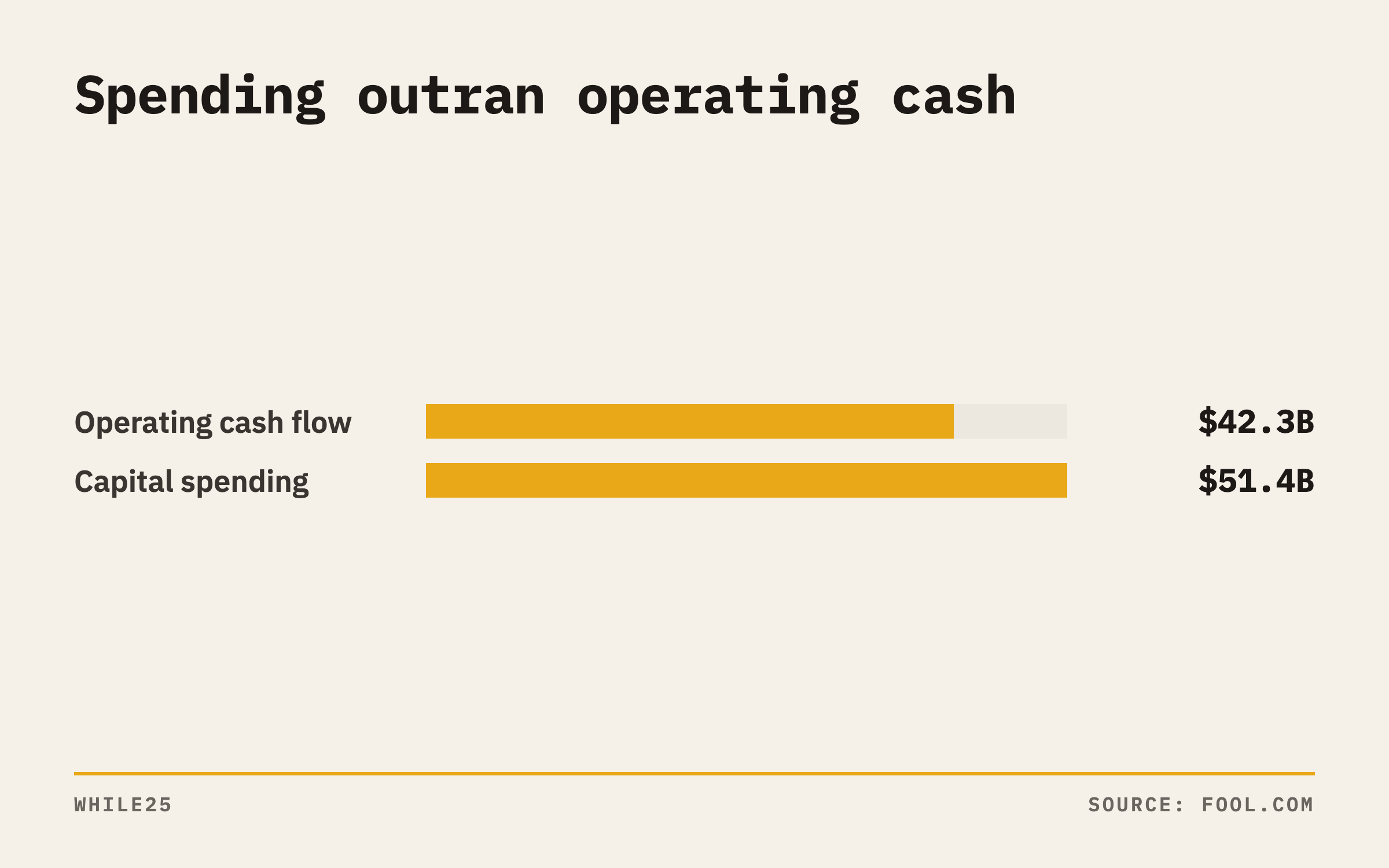 Bar chart: Alphabet's third-quarter operating cash flow of $42.3 billion against capital spending of $51.4 billion
Alphabet filled the gap with bonds and stock
Alphabet had to find the missing cash outside its business. It sold $28.7 billion of senior unsecured notes. Notes are a type of bond. Investors who buy them lend the company money. In return, Alphabet promises to pay interest and repay the loan.
"Senior" means these lenders stand near the front of the line for repayment. "Unsecured" means no specific asset, such as a building, backs the loan. Alphabet raised another $12.4 billion by selling stock.
Alphabet records the borrowing on its balance sheet. The balance sheet is the report of what a company owns and owes. Long-term debt is money due more than a year from now. Alphabet's long-term debt rose from $46.5 billion at the end of 2025 to $125.1 billion.
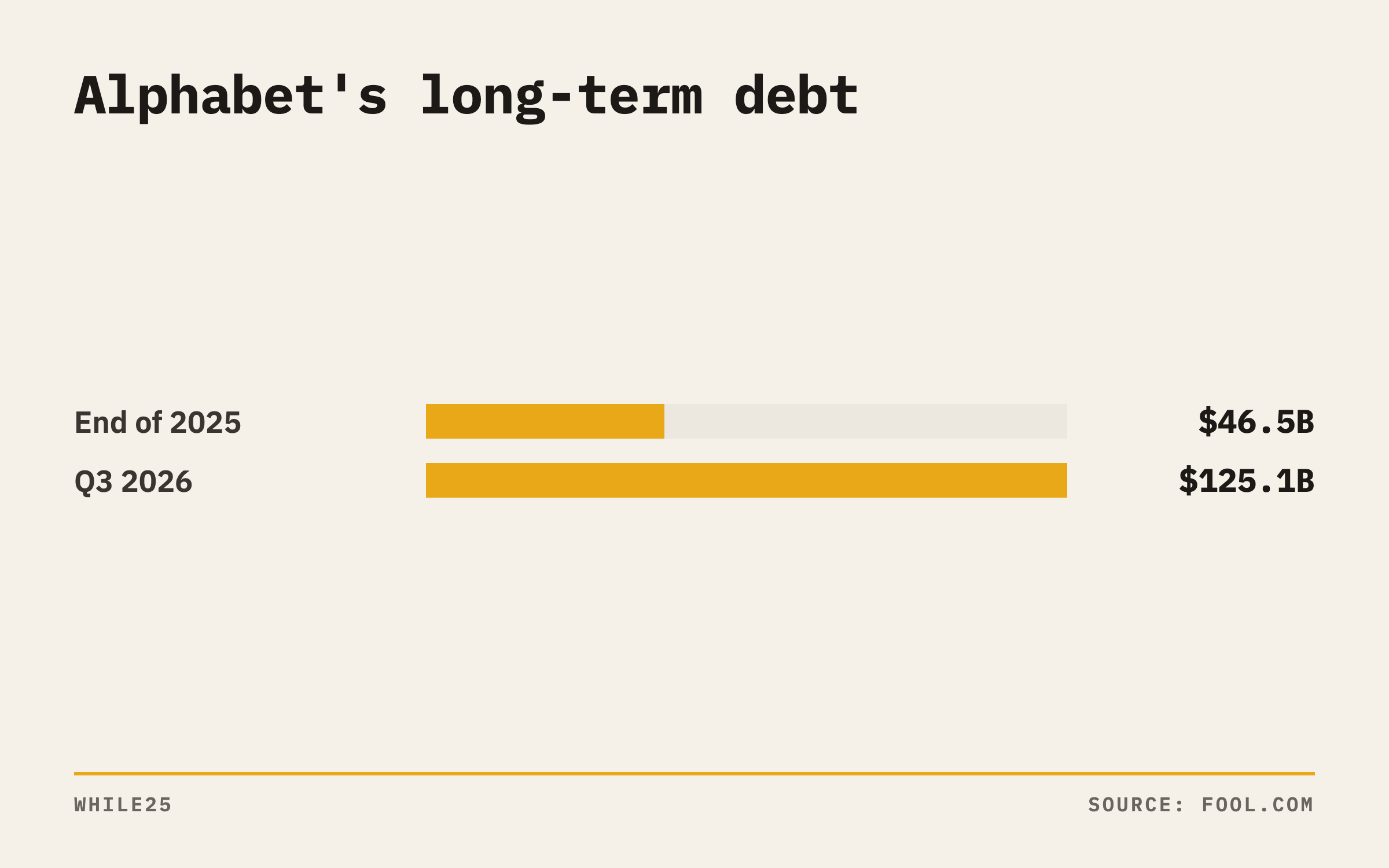 Bar chart: Alphabet's long-term debt rose from $46.5 billion at the end of 2025 to $125.1 billion
Alphabet must pay interest on that debt each year. The 10-year Treasury yield closed at 5.045% on October 28. That yield is the interest rate the US government pays to borrow for 10 years. Most companies pay more than the government to borrow. Lenders see more risk in a company, so they charge a higher rate.
Alphabet plans to spend more
One heavy quarter would draw less attention from investors. In its guidance, Alphabet points to more spending. Guidance is the range a company tells investors to expect.
Alphabet kept its 2026 capex guidance at $195 billion to $205 billion. It said 2027 capex will "increase significantly." Shareholders weighed that sentence against the cash flow numbers. If capex grows at a higher rate than operating cash flow, free cash flow stays negative. In that case, Alphabet would need more borrowing or more stock sales to cover the gap.
Google Cloud's revenue more than doubled
Alphabet is earning revenue from the spending. Google Cloud is the unit that rents computing power and AI tools to other companies. Its revenue grew 103% to $30.7 billion. The unit earned $11.1 billion in operating income. Operating income is the profit from operations before interest and taxes.
Cloud customers need servers. Servers need buildings, cooling and electricity. Alphabet's capex buys the capacity those customers rent.
Alphabet pays for a data center at the start. It collects revenue from that building across many years. In the meantime, its cash flow statement shows the cost ahead of the income.
Microsoft kept free cash flow positive
Microsoft's free cash flow was $18.63 billion. That figure was 27% lower than in the same quarter last year. Microsoft's AI spending ate into its cash. Azure is Microsoft's cloud business. Its revenue grew 48% to $33.17 billion.
Microsoft reported cash flows that beat forecasts. Its shares rose 3% after hours. Google Cloud grew at a higher rate than Azure. Alphabet's stock fell 10%.
Both companies sell cloud computing. Both are pouring money into AI hardware. Microsoft paid for its quarter from operations and had cash to spare. Alphabet sold $28.7 billion of new bonds to cover part of its quarter.
Investors weigh cash against growth
Investors read revenue growth as a sign of demand. They read free cash flow to see who pays to meet that demand.
A company with positive free cash flow can pay for its expansion without new borrowing. Its owners keep the same slice of the company. Its interest bill does not need to grow.
A company with negative free cash flow has two main options. It can borrow, which adds interest payments for years. Or it can sell new shares, which splits future profits among more owners. Investors call that second effect dilution.
With either choice, the company shifts part of the cost of growth onto existing shareholders. Investors priced that trade-off into Alphabet's shares on the evening of October 28. The Nasdaq Composite is a stock index that tracks shares listed on the Nasdaq exchange. Before the results, it had closed the regular trading session up 0.27% that day.
Reading the cash flow statement
Most stories about quarterly earnings lead with revenue. For a company in a heavy building phase, investors may react more to the cash flow statement.
Start with three lines: operating cash flow, capex and free cash flow. After those, check the balance sheet for changes in debt. The share count, the number of shares a company has issued, reveals any new stock.
Alphabet grew sales 25% and collected $42.3 billion of operating cash. It spent $51.4 billion on capex, more than that cash. It covered the rest with bonds and stock sales. Its long-term debt reached $125.1 billion.
You may own shares of a large AI spender yourself or through an index fund. An index fund holds the stocks in a stock index. These lines show how the company pays to build its data centers. Two companies with fast-growing cloud units can fund them in different ways.
Amazon reports on October 29
Amazon reports earnings on October 29. Investors can check its operating cash flow, capex and free cash flow. In those lines, they can see how another large cloud provider pays for its own expansion.
Sources
Not investment advice.