
On November 2, Apple said its gross margin for the holiday quarter will fall between 45% and 46%. Gross margin is the share of each sales dollar a company keeps after paying to make and deliver what it sold. Analysts, who forecast company results for investors, had expected 46.3% on average.
In the same report, Apple beat forecasts on sales, profit per share and iPhone revenue. To beat a forecast is to report a higher number than analysts predicted. Investors sold Apple shares, and the price fell 3% in extended trading. Extended trading is the session that runs after the regular market closes.
The memory chip, a part inside each device, links the strong quarter to the falling stock.
Gross margin in plain terms
The cost of making and delivering a product covers parts, assembly and shipping. Gross margin leaves out research, marketing and head-office pay. Those costs come off later in the income statement. The income statement is the report that lists a company's sales, costs and profit.
Apple's fiscal fourth quarter ended in September. A fiscal quarter is a three-month period in a company's own accounting year. Apple's gross margin in that quarter was 47.9%. Apple kept 47.9% of each sales dollar after covering the cost of the products and services it sold.
Apple said about 1 percentage point of that came from tariff refunds. A percentage point is one whole step on the percent scale. Tariffs are import taxes. A tariff refund returns import taxes a company already paid.
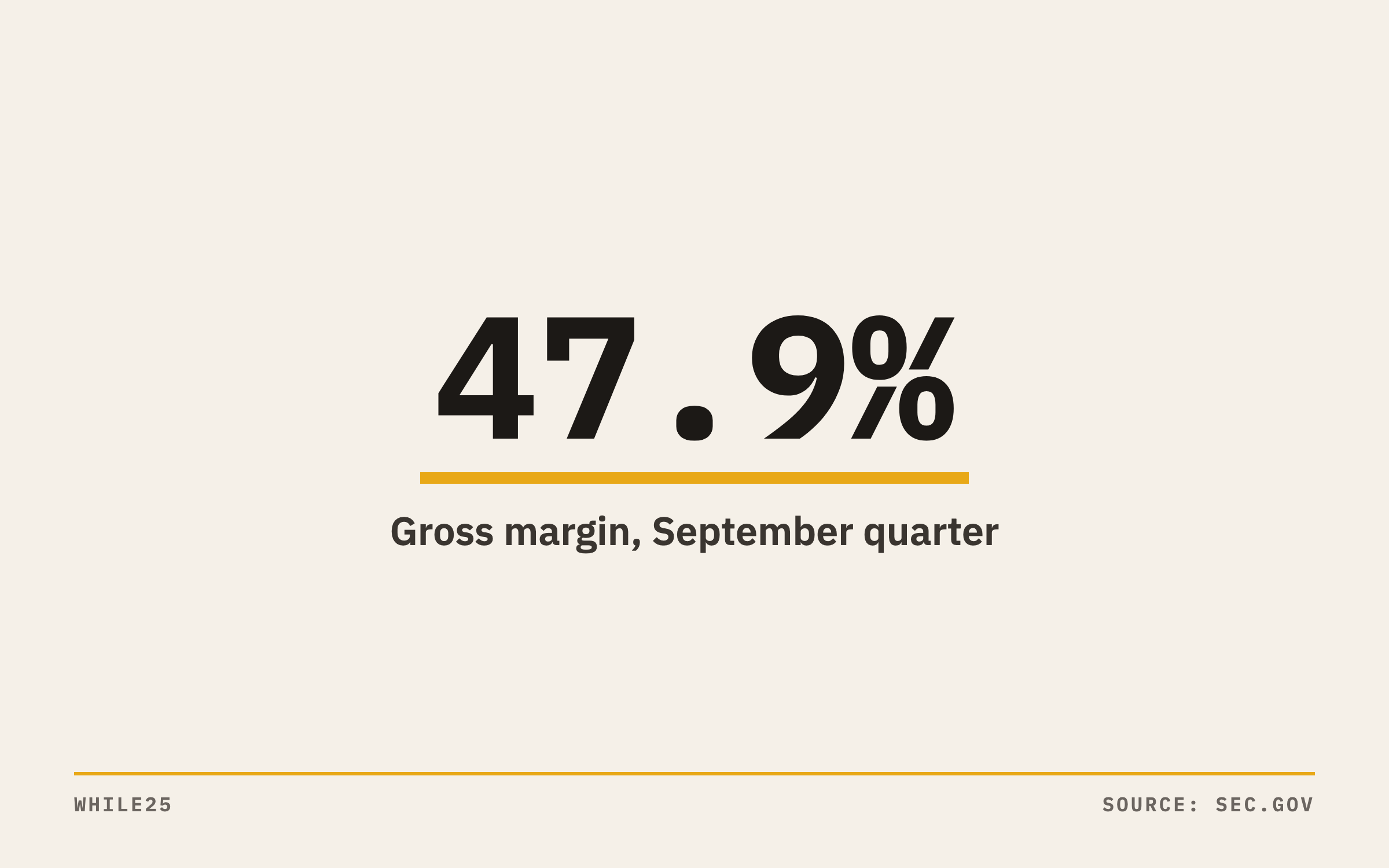 Apple's gross margin was 47.9% in the quarter that ended in September
Investors track gross margin to see the room between a company's prices and its costs. Apple's revenue, meaning its total sales, was $114.48 billion for the quarter. On sales that large, a small change in margin turns into a large change in profit.
The holiday forecast
Apple's December quarter covers the holiday shopping season. For that quarter, Apple guided to a gross margin of 45% to 46%. Guidance is the range a company publishes for its own coming results. The top of Apple's range sits below the 46.3% average estimate from analysts.
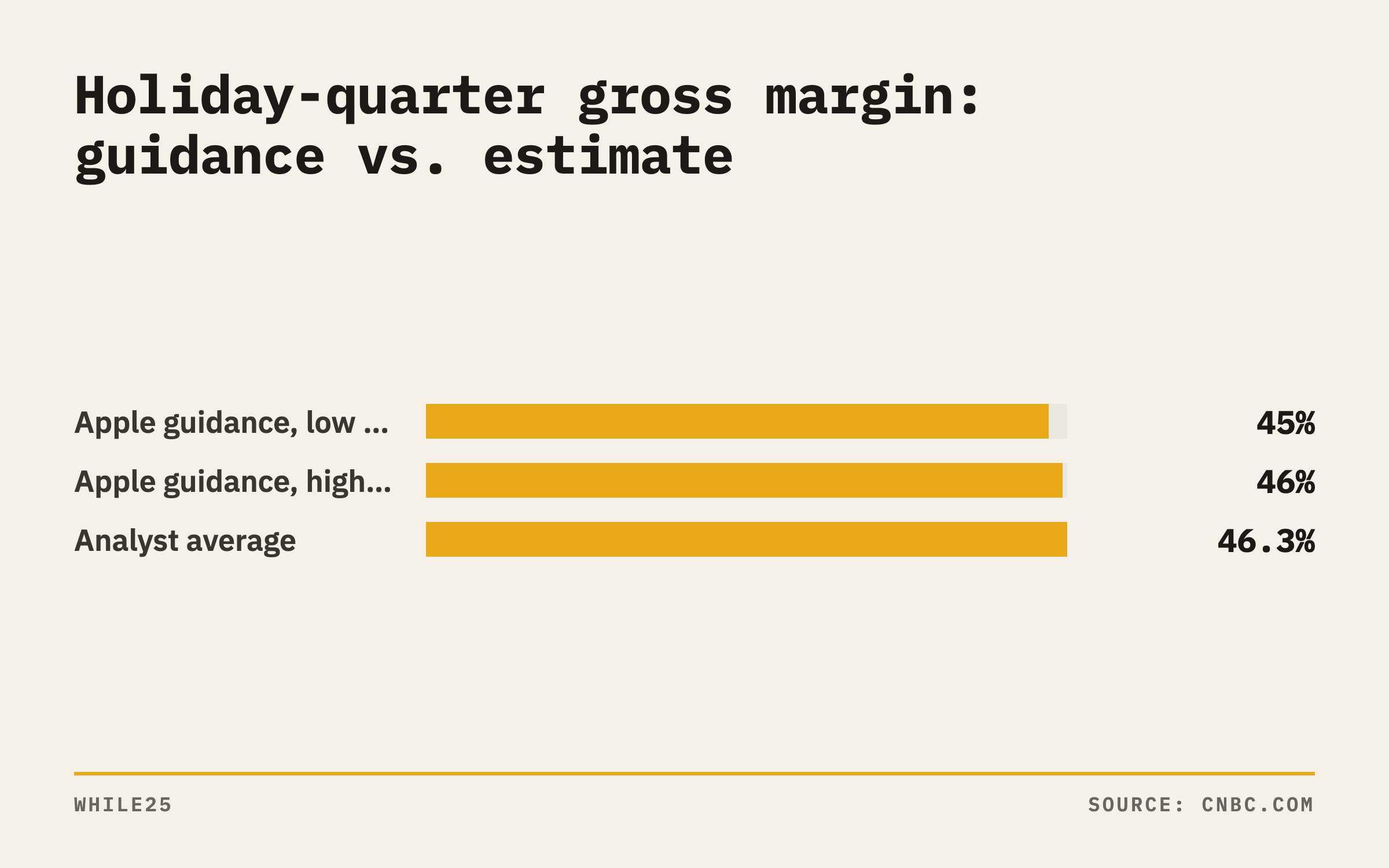 Apple's holiday-quarter gross margin forecast of 45% to 46% sits below the 46.3% analyst average
Apple named the cause. "We saw higher memory costs as compared to the June quarter," Ternus said. The June quarter is the period before the one Apple reported.
Apple warned that persistent inflation in memory chip prices would squeeze gross margins. In this case, persistent inflation means prices that keep climbing from one quarter to the next.
From chip price to iPhone cost
Memory chips hold data. A phone needs working memory for the apps that are open. It needs a second kind, storage, for photos, messages and files. iPhones, iPads and Macs carry both kinds.
A small group of companies makes most of the world's memory chips. SK hynix and Samsung, both based in South Korea, are among the largest. Their prices pass into a device maker's costs through a short chain.
The chain starts at the chipmaker. Memory makers charge more per chip if buyers want more chips than the factories can supply.
Apple pays that higher price for each device it builds. Apple records the cost in a line called cost of goods sold. To find gross margin, a company subtracts that line from revenue.
The chain ends at the margin. Suppose Apple holds steady the prices customers pay. Apple would pay the extra chip cost out of what is left over. Apple can sell the same number of phones at the same price and keep less of each dollar.
Apple's services business sits outside this chain. Services include the App Store, iCloud and Apple Music. Apple ships no memory chip with a services sale. Apple expects services sales to rise between 8% and 9% in the current quarter. Apple pays the higher memory costs on its hardware: the phones, tablets and computers.
Results beat, the stock fell
Apple beat estimates on the main lines for the September quarter. Revenue reached $114.48 billion against $113.39 billion expected. That figure was up 12% from a year earlier. Earnings per share came in at $2.10 against $1.99 expected. Earnings per share is the profit assigned to each share of stock. iPhone revenue was $57.58 billion, above the $56.54 billion forecast.
Investors sold the stock, and it fell 3% in extended trading. Buyers set a share price by what they expect from future quarters. The September quarter is over. The holiday quarter is the next one investors will see. Through its guidance, Apple told investors it expects to keep a smaller share of each sales dollar than analysts had forecast.
The tariff refund gives readers a second point to check. About 1 percentage point of the 47.9% came from refunds of import taxes. A refund sits apart from the regular cost of building products. A reader comparing the two quarters can set that point aside. The rest of the figure shows the trend in day-to-day costs.
The squeeze reached Seoul and Europe
On November 3, investors sold shares in Asia and Europe. An index tracks the combined price of a group of shares. South Korea's KOSPI index closed down 3.59%. Samsung Electronics shares fell 4.15%. SK hynix shares fell 5.03%.
Samsung and SK hynix make memory chips. Apple flagged higher prices from this kind of company. Their share prices fell on the same day.
The Korea JoongAng Daily quoted a market comment. The comment pointed to doubts about the payoff from heavy spending on AI infrastructure. AI infrastructure means the data centers, servers and chips that run AI models.
In Europe, shares of chip-equipment makers fell. These companies build the machines that chip factories use. ASML, ASM International and BE Semiconductor fell between 2% and 4%. Shares of chipmakers STMicroelectronics and Infineon fell more than 3% each. Germany's DAX index closed down 1.05%. The STOXX 600, a broad index of European shares, fell 0.76%.
Investing.com tied the European slide to Apple's margin warning. The same report named a second cause: Oracle's $20 billion capital raise. A capital raise is a company selling new shares or bonds to bring in cash. A bond is a loan that investors make to a company. After the raise, investors felt renewed anxiety over AI funding and cash burn, Investing.com reported. Cash burn is the rate at which a company spends more cash than it brings in.
The link from Apple to an equipment maker runs backward along the supply chain. The supply chain is the series of companies that each sell to the next. Device makers buy chips. Chipmakers buy machines to make those chips. If device makers face a cost squeeze, investors rethink what suppliers further back are worth.
Reading margins in your own holdings
Through gross margin, a reader can see where a company stands between its customers and its suppliers. Suppliers may raise prices faster than the company passes the cost on to customers. In that case, the margin shrinks. In its report, Apple beat sales forecasts and set a margin forecast below estimates.
Apple is one of the largest companies in the S&P 500. The S&P 500 is an index of large US companies that many funds track. An index fund buys the shares in an index. A holder of a broad US index fund owns a slice of Apple's sales and its margin. Any company that buys memory chips in volume carries the memory cost line Apple flagged.
AMD is the next chip company with a scheduled report. AMD reports its fiscal third quarter after the US market closes on November 3. It will hold a call on the results at 5:00 p.m.
In an earnings report, a company publishes its results for the quarter. Readers can compare revenue with estimates to judge the last quarter. They can compare margin guidance with estimates to see what the company expects to keep next. For Apple, the second comparison lined up with the 3% slide.
Sources
Not investment advice.