
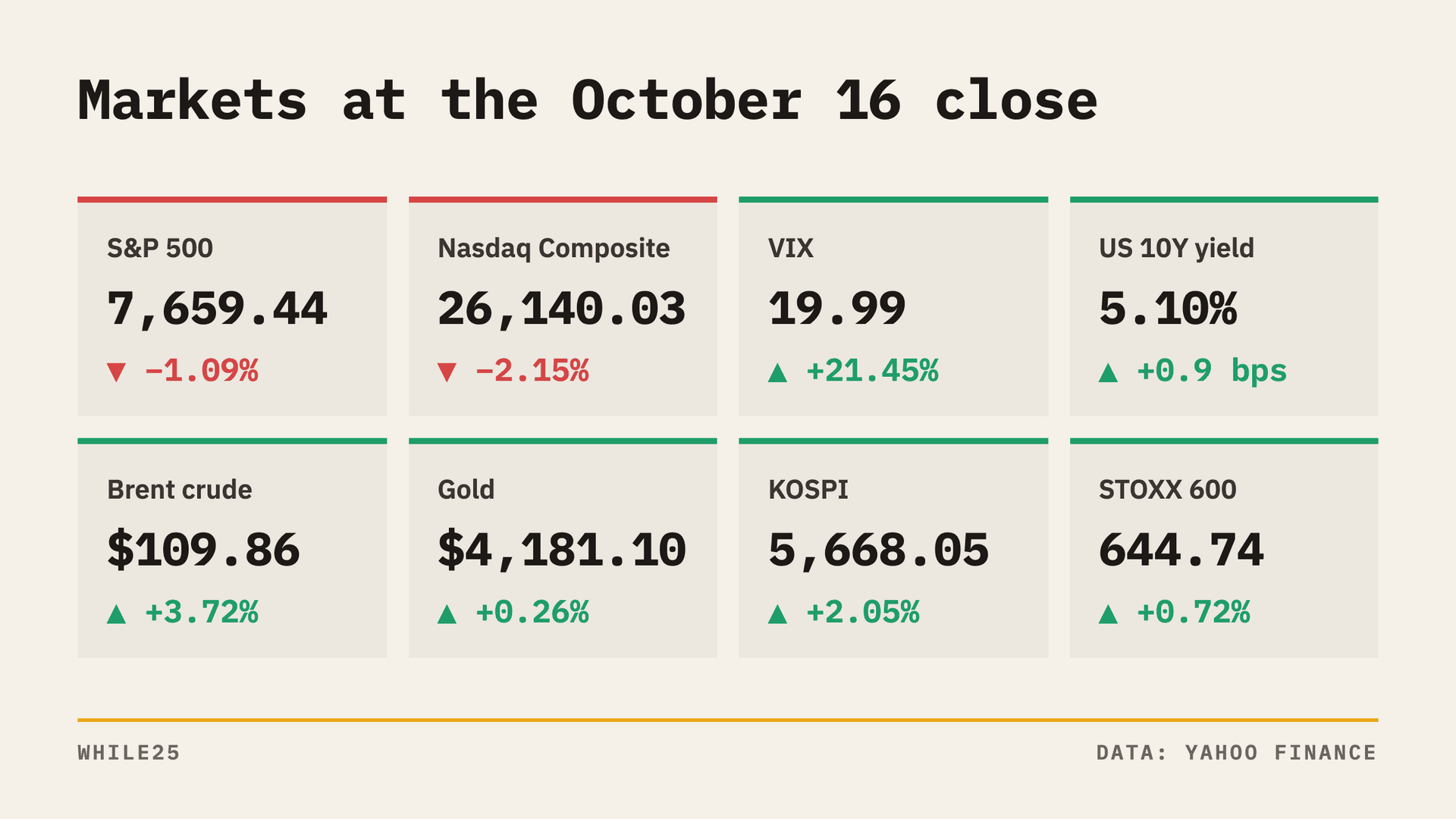
The Philadelphia Semiconductor Index is a basket of 30 chip company stocks. It fell 3.83% on October 16. All 30 of its stocks fell that day. The S&P 500 tracks 500 large US companies, and the Nasdaq leans toward technology. Both indexes finished their worst week since June, according to AP.
During the week of October 19 to 23, investors face the first big test of the worry behind that wave of selling. Companies will report quarterly results, meaning their sales and profit for the past three months. Netflix reports on October 20. Tesla and Meta report on October 21.
The Federal Reserve, or Fed, is the US central bank, which sets interest rates. Its officials went silent on October 17. Traders will work from company results, a light calendar of US economic reports and oil prices. Brent crude, the main global oil price, sits near $110.
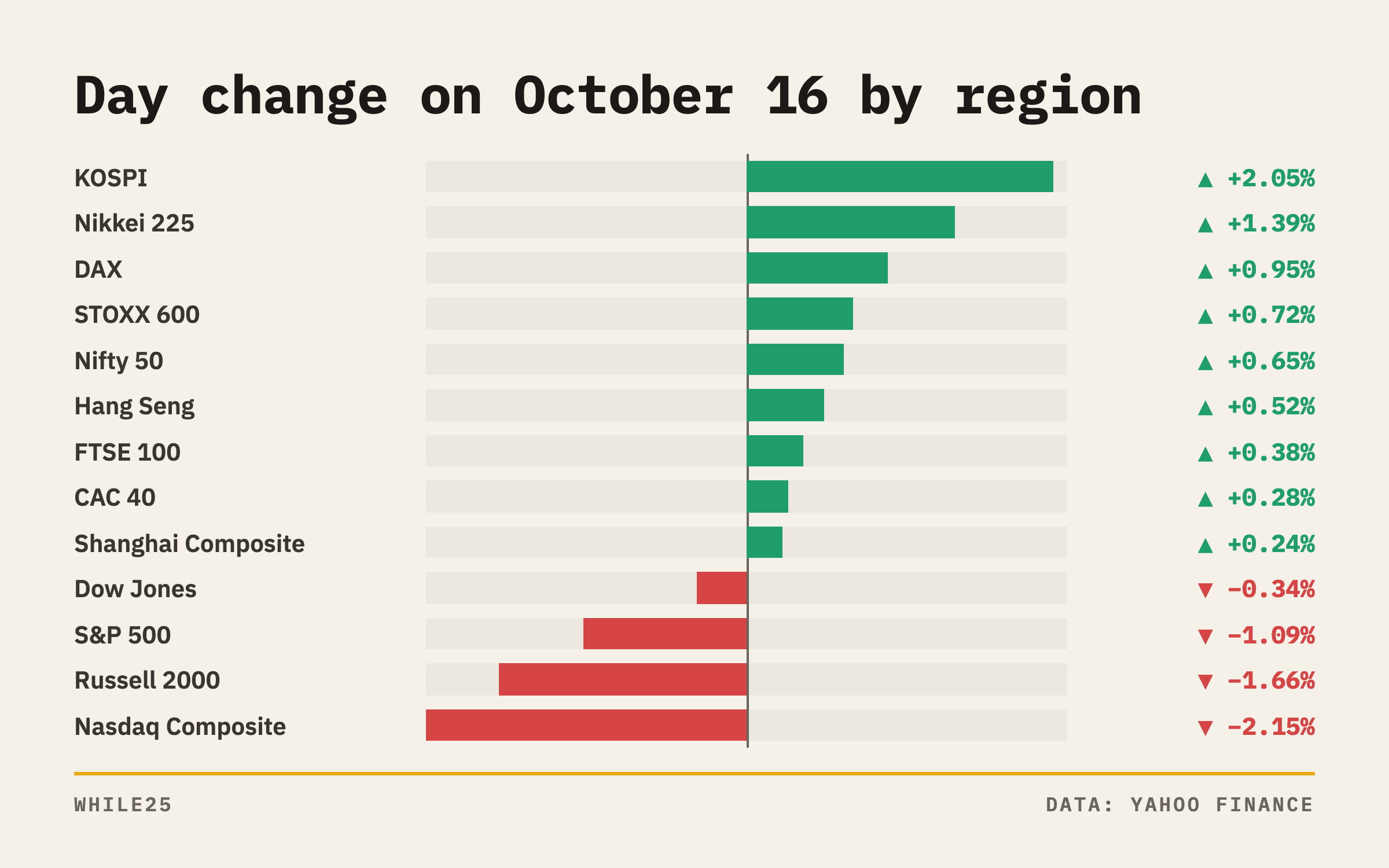 Day change on October 16: US indexes fell while European and Asian indexes rose
Chip stocks took the hit
Chip stocks fell for eight straight sessions, or trading days, through October 16. The semiconductor index lost 11.41% in the week of October 12 to 16. That was its worst week since April 2025. Shares of chipmaker Micron fell 5.63% on October 16. Intel, another chipmaker, lost 5.8%.
CoreWeave rents out computing power for AI. Its shares fell 11.91% to $61.39 that day, for a loss of 25.21% over the week. CoreWeave carries more than $51 billion of debt, according to Tradingkey. Tradingkey linked the selling to two worries. One is competition from Chinese chipmakers. The other is the borrowing that pays for new AI data centers. These are buildings full of computers that run AI.
Investors sold across the US market. The Nasdaq fell 2.15% to 26,140.03. The S&P 500 fell 1.09% to 7,659.44. The Russell 2000, an index of smaller companies, lost 1.66%. The Dow, an index of 30 large US companies, fell 0.34%. Energy stocks rose, which softened the Dow's drop. Despite the slide, the S&P 500 is up 11.9% for the year.
Traders paid more to insure against further losses. The VIX measures how much traders expect stocks to swing over the next month. It jumped 21.45% to 19.99.
Oil climbed as stocks fell
Brent crude touched $110 on October 16. CNBC tied the jump to Iranian attacks on tankers in the Strait of Hormuz. It also cited Ukraine's vow to hit Russian refineries. Brent closed at $109.86, up 3.72% on the day. WTI, the main US oil price, closed at $99.02.
US oil supplies tightened. The Energy Information Administration is a government statistics agency. It reported that US crude oil in storage fell 8.557 million barrels in the week to October 9. On October 18, CNBC reported that oil prices slid. Sanctions are trade penalties that governments place on a country. CNBC said sanctions relief on Russian crude raised hopes of more supply.
Stock traders watch oil because oil prices feed into inflation, the rise in prices across the economy. Consumer price inflation was 3.7% in September. Core inflation, which leaves out food and energy, was 2.6%. Producer prices, the prices businesses charge each other, rose 1.3% in September.
Interest rates on US government debt eased during the week. The 10-year Treasury yield is the interest rate the US government pays to borrow for 10 years. It closed at 5.098% on October 16, down from 5.244% on October 9. Traders count yield moves in basis points, and 100 of them make one percentage point. By that measure, the yield fell 14.6 basis points over five sessions.
Gold closed at $4,181.10. It is down 5.51% over the past month. The US Dollar Index tracks the dollar against six major currencies. It sat at 101.84. Bitcoin, a digital currency, traded at $81,041.99 on October 18.
The Fed goes quiet
Fed officials entered their blackout period on Saturday, October 17. The blackout is a quiet stretch around each meeting where officials set interest rates. During it, officials stop commenting on rates. This one ends on Thursday, October 29, the day after the October 27 to 28 meeting. Fed staff can keep publishing their regular data and reports.
Futures are contracts that let traders bet on future prices and rates. Traders read the odds of an event from futures prices. On October 16, futures traders priced a 17% chance of a rate hike, or increase, at the October meeting. Investopedia reported that figure from CME FedWatch data. The same traders put the odds of a hike by December at 89%. Officials will not publish new economic forecasts at the October meeting.
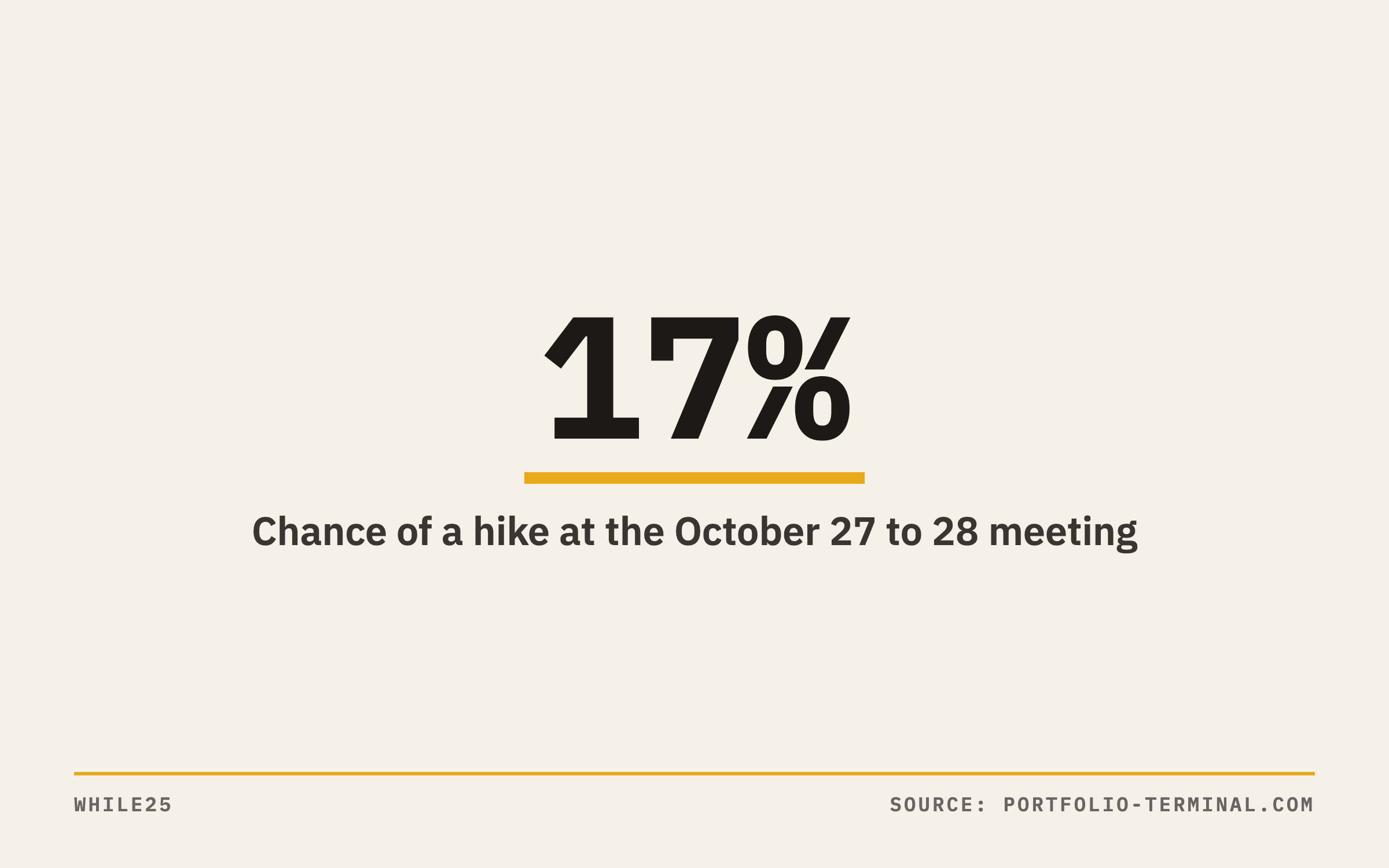 Futures on October 16 priced a 17% chance of a Fed rate hike at the October meeting
Company results take over
Investors turn to company results while the Fed stays quiet. GM, GE and RTX report before trading opens on October 20. Netflix reports after trading closes that day. Its call to discuss results starts at 4:45 p.m. ET. Analysts who follow Netflix expect profit of $0.8210 for each share of stock. They expect revenue, or total sales, of $12.87 billion.
The biggest reports for the AI story come on October 21. Meta, Tesla, IBM, Texas Instruments and Lam Research report after trading closes. Lam Research sells the equipment chipmakers use to make chips. Investors will weigh Lam's outlook, its forecast for coming business, against the spending fears behind the selling. Meta's call starts at 4:30 p.m. ET.
Tesla has published its vehicle numbers. It delivered 486,532 vehicles in the third quarter. A year earlier it delivered 497,099, a record. US buyers rushed to order before a $7,500 federal tax credit for electric cars expired on September 30, 2025.
Analysts expect Tesla to earn $0.4481 a share on $27.94 billion of revenue. In the same quarter of 2025, Tesla reported $0.50 a share on $28.10 billion. Its webcast starts at 5:30 p.m. ET.
Procter & Gamble, Union Pacific and Lockheed Martin report before trading opens on October 22. American Express and SLB report before trading opens on October 23.
Outside the US
European stocks rose on October 16 while US chip stocks fell. Germany's main index, the DAX, gained 0.95%. The STOXX 600, which covers 600 European companies, rose 0.72%. Britain's FTSE 100 added 0.38% that day. It rose 3.13% over five sessions.
Britain's statistics office publishes September inflation at 7:00 a.m. London time on October 21. Reuters published a poll of economists on October 15. Economists in the poll expected the Bank of England, Britain's central bank, to raise rates to 4% in November. Flash PMIs for the euro area come out on October 23. PMIs are early monthly surveys that ask purchasing managers whether business is growing. Purchasing managers buy supplies for their companies.
Asian chip markets took the biggest losses over the week. Korea's main index, the KOSPI, rose 2.05% on October 16. It lost 14.46% over five sessions and 15.63% over the past month. Japan's Nikkei 225 index rose 1.39% on October 16. It lost 5.38% over five sessions.
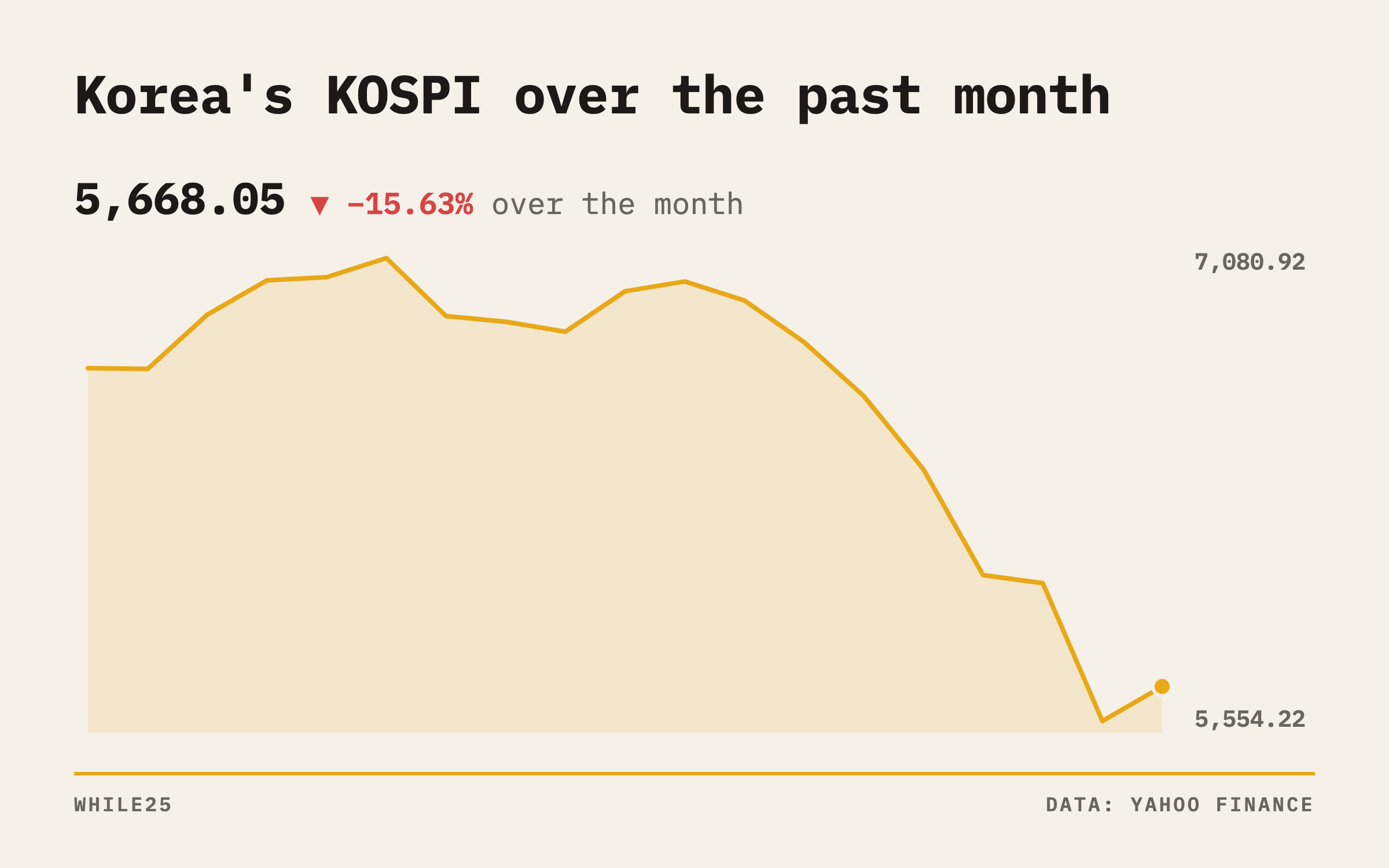 KOSPI over the past month, showing a steep slide in the latest week
China's government reports third-quarter growth at 0200 GMT on October 19. It also reports retail sales, a measure of store spending, and industrial production, or factory output. Economists in a Reuters poll forecast growth of 4.4% from a year earlier. Growth was 4.3% in the second quarter. At that pace, China would fall short of its official target of 4.5% to 5%.
The Bank of Korea, the country's central bank, raised its base rate on August 27. That was its second increase in a row. The base rate is the main interest rate the bank sets. The bank announces its next decision on October 22.
The week's calendar
- Monday, October 19: China GDP, the total value of what its economy produces, at 0200 GMT. NAHB homebuilder confidence for October, a survey of home builders, at 10:00 a.m. ET.
- Tuesday, October 20: US housing starts, the count of new homes begun, and building permits at 8:30 a.m. ET. Pending home sales, or signed home contracts not yet closed, at 10:00 a.m. GM, GE and RTX before trading opens. Netflix after trading closes.
- Wednesday, October 21: UK inflation at 7:00 a.m. London time. The US Treasury sells $13 billion of 20-year debt at 1:00 p.m. ET. This debt repays lenders after 20 years. Meta, Tesla, IBM, Texas Instruments and Lam Research after trading closes.
- Thursday, October 22: US weekly jobless claims, the new filings for unemployment benefits, at 8:30 a.m. ET. Bank of Korea rate decision. Procter & Gamble, Union Pacific and Lockheed Martin before trading opens.
- Friday, October 23: S&P Global flash PMIs at 9:45 a.m. ET. University of Michigan final consumer sentiment, a survey of how shoppers feel about the economy, at 10:00 a.m.
- October 27 to 28: Fed meeting. The Fed's blackout ends on October 29.
Your portfolio
Index funds hold the stocks in an index and follow its moves. Broad US index funds, such as funds that track the S&P 500, hold chip stocks. Those funds lose value when chip stocks fall. The tech-heavy Nasdaq fell 4.48% over five sessions.
Meta and Lam Research report on October 21 from opposite sides of AI spending. Meta buys computing power. Lam sells the tools that build it. Chip investors will hear both companies discuss spending plans that same evening.
The Fed stays silent until October 29. Until then, traders get fresh information from earnings, oil prices and a handful of US reports. The VIX rose 12.87% over the past month. By that gauge, traders expect larger daily swings than they did in September.
Sources
- abcnews.com
- tradingkey.com
- portfolio-terminal.com
- cnbc.com
- cnbc.com
- stlouisfed.org
- federalreserve.gov
- federalreserve.gov
- investrade.com
- finance.yahoo.com
- marketbeat.com
- sec.gov
- ir.tesla.com
- driveteslacanada.ca
- marketbeat.com
- investor.atmeta.com
- ons.gov.uk
- kfgo.com
- invest.robinhood.com
- en.fnnews.com
- fxstreet.com
Not investment advice.