
On November 18, the Federal Reserve released the minutes of its October meeting. The Fed is the US central bank. Minutes are its written record of a meeting. In them, "almost all participants judged that" further rate increases "would likely be appropriate." Participants are the officials who took part. In a rate increase, the Fed raises its main interest rate, and borrowing costs more.
In the same document, officials called demand tied to artificial intelligence (AI) "a material source of inflation risk." Inflation means prices rising across the economy. The price of gold fell 3.53% that day. Bitcoin fell 3.80%.
Traders read the minutes alongside a newer signal. Fed Governor Chris Waller made the case for a half-point rate increase in December. A half point is half of one percentage point. Traders moved their bets toward a bigger hike. Hike is the market word for a rate increase.
A record that comes out after the meeting
The Fed sets short-term US interest rates at scheduled meetings. On the final day, it announces its decision and a short statement. The Fed releases the minutes weeks after the meeting. They summarize the debate in the room and the risks officials raised.
The October meeting ran October 27-28. The Fed released the minutes on November 18. Fed staff draft the summary. The officials who attended review it before release. That review takes time.
Traders keep this delay in mind. In the minutes, officials gave views they held before they saw newer data. Traders read the minutes for the mood of the committee, the group of officials who set rates. They compare that mood with newer numbers.
The Fed held rates, with two votes for a hike
At the October meeting, the Fed kept its benchmark rate in a range of 3.75% to 4%. A benchmark rate is the main rate that other rates follow. This one is the federal funds rate. Banks charge each other this rate for overnight loans. Lenders use it as a base for rates on credit cards, car loans and business credit.
The vote was 10-2. Governor Lisa Cook and Cleveland Fed President Beth Hammack dissented. That means they voted against the decision. Both wanted a quarter-point increase.
Traders describe rate moves in basis points. 100 basis points make one percentage point. A quarter-point move is 25 basis points, and a half-point move is 50.
Fed staff recorded more of the debate in the minutes. Almost all officials expected the Fed to need more increases. Some suggested "a larger increase might be needed at the next policy meeting in December."
AI demand and inflation risk
Fed officials saw AI demand as "a material source of inflation risk." Material here means large enough to matter. Officials had two concerns.
The first concern is prices. Companies building AI systems buy chips, electricity, land and construction work at large scale. These are inputs, the supplies a project needs. If demand for them outpaces supply, sellers raise their prices. Other businesses and households can end up paying those higher costs.
The second concern is debt. Officials cited AI-related debt that "had grown rapidly," in their words. Much of it sat in "complex and opaque financing structures," they said. Financing structures are the ways a deal is set up to borrow money. Opaque here means outsiders struggle to see who holds the risk. Risk, in this case, is the chance of losing money if borrowers fail to pay.
This worry concerns financial stability, the health of the banking and lending system. The Fed watches for losses that could spread from one lender to others. Such chains of losses are hard to trace in advance.
Interest rates sit at the center of both worries. As borrowing gets more expensive, companies and households spend less. AI builders are among those borrowers. Borrowers pay more to carry debt as rates rise. By raising rates to fight inflation, the Fed could strain the same borrowers that officials flagged in the minutes.
Price data from after the meeting
The government released the October consumer price index (CPI) after the meeting. The CPI is the government's monthly measure of the prices people pay.
Core prices leave out food and energy, which swing from month to month. Fed officials watch core as a cleaner read of the underlying trend. That trend is the steady direction beneath short-term noise. In the October report, core prices rose 0.3% on the month. Traders can use this newer reading to test the minutes against fresh evidence.
Waller's case for a half point
Waller supplied the newer signal. He argued for a 50-basis-point hike in December. His alternative was a 25-basis-point hike, plus a public signal that another 25 would follow in January.
He focused on persistence, meaning inflation that lingers. He worried that 3% inflation is becoming the norm. He noted that about 70% of core services components run above that pace.
Core services cover items such as rent, medical care and insurance. Prices in these areas tend to move at a slow pace. Once they rise, they tend to stay high.
Waller spoke for himself. The minutes describe a meeting from late October. Traders weigh both. As a governor, Waller votes at each Fed meeting.
Turning bets into odds
Traders bet on Fed decisions through fed funds futures. A futures contract is a deal whose payout depends on a future price or rate. Traders buy and sell these contracts on CME, an exchange operator in Chicago. Each contract's final payout rests on the average federal funds rate over a month.
If traders expect a hike, they accept a price that points to a higher average rate. CME uses its FedWatch tool to turn those prices into odds. It gives odds for each possible outcome at each meeting.
The Fed meets next on December 8-9. On November 18, traders priced in a full quarter-point hike at that meeting. Priced in means their bets assumed it would happen. Traders treat a quarter point as the base case, the outcome they expect. The open question is the size of the move.
According to FedWatch, 69% of traders expected a 50-basis-point hike by the end of January. The month before, the figure was 38%.
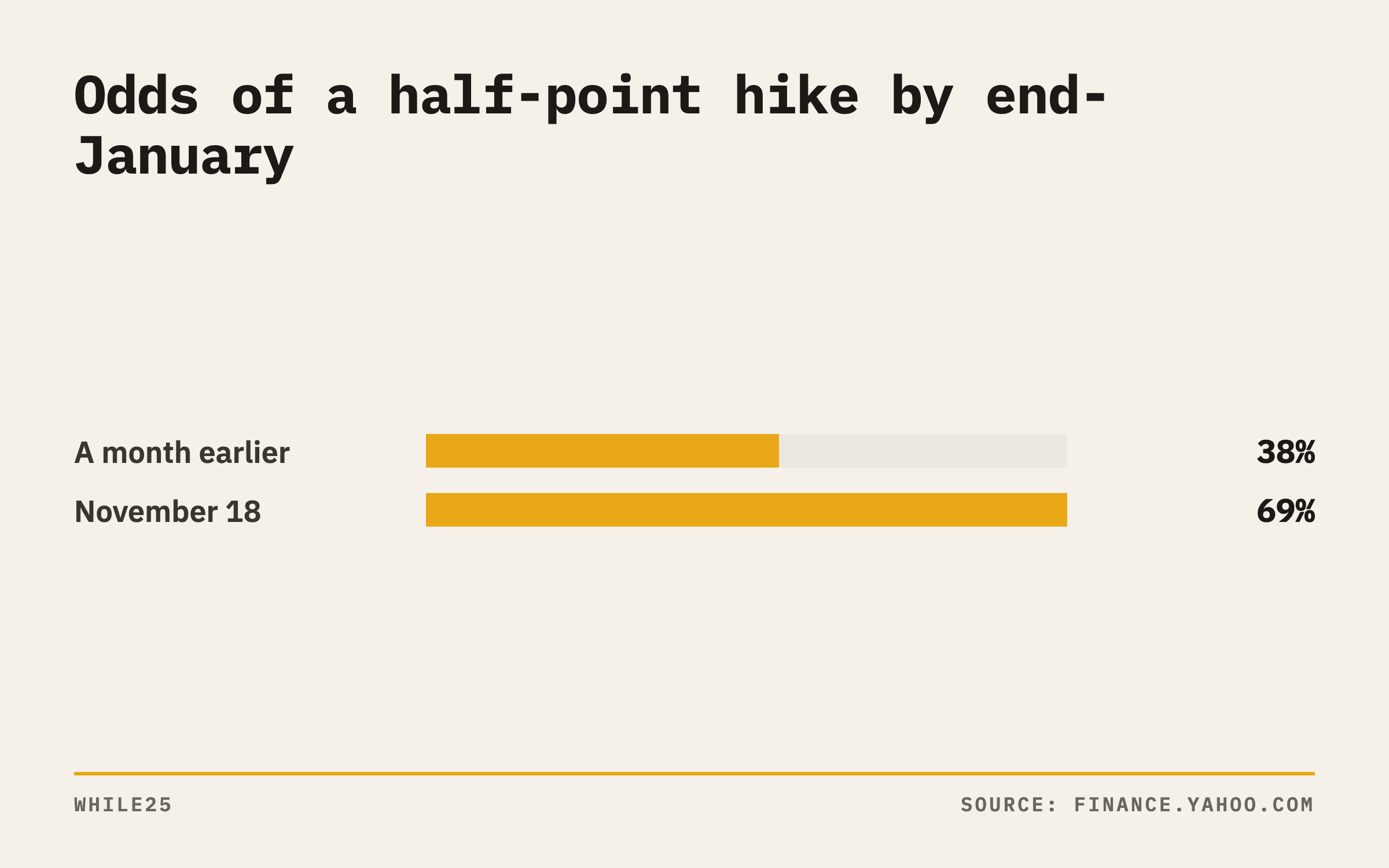 Bar chart showing CME FedWatch odds of a half-point hike by end-January rising from 38% a month earlier to 69% on November 18
Both of Waller's paths fit inside the end-of-January window. One path is a half point in December. The other is two quarter points across December and January. Both reach the same rate by early February. Traders who place these bets are betting on the total size of the increase. Their bets leave the timing open.
Market moves on November 18
Gold fell 3.53% on November 18. Gold futures are contracts to buy or sell gold at a future date. They hit their lowest level since September 2025. Bitcoin fell 3.80%.
Neither asset pays interest. Bonds are loans to a government or company that pay interest. As rates rise, savers earn more on cash and bonds. An investor who holds an asset that pays nothing gives up that income.
The US Dollar Index tracks the dollar against a basket of major currencies. It rose 0.28%. Investors tend to move money into dollar assets, such as US bonds, as US rates rise.
Treasuries are US government bonds. A yield is the yearly return a buyer earns at the current price. Treasury yields moved in different directions. The 2-year Treasury yield moves with expectations for Fed policy. It rose 1.5 basis points to 4.804%. The 10-year yield is the interest rate the US government pays to borrow for 10 years. It fell 3.7 basis points to 5.066%. The 30-year yield fell 4.8 basis points to 5.411%.
A stock index tracks a basket of company shares. Stocks were mixed, with some indexes up and others down. The S&P 500 fell 0.23%, and the Dow Jones fell 1.11%. The Nasdaq Composite rose 0.42%. The VIX is a gauge of how much traders expect stocks to swing. It closed at 24.56.
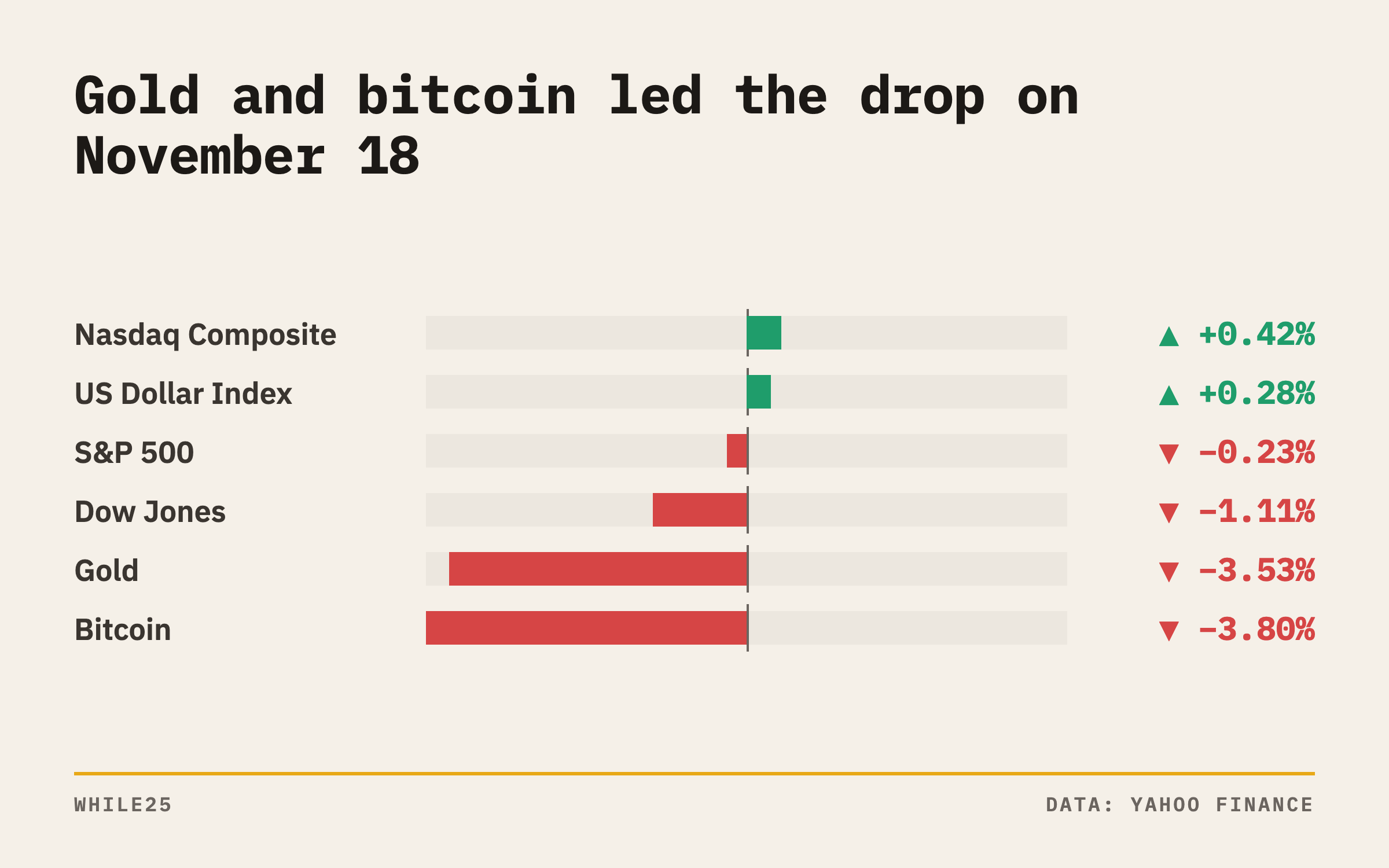 Day-change bars for gold, bitcoin, the US Dollar Index, the S&P 500, the Nasdaq Composite and the Dow Jones on November 18
Dates ahead
Several US reports come out before the Fed meets. Two are due on November 19: initial jobless claims and the Philadelphia Fed manufacturing index for November. Jobless claims count new filings for unemployment benefits. The Philadelphia Fed index tracks factory activity in its region. The University of Michigan consumer sentiment survey follows on November 20. That survey measures how households feel about the economy.
The Fed announces its decision at the end of its December 8-9 meeting. It will release the minutes from that meeting weeks after it ends.
The link to your portfolio
In the minutes, Fed officials debated the size of their next increase. Almost all of them expected more increases. In the same document, officials named AI spending and AI-related debt as risks.
Traders turn those debates into rate expectations, their bets on where rates go next. As they bet, traders change the prices of the assets you hold. On November 18, traders raised the odds of a bigger hike. Gold and bitcoin fell, and the 2-year yield rose.
Traders change the prices they pay for assets with no income as those odds move. They do the same with short-term and long-term bonds. CME updates FedWatch as traders buy and sell futures. Traders will react to each report before December 8-9, and their trades can move the odds and the prices tied to them.
Sources
Not investment advice.