
The Bureau of Labor Statistics (BLS) is the US government agency that measures prices. It will publish October consumer prices on Tuesday, November 10, at 8:30 a.m. ET. It will leave out the yearly inflation rate. The last yearly rate it published was 3.7%, for September 2026. This time, the spot that holds that number will be empty.
The cause dates back a full year. A US government shutdown in the fall of 2025 stopped BLS from collecting October 2025 prices. The yearly rate needs that month, and BLS has no real readings for it.
The yearly rate needs two months
BLS uses the consumer price index, or CPI, to track the cost of a fixed basket of goods and services. US households buy the items in that basket. Each month, BLS staff record prices for food, fuel, rent, cars, haircuts and more. They combine those prices into a single index level.
To get the yearly inflation rate, BLS compares two of those levels. It divides this month's index by the index from the same month a year earlier. The percentage gap between the two is the 12-month change. News anchors call that figure "inflation."
This method has a strength. Seasonal swings, like holiday discounts or summer travel, show up in both months and cancel out. It has a weakness too. BLS needs a real price reading at both ends.
For October 2026, the far end is October 2025.
A month BLS filled with old prices
The 2025 shutdown kept BLS staff from gathering prices that October. BLS filled the gap with older numbers. Its shutdown FAQ says: "Survey data for commodities and services were carried forward to October 2025 from September 2025." For rents, BLS reached further back: "Rents for October 2025 were carried forward from April 2025."
Carrying a price forward means copying an earlier reading into the empty month. For most goods and services, the October 2025 entry repeats September 2025. For rent, it repeats a reading from April 2025.
A yearly change built on that base would set today's prices against stale ones. BLS says it will skip that comparison. Its FAQ states: "BLS will not publish 12-month percent changes for October 2026 for indexes where October 2025 data are not available."
RBC Economics is the research team at the Canadian bank RBC. Its preview put the problem in one line. "We will not get year-over-year CPI data because we are missing data from October 2025 due to the government shutdown."
Contents of the November 10 report
BLS will publish plenty of other data. It will include one-month changes for overall prices and for core prices. Core prices leave out food and energy. Food and energy prices jump with the weather and with oil prices. Economists use core prices to see the slower trend underneath.
The one-month change sets October 2026 against September 2026. BLS collected prices in both months, so it can publish that number.
BLS will publish a few yearly changes too. It will show 12-month changes for gasoline, new vehicles, and used cars and trucks. BLS has an October 2025 reading for these series. They cover fuel and cars, with no food, rent or services. They cannot stand in for the overall yearly rate.
The monthly number carries the weight
Without a yearly rate, traders will read the one-month change as the main inflation signal. RBC forecasts a 0.3% rise for October. The one-month change for September was 0.6%.
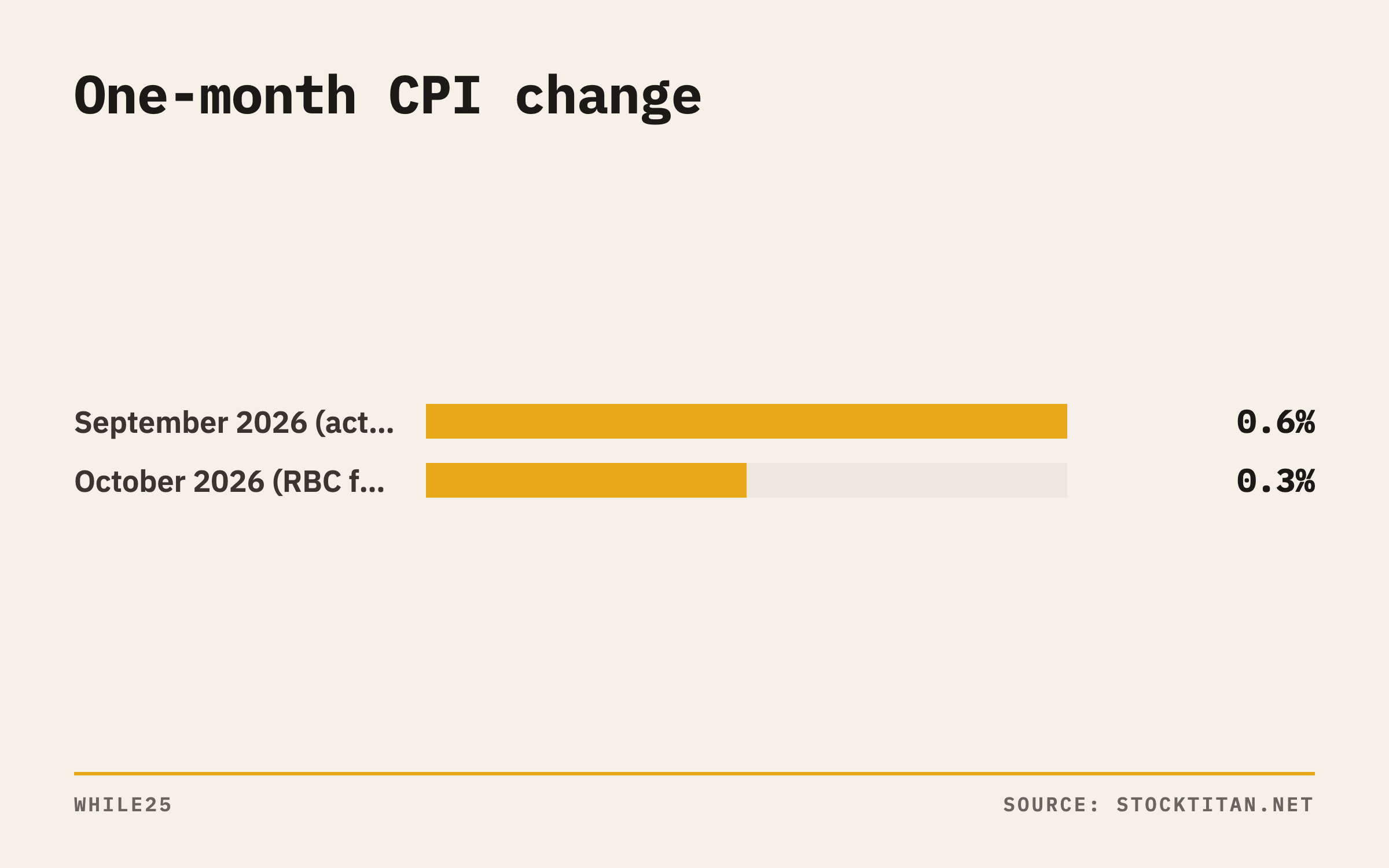 Bar chart comparing September 2026's 0.6% one-month CPI change with RBC's 0.3% forecast for October
A one-month change is small and jumps around. One costly month for fuel or airfares can push it up or down. The yearly rate folds 12 months of moves into one figure, which smooths out those jumps. On November 10, traders lose that cushion and have to judge one month on its own.
Core prices matter more in that setting. Food and energy can swing a single month in either direction. Economists strip them out of the core one-month change to get a steadier read on the trend.
A Fed meeting sits behind the number
This report arrives ahead of a Federal Reserve decision. The Fed, the US central bank, raised its benchmark interest rate in September. That rate sets the base cost of short-term borrowing. September's move was its first increase in three years. The Fed held rates steady in October. Its next meeting runs December 8-9.
On November 6, BLS released a strong October jobs report. Employers added 165,000 jobs. Forecasters had expected 65,000. The unemployment rate fell to 4.1% from 4.2%.
Traders shifted their bets after the release. They raised the odds of a December rate hike, or increase, to 78%, from 70% earlier.
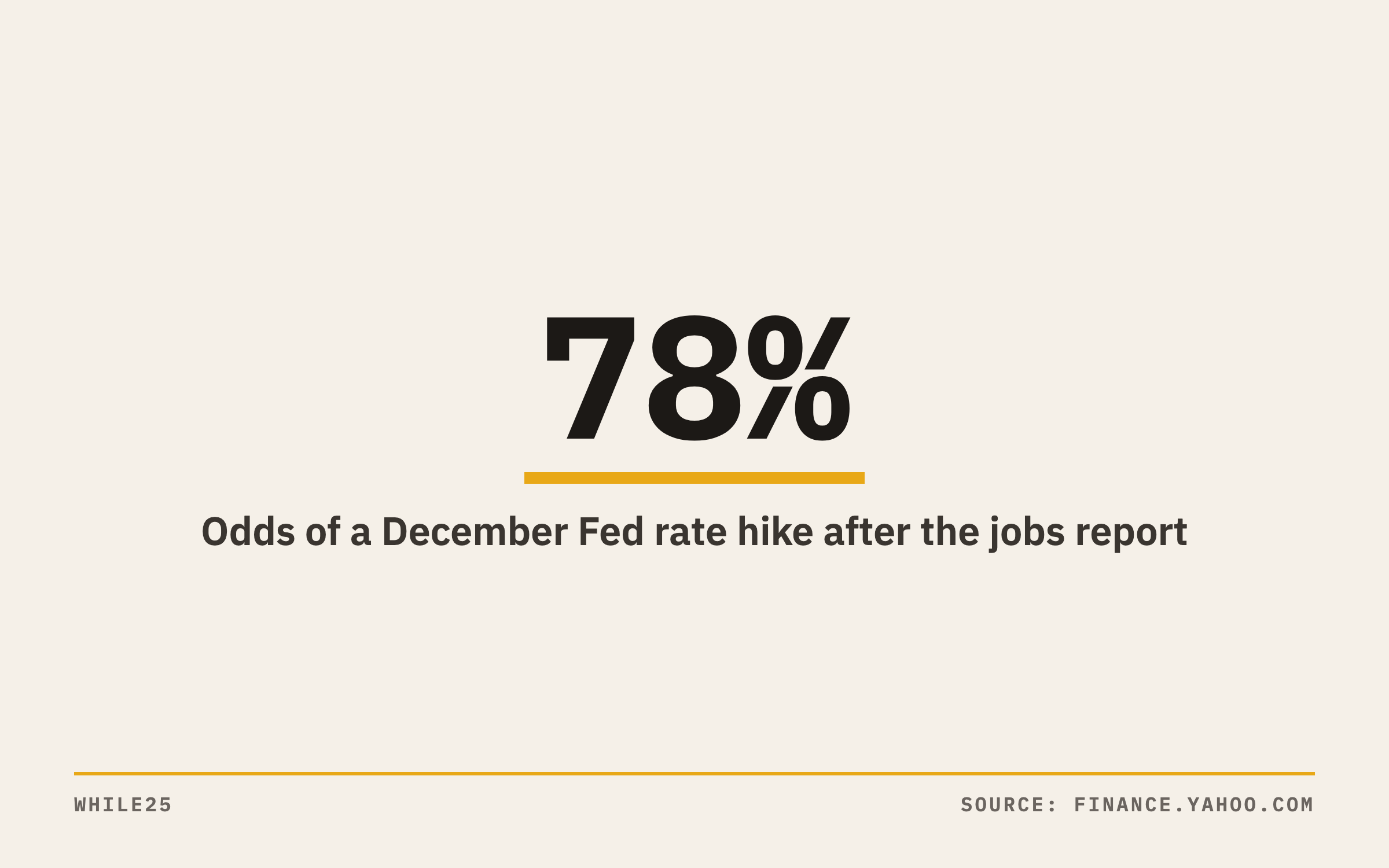 Big number showing 78% odds of a December Fed rate hike after the November 6 jobs report
Bond yields moved with those bets. A bond is a loan to a government or company. A yield is the yearly interest a bond pays a buyer at today's price. Traders count yield moves in basis points. One percentage point equals 100 basis points.
The 2-year Treasury yield, the rate on two-year US government debt, rose 6 basis points to 4.52%. The 10-year yield, the interest rate the US government pays to borrow for 10 years, rose 3 basis points to 4.87%. The 2-year yield tends to track what traders expect from the Fed. That link explains its larger move.
With hike odds at 78%, traders will treat October CPI as their next major clue. They will set the one-month change against September's 0.6% and RBC's 0.3% forecast. They will have no yearly rate to cross-check it.
Reading the report without the headline
Some news outlets and data screens may show a blank in the yearly rate's spot. Others may quote the yearly changes for gasoline or used cars. Those figures cover one corner of the basket. They do not measure overall inflation.
The 3.7% yearly rate for September remains the latest full reading. It covers prices through September 2026 and gives no read on October.
The October 2025 gap is a data problem. For one month, it changes the tools traders use. The base month holds rents carried forward from April 2025 and other prices carried forward from September 2025. Any comparison that reaches back to October 2025 runs into those copied readings. BLS lists the series it will publish in its FAQ.
Dates to watch
- Tuesday, November 10, 8:30 a.m. ET: October CPI. BLS will publish one-month changes for overall and core prices. It will add yearly changes for gasoline, new vehicles, and used cars and trucks.
- Friday, November 13: October producer price index (PPI). The PPI tracks the prices businesses receive for their goods and services.
- December 8-9: Fed policy meeting.
If you hold bonds, or stocks that react to interest rates, expect the November 10 headline to look different. Before the Fed meets on December 8-9, traders will have one consumer-price figure in hand: the one-month change, overall and core. Read it next to September's 0.6% for the comparison the yearly rate would have offered.
Sources
Not investment advice.