
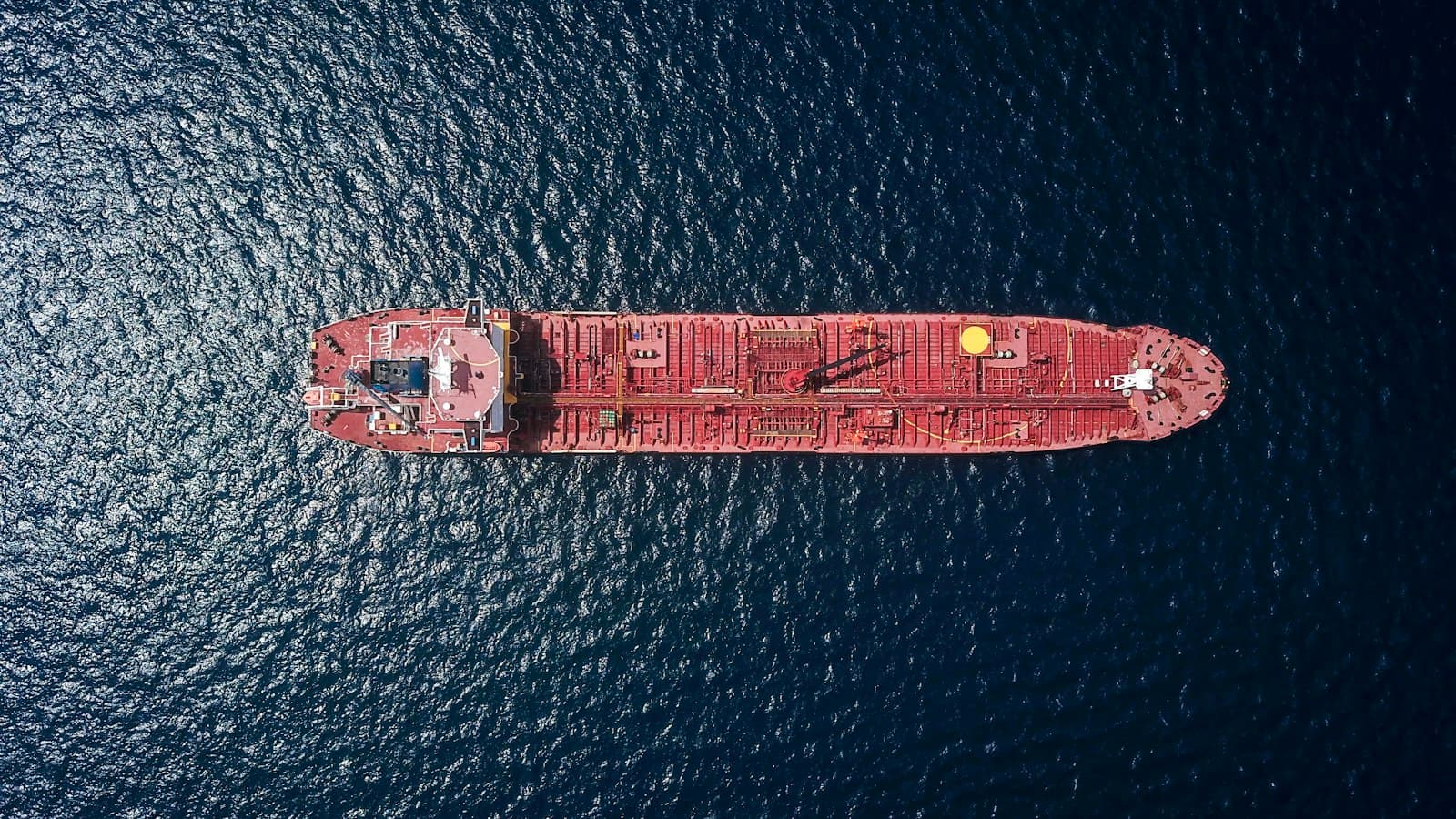
US crude oil fell 3.94% to $100.02 a barrel on November 2. Iran's foreign minister, Abbas Araghchi, set out a two-day plan to reopen the Strait of Hormuz. The strait is a narrow sea lane off Iran's coast. Tankers use it to carry Gulf oil to the world. The plan came out of talks in Qatar, one day before the November 3 US midterm elections.
Most Asian stock markets bounced back from the worst day on Wall Street, the US stock market, since June. South Korea's main stock index, the KOSPI, rose 2.24%. An index tracks the prices of a group of stocks. Europe ended close to flat. Investors sold oil companies, and shares in train maker Alstom sank 27%.
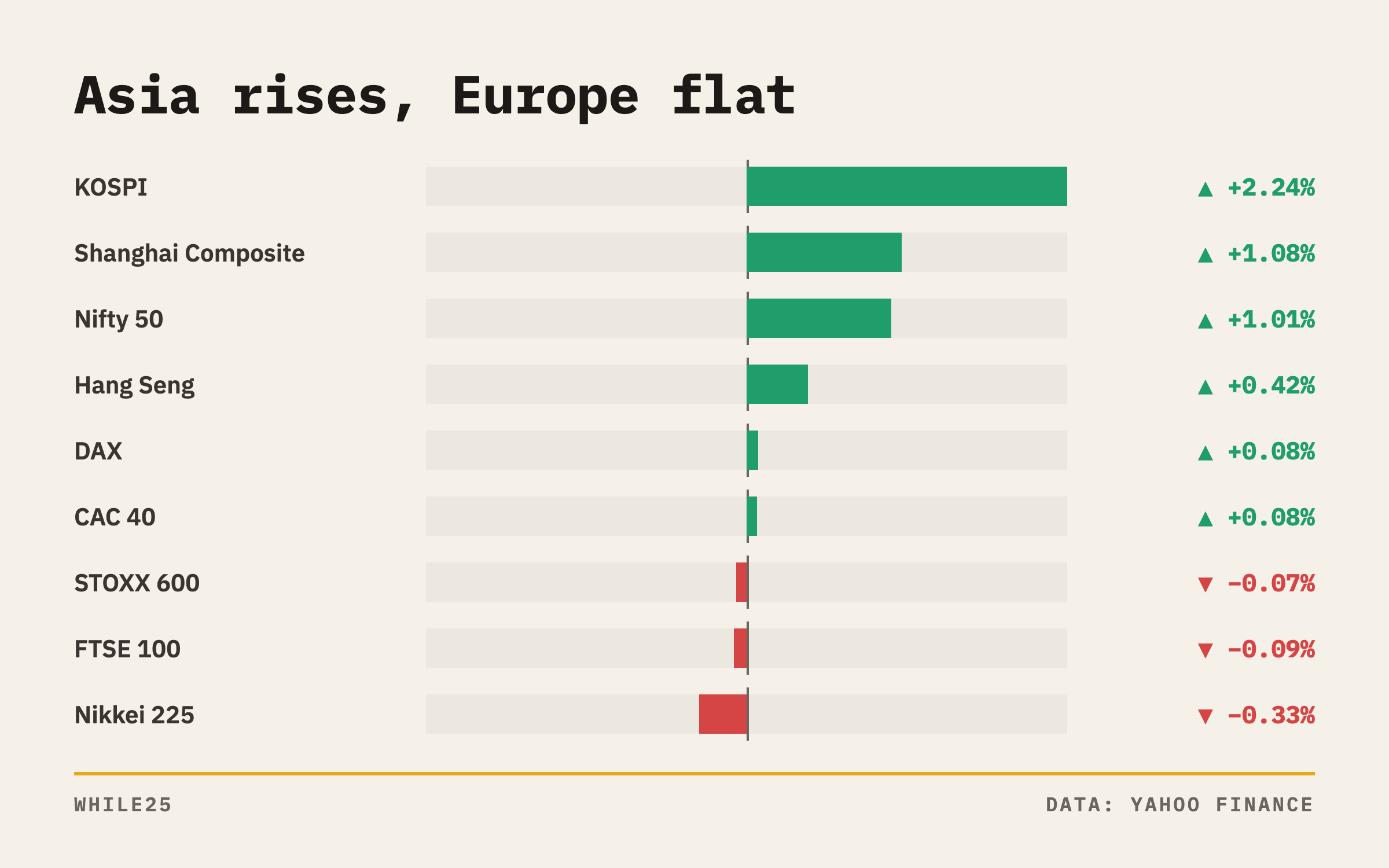 Asian and European stock indexes on November 2, sorted by day change, with the KOSPI up most and the Nikkei down
Oil gives back some of its war premium
A war premium is the extra amount buyers pay for oil because a war could cut supply. Under Araghchi's plan, the United States would take steps on day one, including sanctions relief. Sanctions are trade and financial penalties on Iran. Relief means lifting some of them. Iran would reopen the strait on day two. Its earlier proposal ran over seven days.
Iran wants more than a swap of sanctions relief for open shipping. On October 31, Araghchi listed two conditions. The first is lifting the sanctions that followed the Islamabad memorandum. The second is fewer US forces in the region. He also demanded "the restoration of oil waivers and the release of all our frozen funds, including those held in Qatar." Oil waivers are exemptions that allow trade in Iranian oil despite sanctions. Frozen funds are Iranian money held abroad that Iran cannot use.
Washington has not answered. President Trump said on October 31 that talks were "going fine." He added: "We're not in that much of a hurry." He has said he would not attack before November 3. Officials say Trump will receive strike options after the votes. Secretary of State Marco Rubio said on October 31 that Trump had not decided whether to resume military action.
Traders care about the plan because the strait is close to shut. Trackers recorded two transits, meaning ship crossings, on October 25. Before the crisis, the normal level was about 85 a day. At least four tankers took hits in the Hormuz area on October 30 and 31, according to reports.
Brent crude is the main international oil benchmark, or reference price. It fell 3.2% to $109.75 early in Asian trading, according to Reuters. Brent had ended October at its highest level in six months. Tim Waterer of KCM Trade called the drop "a technical pullback" after last week's strong gains. The phrase means a dip after a fast climb. OPEC+ is a group of large oil exporters. On November 1, it left its December production targets unchanged. Those targets set how much oil members plan to pump.
Asia recovers from a rough Friday on Wall Street
The wave of selling started in New York on October 30. The Nasdaq Composite, an index of stocks listed on the Nasdaq exchange, fell 2.86% to 25,437. That was its worst day since June. Intel shares fell close to 29%. The company gave a weak outlook, its forecast for the coming months, and flagged a slowdown in PCs. Amazon reported third-quarter results below expectations. The Nasdaq ended October down 5.3%. That was its steepest monthly fall since March 2025.
Asian chip stocks moved in different directions on November 2. SK hynix, a South Korean maker of memory chips, rose 3.8%. Samsung Electronics added 1.8%. On those gains, the KOSPI rose 2.24% to 5,859.08. The index has gained 7.12% over five sessions, or trading days. It remains 16.34% lower than a month ago.
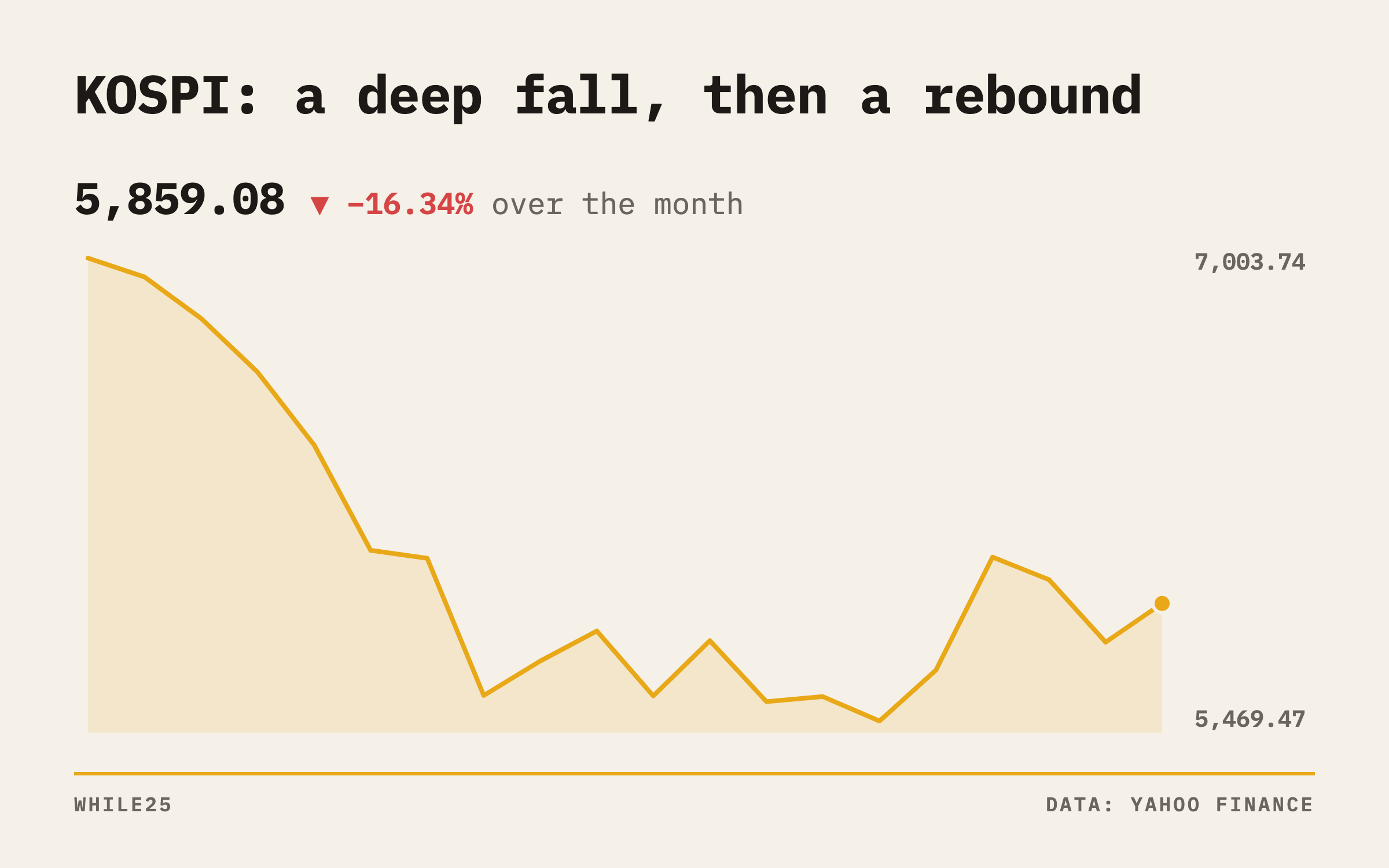 The KOSPI over the past month, showing a deep fall followed by a rebound in the last five sessions
In Tokyo, shares of Kioxia, a Japanese memory chipmaker, plunged 15.8% to a six-month low. Kioxia forecast operating profit of 2 trillion yen for the December quarter. Operating profit is the profit from a company's core business. Analysts who follow the company had expected 2.35 trillion yen. Its September-quarter figure was 1.99 trillion yen. That puts the forecast at a flat quarter.
Kioxia's managers also warned about NAND flash, the memory chips used for storage. They said contract prices, the prices set in deals with buyers, are gaining upward momentum at a slower pace. Chief financial officer Yoshihiko Kawamura said next year's capacity is "fully booked." Capacity is the amount the company can produce. Investors gave more weight to the profit forecast. The Nikkei 225, Tokyo's main index, slipped 0.33%. SoftBank Group dropped 1.6%.
China's Shanghai Composite index added 1.08% to 3,638.03. The gain came even though China's factory activity kept shrinking in October. Hong Kong's Hang Seng index gained 0.42%. India's Nifty 50 index rose 1.01%.
Europe stalls as energy shares slip
European stocks ended the day near flat. The STOXX 600, which tracks 600 large companies across Europe, slipped 0.07%. London's FTSE 100 index fell 0.09%. Germany's DAX and France's CAC 40, the main indexes in those countries, each gained 0.08%.
Investors sold shares in energy producers as crude fell. Energy stocks were down 1% in morning trade, according to Reuters. Alstom shares sank 27%. The French train maker now expects negative free cash flow for the year. That means more cash going out than coming in. Its earlier forecast was positive.
Bonds, the dollar and gold
Treasuries are bonds, or loans, that the US government sells to investors. The 10-year Treasury yield is the interest rate the US government pays to borrow for 10 years. It closed October 30 at 4.929%, down 6 basis points on the day. 100 basis points make one percentage point. Over the past month the yield has fallen 36.4 basis points.
The Federal Reserve, the US central bank, met on October 28. Two officials, Lisa Cook and Beth Hammack, voted against the decision. Both preferred to raise the Fed's benchmark rate by a quarter of a percentage point. That rate guides borrowing costs across the US economy.
The US dollar index measures the dollar against a basket of major currencies. It slipped 0.33% to 101.546. The euro rose 0.39% to $1.1226. One dollar bought 157.657 yen.
Gold gained 0.38% to $3,913.60 an ounce. It has lost 3.09% over five sessions. Bitcoin slipped 0.12% to $78,150.70. The VIX is a gauge of how much traders expect US stocks to swing. It fell 1.80% to 19.07. It stands 24.56% higher than a month ago.
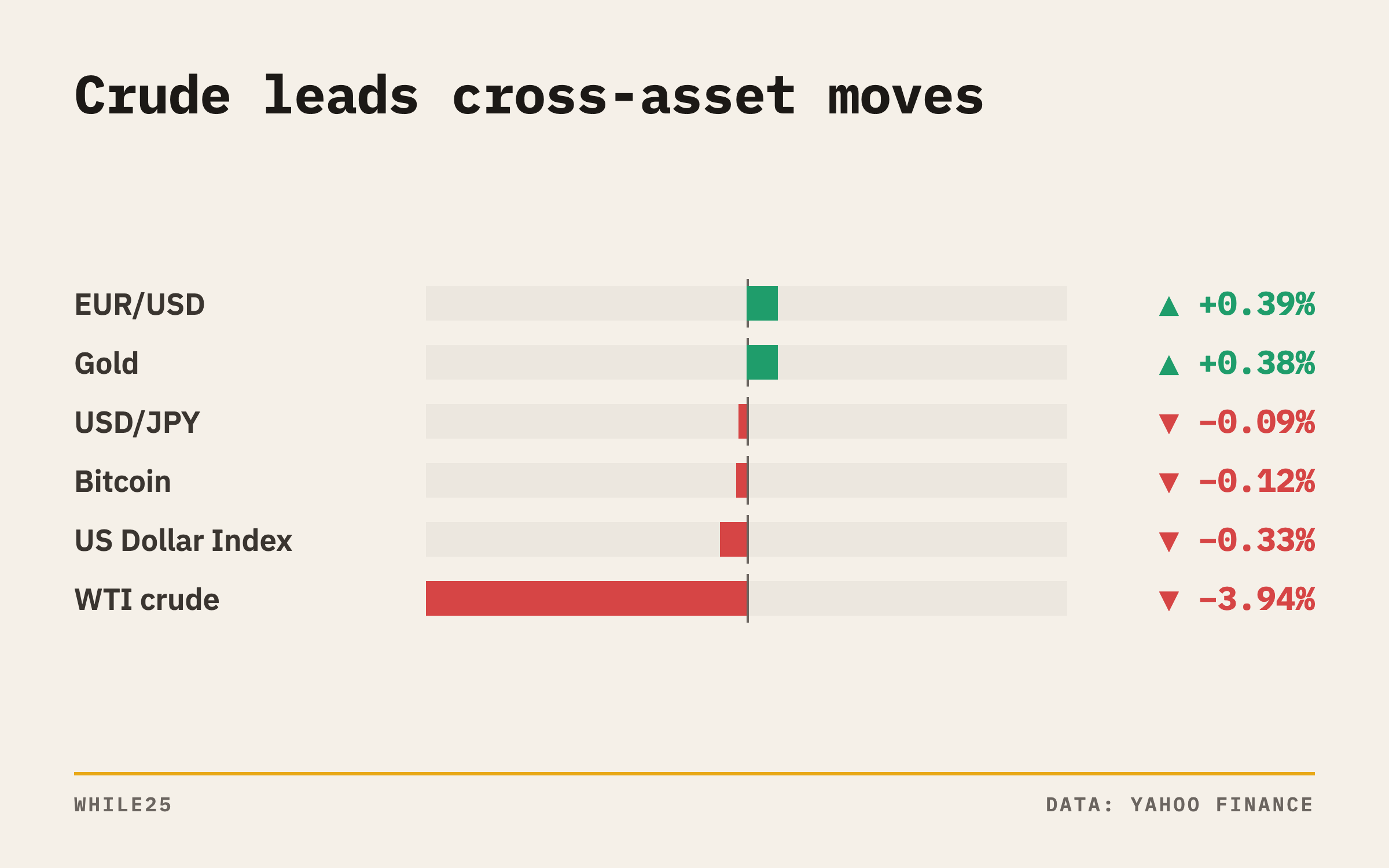 Day change for oil, gold, the dollar index, the euro, the yen rate and bitcoin on November 2, with crude down most
The US open and a crowded week
US stocks had not started trading at the time of writing. The AP reported that US stock futures were rising before the November 2 open. Futures are contracts that trade outside regular hours. Their prices hint at the direction of the open. On October 30 the S&P 500, an index of 500 large US companies, fell 1.82% to 7,580.07. The Dow Jones Industrial Average, another major US index, lost 1.09%.
Apple reports its fiscal fourth-quarter results after US markets close. The fiscal fourth quarter is the last quarter of its accounting year. Analysts expect earnings per share of $1.99 on revenue of $113.4bn. Earnings per share is profit divided by the number of shares. Revenue is total sales.
The calendar ahead
- November 2: Apple reports results after the US close. The US ISM manufacturing survey for October comes out. It is a monthly poll of factory purchasing managers.
- November 3: US midterm elections. Trump has said he would not strike Iran before this date. The Reserve Bank of Australia, the country's central bank, announces its interest rate decision. AMD reports third-quarter results.
- November 4: The US ISM services survey comes out. The eurozone, the countries that use the euro, gets its first estimate of October inflation. Inflation is the rise in consumer prices.
- November 5: The Bank of England, the UK central bank, announces its rate decision.
- November 6: The US releases its October jobs report. Forecasters expect about 60,000 jobs added.
Reading the week for your portfolio
Oil traders now react to statements from Tehran and Washington. Both sides have tied their timing to dates. Iran's plan runs on a two-day clock. Trump has pointed to November 3, and officials say strike options come after the votes.
Crude fell 3.94% on November 2 after a single offer that Washington has not answered. Energy shares, airline stocks and oil funds carry that headline risk until the US responds. Headline risk means a price can jump or drop on the next news report.
The chip stocks offer a separate lesson. SK hynix and Kioxia both make memory chips. Their shares moved in opposite directions on the same morning. For investors, a company's own profit forecast said more than the industry it belongs to.
Sources
- brecorder.com
- biz.heraldcorp.com
- aljazeera.com
- hngn.com
- whio.com
- gurufocus.com
- tradingkey.com
- globalbankingandfinance.com
- cnbc.com
- wsls.com
- cmcmarkets.com
- federalreserve.gov
Not investment advice.