
Seven ships crossed the Strait of Hormuz on October 6, ship-tracking firm Kpler said. That was the lowest count in two months. Kpler counted 10 ships on October 7. On the Sunday and Monday before that, it counted over 20 ships a day.
The Strait of Hormuz is the narrow sea lane between Iran and Oman. Tankers leaving the Persian Gulf sail through it to reach the open ocean. Before the war, hundreds of ships crossed it each day, NBC News reported.
Reporters published Kpler's figures on October 8. That same day, President Trump posted that the US would not attack Iran before the November 3 midterm elections. In the midterms, Americans vote for Congress between presidential elections.
Crude is oil as it comes out of the ground, before refining. Brent crude is the global benchmark, the reference price traders use for oil. Brent rose 4% on the day. European diesel futures rose 6%. A futures contract is an agreement to buy or sell a fuel or other good at a set price on a later date.
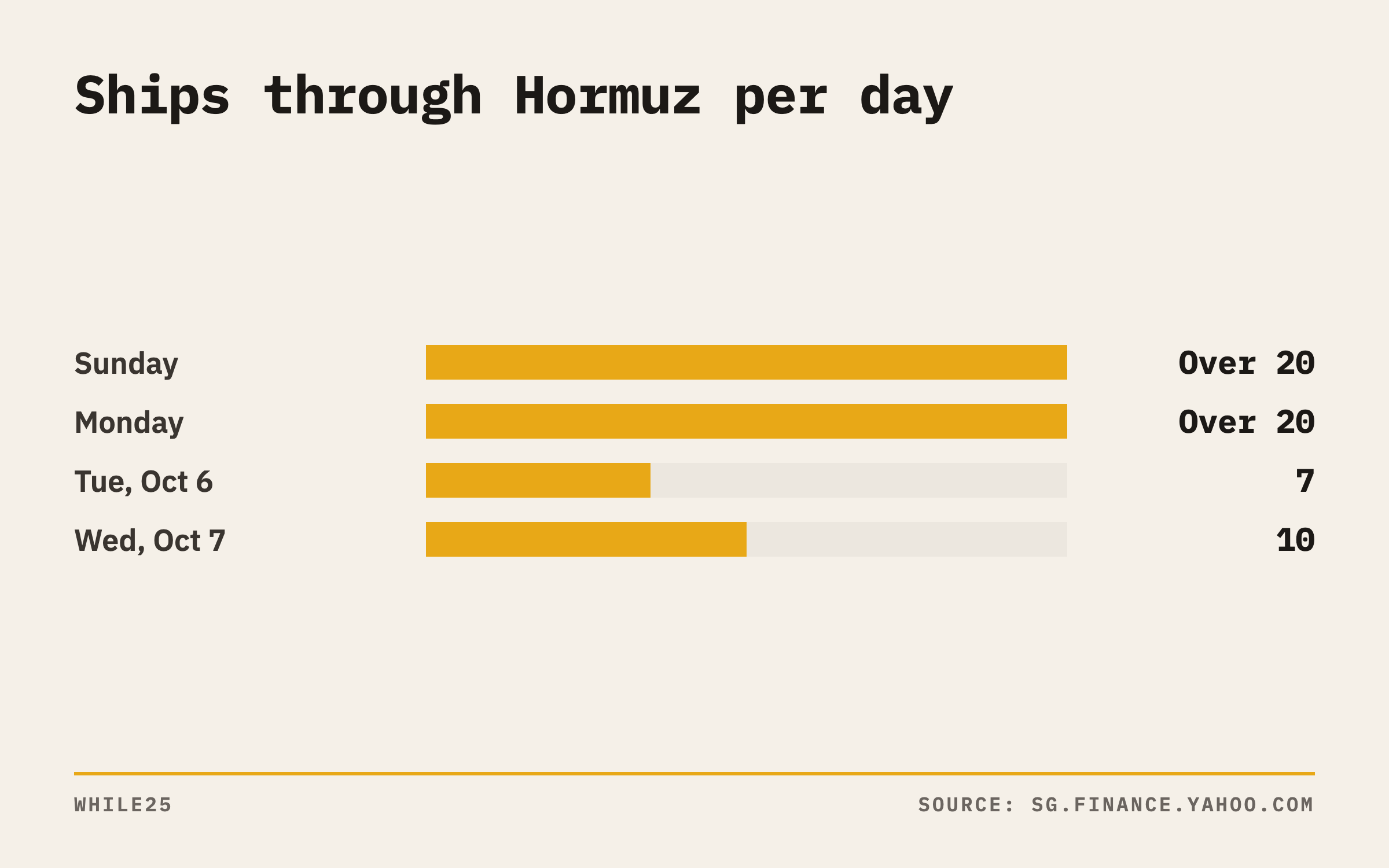 Kpler's daily count of ships crossing the Strait of Hormuz: over 20 on Sunday and Monday, then 7 on October 6 and 10 on October 7
Counting ships
A transit is one ship passing through the strait. Kpler and MarineTraffic both track vessels at sea. Both firms publish counts of the ships that cross.
MarineTraffic's figures cover a longer stretch. From September 28 through that Sunday, traffic averaged fewer than 23 ships a day. The drop to seven on October 6 came after weeks at that reduced pace.
The gap with pre-war traffic is wide. Hundreds of ships a day used the route before the war. In recent weeks, the daily count has run in the low twenties or below.
A White House official said the strait was open. The same news reports carried that statement and Kpler's counts. A route can stay open while few ships use it.
Trump's post and the date
On October 8, Trump posted about Iran. He wrote: "We will not be attacking Iran at any time prior to the Midterm Elections to be held in the United States on November 3rd."
In the same post, he cited "productive discussions with the Islamic Republic of Iran."
With the post, Trump put a specific date on the calendar. Oil traders have that date to watch, along with the daily ship counts.
Oil prices on October 8
Brent rose as high as almost $106 a barrel on October 8. It ended the day at $104.28, up 4%, NBC News reported. Traders call the last price of the day the close.
West Texas Intermediate, or WTI, is the main US crude price. It touched nearly $93 during the day. It closed up 3.6% at $91.49.
Both the high and the close came on the day of Trump's post. The reports we cite give the high and the close without a time of day.
We took our own market data at a different time. It shows Brent at $103.92, up 3.71%, and WTI at $91.18, up 3.29%. Prices change through the day, so the two sets differ.
Prices in other markets moved less. Gold rose 0.43%. A stock index tracks the share prices of a group of companies. The S&P 500, an index of 500 large US companies, fell 0.47%. Europe's STOXX 600 index fell 0.75%. Germany's main index, the DAX, fell 1.18%.
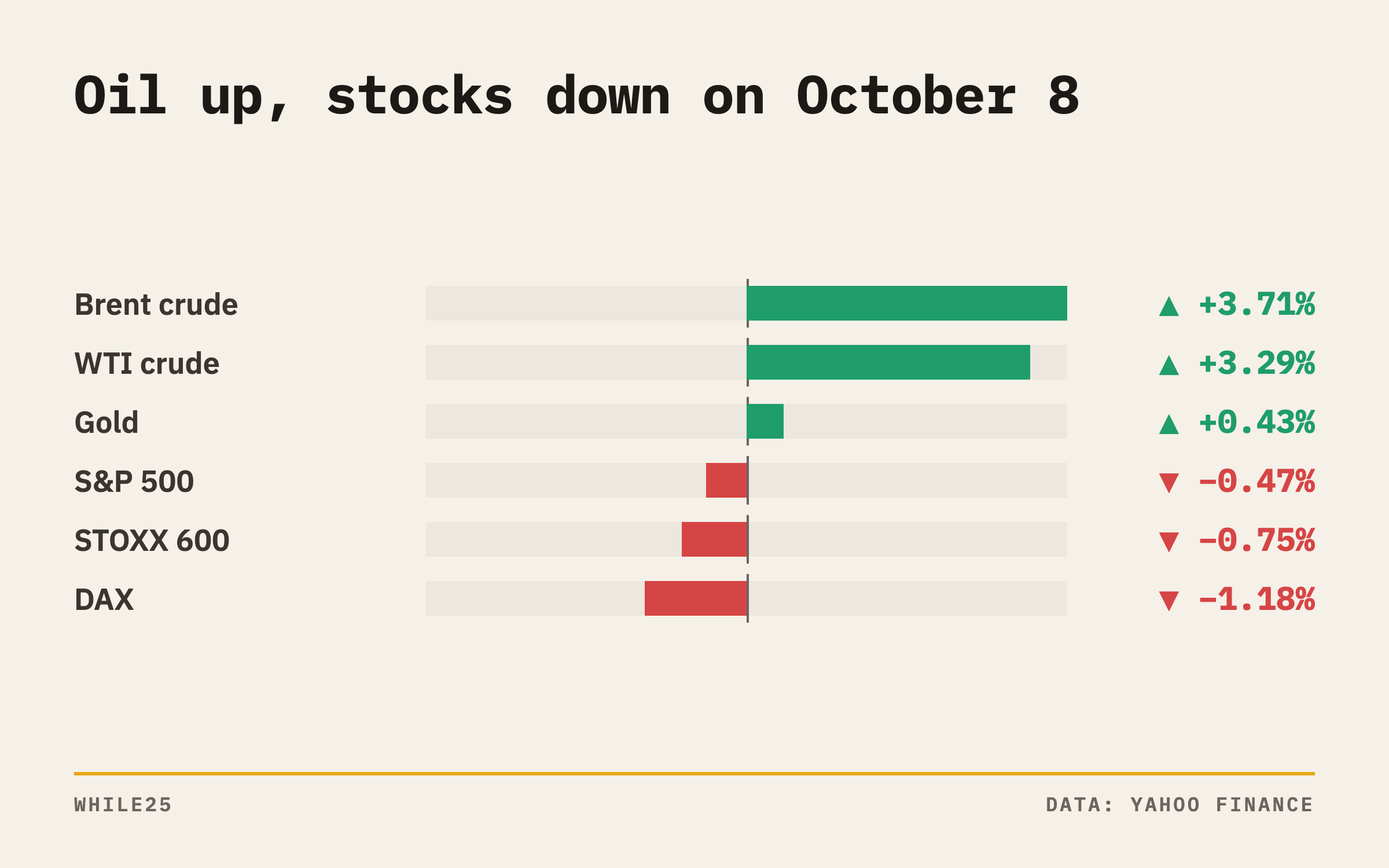 Day change on October 8 for Brent, WTI, gold, the S&P 500, the STOXX 600 and the DAX
Diesel rose faster than crude
Benchmark diesel futures rose 6% in European trading on October 8. Heating oil futures rose more than 5%. Brent rose 4%.
Refineries turn crude into diesel and jet fuel, among other products. The price of diesel has two parts.
One part is the cost of the crude. The other is the refiner's margin. That margin is the gap between the fuel's selling price and the crude's cost.
If crude rises, diesel rises with it. If finished diesel is scarce on top of that, the margin widens. In that case, diesel climbs faster than crude.
Tankers carry refined fuels through the Strait of Hormuz, along with crude. Refineries in the Gulf export diesel and jet fuel to buyers overseas. Europe buys diesel from abroad to meet its needs. Fewer ships through the strait means fewer fuel cargoes on that route.
Heating oil and diesel are close cousins. The US heating oil futures contract tracks ultra-low-sulfur diesel, the same fuel that trucks burn. In the Northern Hemisphere, people buy more heating fuel through the winter months.
The two parts of the diesel price fit the order of the moves on October 8. Crude rose because traders worried about supply. Diesel and heating oil rose on the same worry. They carried the margin for finished fuel on top.
Fuel costs and your money
Crude is the price in the headlines. Diesel and heating oil prices feed into trucking costs, airline fuel bills and home heating. On October 8, those prices rose more than crude.
Investors feel fuel costs through the companies they own that burn a lot of fuel. Delta Air Lines reports third-quarter results on October 9. Quarterly results show a company's sales and profit over three months. In airline results, investors can see how much fuel costs weigh on profit.
Two inflation reports come next. Inflation is the rise in prices over time. The Bureau of Labor Statistics publishes the September consumer price index, or CPI, on October 14 at 8:30 AM ET. The CPI is the main US measure of inflation in the prices households pay.
The Bureau publishes the September producer price index, or PPI, on October 15 at 8:30 AM ET. The PPI tracks the prices businesses receive for their goods. Both reports cover September, before Kpler's early-October lows.
Kpler and MarineTraffic publish ship counts day by day. Trump named November 3 in his post.
Some investors hold energy stocks, airlines or companies that ship goods by truck. They see part of the fuel story in a crude chart. On October 8, the prices further down the chain, at the refinery and the pump, moved more than crude.
Sources
Not investment advice.