
Nvidia shares fell 8.6% in after-hours trading on November 11. Traders sold after reports that the company's board met to weigh removing CEO Jensen Huang. A board is the group of directors that oversees a company and can hire or fire its CEO. After-hours trading is buying and selling that happens once the regular US session has closed. During that day's regular session, investors had pushed up AI stocks across Wall Street.
Traders in Asia sold tech shares on November 12. A stock index tracks the prices of a group of companies as a single number. Hong Kong's main index, the Hang Seng, fell 1.26%. That was the biggest drop among the Asian indexes in our data.
Before the US open, futures on the Nasdaq-100 fell 0.97%. The Nasdaq-100 is an index of large companies on the Nasdaq exchange, heavy in tech. Futures are contracts that let traders bet on an index before the main market opens. In Germany, investors bought on strong company results. They pushed the DAX, Germany's main stock index, to a record close of 26,950.53.
Nvidia's board meets and announces no decision
The Wall Street Journal reported on November 11 that Nvidia's board was preparing to remove Huang. CNBC confirmed in the late evening that the board was meeting to decide whether to remove him. By the end of the night, the board had announced no decision.
Nvidia's bylaws are its internal rule book. Under them, a majority of its 11 directors can dismiss the CEO. They can do so with or without cause, meaning they need no stated reason.
The board had issued a statement on November 8. In it, the board said it had started an independent investigation. A committee of independent directors oversees that review. Independent directors are board members who do not work for the company. Outside lawyers support the committee. The board said it had no reason to believe anyone had compromised national security or Nvidia's secrets. It expressed confidence in Huang.
Nvidia's stock had been falling before the reports. CNBC reported the stock was down 7% for the week before the after-hours drop. That put it on pace for a sixth weekly decline in a row. On the morning of November 12, Nvidia shares that trade in Frankfurt were down 7.1% before the US open.
AI stocks gain before the reversal
US stocks rose on November 11. The S&P 500, an index of large US companies, rose 1.31% to 7,619.38. The Nasdaq Composite, a broad index of Nasdaq-listed stocks, gained 1.60%. The tech-heavy Nasdaq-100 jumped 2.3%. The Dow, another index of large US companies, added 0.49%.
CoreWeave rents out computing power for AI. Its shares jumped 24.7% after the company raised its revenue outlook, its forecast for sales.
After the regular session closed, traders bought some AI stocks and sold others. Shares of AMD and Broadcom, two rival chipmakers, rose in after-hours trading. Super Micro, CoreWeave and Oracle fell. Those three sell AI servers or the computing capacity that runs on them. Servers are the computers that run AI work.
In early trading on November 12, Nasdaq-100 futures fell 0.97%. S&P 500 futures fell 0.37%, and Dow futures rose 0.15%. The Dow gives tech companies less weight than the Nasdaq-100 does. That difference helps explain the gap.
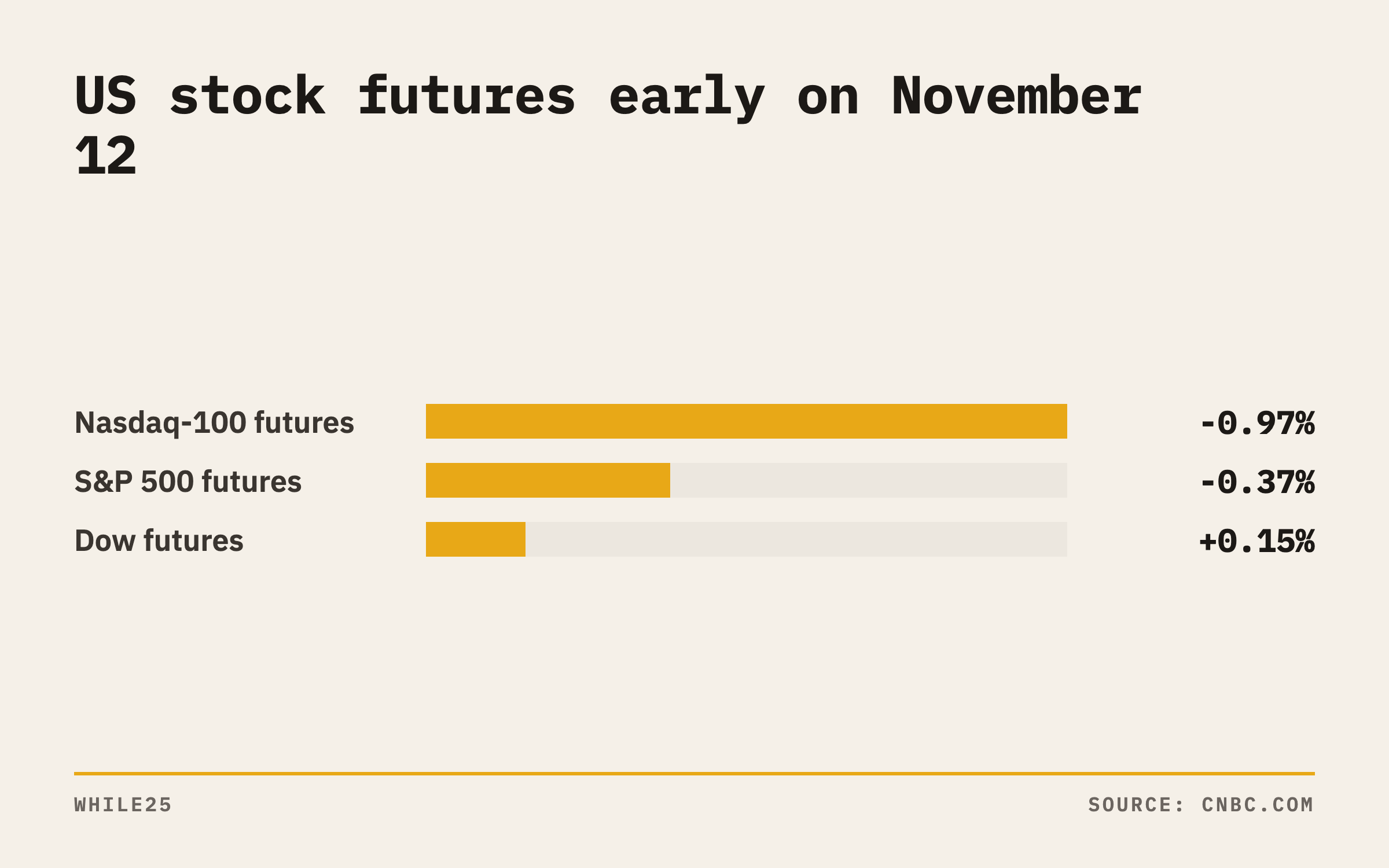 Bar chart of US stock futures early on November 12: Nasdaq-100 down 0.97%, S&P 500 down 0.37%, Dow up 0.15%
The VIX rose 5.15% to 18.39. The VIX is an index that tracks how much traders expect US stocks to swing over the next month. A higher VIX means traders are paying more for protection against big price moves.
Investors push European stocks to records
Germany's DAX rose 1.08% to a record 26,950.53. Siemens, an industrial technology group, led the gains. Its shares rose 3.8% after the company raised its growth outlook. Siemens Energy shares jumped 10.8% on November 11 after the company raised its expectations for profit margins in 2027. A profit margin is the share of sales a company keeps as profit.
The STOXX 600 is an index of 600 large European companies. It closed at a record 663.05 on November 11. On November 12, it added 0.31% to 665.13. STOXX 600 companies are on track for quarterly profit growth of 25%. France's main index, the CAC 40, rose 0.66%. Britain's FTSE 100 gained 0.17%.
Europe's big indexes hold fewer chip and AI companies than the Nasdaq. That left them less exposed to the Nvidia reports. Investors in Europe traded on earnings, meaning company profits.
Investors in Asia sell tech shares
Hong Kong had the biggest fall, with the Hang Seng down 1.26%. Saxo reported that Hong Kong and Taiwan came under pressure over doubts about Nvidia's leadership.
Japan's Nikkei 225 fell 0.70% to 60,819.36. The broader Topix rose 0.20%. Chip-equipment makers build the machines that produce chips. Those companies carry big weights in the Nikkei. A big weight means a company's price moves shift the index more. The Topix spreads its weight across many more companies.
South Korea's main index, the KOSPI, slipped 0.61%. The smaller, tech-heavy Kosdaq fell 1.22%. The Shanghai Composite fell 0.67%. India's Nifty 50 was flat, up 0.02%.
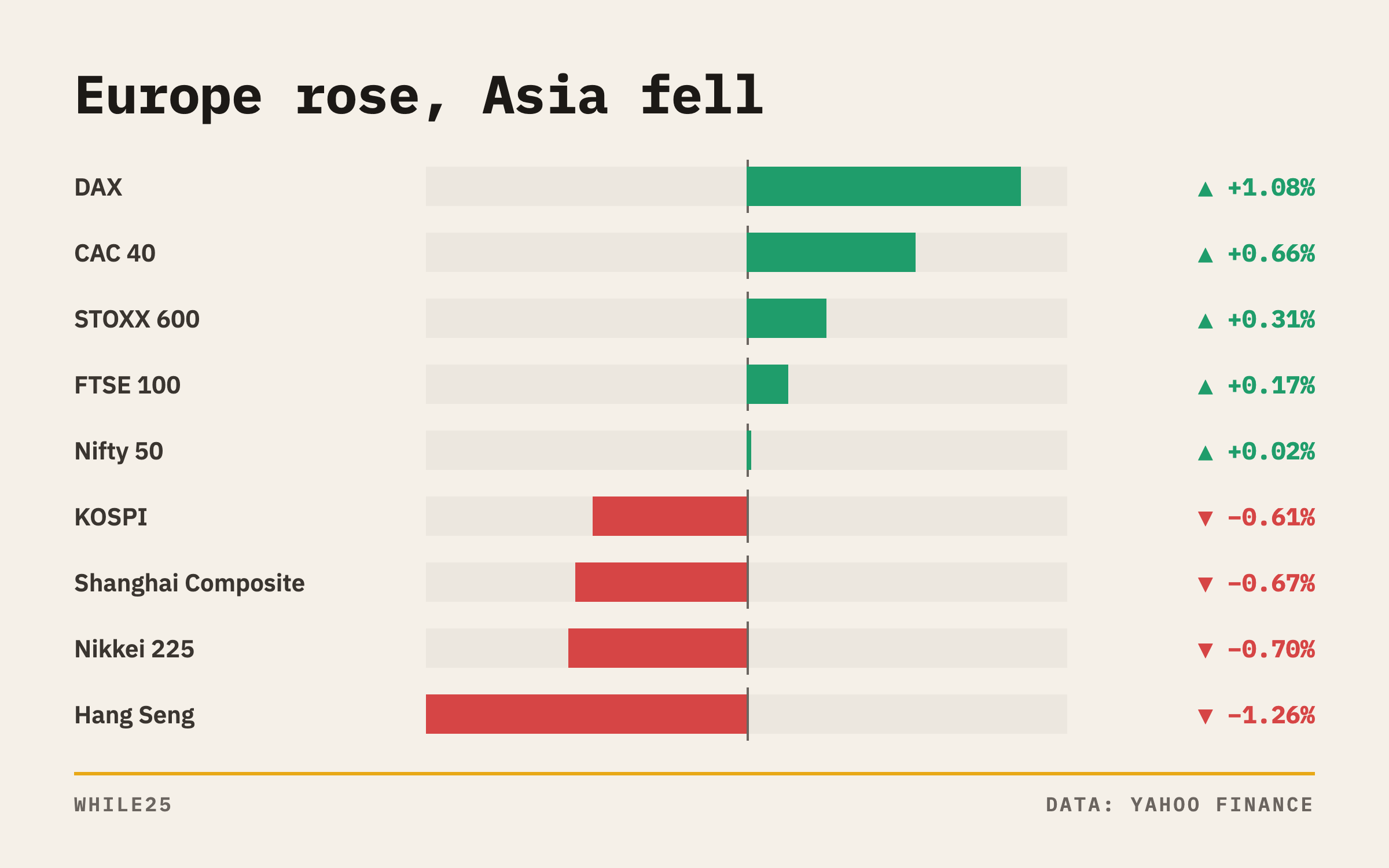 Horizontal bars of day changes on November 12: the DAX, CAC 40, STOXX 600 and FTSE 100 rose, while the Hang Seng, Nikkei 225, Shanghai and KOSPI fell
The yen weakens toward Japan's 160 line
The dollar rose 0.63% to 159.708 yen. That puts it close to 160 yen. Japan bought yen at that level twice this year to support its currency. Japan calls this intervention. The government sells dollars and buys yen to lift the yen's value. Japanese buyers pay more for imported goods if the yen weakens.
Japanese producer prices rose 7.1% in the 12 months to October. Producer prices are the prices companies charge each other for goods. Economists had expected 6.5%. The September reading was 6.8%.
Vice Finance Minister Atsushi Mimura said currency moves "over the past few days have been too rapid." Traders have seen Japan act near this level. On the night of April 30, during Japan's spring intervention, the dollar plunged from around 160 yen to around 155 yen. Japan's Ministry of Finance released figures on November 9. By those figures, Japan spent a record $50 billion in one day, July 30, to prop up the yen.
Toichiro Asada sits on the board of the Bank of Japan, the country's central bank. He urged caution on the pace of more interest-rate rises. The Bank of Japan holds its next meeting on December 17.
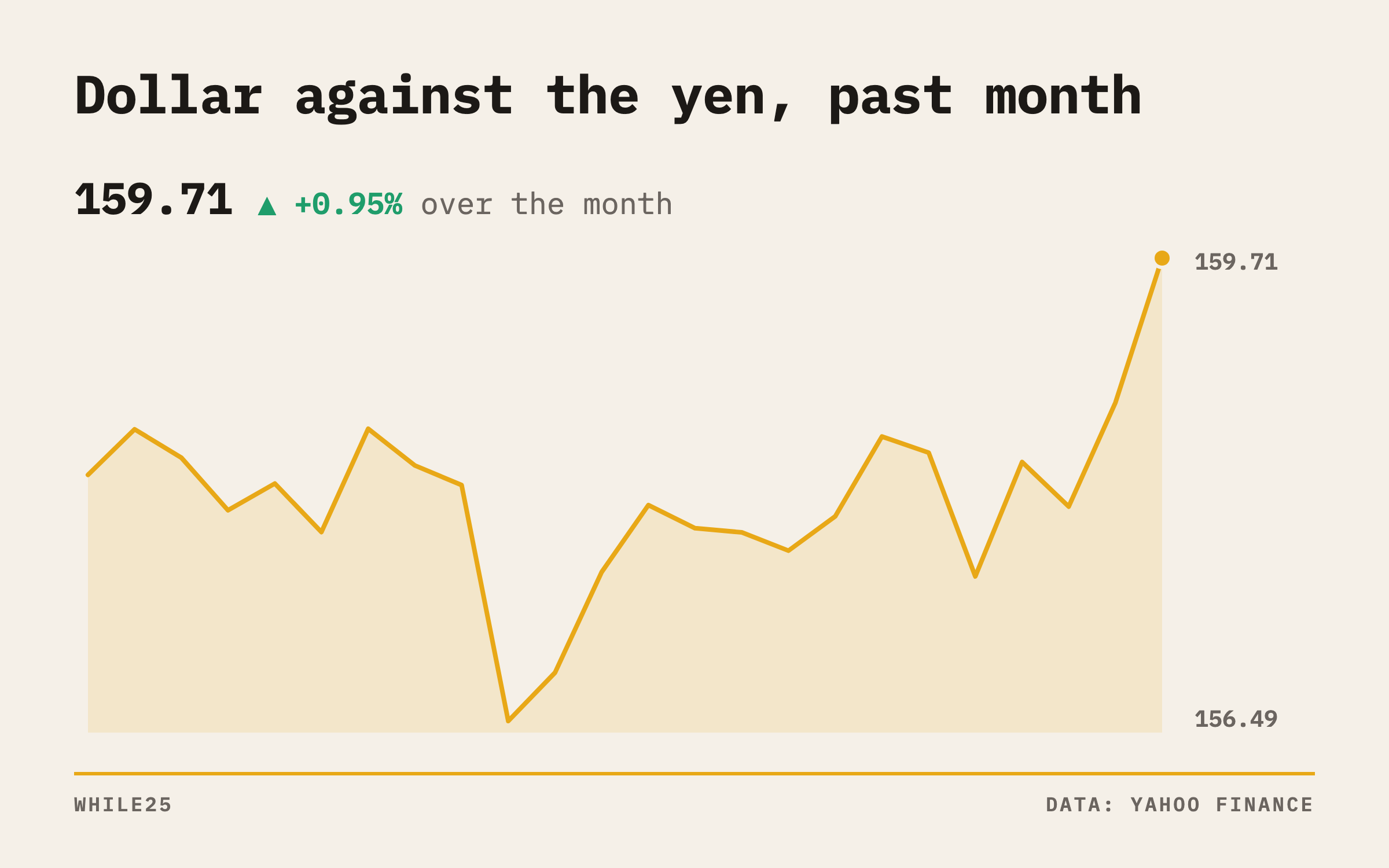 Line chart of the dollar against the yen over the past month, climbing toward the 160 level
Rates, gold, oil and bitcoin
The 10-year Treasury yield ended November 11 at 4.998%. That yield is the interest rate the US government pays to borrow for 10 years.
The Federal Reserve, or Fed, is the US central bank. Traders use interest-rate futures to bet on its decisions. Those traders treat another Fed rate rise after the December 9 meeting as certain, per the CME FedWatch Tool. They put the chance of a half-point rise at close to 10%. A half-point rise lifts the rate by half a percentage point.
The euro fell 0.65% to $1.1096. Saxo reported that the euro tested a 17-month low near 1.1065 during the session. That means it came near its weakest level in 17 months. Gold fell 1.43% to $3,943.2 an ounce.
Brent crude rose 0.34% to $93.08 a barrel. Brent is the global oil benchmark, the reference price for crude around the world. OPEC, a group of oil-producing countries, raised its crude output by close to 2 million barrels a day in October. The US and Iran remain deadlocked in talks over the Strait of Hormuz and Iran's enriched nuclear material.
Bitcoin slipped 0.63% to $73,495.77 as investors kept pulling money from bitcoin exchange-traded funds. Those funds trade on a stock exchange like a share.
On the calendar
- November 12: US weekly jobless claims, which count new applications for unemployment benefits. October existing home sales, which track sales of previously owned homes.
- November 12: The US Treasury sells new 30-year bonds, which are loans to the government, at auction. Fed speakers Hammack, Barr, Goolsbee, Daly, Schmid and Williams give talks.
- November 12: Cisco and Applied Materials report quarterly results.
- November 17: Nvidia reports quarterly results.
- November 18: Briefing with Jensen Huang that lawmakers requested.
- November 19: Anthropic's expected market debut, its first day of trading on a stock exchange.
- November 30: MSCI, a company that builds stock indexes, removes Strategy from its global indexes after the close.
- December 9: Federal Reserve policy meeting, where the Fed sets interest rates.
- December 17: Bank of Japan policy meeting.
Reading the day
Traders from Hong Kong to New York moved stock prices within a day on news from one Nvidia board meeting. An index fund buys the stocks in an index. A fund's holdings are the stocks it owns. Nvidia ranks among the largest holdings in Nasdaq-100 and S&P 500 index funds.
Traders sold tech futures on the reports. Investors in Germany bought on company profits. A fund that tracks the Nasdaq-100 is more open to that kind of headline than one tracking the DAX. If you know your funds' top holdings, you can judge which headlines matter for them.
Sources
- cnbc.com
- cnbc.com
- aljazeera.com
- thenextweb.com
- nvidianews.nvidia.com
- investinglive.com
- home.saxo
- globalbankingandfinance.com
- marketscreener.com
- fxstreet.com
- investinglive.com
- english.adnkronos.com
- investinglive.com
Not investment advice.