
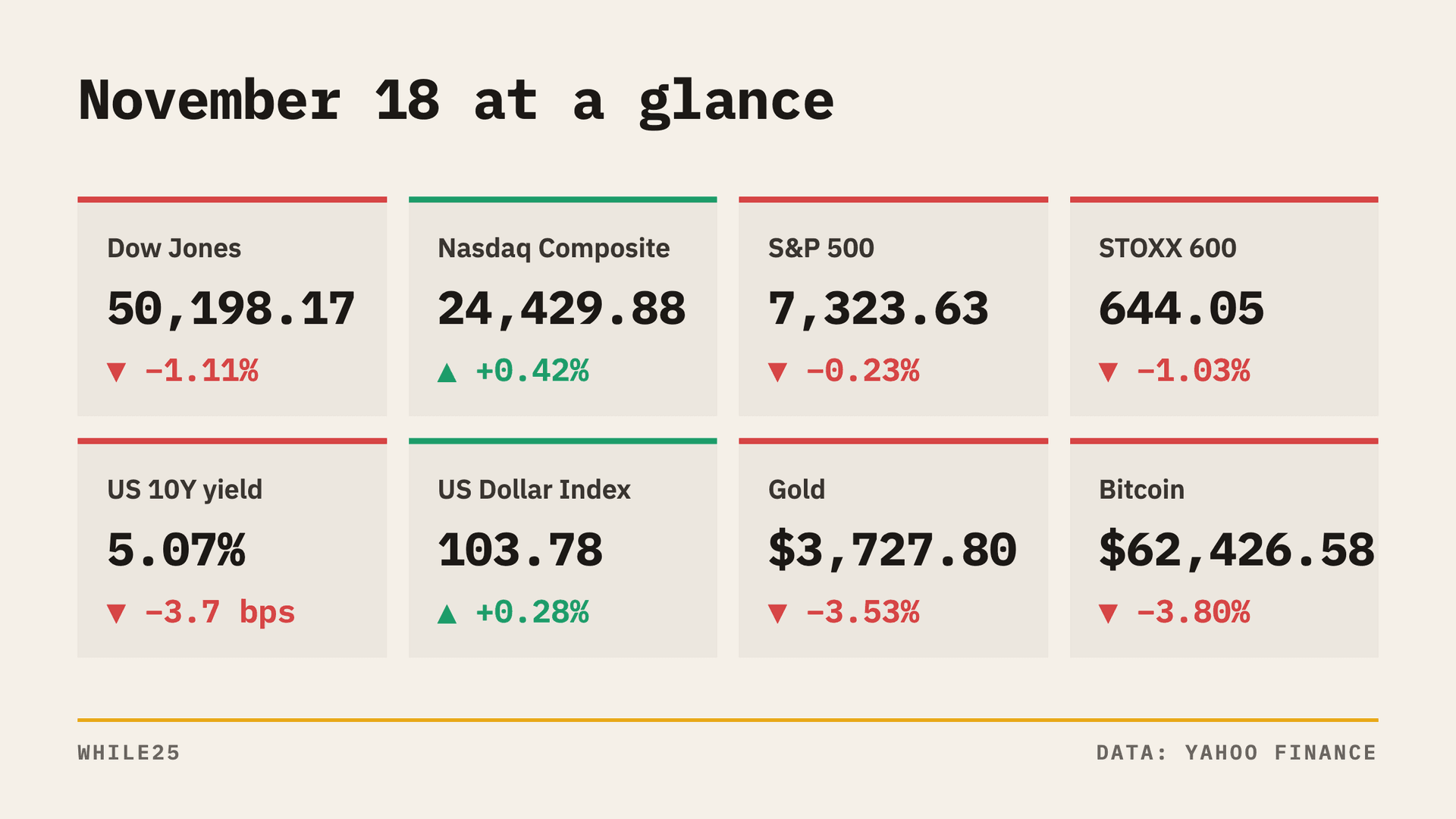
The Federal Reserve, or Fed, is the US central bank. It sets a key short-term interest rate, which shapes the cost of borrowing. On November 18, the Fed released the minutes of its last meeting. Minutes are the official written record of what officials discussed. According to the minutes, "almost all participants" leaned toward more rate rises.
Gold fell 3.53% after the release. Bitcoin, a digital currency, fell 3.80%. A stock index tracks the share prices of a set of companies. US stock indexes moved in opposite directions on company news. The Dow Jones Industrial Average, an index of large US companies, fell 1.11%. Health insurer shares sank. The Nasdaq Composite, an index heavy in technology companies, rose 0.42%. AMD and Broadcom gained and lifted it, though Nvidia fell.
Fed officials leaned toward higher rates
The minutes cover the Fed's October 27-28 meeting. At that meeting, officials voted 10-2 to keep their benchmark rate unchanged. This rate is the Fed's main tool for steering borrowing costs. It stays in a range of 3.75%-4%.
Governor Lisa Cook and Cleveland Fed President Beth Hammack dissented, meaning they voted against the decision. Both wanted a quarter-point increase. That is a rise of a quarter of one percentage point.
"Almost all participants" judged further increases likely to be appropriate, the minutes said. Some officials said the Fed might need a larger increase at the December meeting. Officials called demand tied to artificial intelligence (AI) "a material source of inflation risk." Inflation is a general rise in prices.
Fed Governor Chris Waller argued for a half-point rise in December. His other option was a quarter-point rise, with a clear signal of another quarter point in January.
Traders moved their bets toward bigger rises. Traders quote rate moves in basis points. One percentage point equals 100 basis points, so 50 basis points is half a point. Futures are contracts that let traders bet on a future price or rate. The CME FedWatch tool turns futures prices into odds for Fed decisions.
By FedWatch's count, 69% of traders expect a 50 basis point rise by the end of January. A month earlier, that share was 38%. Futures traders treat a quarter-point rise at the December 8-9 meeting as certain.
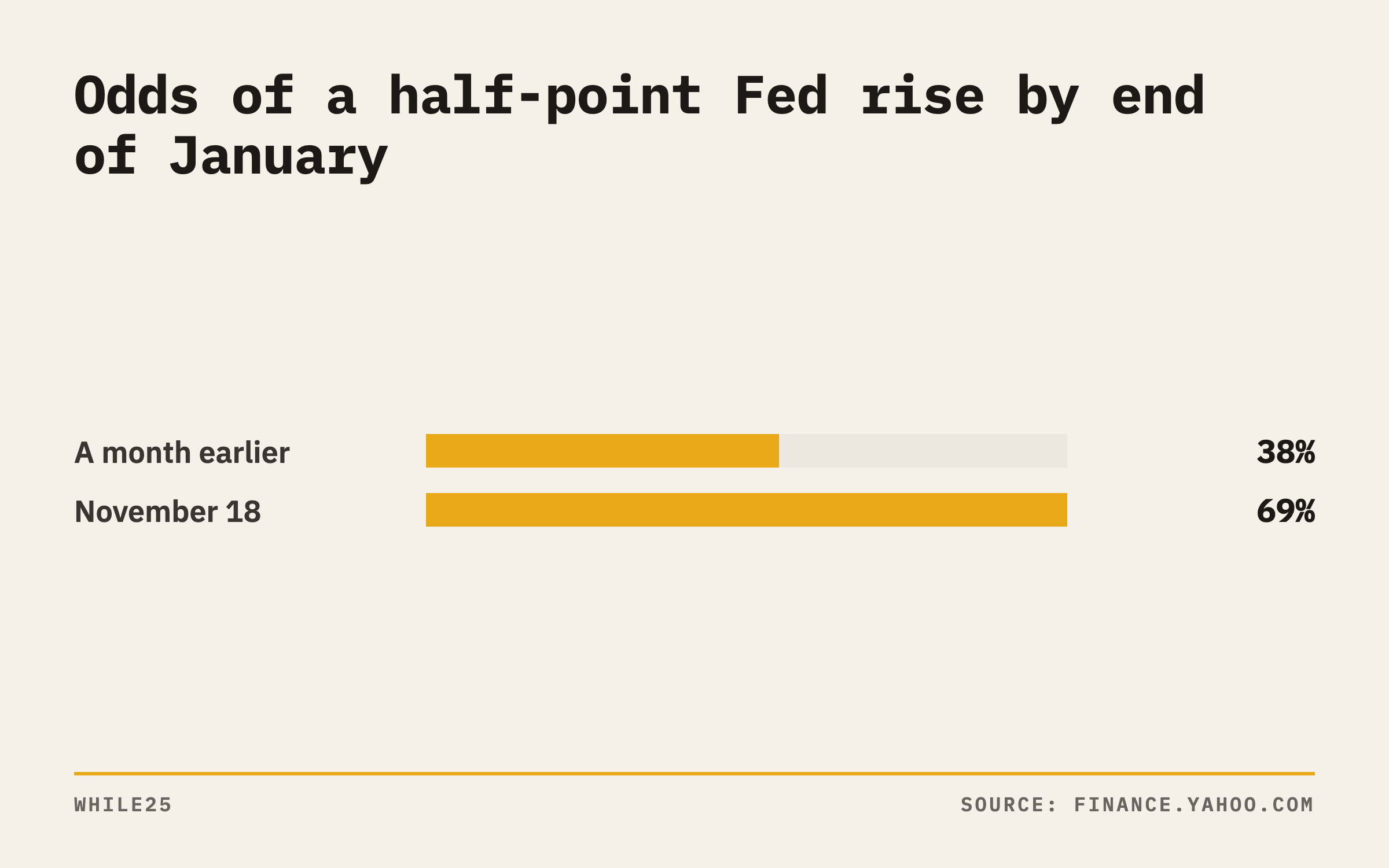 Bar chart: the share of traders expecting a half-point Fed rise by the end of January rose from 38% a month earlier to 69%
Gold and bitcoin pay no interest, and both fell
Gold and bitcoin pay no interest. Bonds are loans to governments or companies, and they pay interest. With higher rates, cash and bonds pay their holders more.
Gold futures fell 3.53% to 3,727.8, their lowest since September 2025. Silver fell 4.86% to $45.068. Gold has fallen 10.39% over the past month.
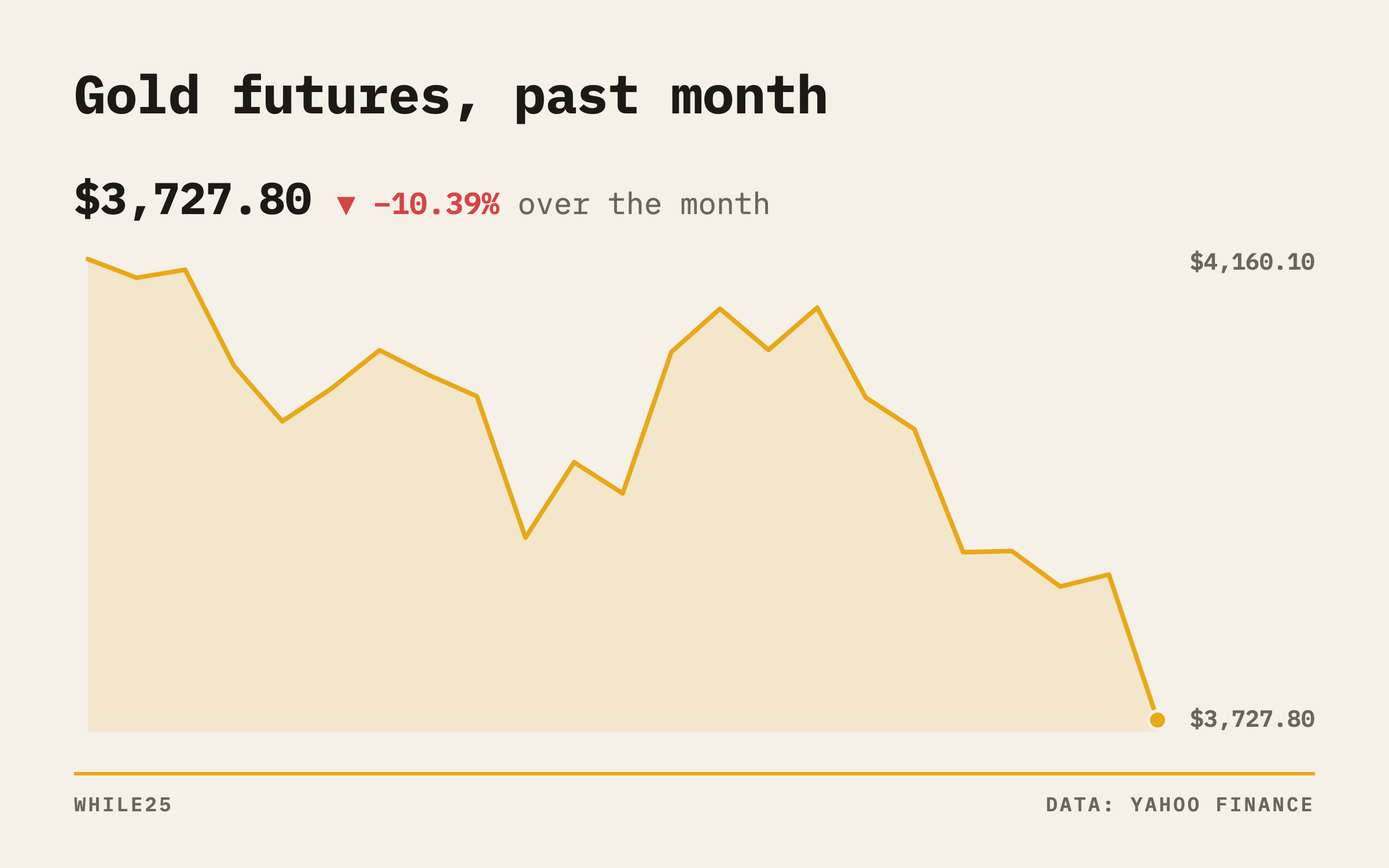 Line chart of gold futures over the past month, sliding to 3,727.8 on November 18
Bitcoin fell 3.80% to $62,426.58. Ether, another digital currency, fell 4.46%. Bitcoin has fallen 23.89% over the past month.
FXStreet reported that investors pulled more money out of spot bitcoin funds than they put in. These exchange-traded funds trade like shares and hold the coin itself. FXStreet reported forced selling of leveraged bets. Leveraged bets are positions that traders buy with borrowed money. Traders face forced selling when losses on those positions grow too large.
The selling spread across major crypto exchanges, the platforms where people trade coins. It followed bitcoin's drop below a key price level that many traders watch. The Crypto Fear & Greed Index measures investor mood. It sat at 11-12, a reading labeled "Extreme Fear."
Short-term yields rose, long-term yields fell
Treasuries are US government bonds. A Treasury yield is the interest rate the US government pays to borrow. The 2-year Treasury yield follows expected Fed moves. It rose 1.5 basis points to 4.804%.
The 10-year yield, the rate the government pays to borrow for 10 years, fell 3.7 basis points to 5.066%. The 30-year yield fell 4.8 basis points to 5.411%.
The US dollar index measures the dollar against a group of major currencies. It rose 0.28% to 103.782. The dollar gained against six of seven major currencies. Its biggest gain, about 0.49%, came against the British pound. The euro fell 0.17% to $1.0979. The dollar held steady against the yen at 159.312.
Nvidia beat estimates, then its shares fell
Nvidia reported adjusted earnings of $2.68 a share. Adjusted earnings are profit that leaves out some one-time items. The per-share figure divides that profit by the number of shares. Analysts, the researchers who forecast company results, had expected $2.48. Revenue, the total money from sales, came in at $115.8 billion. Analysts had expected $109.0 billion.
Nvidia said it expects about $130 billion in revenue for the current quarter, the three months now under way. Buyers lifted the stock early in the trading day on the results and forecast.
By the close of trading, the shares had fallen 2.89% to $150.96. It was the stock's fifth losing day in a row. Jensen Huang has resigned as CEO, or chief executive. Finance chief Colette Kress is serving as interim, or temporary, CEO. Nvidia's board of directors said it would not bring Huang back.
Nvidia delayed its 10-Q, the quarterly report US companies file with regulators. The company said it plans "to file our 10-Q in the coming weeks."
Other chipmakers rose. AMD closed up 5.31% at $530.14. Broadcom closed up 3.65% at $354.08. The two companies lifted the Nasdaq 0.42% despite Nvidia's drop. The Russell 2000, an index of smaller US companies, rose 0.46%.
Health insurers dragged the Dow
The Centers for Medicare & Medicaid Services (CMS) runs Medicare, a US government health insurance program. The agency proposed an anti-fraud rule called CRUSH. UnitedHealth and Humana shares fell 6% each. CVS fell 3%. Cigna fell more than 2%. The insurers pulled the Dow down 1.11%.
The S&P 500, a broader index of large US companies, slipped 0.23%. The VIX measures how much traders expect stocks to swing. It fell 3.53% to 24.56. It has risen 40.42% over the last five trading days.
European stocks fell on miners and IPO cash
The STOXX 600, an index of large European companies, fell 1.03% to 644.05. It sits more than 3% below its record high from last week.
Mining stocks fell 4.7% as copper hit a seven-month low. It was their steepest one-day drop since May 15. Oil stocks fell 2.1%.
London's FTSE 100, which holds many mining companies, fell 1.30%. Germany's DAX fell 1.19%. France's CAC 40 fell 0.85%.
Alexis Bert of Marex pointed to Anthropic's initial public offering (IPO). An IPO is a company's first sale of shares to the public. Bert said the large sum Anthropic is raising could be "draining potentially some liquidity on the market." Liquidity here means cash available to buy shares.
Anthropic set its IPO price at $83 a share, a person familiar with the deal told CNBC. That price sits above the expected range of $70 to $78. Anthropic had said it was offering 825 million shares. At $83 a share, a full sale would raise about $68.5 billion.
Asian stocks slid before Nvidia reported
Asian exchanges last closed on November 17, before Nvidia's results. Reports said the US plans to tighten Chinese companies' access to advanced AI chips. Chip stocks posted the biggest losses after those reports.
Korea's KOSPI index fell 2.59%. Samsung Electronics fell 3.05% and SK Hynix fell 1.79%.
Japan's Nikkei 225 fell 1.34%. Kioxia fell 5.08% and SoftBank fell 3.95%. Hong Kong's Hang Seng fell 1.03%, and the Shanghai Composite fell 0.50%. India's Nifty 50 rose 0.38%.
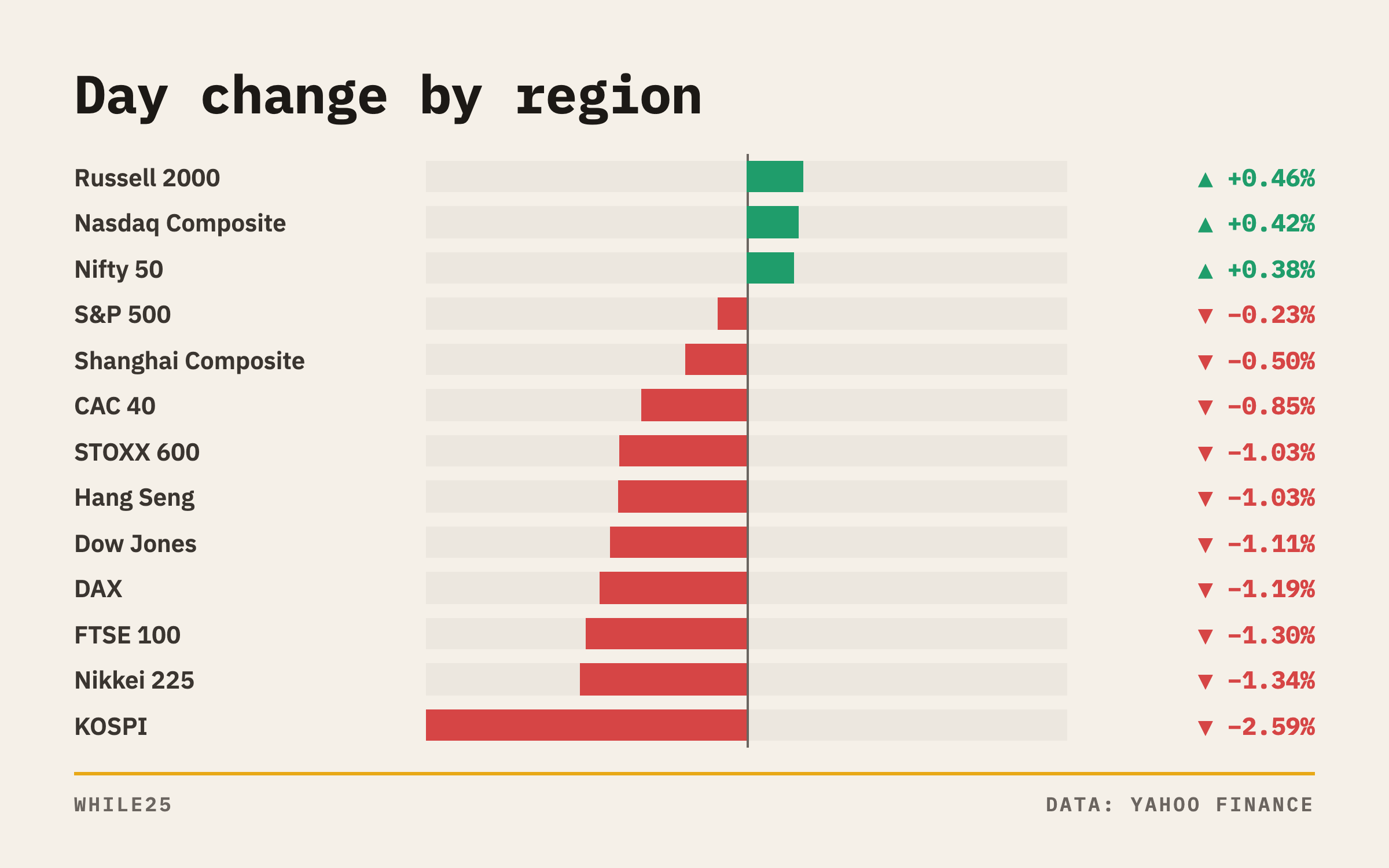 Horizontal bars of day changes for major stock indexes in the US, Europe and Asia; Asian closes are from November 17
Oil stockpiles grew
The front oil futures contract is the one closest to expiry, the date it ends. A monthly switch in that contract distorted the day's crude price moves.
In weekly US figures, crude oil stockpiles, the oil held in storage, rose 3.38 million barrels. Analysts had expected a rise of 58,000 barrels. Gasoline stockpiles rose 5.19 million barrels.
Coming up
- Thursday, November 19: Anthropic shares begin trading on the Nasdaq stock exchange under the stock symbol ANT. The IPO price is $83.
- Thursday, November 19: Walmart third-quarter results, weekly US jobless claims (new filings for unemployment benefits) and the Philadelphia Fed factory survey.
- Friday, November 20: Japan's October consumer prices and a rate decision from the People's Bank of China, China's central bank.
- Friday, November 20: University of Michigan consumer sentiment, a survey of consumer mood.
- December 8-9: the Fed's next policy meeting and rate decision.
For your portfolio
Investors reacted to two kinds of news on November 18. They sold gold and bitcoin, which pay no interest, after Fed officials talked of higher rates. On the same news, investors lifted the dollar and the 2-year yield. Investors moved stock indexes on company news.
A sector is a group of companies in the same business. One sector can move a whole index. Health insurers pulled the Dow down. AMD and Broadcom pushed the Nasdaq up while Nvidia fell.
An index fund copies the holdings of an index. Its daily result depends on which companies sit inside it. A portfolio is the mix of investments a person owns. Its exposure to Fed news depends on its share of assets that pay nothing.
Sources
- cnbc.com
- finance.yahoo.com
- investinglive.com
- fool.com
- cnbc.com
- finance.yahoo.com
- tradingkey.com
- fxstreet.com
- cmcmarkets.com
Not investment advice.