
Nvidia shares fell 8.6% in after-hours trading on Wednesday, November 11, Al Jazeera reported. After-hours trading takes place after the main US stock market closes for the day. CNBC put the drop in that session at more than 9%. The fall followed a report in The Wall Street Journal. The paper said Nvidia's board was preparing to remove CEO Jensen Huang. It published the report after the US market closed. Late that evening, CNBC confirmed that the board was meeting to decide whether to remove him.
Stocks had risen during the regular trading day. On November 11 the S&P 500 rose 1.31% and the Nasdaq Composite gained 1.60%. Both are stock indexes, measures that track the share prices of a large group of companies. By the time of the report, the main US exchanges had shut. Exchanges are the marketplaces where shares change hands. Even so, traders put a price on Nvidia within hours. They used three channels: the after-hours session, the Frankfurt market and stock index futures. Each channel works in its own way. Each draws a smaller or different crowd than the regular session.
Trading after the closing bell
US stock exchanges hold one main trading session on business days. Traders do most of the day's buying and selling there. Exchanges and electronic trading networks add extra sessions before the main session opens and after it closes. Retail brokers are the firms that handle trades for individual investors. Many let customers send orders into the extra sessions.
Fewer traders take part in those sessions. Large funds, index-tracking funds and many market makers do most of their business in the main session. Market makers are firms that stand ready to buy and sell through the day. With fewer traders around, fewer buy and sell orders wait at each price.
Traders call a market like this thin. The spread is one way to see it. The spread is the gap between two prices, the bid and the ask. The bid is the highest price a buyer offers. The ask is the lowest price a seller accepts. During the main session, Nvidia's spread is tiny. Buyers and sellers have orders waiting at most price levels. After hours, the gap can widen. A seller in a hurry may have to accept a bid below the last trade. That trade becomes the new price on screens.
Thin trading accounts for the two figures from CNBC and Al Jazeera. The after-hours price changes with each trade. The two outlets captured the same session at different moments. A quoted after-hours price shows where the latest trade took place. It says less about how many shares could have traded at that price.
Brokers set rules for this thin market. Outside the main session, many accept limit orders and no other kind. A limit order names the worst price a trader will accept. That protects the trader from a trade far from the last quoted price. Many brokers switch off stop orders until the main session opens. A stop order is an instruction to sell once the price falls to a set level.
Trading in Frankfurt starts first
Investors in Germany trade Nvidia stock. Frankfurt's exchanges list shares of large US companies. European investors can buy them in euros during their own working day. The Frankfurt prices stay close to the US price. Traders buy in one market and sell in the other if the two drift apart. Traders call that trade arbitrage.
Europe's trading day starts hours before New York's. On Thursday, November 12, Nvidia's Frankfurt-listed shares were down 7.1% in premarket trading, CNBC reported. Premarket trading means trading before the main US session opens.
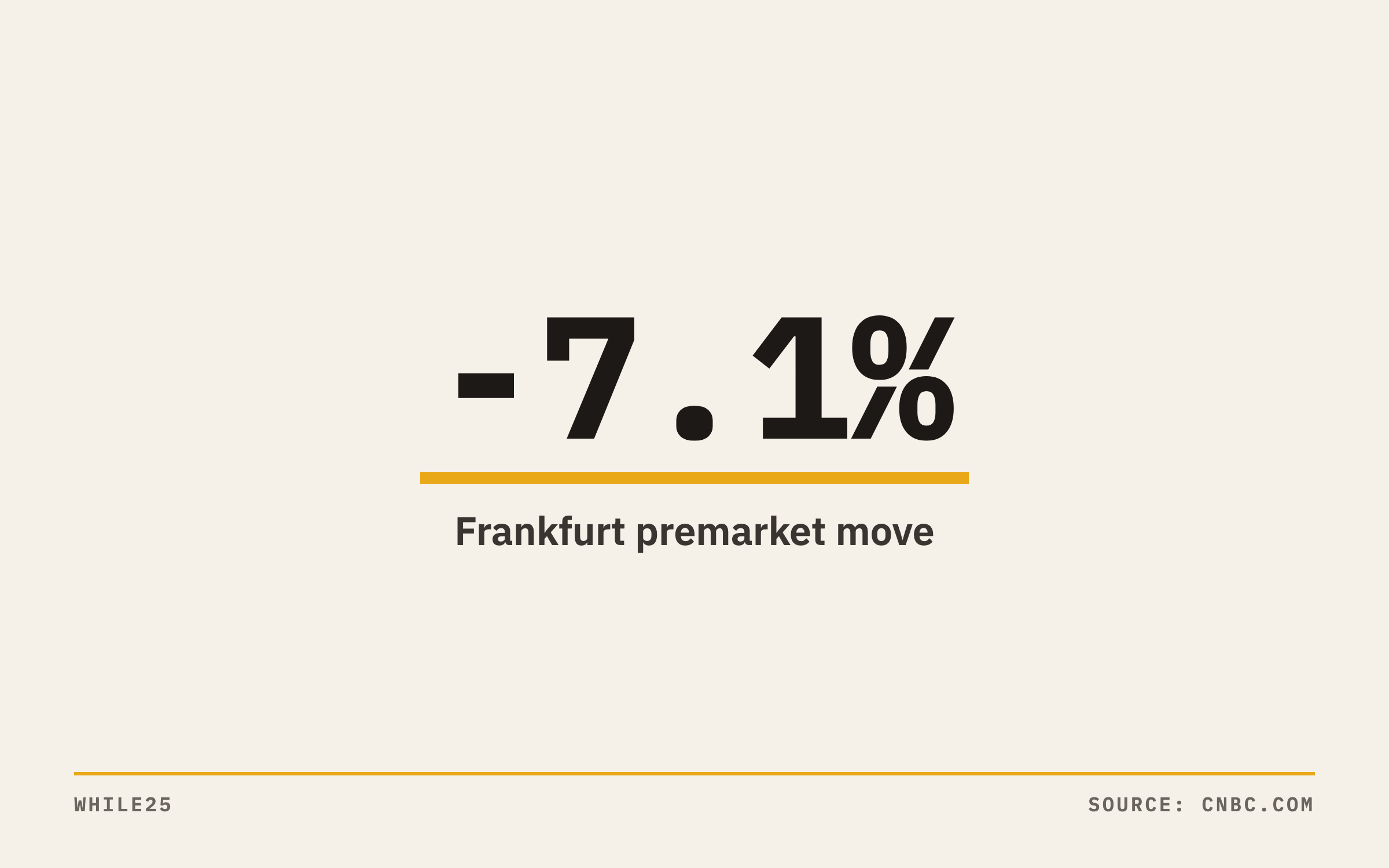 Nvidia's Frankfurt-listed shares were down 7.1% in premarket trading on November 12
The Frankfurt drop was smaller than the after-hours readings from New York. A Frankfurt quote differs from a New York one for two reasons. First, traders there price the shares in euros. The euro fell 0.65% against the dollar on November 12. A euro price carries currency moves on top of moves in the stock. Second, Frankfurt has thin trading in US stocks, like New York after hours. Market makers there base their buy and sell prices in part on the latest US price. Traders there swap fewer shares than in New York.
A US trader waking up on November 12 could see a price from Frankfurt. A new group of traders had set it, hours after the first reaction.
Index futures cover the whole market
Stock index futures are contracts tied to the value of an index, such as the Nasdaq-100. Traders buy and sell them on an exchange around the clock on weekdays, with short breaks. Their price moves with traders' latest view of what the index is worth.
Early on Thursday, November 12, Nasdaq-100 futures fell 0.97%, according to CNBC. S&P 500 futures fell 0.37%. Dow futures rose 0.15%. CNBC linked the slide to Nvidia's drop.
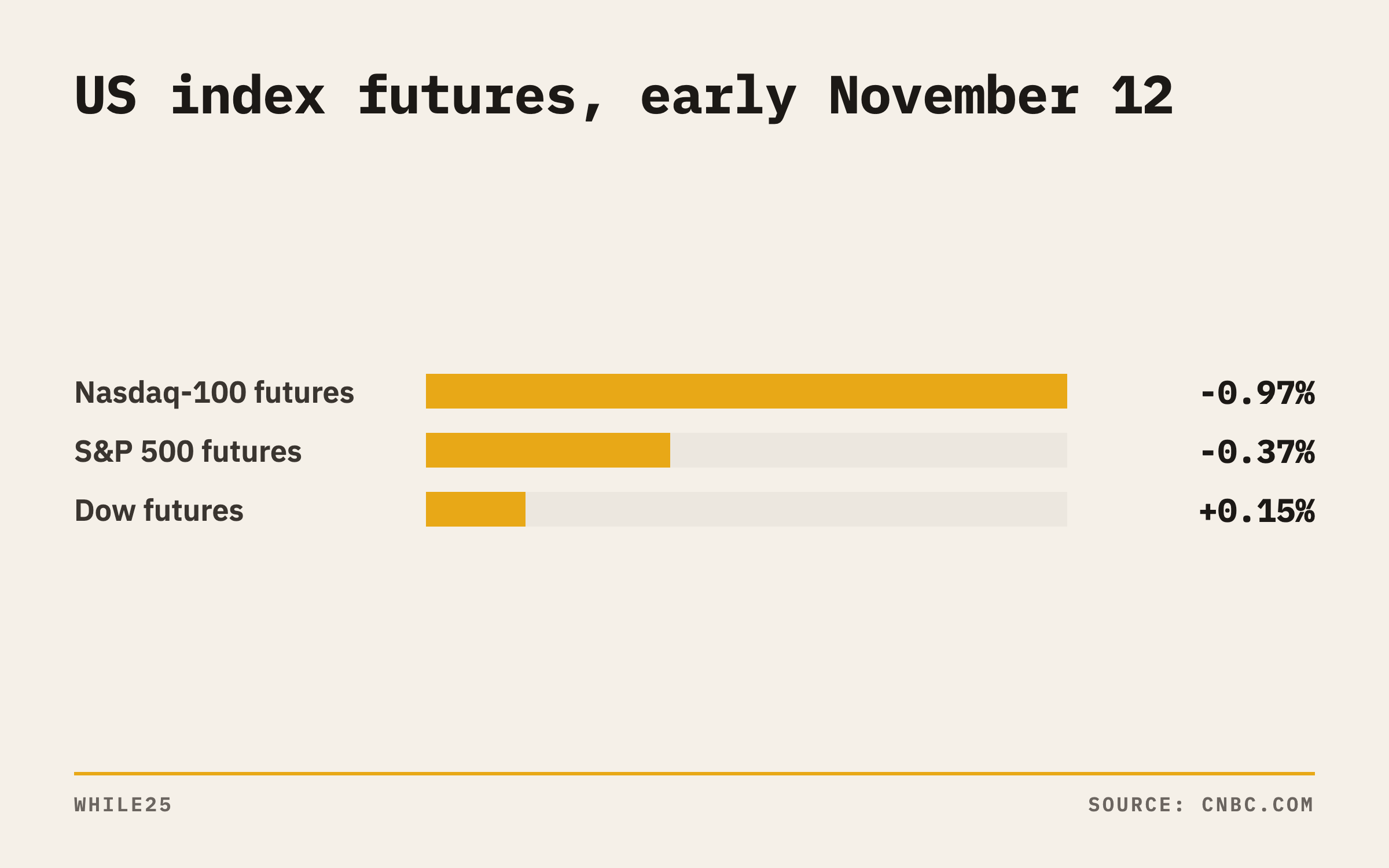 Nasdaq-100 futures fell 0.97% and S&P 500 futures fell 0.37% early on November 12, while Dow futures rose 0.15%
The split comes from the way each index weighs its members. The Nasdaq-100 and the S&P 500 weigh companies by market value. Market value is the total worth of a company's shares. Nvidia ranks among the largest companies in both. Traders who marked Nvidia down marked those futures down with it. The Dow weighs companies by share price. That method gives Nvidia less influence.
More traders buy and sell futures than trade single stocks after hours. Large funds use futures to hedge at any hour. To hedge means to protect a set of investments against losses. A futures price rests on heavier trading than Nvidia's own after-hours price. It tracks a whole index. It says more about the wider market than about one company.
A new price at the open
At the start of the main session, Nasdaq runs an opening auction called the Opening Cross. The exchange gathers the buy and sell orders that traders placed before the open. It finds the single price at which the largest number of shares can trade. After that, the full crowd of the main session joins in. That crowd includes index funds, pension managers and market makers.
The opening price can land above or below the overnight prices. Smaller groups set those overnight prices, reacting within hours to one news report. Between the close and the open, traders can learn more. More traders take part at the open. Those traders set the first price of the main session.
Nvidia's next scheduled event is its quarterly results report on November 17.
Reading overnight prices
Suppose you own Nvidia, or a fund that holds it. A small slice of the market set the price you saw on the evening of November 11. That price showed the first reaction to a report. A larger crowd sets the price at which big blocks of shares can trade. That crowd gathers at the open.
The size of the drop depended on where traders bought and sold. In New York after hours, the fall was 8.6%, or more than 9% at one point. In Frankfurt, the shares were down 7.1%, priced in euros. Nasdaq-100 futures fell 0.97% for the whole index. Each number came from a different group of traders at a different hour.
Session rules affect your own orders. A stock can open below its price at the previous close. Picture a stop order set between those two prices. The sale can go through at the lower opening price, below the level the trader chose. A limit order caps the price, but the trade may not happen at all. Before you trade, check which session your order will enter and which rules apply there. Those two facts tell you what kind of price you are likely to get.
Sources
Not investment advice.