
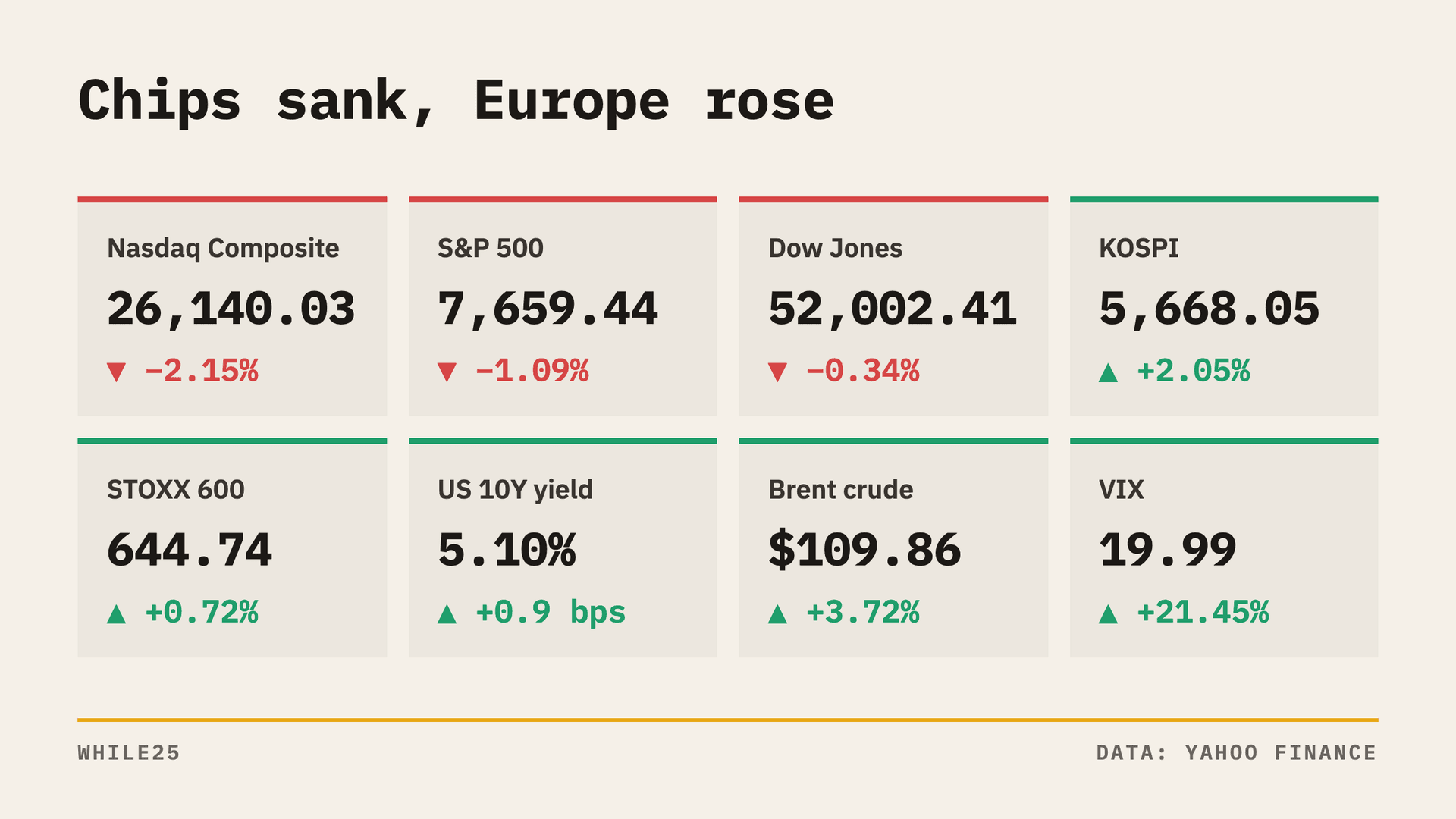
The Nasdaq Composite, a tech-heavy index of US stocks, fell 4.48% in the week ended October 16. Europe's STOXX 600, an index of 600 large European companies, rose 2.09%. Investors sold AI and memory-chip stocks for five sessions, or trading days. They moved money into European shares. South Korea's main stock index, the KOSPI, fell hardest. It lost 14.46% for the week. That was its steepest weekly drop since October 2008.
Investors reacted to three pieces of news within two days. On October 13, a Chinese chipmaker announced plans for a new memory chip. On October 14, investors grew worried about an AI company's debt. The same day, a US report showed prices rising faster than economists had forecast.
China's CXMT rattled memory chipmakers
On October 13, Chinese chipmaker CXMT said it plans to launch a 4F² DRAM chip before the end of 2026. DRAM is the memory chip that holds data while a computer or server runs. 4F² is the name of the chip's design. Investors weighed the risk of a new low-cost rival for Samsung, SK Hynix and Micron. Samsung fell 7.4% that day, and SK Hynix fell 10%.
Investors sold Japanese stocks the same day. The Nikkei 225, Japan's main stock index, fell 2.03% on October 13. Sumco led the decline with a 9.17% loss. The company makes silicon wafers, the thin discs that chips are built on. Softbank fell 8.13%. The Nikkei ended the week down 5.38%.
Korea's worst week since 2008
Investors in Seoul kept selling for days. On October 15, the KOSPI fell 7.57% to 5,554.22. That was the index's seventh losing session in a row. Samsung Electronics closed down 9.48%, and SK Hynix closed down 11.06%.
Foreign investors were net sellers of 3.63 trillion won of Korean stocks that day, about $2.7 billion. Net means they sold that much more than they bought. Their selling streak stretched to eight sessions in a row.
The KOSPI bounced 2.05% on October 16 to close at 5,668.05. Even after that gain, the index ended the week down 14.46%.
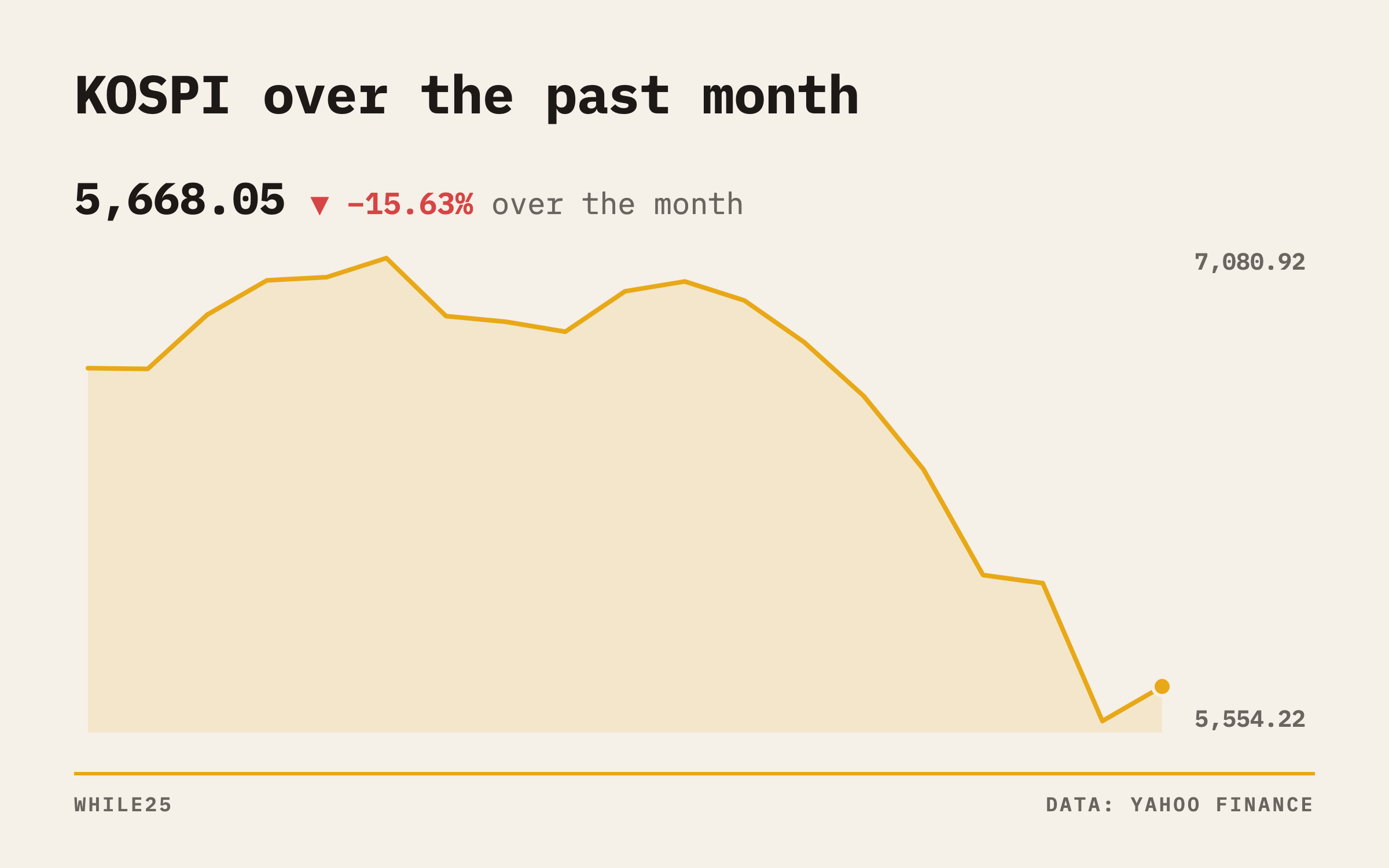 The KOSPI's daily closes over the past month, showing the steep drop in the week to October 16
Investors worried about AI debt
In the US, investors added a second worry to the chip scare: debt. CoreWeave is a company backed by Nvidia. Its shares fell more than 15% on October 14 as investors worried about its debt. They rose 6% on October 15, then dropped 12% on October 16.
Chip funds followed the same path. An ETF is a fund that trades like a stock. The iShares Semiconductor ETF holds US chip stocks. It fell 8% for the week through October 15. It lost another 4% on October 16.
Investors sold big tech shares on the last day too. Meta fell close to 4% on October 16. Apple rose about 0.5%. It was the only member of the Magnificent Seven to finish higher. That group is the seven biggest US tech companies.
The Nasdaq fell 2.15% on October 16. Its weekly loss ended a four-week winning streak. The S&P 500, an index of 500 large US companies, lost 1.95% for the week. The Russell 2000, an index of smaller companies, lost 3.05%. The Dow Jones Industrial Average, an index of large US companies, rose 0.67%. That was its second weekly gain in a row.
Traders paid more for protection against stock swings. The VIX measures how much they pay for that protection. It rose 34.70% for the week to 19.99.
A hot inflation report, then calmer bonds
The third piece of news concerned prices. On October 14, the US released its consumer price index (CPI). The CPI tracks the prices people pay. Prices were 3.7% higher than a year earlier. Economists had forecast 3.6%.
On October 15, the US released its producer price index (PPI). The PPI tracks the prices businesses charge. That index rose 1.3% in a single month.
After those reports, traders bet more on a Fed rate hike. The Fed is the US central bank, and a hike means it raises interest rates. In September, the Fed raised its target range for short-term rates to 3.75% to 4.00%. CME FedWatch is a tool that reads the odds of Fed moves from futures prices. Futures are contracts that traders use to bet on where rates will go. A week before the CPI report, FedWatch showed a 17.7% chance of another hike in October. After the report, the odds climbed toward 44% at one point.
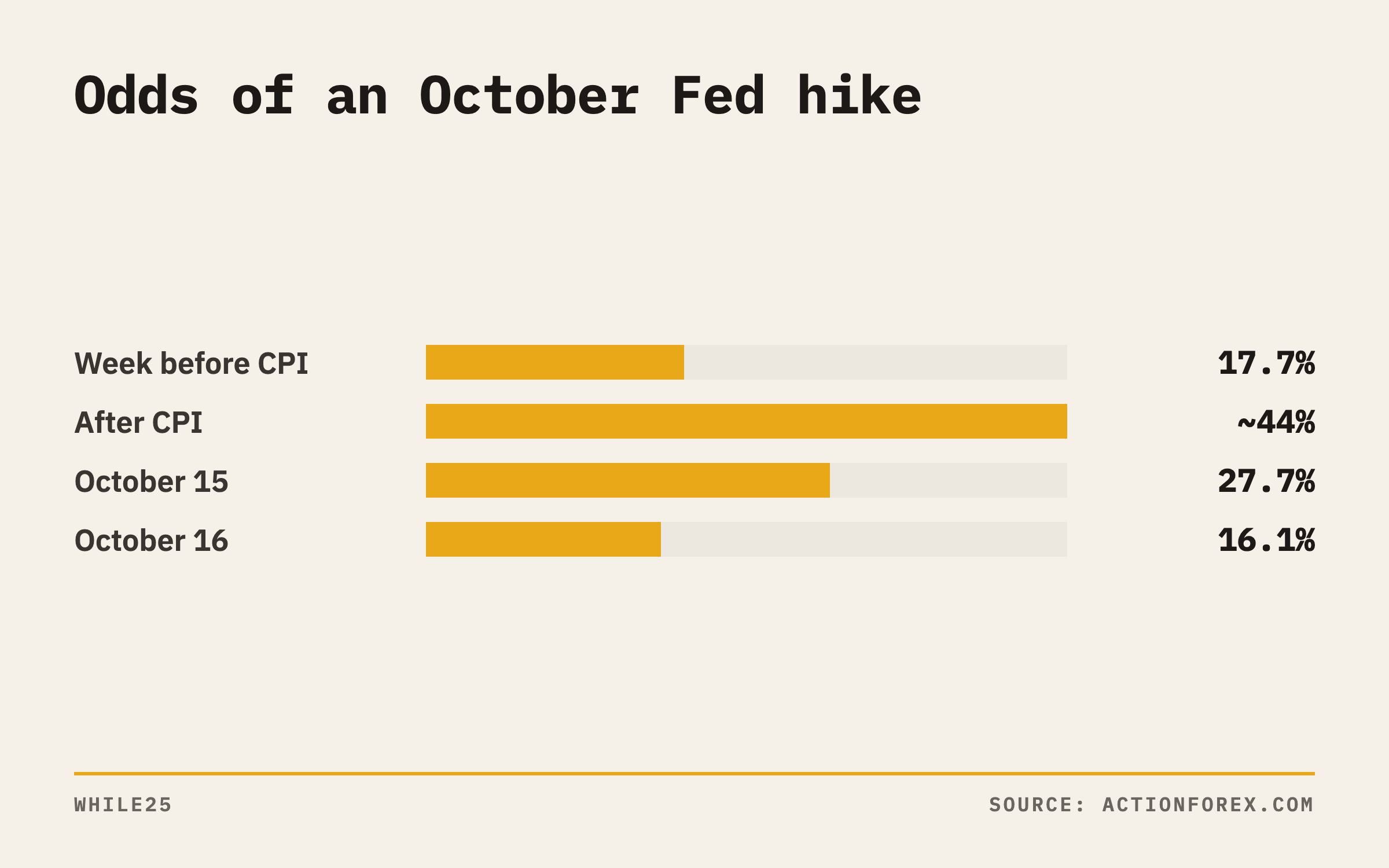 CME FedWatch odds of an October Fed rate hike, from a week before the CPI report through October 16
The 10-year Treasury yield jumped to 5.33% after the CPI report. That yield is the interest rate the US government pays to borrow for 10 years. With higher yields, investors earn more from bonds. That can make stocks look expensive by comparison.
Fed Chair Kevin Warsh spoke on October 16 at the IMF-World Bank meetings in Bangkok. He declined to say in advance how the Fed would decide on October 27-28. Traders put the hike odds at 27.7% on October 15. They cut them to 16.1% on October 16.
Investors also bought safer assets. The 10-year yield then fell back. It ended the week at 5.098%, down 14.6 basis points over five sessions. One hundred basis points make one percentage point.
The dollar made a similar round trip. The US Dollar Index measures the dollar against six major currencies. It jumped to about 102.945 after the CPI report. It ended the week down 0.36% at 101.84. One dollar bought 157.987 yen, Japan's currency.
Investors moved money into Europe
Some of the money investors pulled from AI stocks went to Europe. The STOXX 600 had its best five days since the week beginning August 3. Bloomberg reported that European shares were heading for their biggest weekly lead over the S&P 500 since March. Bloomberg tied that lead to investors moving out of AI-related stocks.
The main national indexes rose too. Britain's FTSE 100 gained 3.13% for the week. Germany's DAX gained 2.13%, and France's CAC 40 gained 1.97%. European chip stocks recovered on October 16. Shares of ASML, ASM, Soitec and Infineon each rose more than 1%.
Other Asian markets were mixed. Shanghai stocks fell 2.56% for the week. Hong Kong's Hang Seng index was close to flat at -0.10%. India's Nifty 50 index rose 2.78%.
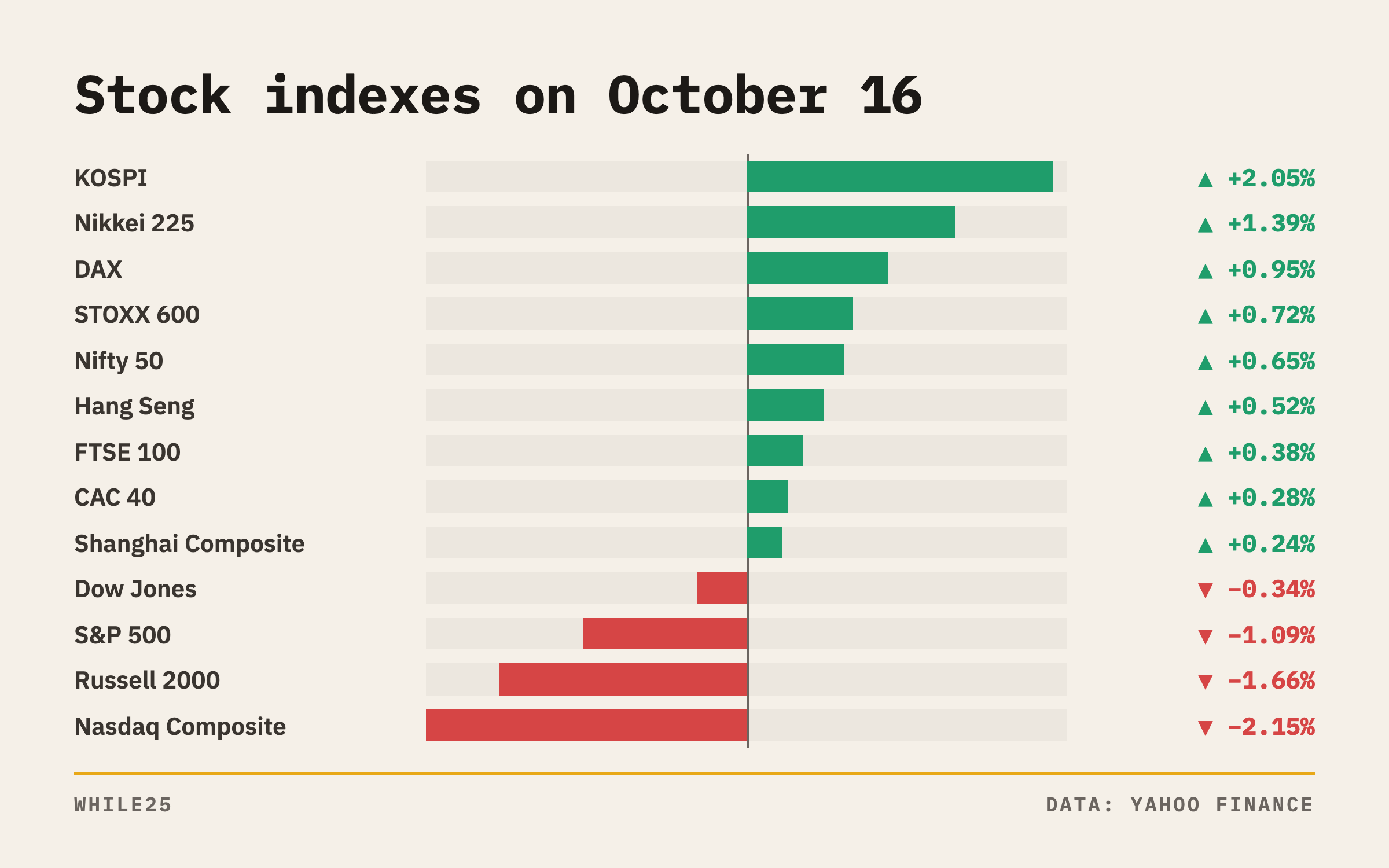 Day moves of major stock indexes in the US, Europe and Asia on October 16
Oil rose as Iran escalated attacks
Oil prices went the other way. Brent crude is the global benchmark price for oil. It rose 3.72% on October 16 to $109.86 a barrel. CNBC reported that Brent touched $110 as Iran escalated attacks in the Strait of Hormuz. WTI, the main US oil price, gained 3.51% to $101.41.
During the week, traders switched to a new futures contract for oil. Traders call this switch a roll. Because of the roll, neither oil price has a clean weekly change.
Less oil is passing through the strait. Data from the firm Kpler showed flows of 11.62 million barrels a day in the week to October 13. The usual level, or baseline, is 17.15 million. On October 15, members of the International Energy Agency agreed to speed up the release of about 100 million barrels from emergency stocks. Those stocks are oil supplies that governments keep for crises. AAA said US diesel averaged $6.33 a gallon on October 16.
Gold fell 0.83% for the week to $4,181.10 an ounce. Bitcoin fell 0.85% over five days to $81,068.94.
Coming up next week
- October 19, 10:00 Beijing time (10:00 p.m. ET on October 18): China releases third-quarter GDP, the total value of what its economy produced. It also releases September retail sales and industrial output. The median, or middle, forecast in a Reuters poll of economists was 4.4% growth from a year earlier.
- October 20: The US releases September housing starts and building permits at 8:30 a.m. ET. These show how many homes builders started and how many won approval. Netflix reports earnings, its quarterly results, after the close of trading.
- October 21: Tesla, Meta, IBM, SAP, Texas Instruments and Lam Research report earnings after the close. The US Treasury sells $13 billion of 20-year notes at 1:00 p.m. ET. Notes are bonds the government sells to borrow money.
- October 22: The US releases weekly jobless claims at 8:30 a.m. ET. Claims count people who filed for unemployment benefits.
- October 23: S&P Global releases early October surveys of businesses at 9:45 a.m. ET. These are called flash PMIs. The University of Michigan releases its final October consumer survey at 10:00 a.m. ET.
- October 27-28: The Federal Reserve decides on rates. Its target range stands at 3.75% to 4.00%.
The takeaway for your portfolio
This week, one theme linked markets on three continents. Investors reacted to a chip plan in China and a debt scare in the US. They sold stocks in Seoul, Tokyo and New York within days. Broad European indexes gained over the same five sessions. A portfolio's week depended in large part on how much it held in AI and memory-chip stocks. The next scheduled events tied to that theme are the chip and tech earnings on October 21 and the Fed meeting on October 27-28.
Sources
- finance.yahoo.com
- startupfortune.com
- tokenpost.com
- actionforex.com
- uk.finance.yahoo.com
- bloomberg.com
- grafa.com
- bloomberg.com
- cnbc.com
- investrade.com
- 1027wbow.com
- tradingeconomics.com
Not investment advice.