
South Korea's main stock index is the KOSPI. An index combines the share prices of many companies into one number. A share is a small slice of ownership in a company. The KOSPI fell 14.5% in the week to October 16. That was its steepest weekly drop since October 2008, the month the global financial crisis reached Seoul.
The worst day was Thursday, October 15. The KOSPI fell 7.57% and closed at 5,554.22. The close is the index level at the end of the trading day. That made seven losing sessions in a row. A session is one day of trading. On the same day, foreign investors sold a net 3.63 trillion won of Korean stocks. The won is Korea's currency, and that sum is about $2.7 billion. "Net" means their sales minus their purchases. Foreign investors had sold more than they bought for eight straight sessions.
Compare that week with 2008. The two falls are similar in size. Their causes differ, and comparing those causes shows how the Korean market works.
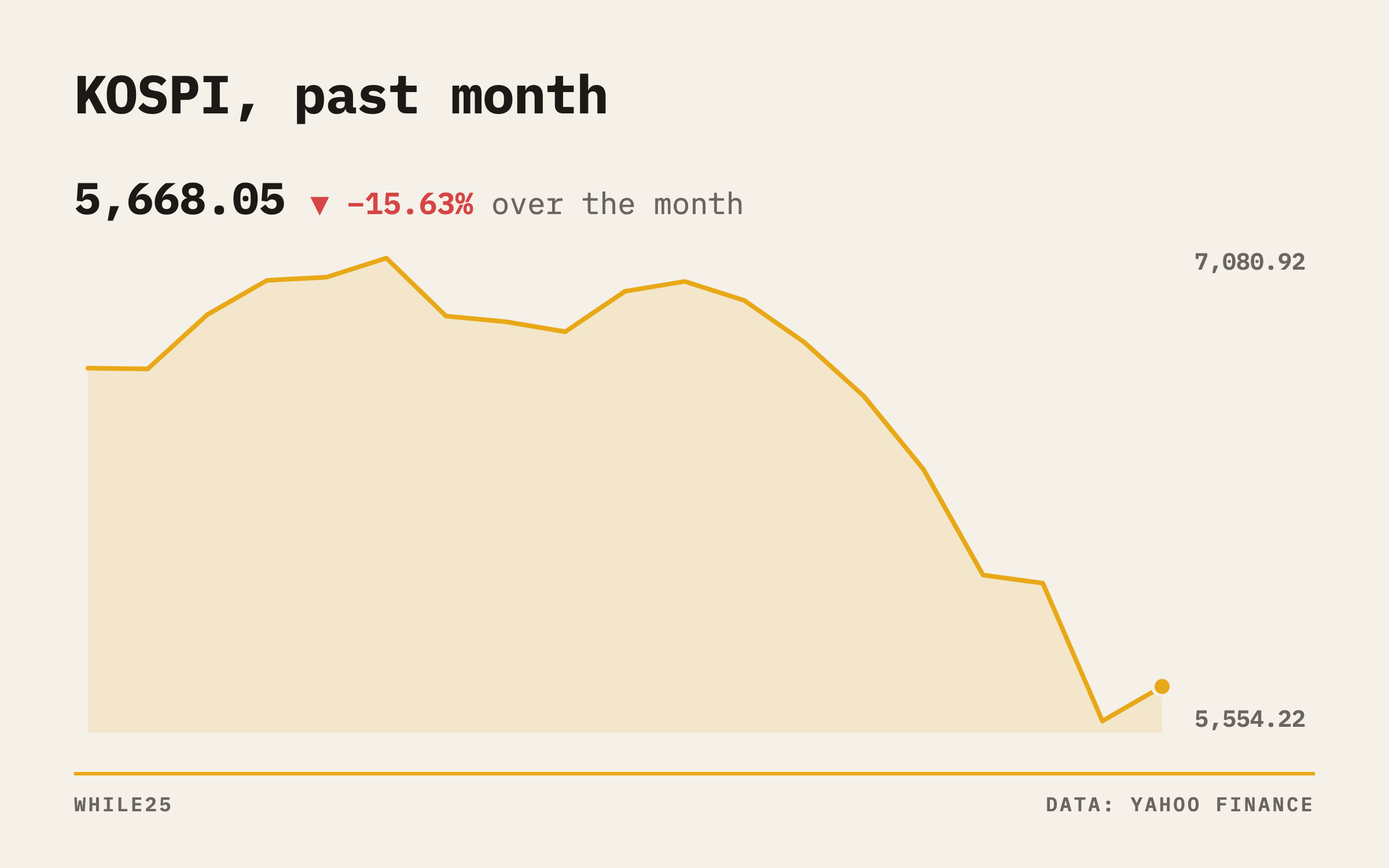 Line chart of the KOSPI over the past month, showing a steep slide in the week to October 16
October 2008: a banking system in trouble
In the autumn of 2008, a crisis spread from American banks around the world. Lehman Brothers, a large US investment bank, had collapsed weeks before that October. An investment bank raises money for companies and trades financial assets. Banks around the world stopped trusting each other. They cut lending, and companies had trouble borrowing.
The crisis hit Korea with force. Korea's economy runs on exports, the goods it sells abroad. Its banks and companies depended on borrowed dollars. Lenders pulled back, so Korean borrowers struggled to renew those dollar loans. The won lost value at speed. Investors sold shares in Korean banks, exporters and builders. Investors feared for the financial system itself, so the selling reached companies across the economy.
On October 24, 2008, the KOSPI fell 110.96 points, or 10.57%, to close at 938.75. A point is one unit of the index's level. That was its first close below 1,000 since June 2005. In one session, the index fell back through a level it had held since then.
That fall showed investors' fear for the whole economy. Banks that stop lending force factories to cut output. Shops lose customers, and workers lose jobs. Investors sold because the future profits of most Korean companies looked at risk.
October 2026: two chipmakers
Investors began this week's selling after a rival's product announcement. On October 13, the Chinese memory-chip maker CXMT made that announcement. CXMT said it plans to launch a new type of DRAM chip before the end of 2026. DRAM is the memory that holds data while a computer or server is running. Samsung Electronics and SK Hynix are among the world's biggest DRAM makers. Samsung's shares fell 7.4% that day, and SK Hynix fell 10%.
A capable new rival can push prices down. Buyers gain bargaining power once more companies can make advanced memory. The profits of today's leaders can shrink as a result. Investors dumped shares in the two Korean leaders.
On October 15, two days after the announcement, investors sold more. Samsung closed down 9.48% at 210,000 won. SK Hynix fell 11.06% to 1,262,000 won. The KOSPI fell 7.57% that day.
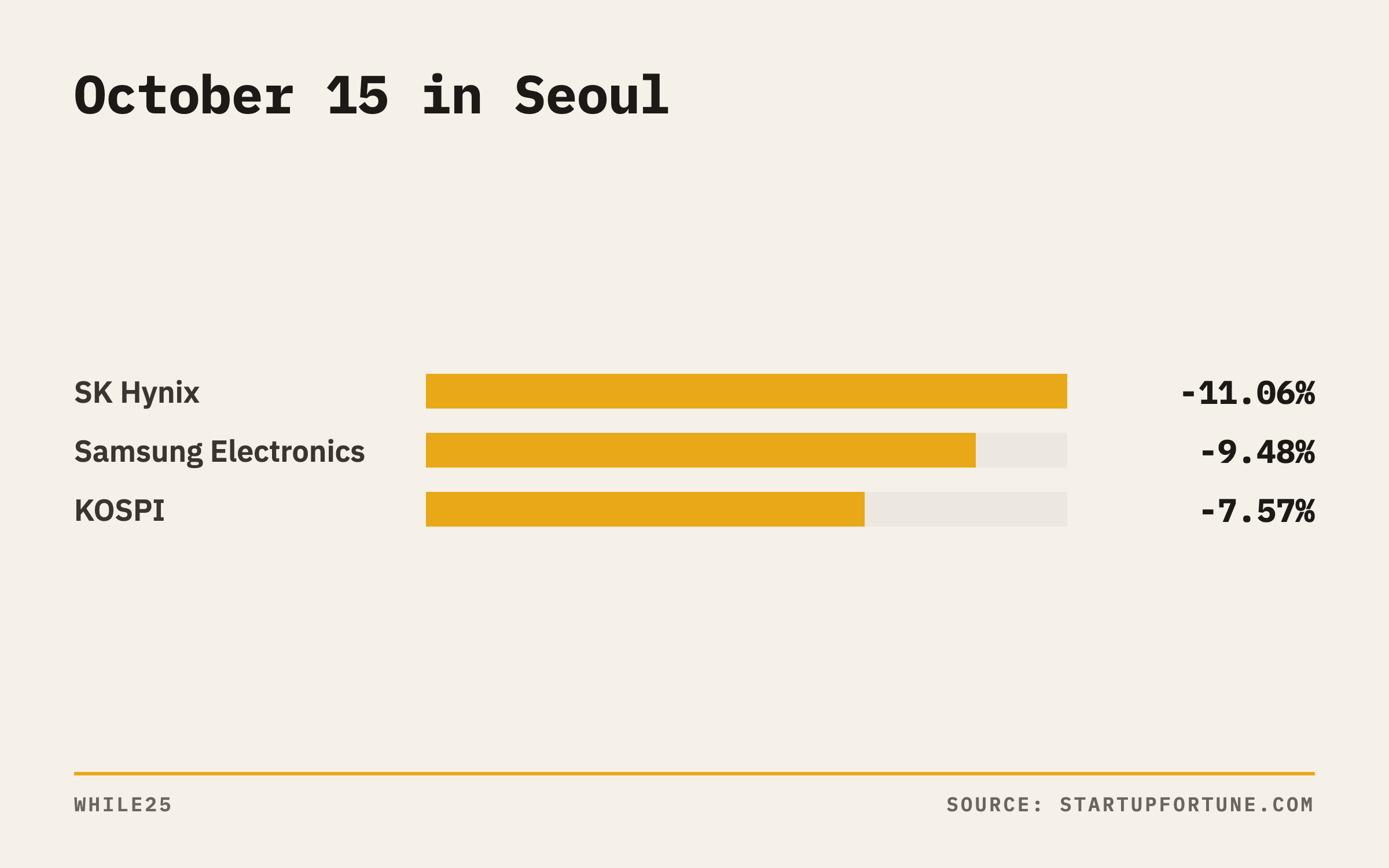 Bar chart of October 15 losses: SK Hynix down 11.06%, Samsung Electronics down 9.48%, KOSPI down 7.57%
Outside Korea, investors focused their selling on memory chips. Hong Kong's Hang Seng index ended the same five sessions down 0.10%. China's Shanghai Composite index fell 2.56%. Japan's Nikkei 225 fell 5.38%. That index includes several chip-related companies. In New York, the Roundhill Memory ETF fell another 5.5% on Friday. An ETF is a fund that trades on an exchange like a single stock. This one holds memory-chip stocks. Investors sold the chip industry across borders.
Two stocks can sink a whole index
The KOSPI gives each company a weight, or share of the index, based on its market value. Market value is the price of one share times the number of shares. Bigger companies count for more. By that measure, Samsung Electronics and SK Hynix are the two largest companies on the exchange. A sharp fall in both drags the index down. Many smaller companies can hold steady on the same day.
Under this design, news from one industry can move the index by a crisis-sized amount. On October 15 the index lost 7.57%. On a chart, that fall looks like 2008. The two companies that led the fall share one business: memory chips.
In March 2026, the KOSPI fell 12.06% in one day. That is the largest one-day drop on record. It beat the 10.57% fall of October 24, 2008. The index's worst day came in 2026.
Index points can mislead across years. On Friday, October 16, the KOSPI rose 2.05%, a gain of 113.83 points. On October 24, 2008, a fall of 110.96 points was 10.57% of the index. Today the index sits at a higher level. A similar move in points is a smaller move in percent. Use percentages to compare across years.
Two Octobers, two kinds of damage
The two Octobers differ in where the damage sits. In 2008 the trouble sat in the banks, which lend to businesses across an economy. This week the trouble sat in the expected profits of memory-chip makers. A weaker outlook for chip prices hurts those companies, their suppliers and their shareholders. Shareholders are the people who own a company's shares. On its own, a chip slump leaves banks free to lend.
Some patterns repeat. Foreign investors sold large amounts, and their net selling ran for eight straight sessions to October 15. Foreign investors who pull large sums out can push a market down faster than local news would.
The speed of the fall repeats. A market can fall like a crisis market if its biggest companies share one risk. The wider economy can look the same from one week to the next, while the index ends 14.5% lower.
Dates to watch
China publishes its third-quarter growth figures at 0200 GMT on October 19. It releases September activity data at the same time. Growth figures show how much the economy expanded. China is a large buyer of Korean chips.
On October 21, after the US market closes, Lam Research and Texas Instruments report quarterly results. Quarterly results are a company's sales and profits for the past three months. Lam Research sells the machines chipmakers use to build chips. Its results show how much chipmakers are spending.
The US Federal Reserve meets on October 27-28. The Fed is the US central bank, and it sets US short-term interest rates. Through rates, Fed officials move the dollar and shift how much money foreign investors send to markets like Korea.
Your Korea fund and memory chips
Many investors own Korean stocks through a fund. It might be a Korea fund, an Asia fund or an emerging-markets fund. An emerging-markets fund buys stocks in developing economies. Those funds often track indexes weighted by market value. To track an index means to hold its companies in the same proportions. A Korea fund can then hold a large slice in Samsung Electronics and SK Hynix. Owning "Korea" through such a fund is, in large part, a bet on memory chips.
A fund's country label tells you where its companies are listed. Listed means their shares trade on that country's stock exchange. Its top holdings, the companies it owns most of, tell you what moves its price. This week, investors started selling after a Chinese rival's chip plan. Korea's index went on to have its worst week since the 2008 banking crisis.
Sources
- tokenpost.com
- startupfortune.com
- koreatimes.co.kr
- khan.co.kr
- finance.yahoo.com
- investrade.com
- 1027wbow.com
- actionforex.com
Not investment advice.