
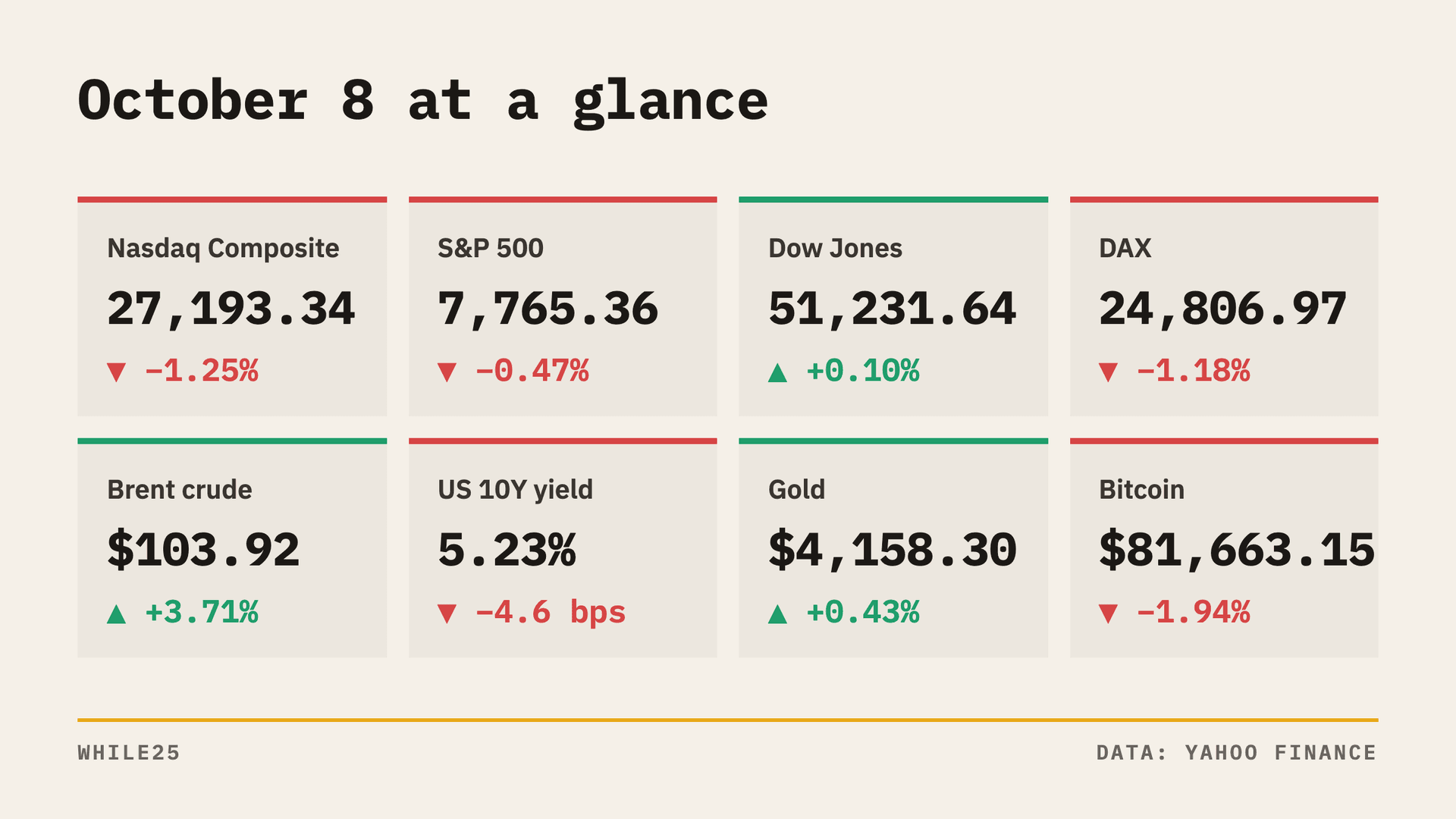
Traders sold shares of chipmakers and AI companies on October 8. They sold after the Financial Times (FT) reported that OpenAI's revenue was lower than earlier estimates. The Nasdaq Composite, an index heavy in tech stocks, fell 1.25% to 27,193.34. An index tracks a group of stocks as one number.
Oil prices went the other way. Brent crude is the oil price most of the world uses as its benchmark. It rose 3.71% to $103.92 after President Trump posted about Iran.
Other US stock indexes split. The S&P 500 tracks 500 large US companies. It fell 0.47% to 7,765.36, its second loss in a row since it set a record high. The Dow Jones Industrial Average, another index of large US companies, rose 0.10% to 51,231.64. The Russell 2000, an index of smaller US companies, rose 0.03%.
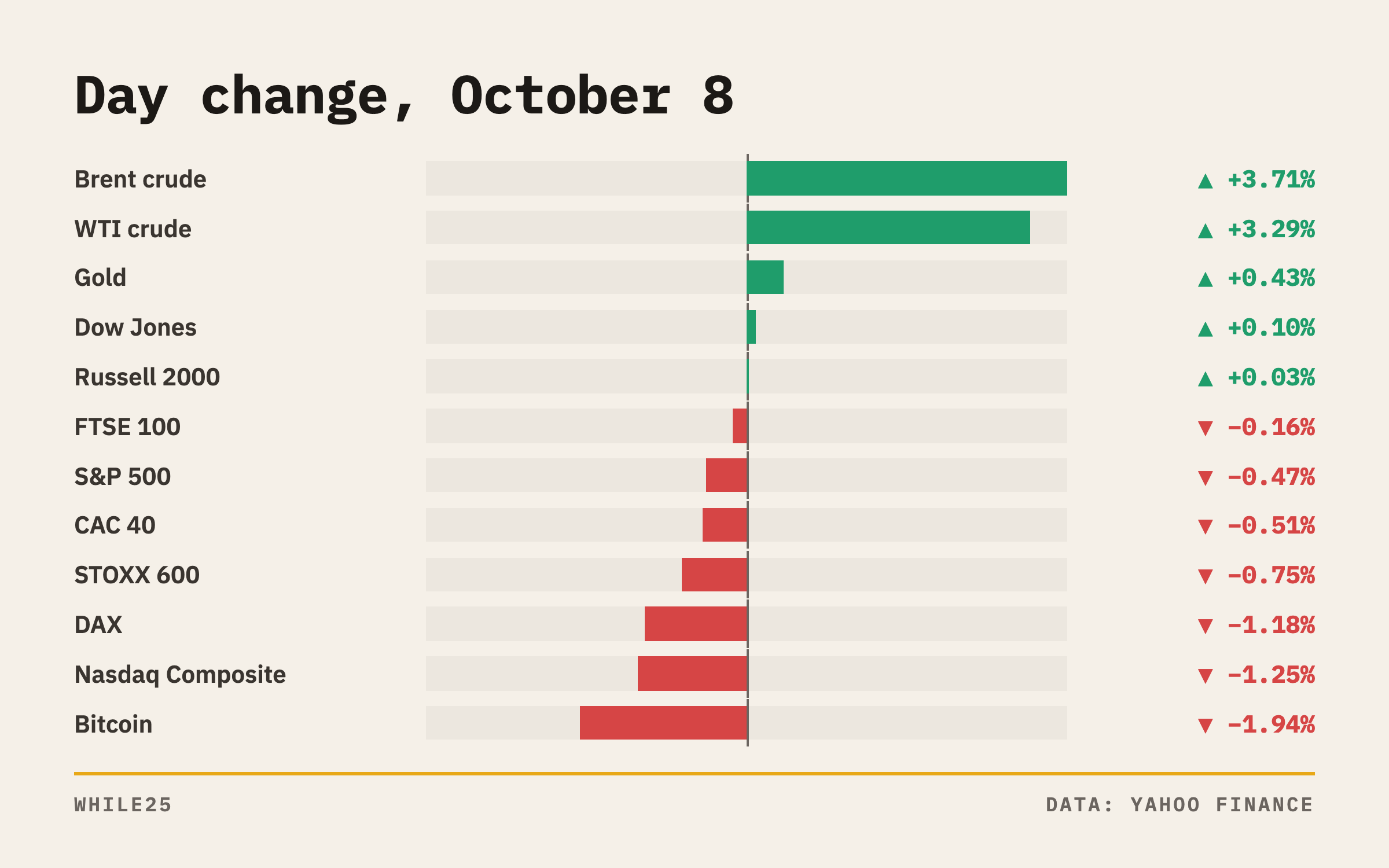 Day changes on October 8 for US and European stock indexes, oil, gold and bitcoin
A smaller number for OpenAI
The FT reported that OpenAI "recently told investors that its annualized revenue was nearing $50 billion." Annualized revenue takes sales from a recent stretch and scales them up to a full year. Media outlets had reported a figure of $70 billion. A source said the $70 billion figure did not come from OpenAI.
The FT explained the gap. Investors who cited $70 billion started from an estimate that OpenAI's August sales reached $40 billion. They applied a 70% growth figure that OpenAI had given them. The FT said OpenAI's own figure "topped out at roughly $50 billion as of September."
The two leading AI labs count revenue in different ways. OpenAI reports net revenue, the part it keeps after partners take their share. Anthropic includes gross revenue from cloud providers, the companies that rent out computing power. Gross revenue is the full amount customers pay through those partners.
Bloomberg and Reuters reported in August that Anthropic was on track for more than $65 billion in annualized revenue. CNN reported that the $70 billion figure may have come from a comparison with Anthropic.
Investors watch OpenAI's sales to judge if AI spending pays for itself. Chipmakers sell the hardware that this spending buys. Their shares fell first.
Chipmakers led the drop
Nvidia fell 2.9%, Intel 5.3% and Oracle 5.5%. Arm and Marvell each fell more than 6%. Micron fell more than 5%. The Philadelphia Semiconductor Index tracks a group of chip stocks listed in the US. It fell as much as 4% during the trading day. The Nasdaq had its worst day since mid-August.
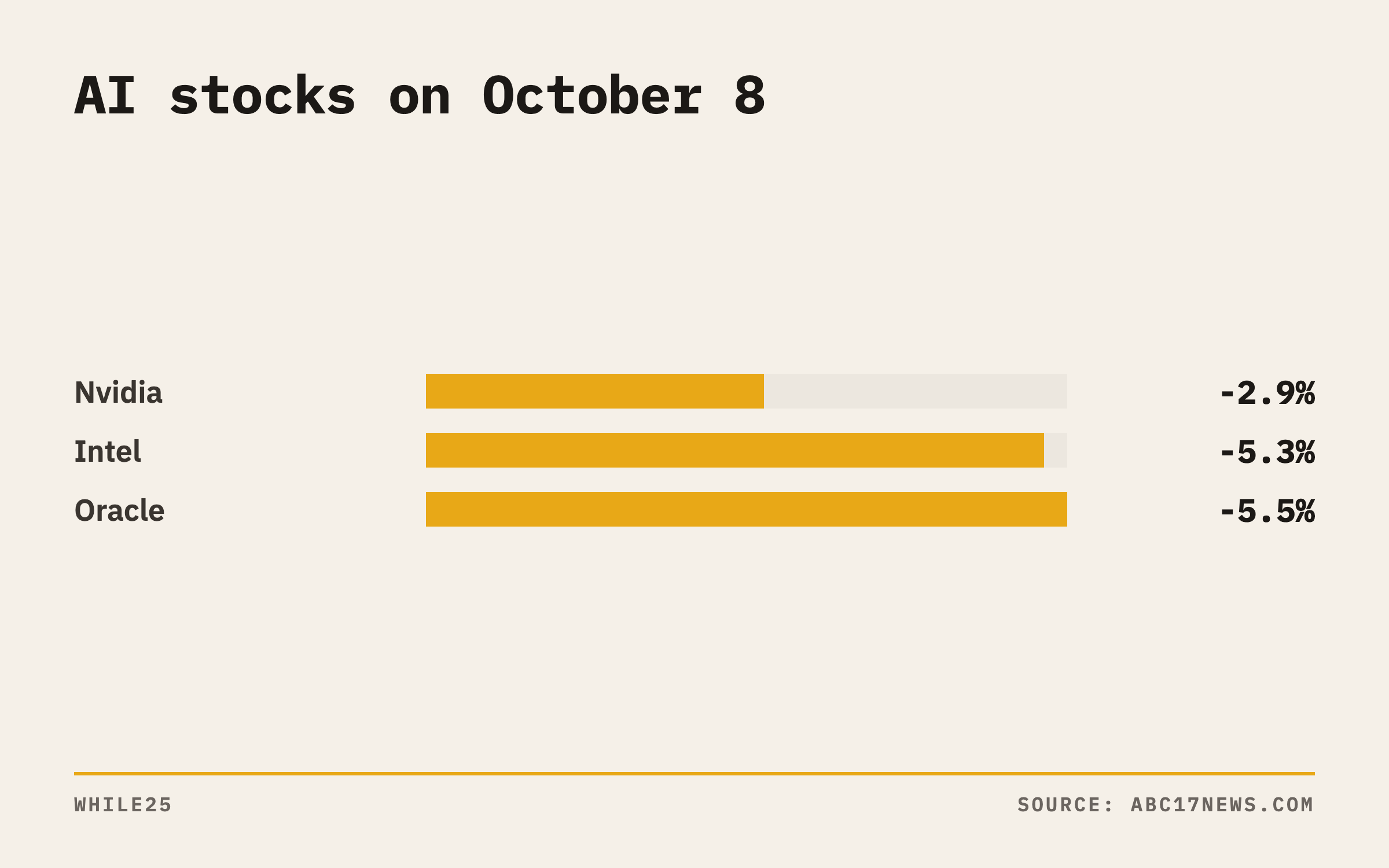 Nvidia fell 2.9%, Intel 5.3% and Oracle 5.5% on October 8
The drop followed a climb. Including October 8, the Nasdaq is up 3.58% over the past month. The VIX measures how much traders expect stocks to swing. It rose 2.19% to 15.41.
The day's US economic news was calmer. Initial jobless claims count new filings for unemployment benefits each week. They fell by 2,000 to 197,000 for the week ended October 3. Continuing claims, the count of people still collecting benefits, rose by 17,000 to 1.71 million.
PepsiCo said its revenue rose 5.6% to $25.27 billion. Earnings per share is a company's profit divided by its number of shares. PepsiCo cut its forecast for growth in core earnings per share, its preferred profit measure. It now expects 2.5% to 3%, down from the low end of 5% to 7%.
Oil rose after Trump's Iran post
Brent touched almost $106 a barrel during the day. It settled at $103.92. WTI, the main US oil price, rose 3.29% to $91.18.
On October 8, Trump wrote that the US would "not be attacking Iran at any time prior to the Midterm Elections" on November 3. He cited "productive discussions with the Islamic Republic of Iran."
Ship traffic through a key sea lane dropped. The Strait of Hormuz is the narrow sea lane that carries oil out of the Persian Gulf. Kpler, a cargo-tracking firm, counted seven ships through it on October 6 and 10 on October 7. That was a two-month low, down from more than 20 on each of October 4 and 5. A White House official said the strait was open.
Fuel prices rose with crude. Futures are contracts to buy or sell something at a set price on a later date. European diesel futures rose 6%. Heating oil rose more than 5%. Diesel powers trucks, ships and farm machines. Its price feeds into the cost of moving goods.
Bond yields rose and fell
A bond is a loan that investors make to a government or company. Its yield is the yearly return investors earn on that loan. Investors can demand higher yields after oil prices rise. Dearer oil raises the risk of inflation, a broad rise in prices.
The 10-year Treasury yield is the interest rate the US government pays to borrow for 10 years. On October 8 it moved both ways. It rose from 5.28% in late trading on October 7 to 5.35% in early trading on October 8. After that, it fell to 5.23%.
The 10-year closed at 5.231%, down 4.6 basis points. One percentage point equals 100 basis points. The 30-year yield fell to 5.60% from 5.73% that morning.
That drop came after the government sold $22 billion of 30-year bonds at an auction, a sale where buyers bid. The highest yield at that auction was below 5.62%.
The one-day dip came during a steep climb. The 10-year yield is up 42.5 basis points over the past month. Higher yields mean higher borrowing costs for companies and homebuyers. They make bonds a stronger rival to stocks.
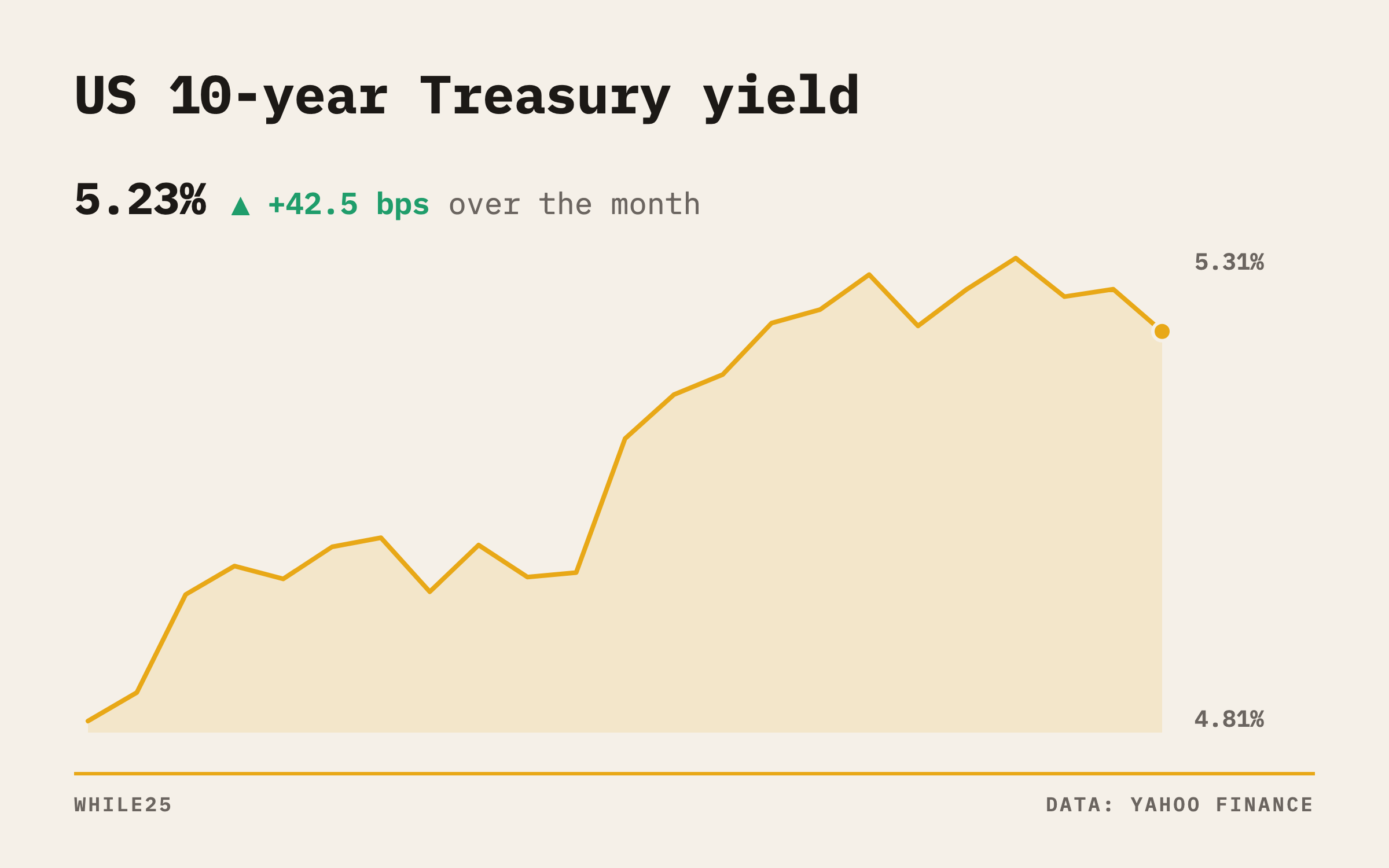 The 10-year Treasury yield over the past month, closing at 5.231% on October 8
Other markets saw smaller moves. The US Dollar Index tracks the dollar against a basket of major currencies. It slipped 0.13% to 102.106. The euro rose 0.14% to $1.1217. Gold rose 0.43% to $4,158.30 an ounce.
Bitcoin fell 1.94% to $81,663. CoinGlass, a crypto data firm, counted $974 million of crypto liquidations over 24 hours. In a liquidation, an exchange closes a trader's bet made with borrowed money after it loses too much.
Stocks fell in Asia and Europe
Asian markets closed before the FT report came out. Traders there sold as bond yields and oil rose. Japan's Nikkei 225 fell 1.42% to 69,042.11. Korea's KOSPI fell 2.62% to 6,625.93. SoftBank Group fell 4.28%.
Samsung Electronics fell 2.42% to 262,000 won. On the same day, Samsung estimated its third-quarter operating profit, the profit from its main business, at about 107.4 trillion won. That was up 782.5%. SK Hynix fell 2.44%. China's Shanghai Composite did not trade. Its last close was on September 30.
European stocks closed lower as oil rose. Germany's DAX fell 1.18%. The STOXX 600, a broad index of European companies, fell 0.75%. France's CAC 40 fell 0.51%, and London's FTSE 100 fell 0.16%.
Gilts are UK government bonds. Britain's 30-year gilt yield touched 6.047%, its highest level in 52 weeks. It eased to 5.997% after that.
Two London companies announced buybacks. In a buyback, a company buys its own shares. Tesco raised its buyback to £950 million. Imperial Brands announced a new £1.5 billion buyback. Those two companies helped hold the FTSE 100 up with their plans.
Dates to watch
- October 9: Delta Air Lines reports third-quarter results.
- October 13: JPMorgan and Goldman Sachs report before the US stock market opens. Wells Fargo reports at 7:00 a.m. and Citigroup at about 8:00 a.m.
- October 14: The government releases the September consumer price index (CPI), the main US inflation gauge, at 8:30 a.m. ET. Bank of America and Morgan Stanley report.
- October 15: The government releases the September producer price index at 8:30 a.m. ET. It tracks the prices businesses receive. Taiwan chipmaker TSMC reports third-quarter results.
- November 3: US midterm elections, the date in Trump's Iran post.
Companies and agencies can change these dates.
Reading the day
Arm and Marvell each lost more than 6% in one day after a report on a private company's revenue. People who hold a broad US index fund own shares in those chipmakers.
Oil rose and bond yields fell on the same day. Those two moves pull on stock prices in opposite directions.
The CPI report on October 14 is the next scheduled reading on inflation. TSMC's results on October 15 are the next one on AI chip demand.
Sources
- abc17news.com
- finance.yahoo.com
- finance.yahoo.com
- nbcnews.com
- sg.finance.yahoo.com
- wsls.com
- tradingkey.com
- finance.yahoo.com
- daytradingtoolkit.com
Not investment advice.