
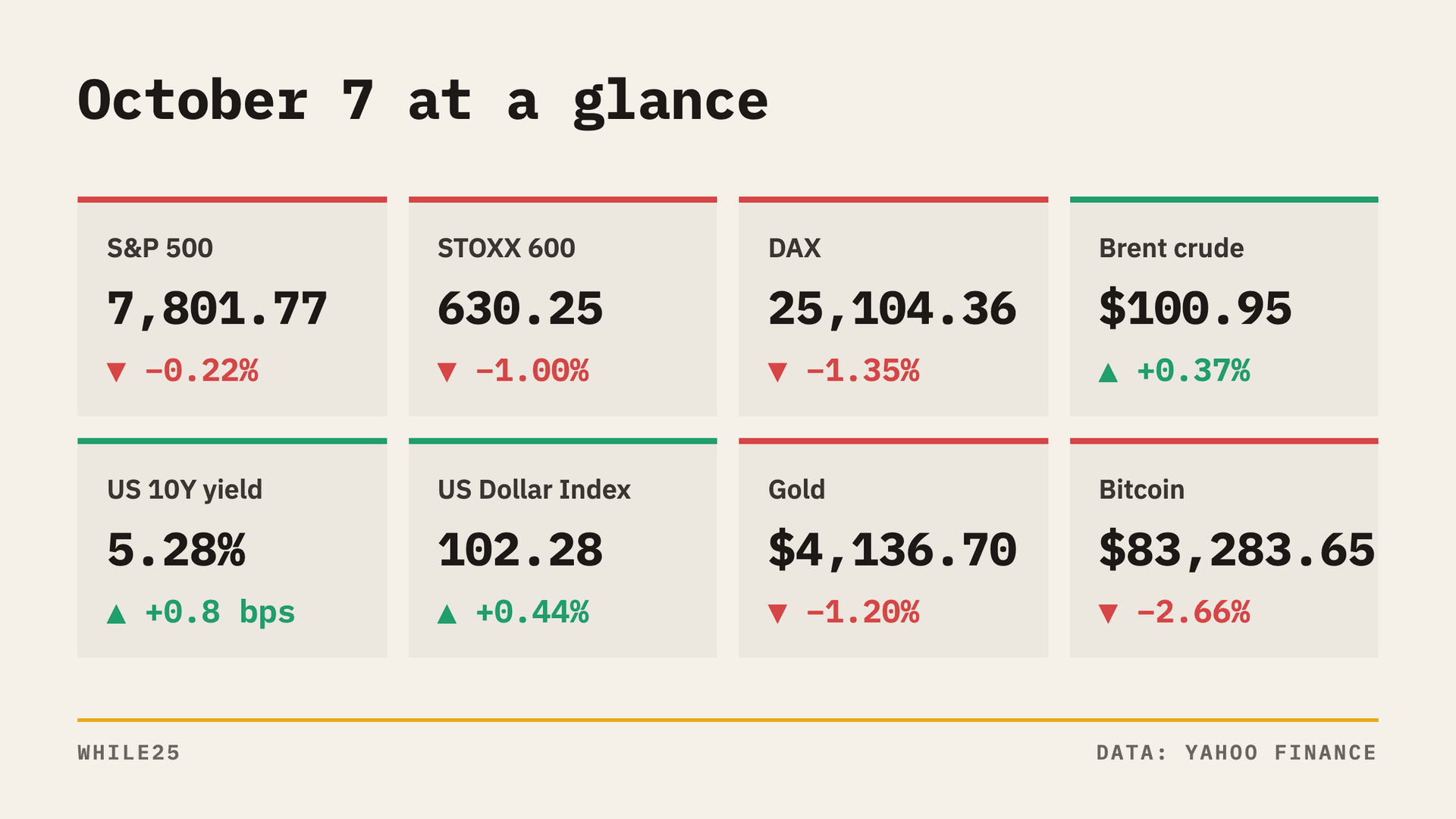
Brent crude is the global oil benchmark, the reference price for most of the world's crude oil. It closed at $100.95 a barrel on October 7. Treasuries are bonds, the IOUs the US government sells to borrow money. The 30-year Treasury yield is the interest rate the government pays to borrow for 30 years. On October 7 it reached 5.72%, its highest level since 2002.
The S&P 500 is a stock index, a single number that tracks the share prices of large US companies. It set a record close on October 6, ending the day at its highest level on record. On October 7 it fell 0.22% to 7,801.77. European stocks fell harder. The STOXX 600, an index of large companies across Europe, fell 1.00%.
Investors had three reasons to worry. Oil stayed expensive amid attacks on ships near the Strait of Hormuz. A tropical storm threatened oil platforms in the Gulf of Mexico. The Federal Reserve, the US central bank, released minutes from its September meeting. Minutes are the written record of what officials discussed. In the minutes, officials pointed to another interest rate rise by year end.
Investors saw each one as an inflation risk. Inflation means a broad rise in prices. Lenders who fear inflation charge more interest, which pushes borrowing costs up.
Oil stays above $100
Brent returned above $101 a barrel on October 7. It touched $102.59 during the day before easing. It closed at $100.95, up 0.37%. US crude oil, known as WTI, slipped 0.56% to $88.94.
The Strait of Hormuz is the narrow sea lane out of the Persian Gulf. Tankers use it to carry Gulf oil to the rest of the world. UK officials have counted at least nine attacks on ships there since the start of October. The attacks come amid a continued conflict between the US and Iran.
A storm in US waters added a second worry. Tropical Storm Isaias had top sustained winds of 40 miles per hour on October 7. Producers in the US Gulf of Mexico shut in about 25.08% of current oil output. Shutting in means they stopped pumping for safety. They shut in 16.37% of natural gas output, and crews left eight production platforms. Chevron said it was moving non-essential staff off its Gulf platforms as a precaution. The company said it expected no changes to production.
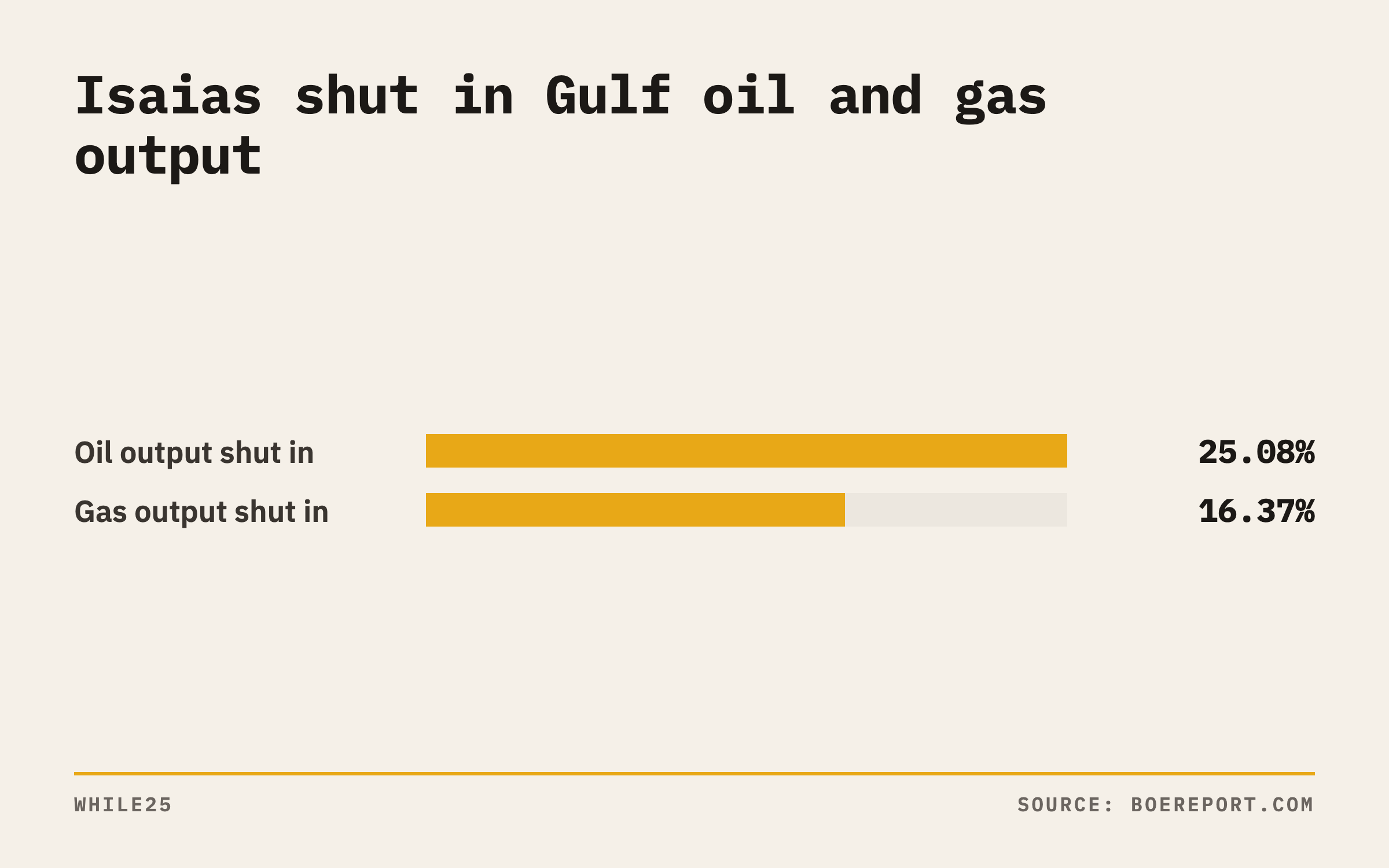 Bar chart showing Gulf of Mexico producers shut in 25.08% of oil output and 16.37% of gas output on October 7
Forecasters expect Isaias to become a hurricane by October 9 and peak as a Category 2 storm. The path they forecast runs east of the major offshore oil and gas fields south of Louisiana and Texas.
Long-term borrowing costs hit a 2002 high
Expensive oil means people pay more for fuel, shipping and goods. Bond investors who fear inflation ask for more interest to lend money for long stretches. The 30-year Treasury yield reached 5.72% on October 7, its highest level since 2002.
The 10-year yield is the rate the government pays to borrow for 10 years. It closed at 5.277%, up 0.8 basis points on the day. One hundred basis points make one percentage point. The bigger move came over the past month, as the 10-year yield climbed 47.1 basis points.
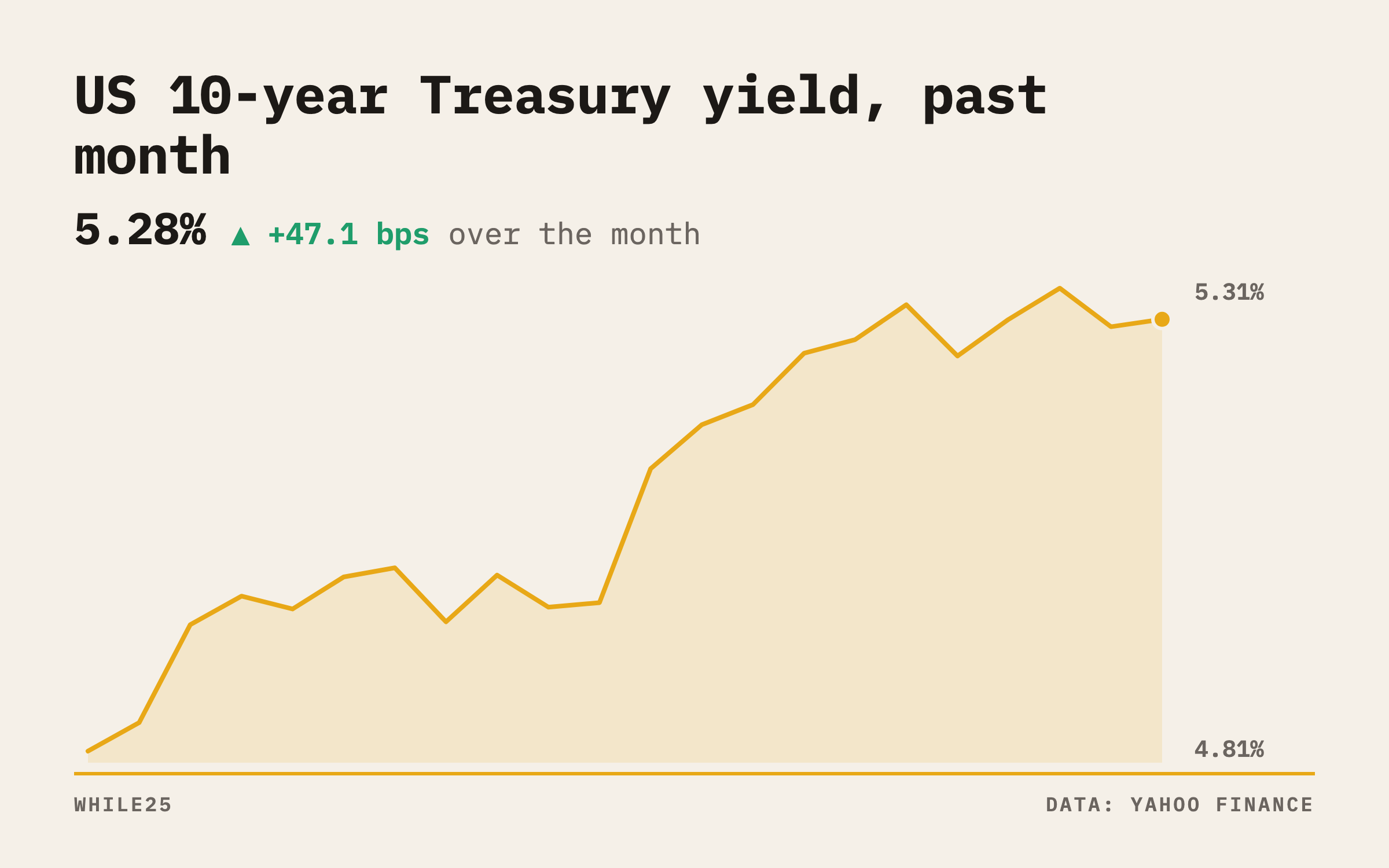 Line chart of the US 10-year Treasury yield over the past month, rising toward its October 7 close
Lenders tend to set rates on mortgages, car loans and company debt in line with these yields. Investors who can earn more from bonds see stocks as pricier by comparison. A buyer can lock in a steady return from the government without the swings of the stock market.
Fed officials point to another rate rise
The Fed released the minutes of its September meeting on October 7. The federal funds rate is the Fed's main short-term interest rate. It forms the base cost of borrowing across the economy. Officials judged that another increase in that rate "would likely be appropriate by year end." According to the minutes, participants "approached each meeting with an open mind."
Traders use contracts called swaps to bet on where rates go. On October 7, swap traders put a 24% chance on a rate rise this month. They priced in a full increase by year end, meaning their bets assumed one rise before the year closes. The Fed's next meetings run October 27 to 28 and December 8 to 9.
Europe had the worst day
European stocks fell the most of any region. The STOXX 600 fell 1.00%. Germany's leading index, the DAX, lost 1.35%. France's CAC 40 index fell 1.22%. Britain's FTSE 100 index fell 0.79%. Reporters cited high oil prices, rising bond yields and concerns about France's government budget.
Shares of Fresenius Medical Care fell nearly 7%, and chipmaker Infineon shed about 5.7%. Deutsche Bank dropped nearly 5%. A few shares rose. Renault climbed nearly 4%, and Pernod Ricard gained 2.75%.
The euro fell 0.50% to $1.1197.
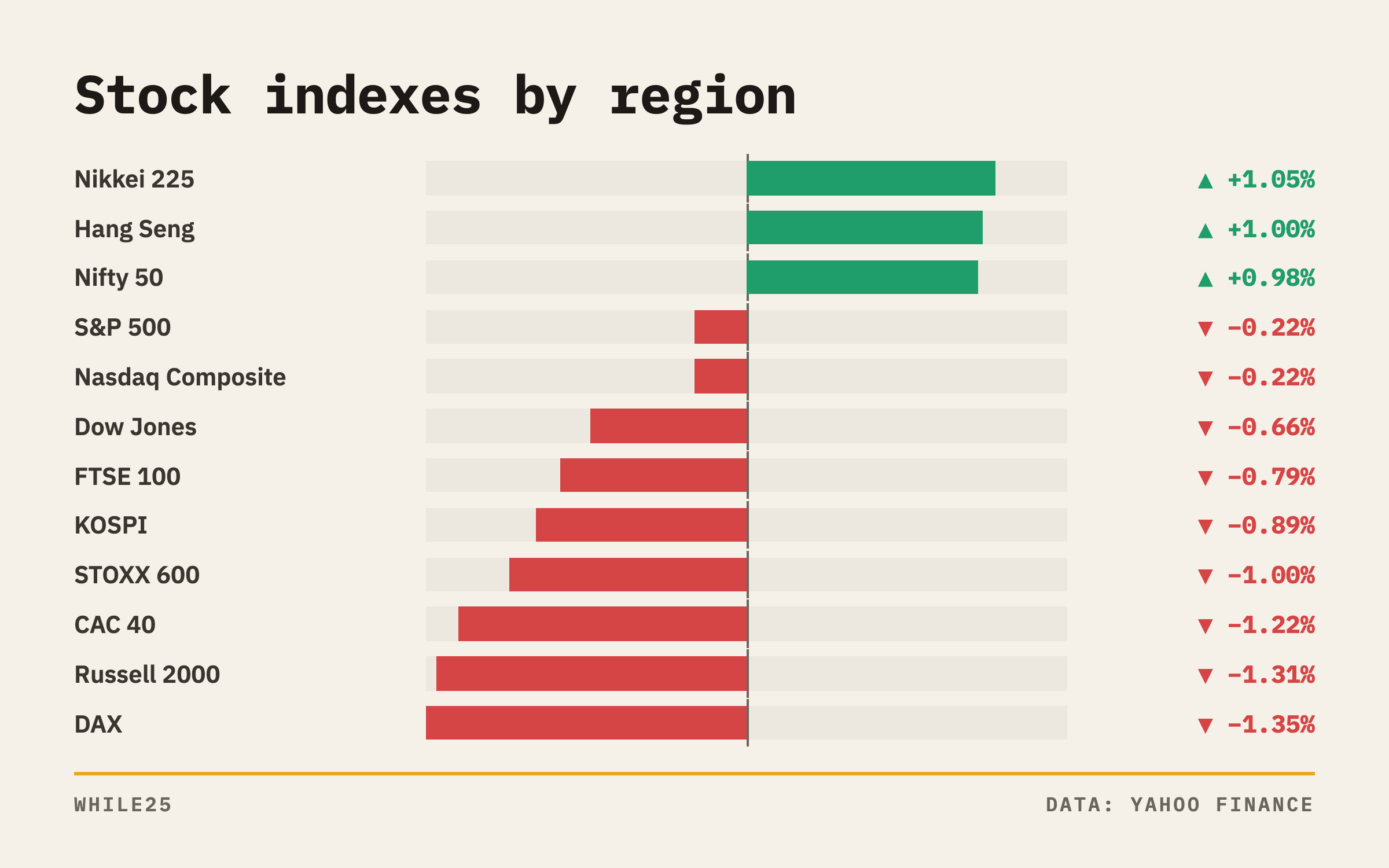 Day change for major stock indexes in the US, Europe and Asia, with European indexes among the biggest losers
US stocks step back from records
The S&P 500 and the Nasdaq Composite each fell 0.22%. The Nasdaq Composite is an index of shares listed on the Nasdaq exchange. Both had set records on October 6. The Dow Jones Industrial Average, another index of large US companies, fell 0.66%. The Russell 2000, an index of smaller US companies, fell 1.31%.
A broker is a firm that buys and sells shares for customers. Shares of online broker Webull fell 19.09% to $5.89. A House committee raised national security concerns about Webull's ties to China in a report. The committee wrote that 62% of Webull's employees live in China. The committee urged the Committee on Foreign Investment in the U.S. to open a formal review of Webull's structure and data security. That federal panel reviews foreign investment for national security risks.
Webull said the report contains "significant inaccuracies and unsupported conclusions." The company said it runs its US operations from Florida and New York. It said it keeps customer data within US borders. Shares of rival brokers fell. Robinhood lost 2.22%, and Interactive Brokers fell 3.14%.
The VIX, a gauge of how much traders expect stocks to swing, rose 0.47% to 15.08.
Asia traded a day earlier
The Asian moves below are from October 6, before the October 7 session. Japan's leading index, the Nikkei 225, rose 1.05% to 70,683.98. It closed above 70,000 for the first time since July. Hong Kong's Hang Seng index gained 1.00%, and India's Nifty 50 index gained 0.98%. South Korea's KOSPI index fell 0.89% as technology shares dropped. Mainland China's stock exchanges stayed shut for the National Day holiday.
Dollar up, gold and bitcoin down
The US Dollar Index measures the dollar against a group of major currencies. It rose 0.44% to 102.279.
Gold fell 1.20% to $4,136.70 an ounce. Gold pays no interest, so investors find it less appealing as bond yields rise and the dollar strengthens. Over the past month gold has fallen 6.81%.
Bitcoin fell 2.66% to about $83,284. A leveraged bet uses borrowed money. An exchange closes it once losses eat through the trader's deposit. Over 24 hours, exchanges closed about $696 million of such bets. Traders betting on rising prices had placed most of them.
Dates to watch
- October 8: The Shanghai and Shenzhen exchanges reopen after the National Day holiday.
- October 9 to 10: Forecasters expect Isaias to become a hurricane. They expect heavy rain on the central Gulf Coast and the Southeast from Friday into the weekend.
- October 14, about 6:45 a.m. ET: Bank of America reports third-quarter results, its results for July through September.
- October 14, 8:30 a.m. ET: The US Consumer Price Index for September. This is the main monthly gauge of inflation.
- October 27 to 28: Federal Reserve meeting on interest rates, with a decision on October 28.
The read for your portfolio
A portfolio is the mix of investments a person holds. On October 7, oil prices, bond yields and Fed rate bets shared one theme, inflation. An investor holding stocks, bonds and gold took losses on all three. Stocks dipped and gold fell. Bond prices move opposite to yields, so bond prices slipped as yields rose.
Investors spread money across types of assets to soften losses. That spread gave little cover on a day all three fell for the same reason. The September inflation report on October 14 is the next scheduled reading on that worry.
Sources
- finance.yahoo.com
- finance.yahoo.com
- finance.yahoo.com
- finance.yahoo.com
- boereport.com
- claimsjournal.com
- fool.com
- tipranks.com
- edgeconsultancykw.com
- newsroom.bankofamerica.com
- bls.gov
- federalreserve.gov
Not investment advice.