
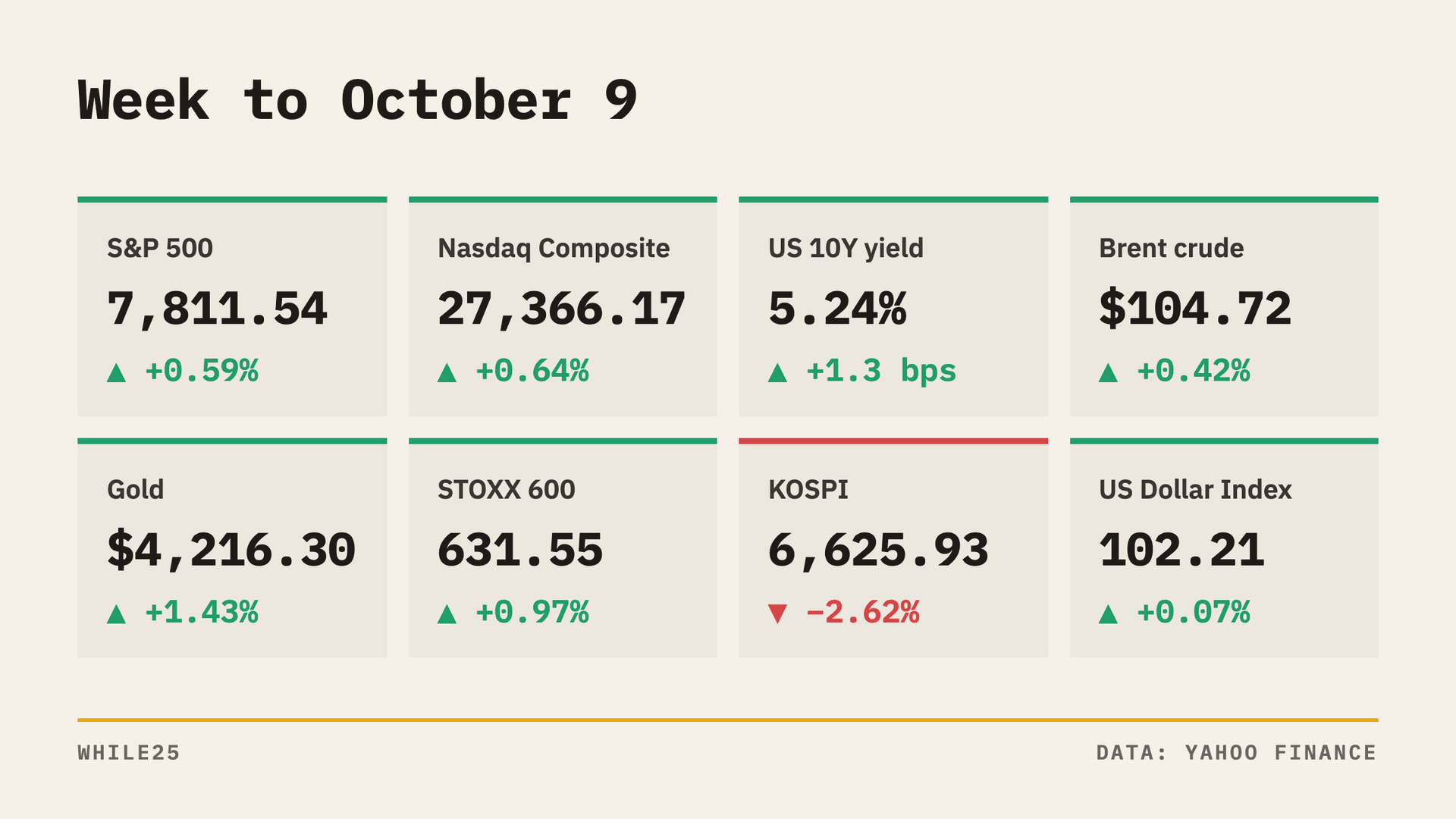
The 10-year Treasury yield touched 5.33% this week. This yield is the interest rate the US government pays to borrow for 10 years. It reached its highest level since early 2002. Later in the week, buyers showed up at the government's bond sales. The yield ended Friday, October 9, at 5.244%. That was a drop of 3.3 basis points for the week. One hundred basis points make one percentage point.
US stocks gained as bond yields eased. The S&P 500, an index of 500 large US companies, rose 1.15% for the week. Korea, mainland China and continental Europe had a harder week.
Borrowing costs at a 2002 high
Lenders use the 10-year rate to price mortgages and company loans. Investors use it to judge stocks. A government bond paying above 5% competes with shares for investors' money.
The 30-year yield climbed close to 5.67%. That was the 30-year's highest level since 2002. Over the past month, the 10-year yield rose 40.7 basis points. Bloomberg tied the rise to investor worry over high energy costs and inflation. Inflation is the pace at which prices rise. Brent crude, the reference price for oil traded worldwide, closed at $104.28 on October 8.
Households feel the same pressure. The University of Michigan released a survey on October 9. It put consumer sentiment at 46.3. Consumer sentiment is a gauge of how upbeat households feel. Economists had expected 47.8. People in the survey expect 4.7% inflation over the next year. The previous reading was 4.6%.
The Federal Reserve, the US central bank, raised its target rate on September 16. The target rate guides what banks charge each other for short-term loans. The Fed lifted it by a quarter of a percentage point, to a range of 3.75% to 4.00%.
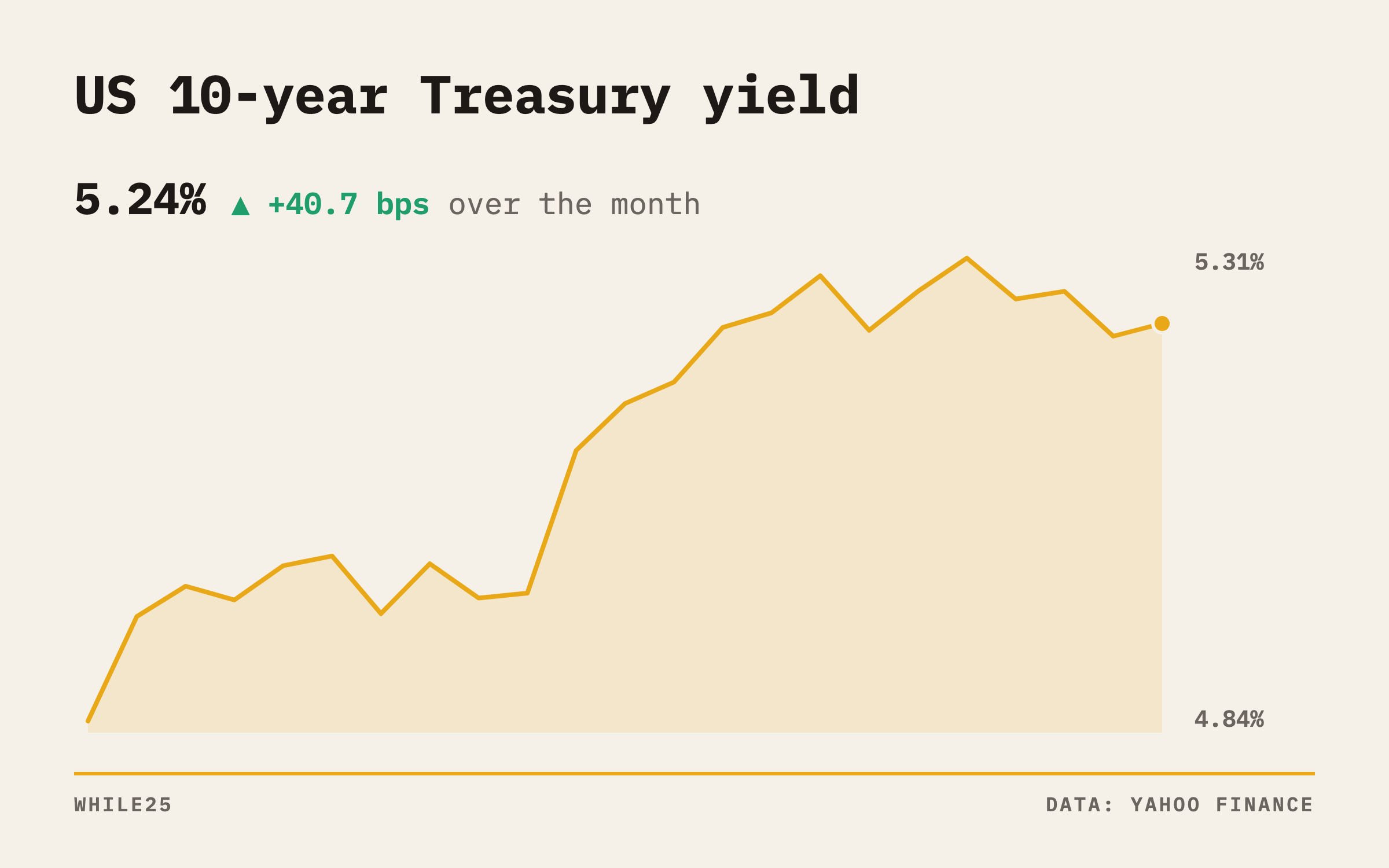 Line chart of the US 10-year Treasury yield over the past month, climbing toward a 2002 high and easing at the end of the week
Bond buyers brought relief
The US Treasury raises money by auctioning new bonds. A bond is a loan to the government that pays interest. If few buyers bid, the Treasury must offer a higher rate to sell its debt. If many buyers compete, it can borrow for less.
Buyers showed strong demand at this week's sales. Their bids sparked a relief rally, a rebound in bond prices after a slide. At the 30-year auction on Thursday, October 8, indirect bidders took more than 72% of the bonds. Indirect bidders are a group that includes foreign buyers. Across the last 10 auctions, their average share is 68%.
Bond prices and yields move in opposite directions. Buyers competing for bonds lift prices and lower yields. Those buyers pulled the 10-year yield off its peak.
Short-term rates moved the other way on Friday. The 2-year yield reflects what traders expect the Fed to do next. It rose four basis points to 4.79%. Traders kept worrying that high energy costs would lift inflation.
Iran, oil and a hurricane
On October 8, President Trump wrote that the US would not attack Iran before the November 3 midterm elections. Midterms are the national US vote held between presidential elections. Brent closed that day at $104.28, a gain of 4%.
A storm cut oil supply. As of October 8, Hurricane Isaias had shut close to 1.3 million barrels a day of output. That equals 62.9% of Gulf of Mexico oil production.
Investors sold shares as oil jumped. On Thursday, the S&P 500 fell 0.5%. The Nasdaq Composite, an index heavy in tech stocks, fell 1.2%. On Friday, oil prices and bond yields eased, and shares in Europe and the US rose.
Brent settled Friday at $104.72. The settle is the official closing price for the day. WTI, the main US oil price, settled at $91.85. Both figures are futures prices. A futures contract is a deal to buy oil for delivery in a later month. During the week, both quoted prices switched to a contract for a later month. That switch leaves neither price with a clean weekly change.
US stocks: a record, a dip, a weekly gain
The S&P 500 hit a record of 7,844.52 early in the week. It eased after that and closed Friday at 7,811.54. The Dow Jones Industrial Average, another index of large US companies, rose 0.93%. That was its biggest weekly gain since the week ended August 7.
The Nasdaq rose 0.64%, its fourth straight weekly gain. The index's last streak of that length was a six-week run that ended May 8.
Smaller companies lagged. The Russell 2000, an index of small US companies, fell 0.91% for the week. The VIX ended at 14.84. The VIX measures how much traders expect stocks to swing.
Fund investors leaned toward bonds. Investors pulled $5.11 billion from US stock funds, according to LSEG Lipper. That was the first weekly outflow from those funds since September 16. Investors put a weekly record $19.78 billion into bond funds.
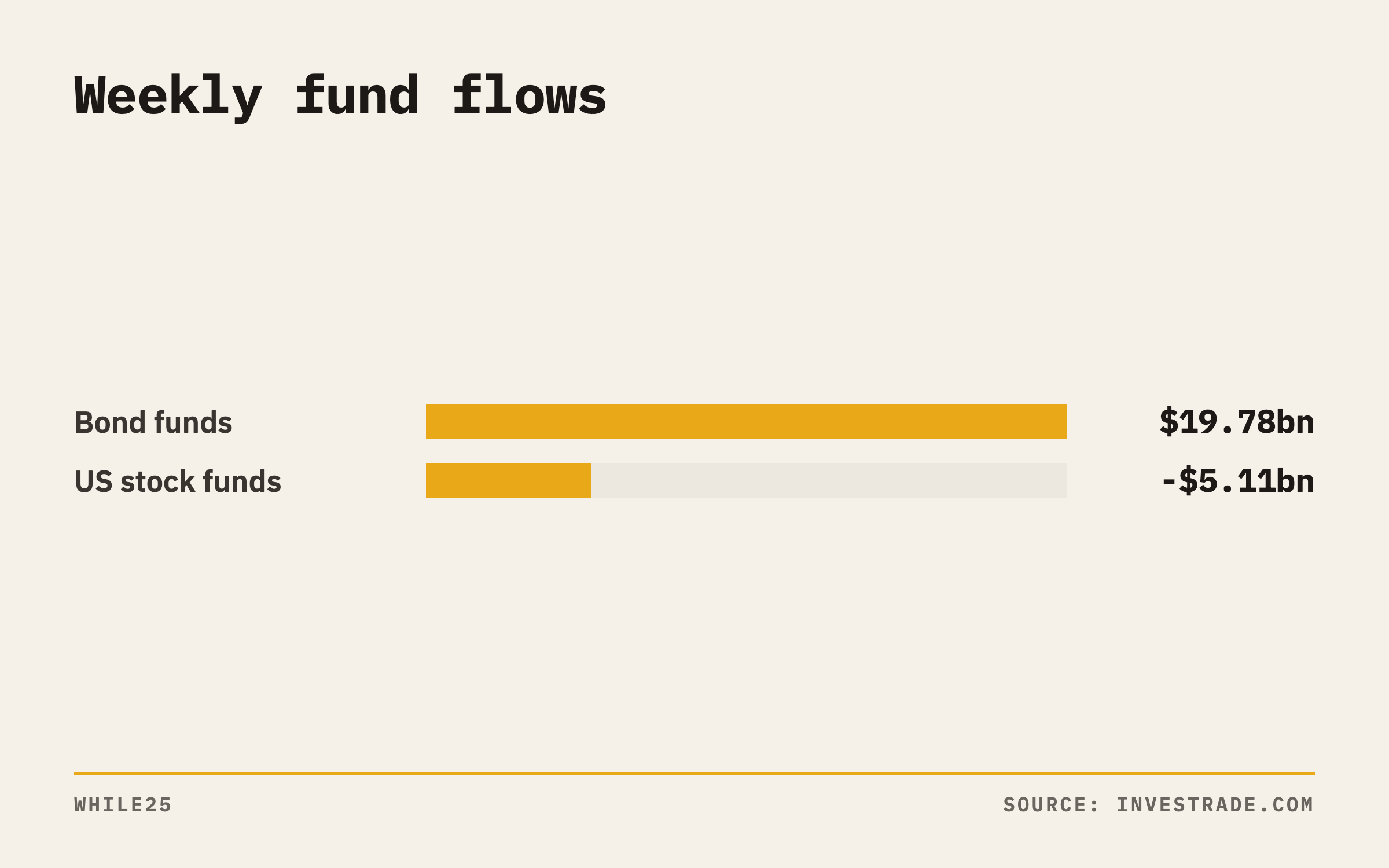 Bar chart of weekly fund flows: $19.78 billion into bond funds and $5.11 billion out of US stock funds
Europe: investors worry about French debt
The STOXX 600, a broad index of European shares, rose 0.03% for the week. On October 8, it fell 0.7% to 625.7. That day, bond yields in the eurozone's largest economies extended their surge. The eurozone is the group of countries that use the euro. The index gained 1% on Friday.
London's FTSE 100 gained 0.86% for the week. Germany's DAX fell 0.57%, and France's CAC 40 fell 1.19%. Each is its country's main stock index.
The euro fell for a fifth straight week. Investors worried about France's public debt, the money its government owes. EUR/USD ended at 1.1206. That figure is the number of dollars one euro buys.
Asia: Korea fell despite Samsung's guidance
Guidance is a company's early estimate, released before auditors finish their review. On October 8, Samsung Electronics guided to close to 107.4 trillion won of third-quarter operating profit. Operating profit is the money a company makes from its core business. Samsung put sales at close to 195 trillion won.
The same day, Samsung shares fell 2.42% to 262,000 won. SK Hynix, Korea's other big memory-chip maker, fell 2.44%. The KOSPI, Korea's main stock index, fell 2.62% to 6,625.93. It lost 3.10% over the five trading days through that October 8 close.
Mainland Chinese stocks lagged as well. The Shanghai Composite fell 1.92%. China's CSI 300, an index of 300 large mainland stocks, fell a little less than 1% in a holiday-shortened week. That was its ninth straight weekly decline.
Japan and Hong Kong held up better. Japan's Nikkei 225 rose 1.06%, and Hong Kong's Hang Seng rose 1.00%.
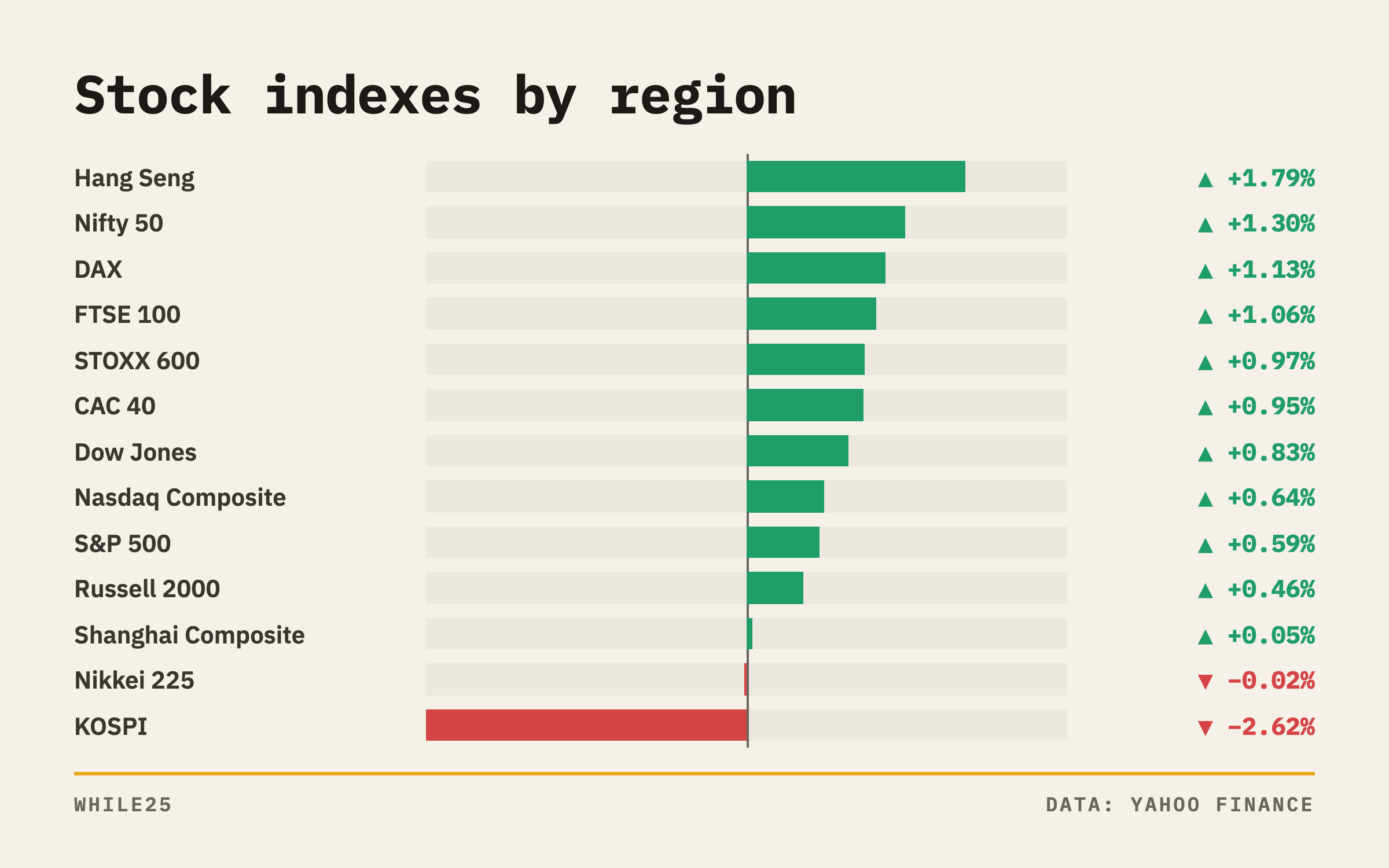 Bar chart of the latest daily moves in major stock indexes across the US, Europe and Asia, with the KOSPI the weakest
Dollar, gold and bitcoin
The US Dollar Index rose 0.27% to 102.21. This index measures the dollar against major currencies. One dollar bought 158.246 yen at Friday's close. Gold rose 1.30% for the week to $4,216.30 an ounce. Bitcoin fell 3.49% to $82,795.
The week ahead
- Monday, October 12: Columbus Day. US stock markets stay open. SIFMA, the bond dealers' trade group, recommends a full close for the bond market.
- Tuesday, October 13: JPMorgan, Citi, Goldman Sachs and Wells Fargo report third-quarter results.
- Wednesday, October 14: The September consumer price index (CPI) comes out. The CPI is the main US inflation gauge. Bank of America, BlackRock, Morgan Stanley and State Street report.
- Thursday, October 15: The producer price index (PPI) comes out. It tracks the prices businesses charge. BNY, PNC, Schwab and U.S. Bancorp report.
- October 27 and 28: The Federal Reserve meets to set interest rate policy.
- October 29: Samsung reports final third-quarter results.
- November 3: US midterm elections.
The week and your portfolio
Investors took their cue from bond yields this week. Buyers at strong auctions lowered borrowing costs, and the S&P 500 rose. The oil spike on October 8 worked against that gain. Stock funds, bond funds and mortgage quotes track the same 10-year rate. The inflation reports on October 14 and 15 are the next scheduled test for that rate.
Sources
- investrade.com
- tradingview.com
- bloomberg.com
- nbcnews.com
- tradingeconomics.com
- en.sedaily.com
- news.samsung.com
- tradingkey.com
- brecorder.com
- sifma.org
- federalreserve.gov
- federalreserve.gov
- cnbc.com
Not investment advice.