
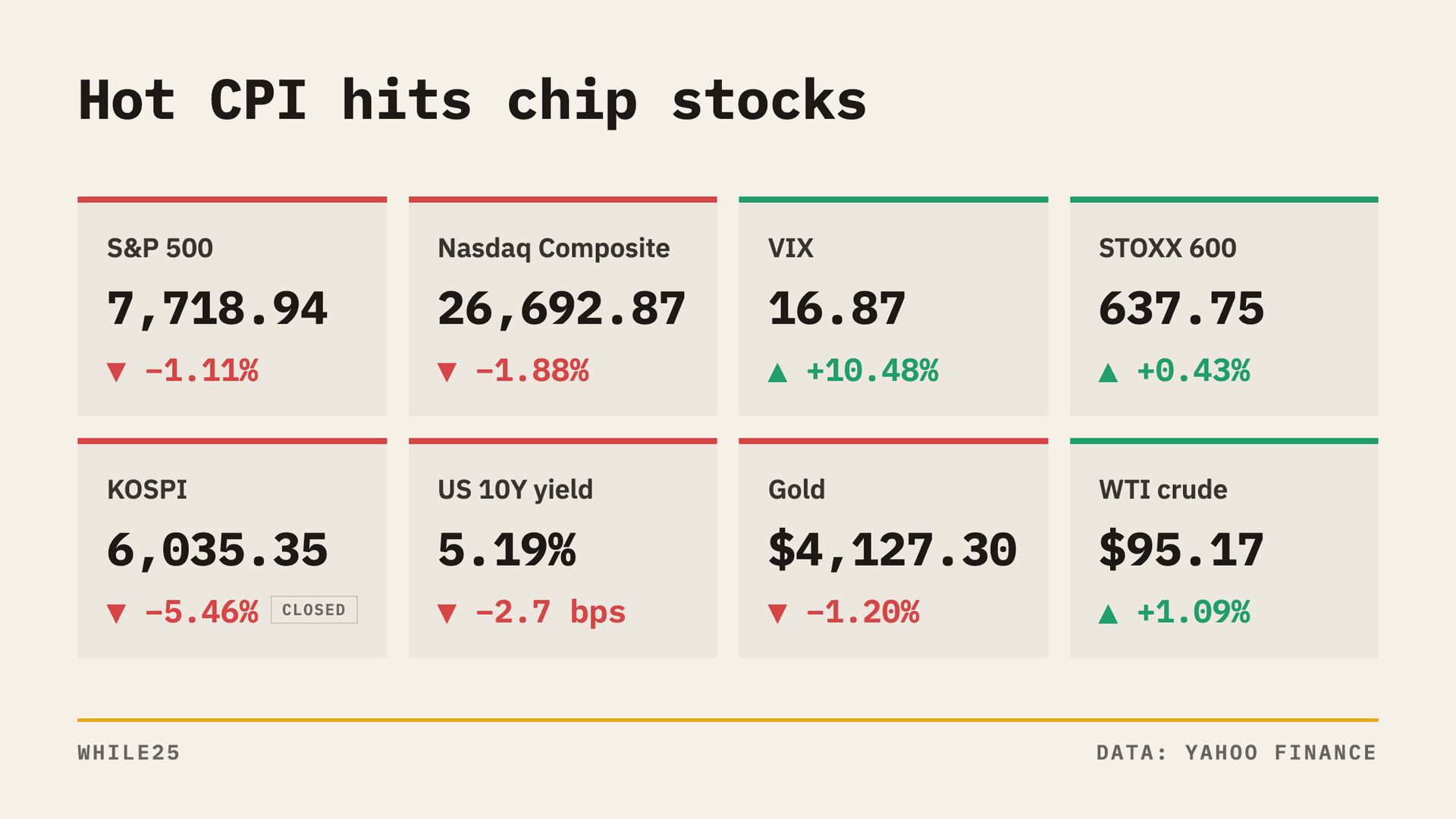
US consumer prices rose 3.7% in the year to September. Economists had expected 3.6%. The Bureau of Labor Statistics released the report on October 14. Traders responded with bigger bets that the Federal Reserve, the US central bank, would make another interest-rate increase.
Investors sold stocks of chipmakers and of companies tied to AI data centers. A stock index is one number built from the prices of a group of stocks. The Nasdaq Composite, an index heavy in technology stocks, fell 1.88%. The S&P 500, an index of large US companies, fell 1.11% to 7,718.94. It was the index's worst day since July. In Europe, stocks rose. Drugmakers and ASML, a company that makes chipmaking equipment, gained the most.
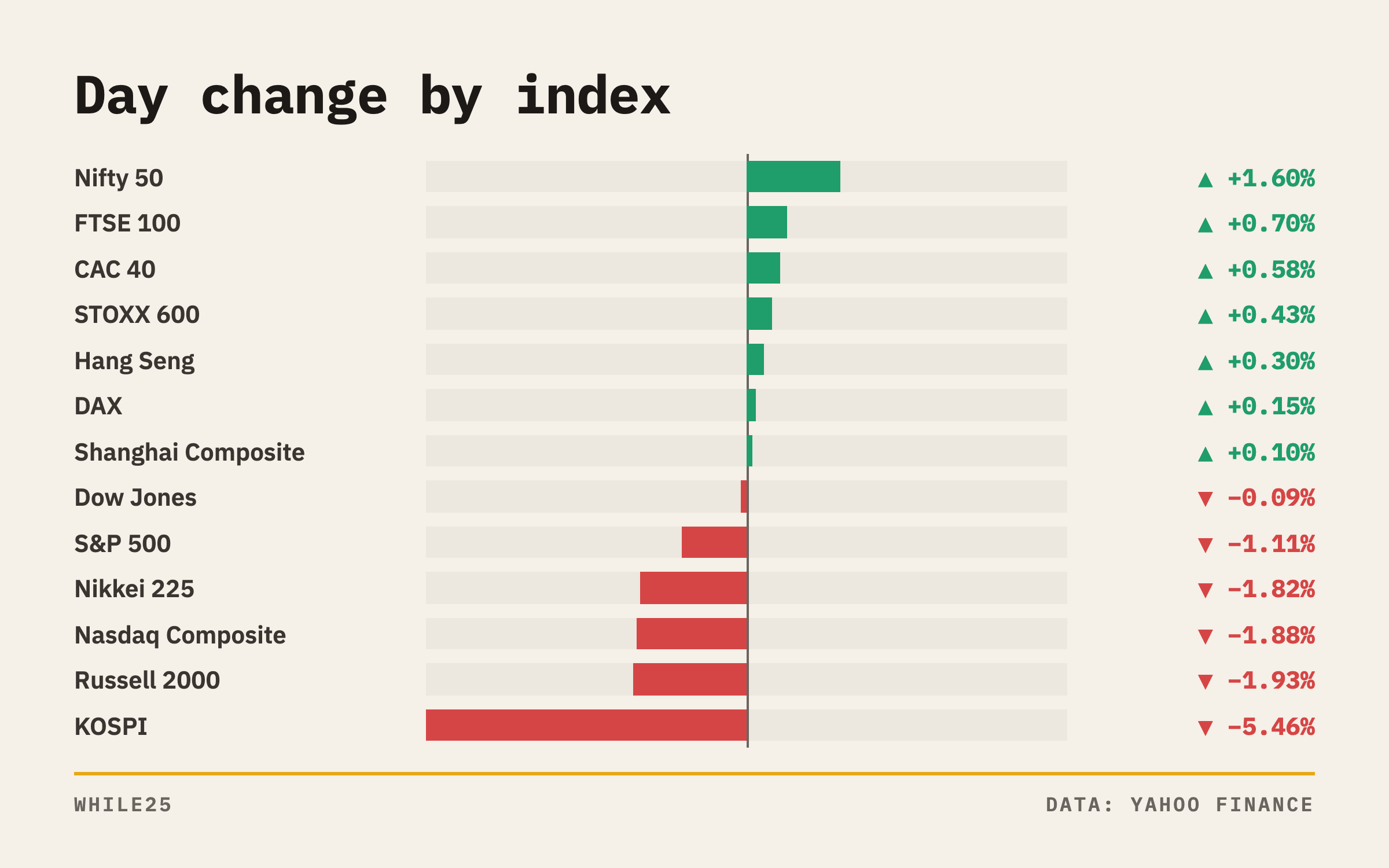 Day change for major stock indexes: US indexes fell, European indexes rose, and Korea's KOSPI led Asia lower on October 13
Gas prices made up over half the rise
The Bureau of Labor Statistics uses the consumer price index, or CPI, to track what households pay for a basket of goods and services. The bureau said the index rose 0.6% in the single month of September. Gasoline prices rose 9.1% in the month. That jump in gas made up over half of the 0.6% rise. Over 12 months, gasoline is up 34.2%. The wider energy index is up 20.4%.
Energy prices jump and fall by large amounts from month to month. For that reason, economists watch a second measure called "core" prices, which leave out food and energy. Core prices rose 0.3% in September. Economists in a Reuters poll had expected 0.2%. Over the year, core prices rose 2.6%, against a 2.5% forecast. In the prior report, the figure was 2.4%.
Fed officials watch the core number to gauge price pressure beyond the gas pump. Officials who favor higher rates can point to a higher core reading to make their case.
Traders moved their bets toward a Fed hike
The Fed raises its policy rate, the base interest rate it controls, to slow price rises. After a hike, lenders across the economy charge more for loans. The Fed's current target is a range of 3.75% to 4%. It set that range with a hike in September, its first in three years.
CME Group runs a tool called FedWatch. CME uses the tool to work out the odds of Fed moves from the prices of interest-rate futures. These futures are contracts that pay out based on where the Fed's rate lands. Before the CPI report, CME put the chance of a hike at the October 27-28 meeting at about 22%. After the report, it put the odds at about 52%.
"The last mile back to target could remain bumpy and keep interest rates elevated," said Jeffrey Roach, chief economist at LPL Financial. Roach's "target" is the inflation rate the Fed aims for.
Bond traders moved in the same direction. A bond is a loan that investors make to a government or company. The bond's yield is the interest rate the lender earns. The 2-year Treasury yield is the rate on two-year US government debt. Traders move it in line with what they expect from the Fed. It rose 2.98 basis points to 4.823%. One hundred basis points make one percentage point.
Longer-term rates moved the other way. The 10-year yield, the rate the US government pays to borrow for 10 years, slipped 2.7 basis points to 5.19%. The 30-year yield fell 3.2 basis points to 5.531%.
Households feel those rates through their loans. The Mortgage Bankers Association put the average rate on a 30-year home loan, or mortgage, at 7.50%. That is the highest since November 2023.
Investors sold chip and AI stocks
Some companies get most of their value from profits investors expect years from now. Investors pay less for those distant profits when rates rise. Technology stocks fell about 3% on October 14. Technology was the weakest S&P 500 sector, or industry group, that day.
CoreWeave rents out computing power for AI. Its stock fell 15.5%. The yield on its unsecured bonds had touched 15%, according to a social media post. Unsecured bonds are loans with no company property set aside to back them. A yield that high means lenders demand a steep return to fund the company.
CoreWeave reported a backlog of $104 billion in its most recent quarterly results. A backlog is work customers have signed up for that the company has not delivered. Rival Nebius Group dropped over 9%.
Investors sold stocks across the AI supply chain, the companies that provide AI's hardware and services. Oracle fell 8.8%, GE Vernova 6.2% and Advanced Micro Devices 5.7%. Nvidia lost 3.2% and Broadcom 3.1%. The PHLX Semiconductor index, a basket of chip stocks, was down more than 10% over five days.
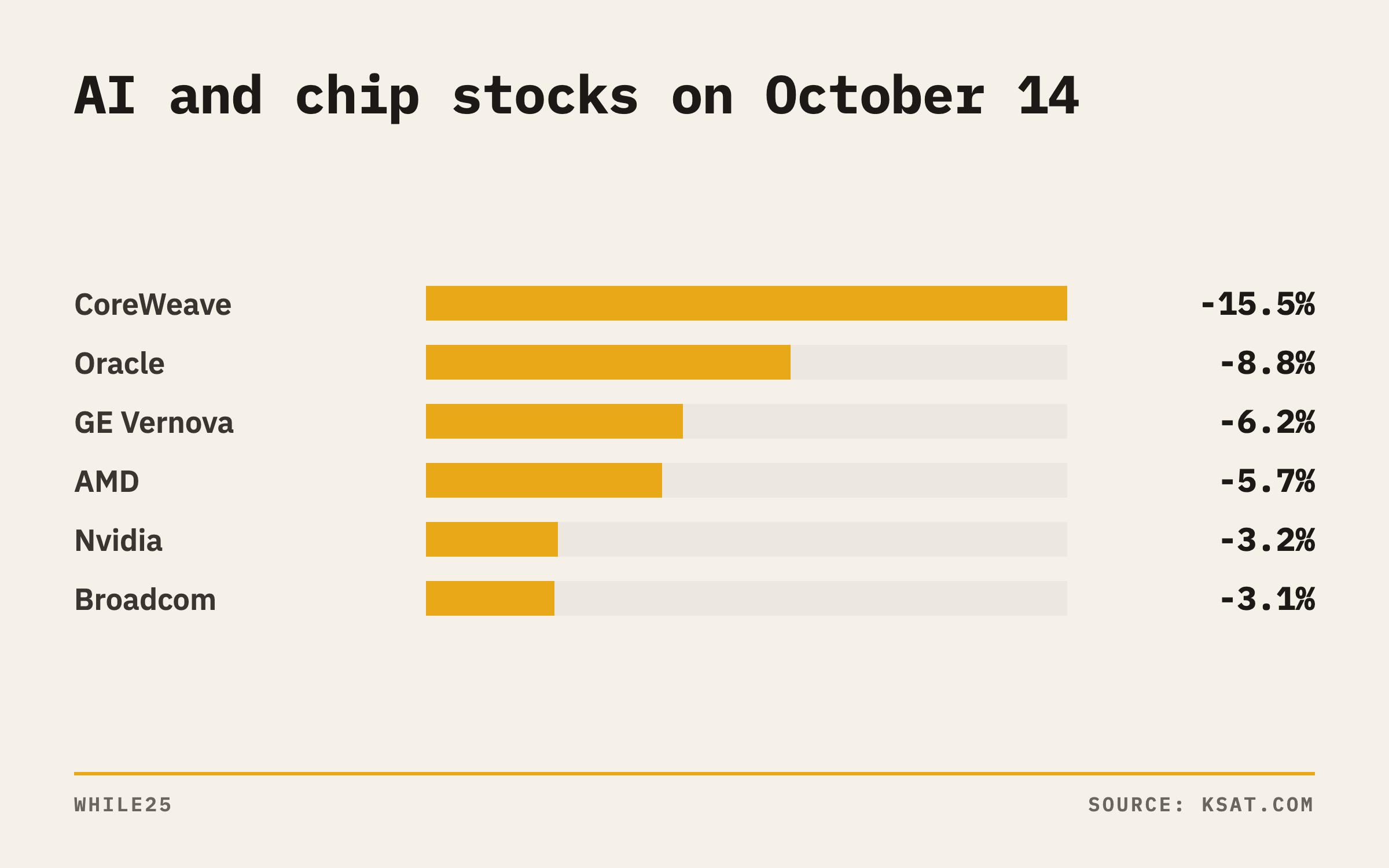 CoreWeave, Oracle, GE Vernova, AMD, Nvidia and Broadcom all fell on October 14, with CoreWeave down the most
The Nasdaq Composite closed at 26,692.87. The Russell 2000, an index of smaller companies, fell 1.93%. The Dow, another index of large US companies, ended 0.09% lower. The S&P 500 has fallen in five of the six trading days since its record high.
Bank of America's stock fell 4.7% after the bank reported its third-quarter results. The bank earned $0.91 for each share of its stock. Analysts had expected $1.10. Those earnings came after a $1.2 billion regulatory penalty.
Investors moved money into steadier businesses. Healthcare and consumer-staples stocks both rose more than 2%. Consumer-staples companies make everyday goods like food and soap. The VIX is a gauge of how much traders expect the S&P 500 to swing. It rose 10.48% to 16.87.
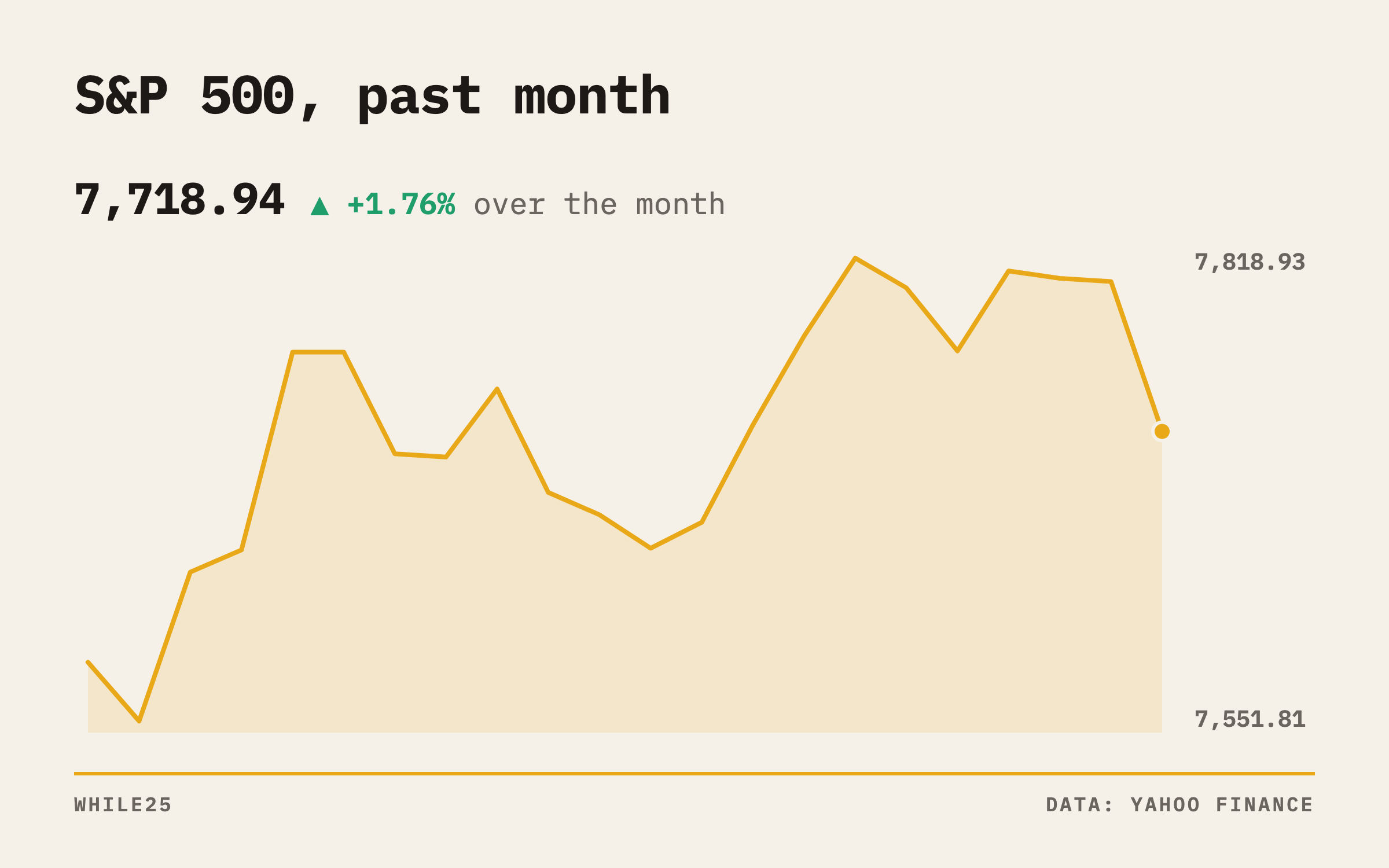 The S&P 500 over the past month, including the slide from its record high
European investors bought drugmakers and ASML
The STOXX 600, a broad index of European companies, rose 0.43% to 637.75. Healthcare was the best sector, up 2.3%. Drugmaker GSK rose 4.6%.
ASML is a Dutch company that makes the machines used to produce chips. Its stock rose 1.2% after the company reported results. The company said customers were "already looking to place orders" for advanced tools for 2029 and 2030. European chip investors took that as a reason to buy on a day US chip stocks fell.
London's FTSE 100 index rose 0.70%. The CAC 40 index in Paris rose 0.58%, and Germany's DAX index rose 0.15%.
The European Central Bank, or ECB, sets interest rates for the countries that use the euro. Traders expect it to keep rates unchanged in October. Data provider LSEG puts the chance of an ECB hike in December at 81%.
Investors in Korea sold chip stocks
The latest Asian closing prices in this report are from October 13. Korea's main stock index, the KOSPI, fell 5.46% to 6,035.35. It was the index's worst trading day in 21 months. Samsung Electronics fell about 7% and SK Hynix about 10%.
Investors sold after CXMT, a Chinese maker of memory chips, announced a technology breakthrough. Memory chips store data. Over five trading days, the KOSPI is down 13.83%.
Japan's Nikkei 225 index fell 1.82%. Hong Kong's Hang Seng rose 0.30%, and the Shanghai Composite rose 0.10%. India's Nifty 50 rose 1.60%.
Dollar, metals, oil and bitcoin
The dollar rose in value as traders raised their hike bets. The dollar index is a gauge of the dollar against a basket of major currencies. It rose 0.36% to 102.547. The euro fell 0.44% to $1.1156.
Gold fell 1.20% to $4,127.30 an ounce. Gold pays no interest. Investors find it less attractive to hold when they expect higher rates. December silver is a futures contract, a deal made today for silver delivered in December. It fell 6.13% to $55.88.
Oil prices rose. A benchmark is the standard price traders quote for a type of oil. WTI is the US benchmark for crude, the oil that comes out of the ground. It rose 1.09% to $95.17 a barrel. Brent, the global benchmark, rose 0.35% to $106.06. Bitcoin, a digital currency, fell 1.53% to $81,823.
Dates to watch
- October 15: TSMC third-quarter results and an earnings call, where executives discuss the results, 2:00 to 3:30 p.m. Taipei time.
- October 15, 8:30 a.m. ET: US September producer prices (the prices businesses receive), retail sales (spending at stores) and weekly jobless claims (new filings for unemployment benefits).
- October 16: US September import and export prices at 8:30 a.m. ET. Industrial production (output from factories, mines and utilities) follows at 9:15 a.m. ET.
- October 27-28: Fed meeting on interest rates.
- November 3: US midterm elections.
- November 10, 8:30 a.m. ET: US October CPI.
The takeaway for a portfolio
After one inflation report, traders moved the odds of a Fed hike from about 22% to about 52%. Chip and AI stocks fell the most. These stocks make up a big share of US stock indexes.
An index fund is a fund that holds the stocks in an index. A broad US index fund holds these chip and AI stocks. A big fall in them can pull the fund down while most of its other companies move little.
Bond investors felt the report through the 2-year yield. Borrowers felt it through a 7.50% mortgage rate. The next scheduled events that could shift those odds are producer prices on October 15 and the Fed meeting on October 27-28.
Sources
- bls.gov
- theedgemalaysia.com
- finance.yahoo.com
- abcnews.com
- ksat.com
- investrade.com
- marketscreener.com
- home.saxo
- fool.com
- 247wallst.com
- investor.tsmc.com
- tradingkey.com
Not investment advice.