
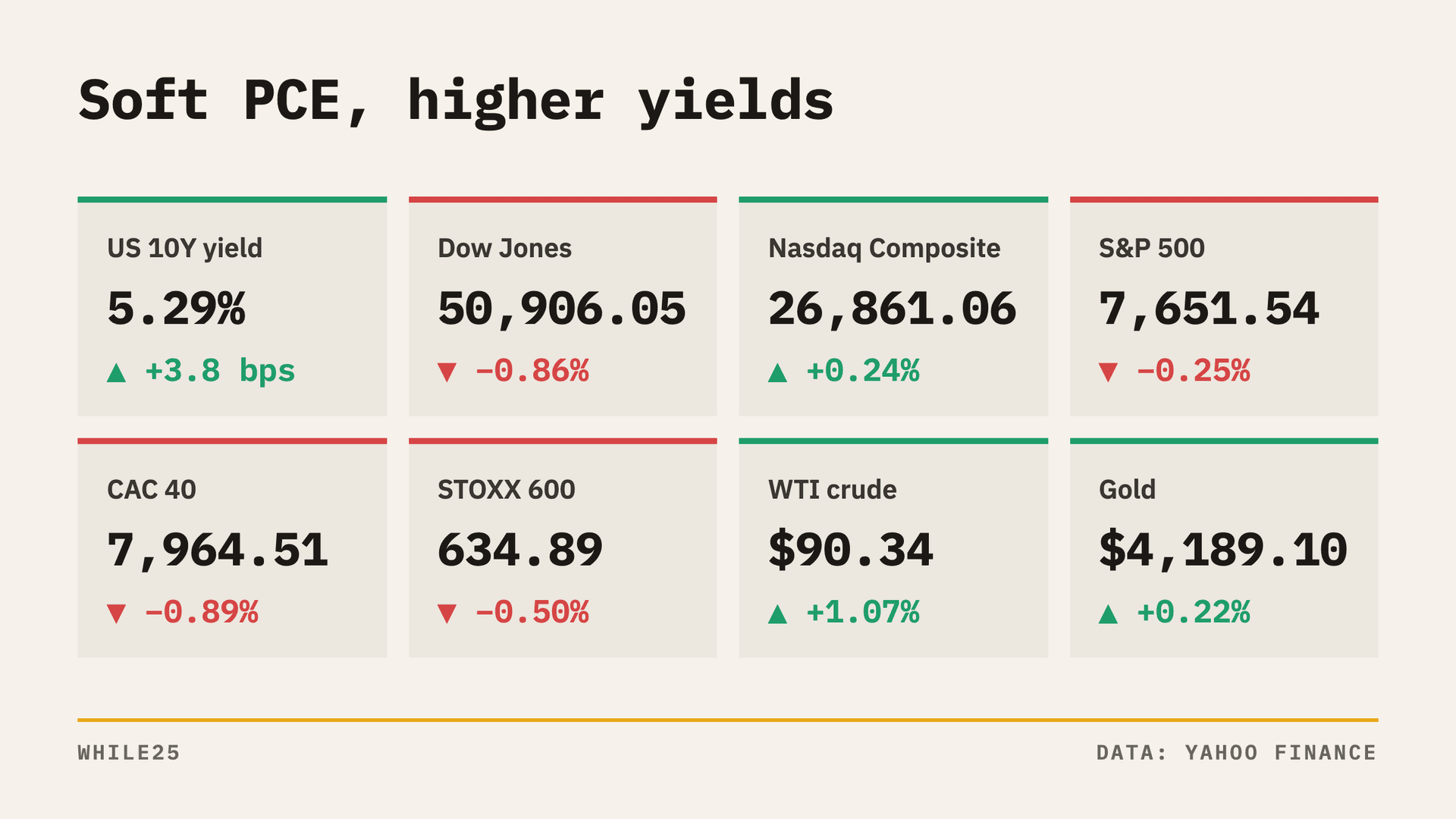
The US 10-year Treasury yield closed at 5.293% on September 30, up 3.8 basis points, on a day when August inflation came in below forecast. That is its highest level since June 2007, and it caps a month in which the 10-year added 53.5 bps. Stocks split under the pressure: the Dow Jones fell 0.86% while the Nasdaq Composite rose 0.24%.
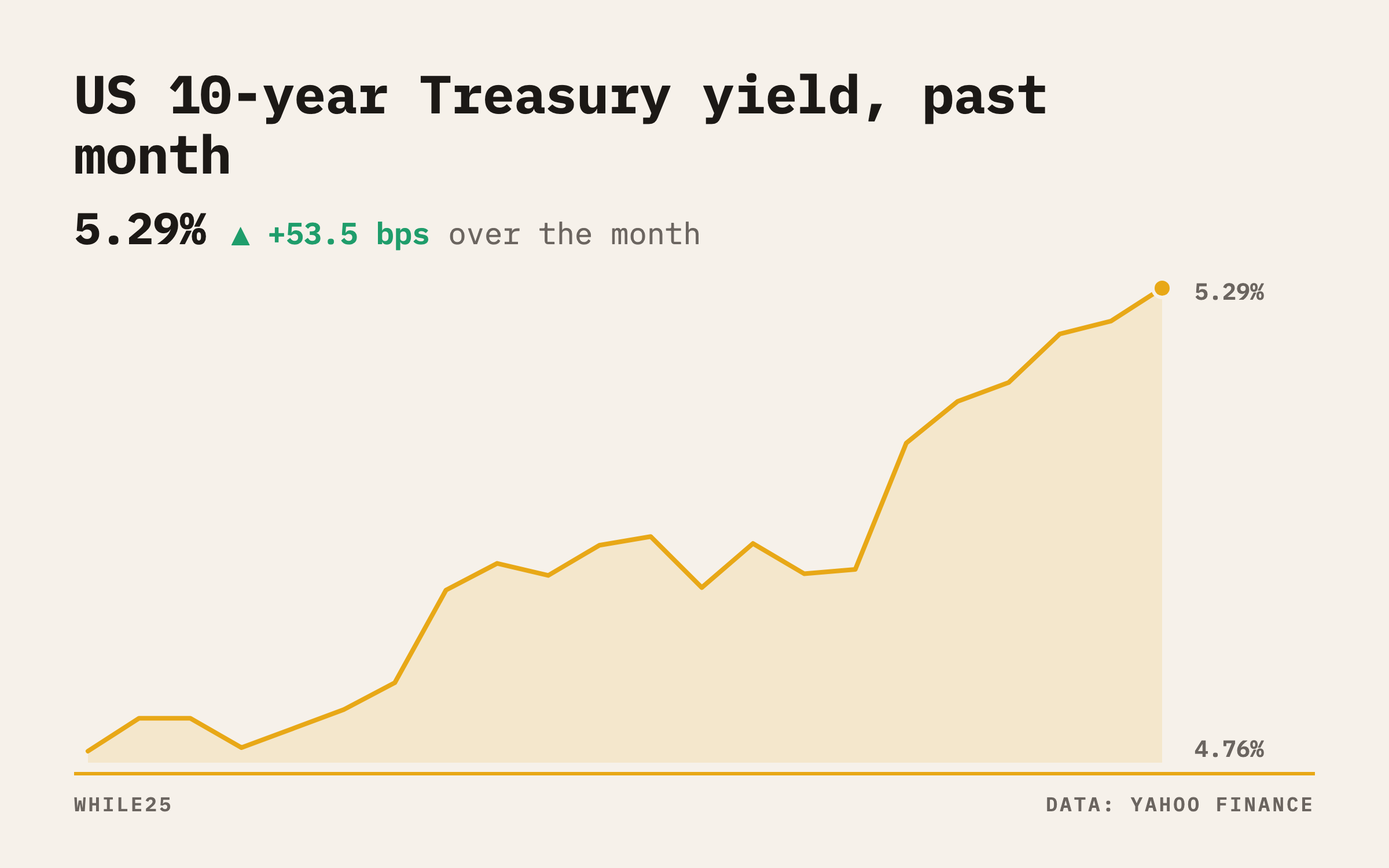 The US 10-year Treasury yield over the past month, climbing to its highest level since June 2007 on September 30
A cooler PCE print moved Fed odds, and bonds sold anyway
August's personal consumption expenditures price index, the Fed's preferred inflation gauge, rose 3.4% from a year earlier against 3.7% expected. Core PCE, which strips out food and energy, rose 3% against 3.3% expected, and 0.2% on the month against 0.3%. CME FedWatch then showed a 65.1% probability that the Fed holds at its October meeting, up from even odds the previous day.
That shift follows a hike. On September 16 the FOMC voted 12-0 to lift its target range to 3.75%-4.00%, its first increase since 2023, citing "persistent pressure in energy and consumer price measures." New York Fed President John Williams said "We have time to gather more information" and that he sees "no need for urgency," while pointing to one more hike "late this year."
A softer policy path tends to drag the 10-year lower. On September 30 it rose. AP reported that data showing the US economy ran stronger in the spring than first estimated helped keep yields high, and that those yields weighed on stocks. The 30-year touched 5.6206%, its highest since June 2002.
Why a long bond can climb when Fed odds fall
The Adrian-Crump-Moench (ACM) model splits the 10-year yield into two parts: the average short rate markets expect over the next decade, and the term premium. The term premium is the extra return investors demand for holding a long Treasury instead of rolling short-dated bills. The model put it at 0.70% as of August 31, after readings sat below zero for most of 2016 to 2024.
When expectations for the Fed soften and the 10-year climbs, that identity leaves the term premium as the component carrying the move. One analysis of the selloff lists the forces behind it: expected Fed hikes, "an energy crisis kicked off by the war in Iran, ballooning US government debt and budget deficits, and a historic investment cycle driven by the AI build-out." A recent Treasury auction drew its weakest bid-to-cover ratio in a year, meaning fewer bids per dollar of debt on offer.
The 10-year had closed at 5.24% on September 28. Two sessions later it sat at 5.293%.
Micron and Alphabet held the Nasdaq up as the Dow slid
The S&P 500 fell 0.25%, the Russell 2000 of smaller companies lost 0.39%, and the VIX rose 1.87% to 16.34. Tech moved the other way. Alphabet rose 3% in midday trading, Hewlett Packard Enterprise gained 3.9% and MongoDB added 3.4%.
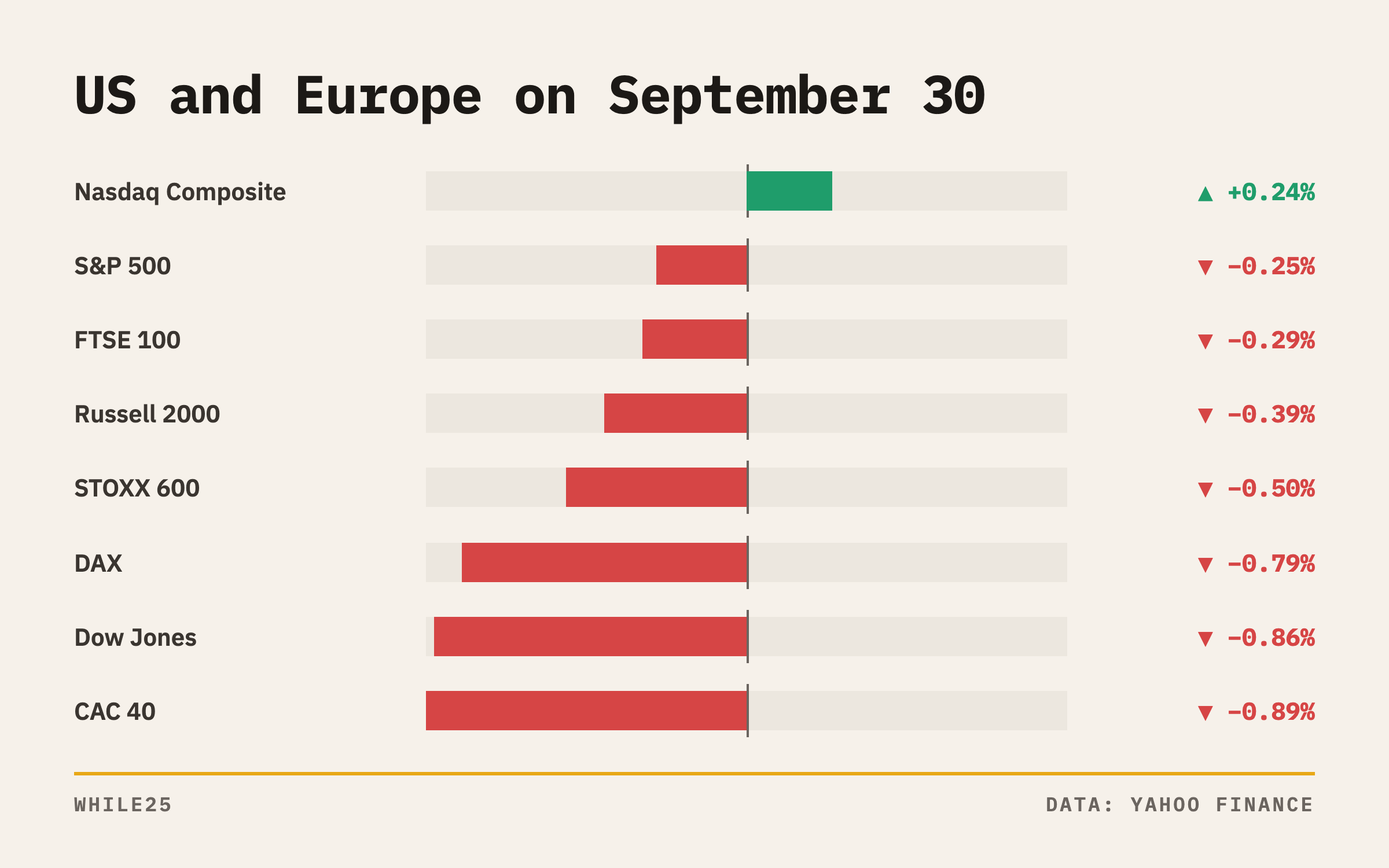 Day change for US and European equity indices on September 30, with the Nasdaq the lone gainer
Micron then posted fiscal fourth-quarter revenue of $54.23 billion against $51.07 billion expected, and adjusted EPS of $33.42 against $31.61. DRAM revenue rose 343% from a year earlier to $39.8 billion, 73% of sales. Guidance for the next quarter came in at $61.5 billion, plus or minus $1.5 billion, with adjusted EPS of $38.15, against analyst expectations of $57 billion and $35.40.
The two halves of the tape connect. The AI build-out sits on that list of reasons long yields are rising, and the same spending runs through Micron's revenue line; the company's full-year net capex reached $27.37 billion. One cycle feeds the Nasdaq's earnings and the bond market's list of worries at once.
Europe's September inflation prints jumped on energy
The CAC 40 fell 0.89%, the DAX 0.79%, the STOXX 600 0.50% and the FTSE 100 0.29% on the last session of the quarter. National inflation prints for September set the backdrop. France's harmonized rate rose to 3.4% from 2.6%, Italy's to 4.1% from 3.2%, Germany's to 3.3% from 2.9%, and Spain's to 5.0% from 4.6%, driven by the energy-price shock from the Iran war.
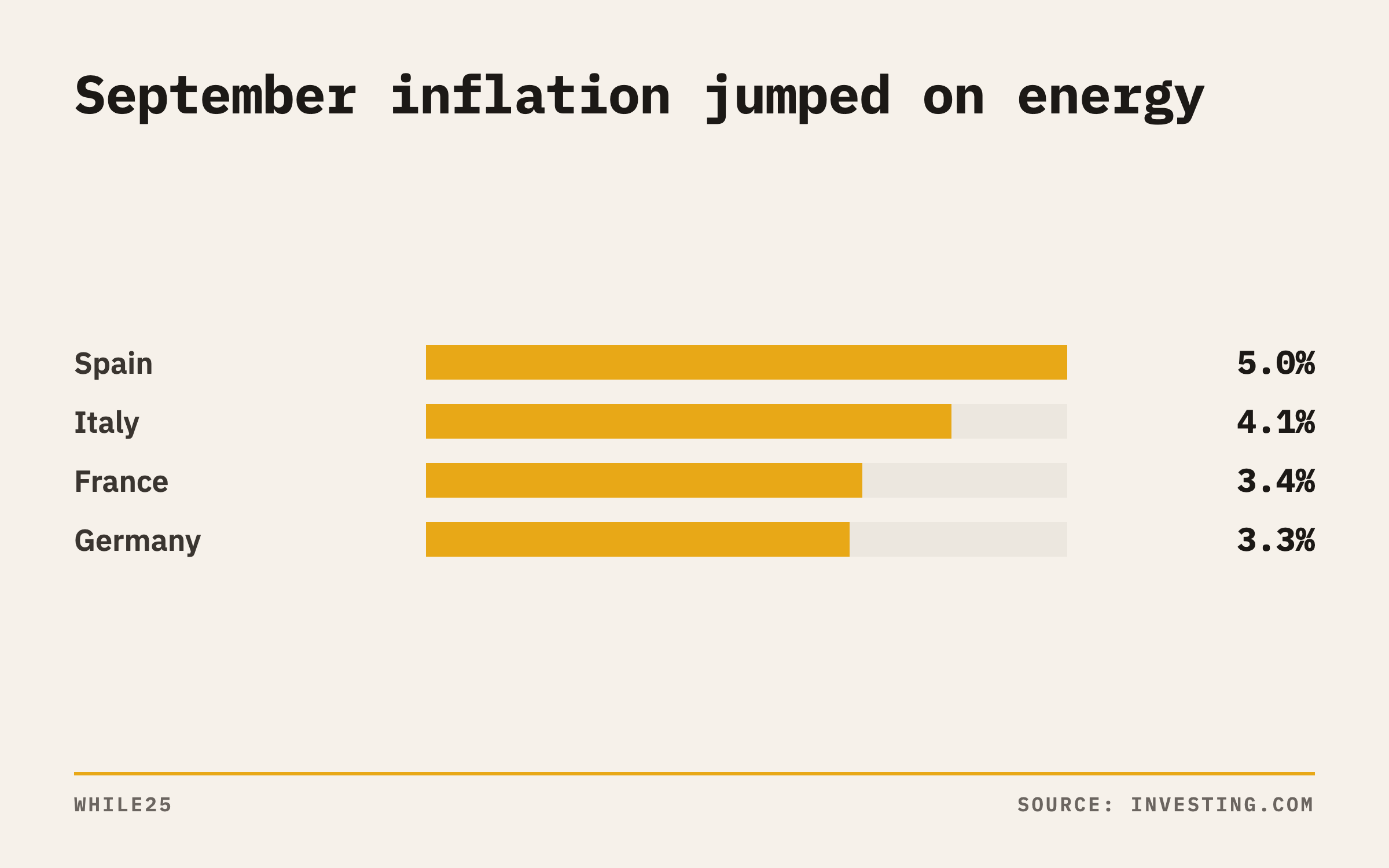 September year-on-year inflation in Spain, Italy, France and Germany
The ECB has raised rates twice this year, and markets expect four more hikes over the next year. Economists polled by Reuters expect euro zone inflation at 3.6% for September, up from 3.2% in August. Investing.com reported the STOXX 600 was headed for its first monthly loss in six as bond yields tied to Middle East tensions weighed. EUR/USD ended flat at 1.134 and is down 2.14% over the month.
Tokyo bounced as Seoul stepped into its bond market
The market data for Asia runs to the September 29 close, when the Nikkei 225 fell 0.60%, the Hang Seng 0.48%, the KOSPI 0.27% and the Nifty 50 0.28%, while the Shanghai Composite gained 0.18%. On September 30, AP reported the Nikkei jumped 1.9%.
Seoul answered the US move with policy. South Korea's government signaled emergency bond buybacks and reduced issuance, and Korea's 10-year yield fell 4.8 bps to 4.422%. Ajupress reported that rising Treasury yields pressured equities across the region.
Oil rose on Iran headlines; gold is down 6.52% on the month
WTI crude rose 1.07% to $90.34 after President Trump's statements on Iran sanctions. Gold added 0.22% to $4,189.10 on the day but is down 6.52% over a month in which the 10-year added 53.5 bps. The dollar index edged up 0.08% to 101.45 and is up 2.03% over the month, while USD/JPY slipped 0.05% to 157.329. Bitcoin was flat at 83,678.
Payrolls on October 2 lead a crowded calendar
- October 1: Fed Governors Lisa Cook and Christopher Waller and Vice Chairs Michelle Bowman and Philip Jefferson speak.
- October 2, 8:30 a.m. ET: US September employment report. August payrolls rose 162,000 with unemployment at 4.1%; ADP counted 90,000 private jobs added in September, up from 36,000 in August.
- October 2: Eurostat flash euro area inflation for September, with the Reuters poll at 3.6%.
- October 7, 2:00 p.m. ET: Minutes of the September 15-16 FOMC meeting.
- October 27-28: FOMC meeting, with the press conference on October 28 at 2:30 p.m.
- October 29, 14:15 CET: ECB rate decision.
What September 30 says about your rate exposure
The session pulled apart two things traders tend to treat as one: the path of the Fed and the level of long yields. A cooler inflation print moved the odds on the October meeting, and the 10-year rose anyway. Positions priced off the long end, from rate-sensitive cyclicals to long-duration growth to the carry on a leveraged book, answered to the bond market that day. The Dow-Nasdaq split shows where AI earnings offset that pressure and where nothing did.
Sources
- ca.finance.yahoo.com
- foxbusiness.com
- raisin.com
- ajupress.com
- 247wallst.com
- finance.yahoo.com
- finance.yahoo.com
- investing.com
- investing.com
- globenewswire.com
- cnbc.com
- bls.gov
- federalreserve.gov
- financecalendar.com
- ec.europa.eu
- eco3min.fr
Not investment advice.