
On October 13, the Korea Exchange stopped computer-driven selling in KOSPI-listed shares for five minutes. The pause started at 9:48 a.m. The KOSPI is South Korea's main stock index. An index is a single number that tracks the prices of a group of shares. At 9:50 a.m., the KOSPI stood at 6,127.15. It was down 257.09 points, or 4.03 percent.
The exchange calls this kind of pause a sidecar. A sell-side sidecar holds back computer selling. This one was Korea's first in nearly two months. Two chip makers sat at the center of the drop. Samsung Electronics closed down 7.39 percent at 232,000 won. The won is South Korea's currency. The close is the last price of the trading day. SK hynix fell 10.09 percent to 1.443 million won.
The exchange keeps two emergency brakes for days like this. The sidecar is the light one. The circuit breaker is the heavy one. The two trip at different levels and stop different things.
A market under strain
The KOSPI was weak before October 13. On October 12, it closed at 6,384.24, down 3.65 percent. A session is one trading day. Over the five sessions to that close, the index lost 8.42 percent. On October 12, Samsung dropped 4.4 percent and SK hynix 4.5 percent.
The index then opened October 13 down 3.1 percent. Analysts pointed to news from China. CXMT is a Chinese memory chip maker. Reports said it plans server DDR5 chips with a more compact cell design by year-end. DDR5 is the current generation of memory used in computers and data-center servers. Samsung and SK hynix both sell that kind of memory. A denser rival product would compete on their home turf.
Foreign investors sold a net 2.2 trillion won of Korean shares on October 13. "Net" means their sales minus their purchases. Since the start of the year, their net selling reached 199 trillion won. Heo Jae-hwan of Eugene Investment & Securities said: "The outflows are too large to be attributed solely to portfolio rebalancing after the rally."
Outflows are money that investors pull out of a market. A rally is a stretch of rising prices. Portfolio rebalancing means selling some winners to bring a fund's mix back to its plan.
Program trading in plain words
Program trading means computers sending large batches of orders at once. An order is an instruction to buy or sell. A fund that tracks an index may need to sell a slice of 200 stocks together. A computer program fires those orders in one burst.
Arbitrage desks use the same method. These trading teams buy and sell to capture small price gaps. They work the gaps between index futures and the shares inside the index.
An index future is a contract that tracks where an index will stand on a set date. Traders use it to bet on a move or to protect a portfolio, without buying each stock. A portfolio is a set of investments. The KOSPI 200 is an index of 200 large Korean companies. The KOSPI 200 futures index tracks the futures contracts on it.
Futures are cheap and quick to trade. In a sell-off, a wave of heavy selling, traders can push futures prices down at speed. Programs respond by selling the matching shares, which keeps the two prices in line. Lower share prices can then pull futures down in turn. That loop can turn a bad morning into a rout, a steep and disorderly fall, within minutes. The exchange uses the sidecar to cut the loop for a short spell.
The sidecar, step by step
The first step is the trigger. The exchange fires a sell-side sidecar if the KOSPI 200 futures index falls 5 percent or more for at least one minute. The one-minute test keeps a single stray trade from setting it off.
The second step is the pause. For five minutes, the exchange holds program sell orders in KOSPI-listed shares. On October 13, that window opened at 9:48 a.m.
The third step concerns the trading that continues. A person can sell Samsung shares through a broker's app during the pause. A broker is a firm that places trades for clients. A fund manager can enter orders by hand. The share market stays open, with one type of order set aside. After five minutes, the exchange accepts program orders again.
The heavy brake: circuit breakers
A circuit breaker needs a deeper fall and stops more trading. Korea's rules set three stages. Each stage measures the KOSPI's fall from the previous day's close.
Stage one fires at an 8 percent fall. The exchange then stops taking orders in the KOSPI market for 20 minutes. The halt covers linked futures and options as well. Options are contracts that give the right to buy or sell at a set price. Stage two repeats that 20-minute halt at a 15 percent fall. At 20 percent, stage three halts all KOSPI trading.
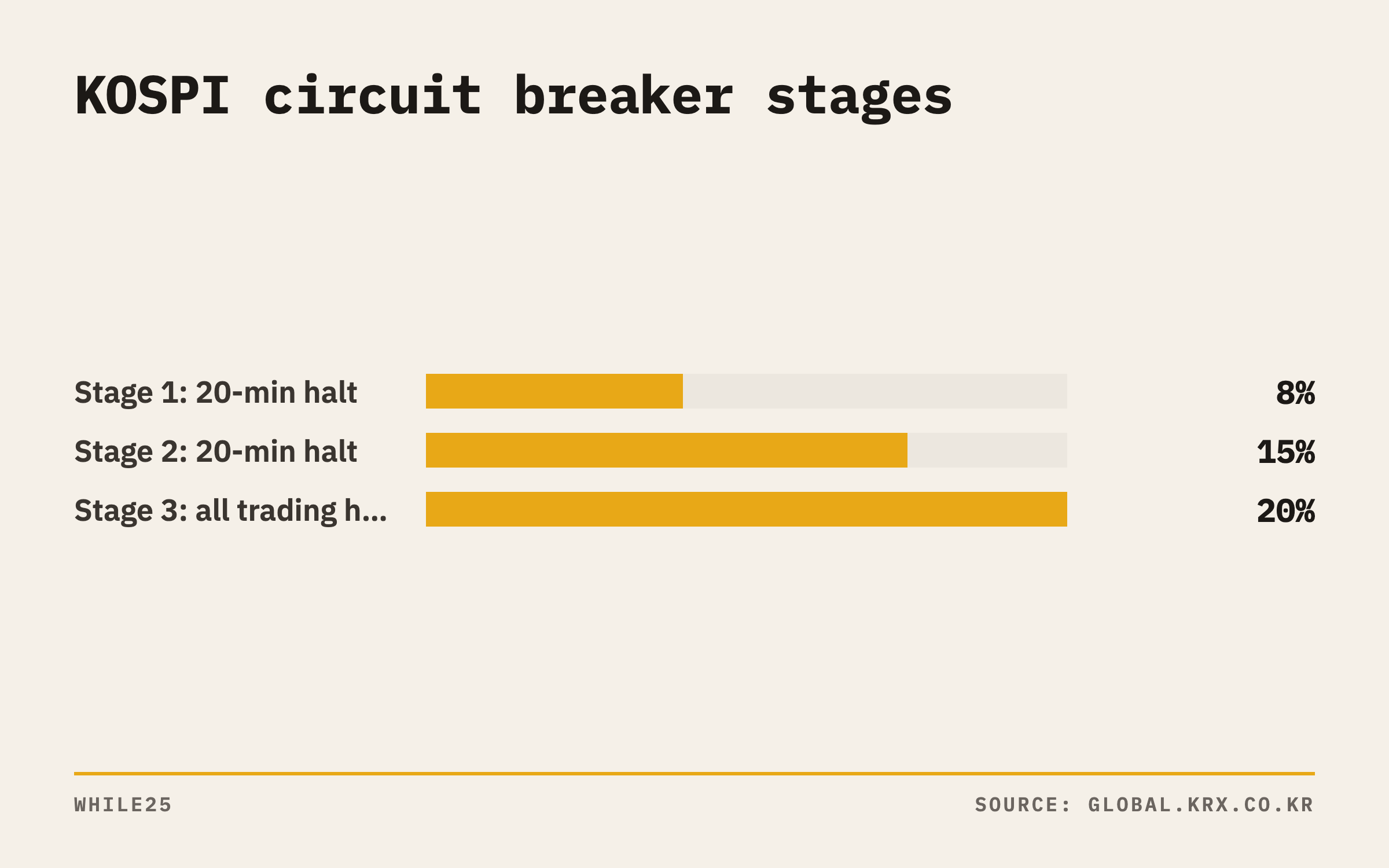 Bar chart of the three KOSPI circuit breaker stages, which trigger at falls of 8%, 15% and 20% from the previous close
The rules limit timing in two ways. Each stage can fire once per day. Stages one and two cannot fire within 40 minutes of the close.
The two tools differ in scope. A sidecar sets aside one kind of order for five minutes. A circuit breaker stops orders from people and computers alike. On October 13, the KOSPI was down 4.03 percent at 9:50 a.m. That fall stopped short of the 8 percent line. The exchange triggered the sidecar and left the circuit breaker untouched.
The five minutes and the close
The exchange held program selling for five minutes, as its rules require. Sellers kept pushing prices down after the pause ended. Samsung closed down 18,500 won ($14) a share, or 7.39 percent. SK hynix closed down 162,000 won, or 10.09 percent.
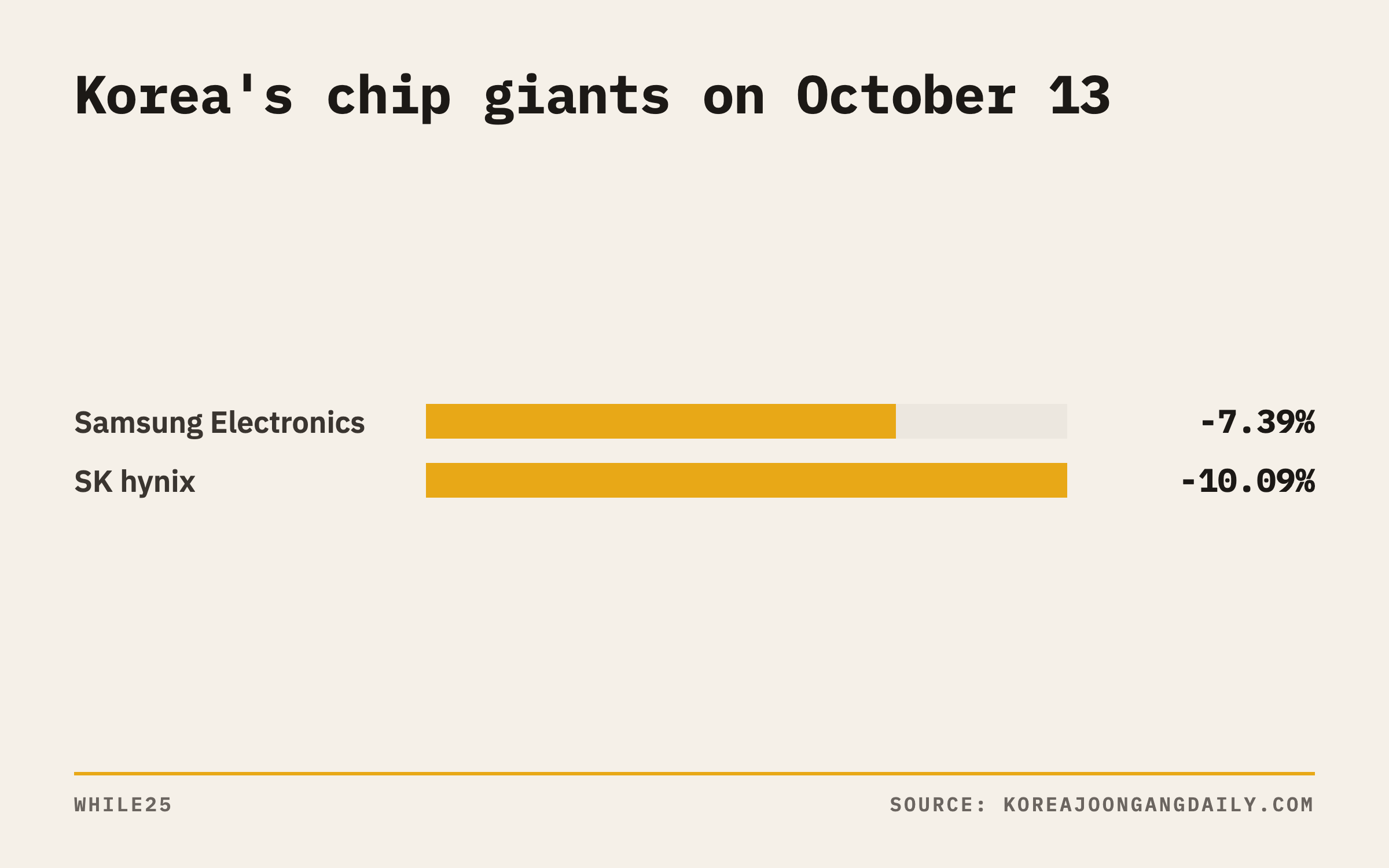 Bar chart showing Samsung Electronics fell 7.39% and SK hynix fell 10.09% on October 13
A pause gives traders time. They can read the news and cancel stale orders. They can also see who wants to buy. If sellers want out after that, they push prices lower. Foreign investors ended the day as net sellers of 2.2 trillion won. That figure covers the full trading day, which ran for hours past the five-minute window.
The view from an index fund
Many US investors own Korean shares through index funds. An index fund buys the shares in an index, so its owners skip picking stocks. Emerging-markets and Asia index funds often count Samsung and SK hynix among their larger holdings.
During a sidecar, some program trades in Seoul wait inside a five-minute window. The companies' earnings stay the same. Your fund values its Korean shares at their closing prices. On October 13, a fund holding Samsung valued it at its close of 232,000 won.
A circuit breaker would matter more for price discovery. Price discovery is the process of buyers and sellers agreeing on a price. During a halt, no KOSPI shares change hands in Seoul. Investors trade US-listed funds that hold Korean shares while Seoul's market is closed. In those hours, traders price the funds on estimates. A long halt, or a stage-three stop, gives those estimates more time without a local price to check them.
You can read a sidecar as a signal about speed. It means KOSPI 200 futures fell 5 percent or more and stayed there for a minute. A Korea-heavy fund's value depends on later prices. It rests on where traders price Samsung, SK hynix and other Korean shares once the brakes come off.
Sources
Not investment advice.