
Micron Technology's share price fell 3.9% on Monday, October 12. A Chinese rival had said a denser memory chip design is close to market. The stock had ended the prior trading day at $1,029.00. On October 12, its lowest price was $978.50. Its last trade came at $989.04, according to MarketBeat.
Shares of the big Korean memory makers fell on the same day. Yahoo Finance reported that SK Hynix dropped 3% and Samsung Electronics lost 4%. The news came from ChangXin Memory Technologies, or CXMT. CXMT is China's main maker of computer memory. Its chief executive spoke at the fourth Integrated Circuit and Chiplet Conference in Shanghai on October 9 and 10.
To see why investors sold the largest memory stocks after a conference talk, start with the smallest part inside a memory chip.
The smallest part of a memory chip
The chips in this story are DRAM. DRAM is the short-term working memory that computers and servers use to hold data while they run. A DRAM chip is a grid of tiny storage spots called cells.
Each cell holds one bit, a single 1 or 0. It uses two parts to do this. A transistor is a tiny electric switch. A capacitor is a tiny container for electric charge. A charged container reads as 1, and an empty one reads as 0.
Memory makers sell storage by the bit. Factories build many chips on one wafer, a thin silicon disc, and cut the chips from it. A smaller cell fits more bits on each wafer. More bits from the same wafer lower the cost of each bit. Shrinking the cell is the oldest way memory makers compete on price.
Reading 4F² and 6F²
Engineers use a shorthand for cell size. F stands for the feature size. That is the width of the smallest line a factory can print on a chip. F² is a square with sides of that width.
Today's industry standard is 6F². Each cell covers an area equal to six of those squares. CXMT's design is 4F², so each cell covers four. According to Seoul Economic Daily, CXMT says the 4F² structure "can reduce cell area by about 33%" compared with 6F².
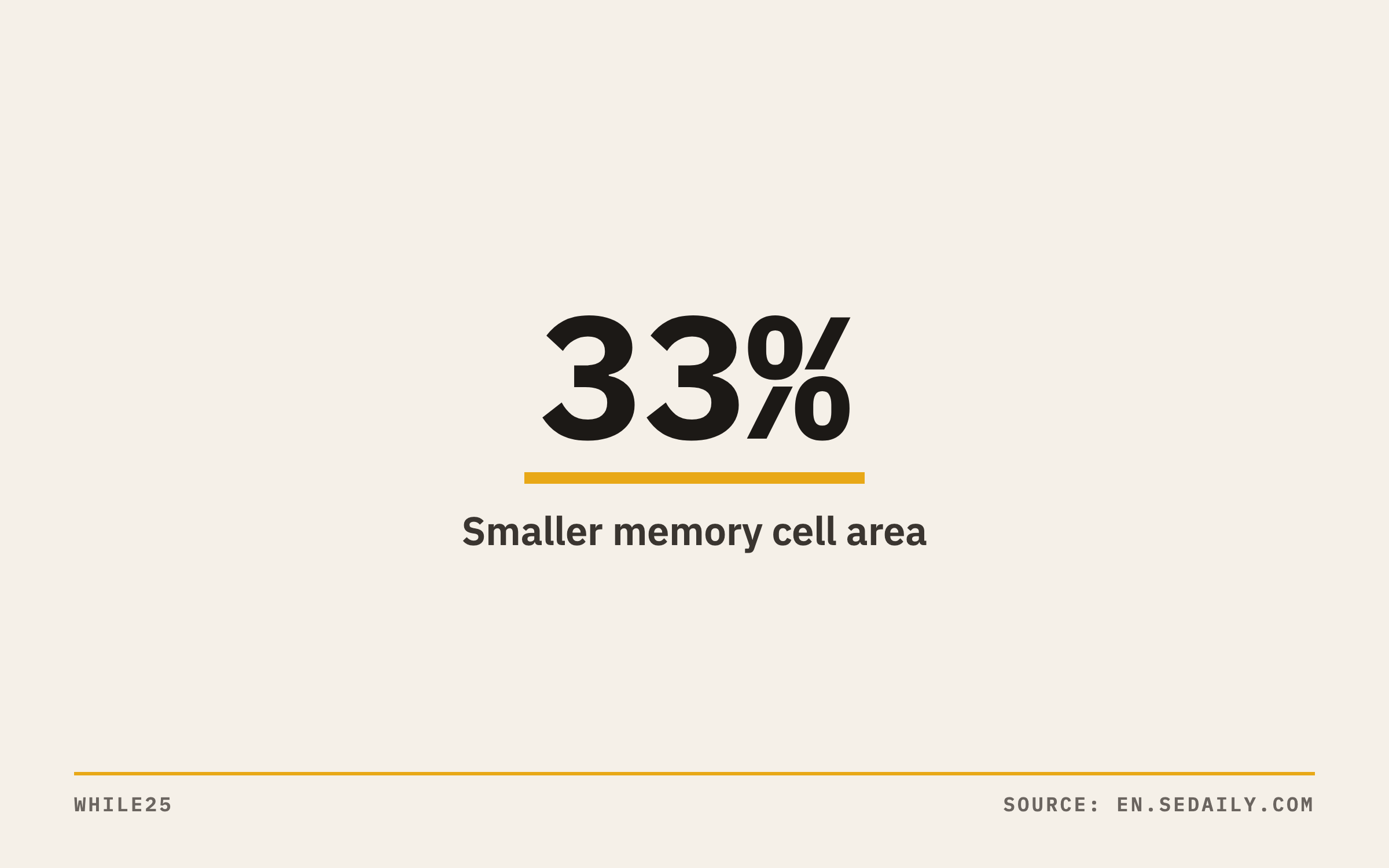 CXMT says its 4F² design cuts memory cell area by about 33% compared with the 6F² standard
The hard part is the physical layout. In a 6F² cell, the transistor lies flat. It takes up floor space beside its neighbors. To reach 4F², chipmakers stand the transistor on its end. The cell gains height and uses less floor space.
CXMT says it laid the groundwork with a "vertical surrounding gate," or VSG, transistor. In this design, current flows along a path that runs from bottom to top. The gate is the part that turns the switch on and off. In a VSG transistor, the gate wraps around that path. An upright switch frees the floor space that the smaller cell needs.
CXMT's timeline against Samsung and SK Hynix
The CEO said CXMT would launch a server memory product using the design by year-end. The product is a DDR5 registered memory module, or RDIMM. DDR5 is the current generation of computer memory. An RDIMM is a memory stick built for servers. It carries an extra chip that steadies the signals between the memory and the processor.
The Korean makers have their own plans for the same layout. Samsung plans to use the 4F² structure in DRAM made at below 10 nanometers. A nanometer is one billionth of a meter. Samsung aims to begin mass production, meaning output in large volumes, in 2028. SK Hynix disclosed its own 4F² roadmap last year. A roadmap is a company's published plan for future products.
Seoul Economic Daily wrote that, on announced timelines, CXMT "would be about two years ahead of Samsung Electronics." The phrase "on announced timelines" carries the weight of that sentence. It sets a target date from CXMT against a target date from Samsung. Neither company has shipped a 4F² product.
Investors' reading
A commodity is a product that buyers treat as the same from any seller. Much of DRAM sells as a near-commodity. In many cases, a buyer can swap a standard DDR5 part from one maker for a part from another. That link ties prices to supply and to cost. A rival that makes more bits per wafer can offer them for less.
MarketBeat summed up the concern in one line: "Investors fear this could eventually challenge Micron's pricing power and supply advantage." Pricing power is a company's ability to keep its prices high without losing buyers. A supply advantage means having more product to sell, or making it at lower cost than rivals.
Micron came into the day below its peak. Yahoo Finance reported the stock sat around 16% below its all-time high in June. An all-time high is the highest price a stock has reached.
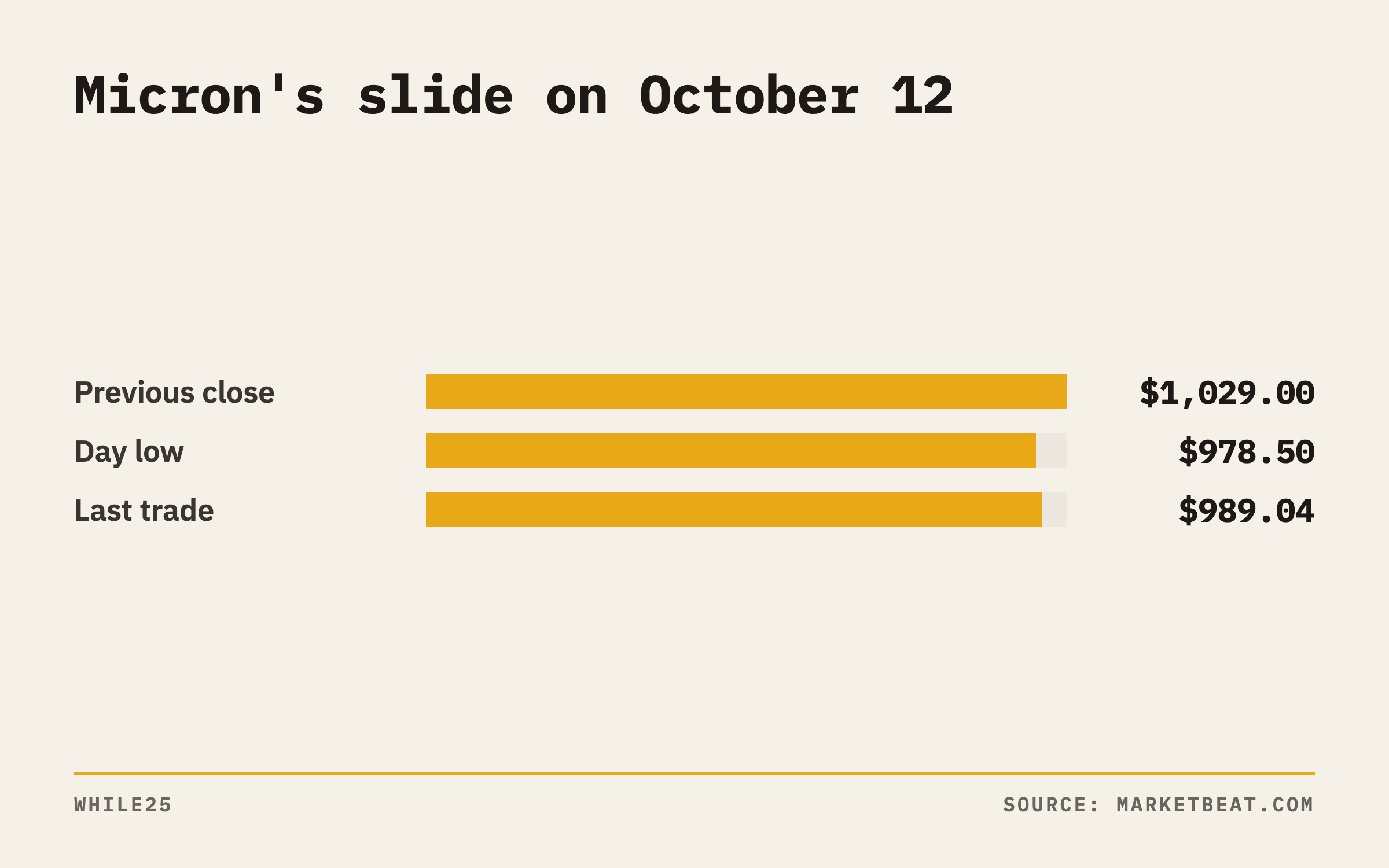 Micron's share price on October 12: previous close $1,029.00, day low $978.50, last trade $989.04
Many technology stocks fell that day. An index tracks the prices of a group of stocks as one number. The Nasdaq Composite, an index heavy in technology companies, lost 0.44% on October 12. The S&P 500, a broad index of large US companies, slipped 0.06%. The Dow Jones, another index of large US companies, rose 0.38%.
Hammerstone Markets wrote that technology stocks "lagged all day." Nine of the eleven S&P sectors, or industry groups, finished with gains. XLE, a fund that tracks energy stocks, led with a 1.43% gain. XLC, a fund that tracks communications stocks, rose 0.97%.
MarketBeat pointed to "broader technology-sector weakness and higher oil prices" as extra selling pressure on Micron. Selling pressure is the push on a price when sellers outnumber buyers. Brent crude, the main global price for unrefined oil, rose 1.15% to $105.92 a barrel. US crude, called WTI, gained 1.43% to $93.16.
The open questions
CXMT disclosed no specifications. The public has no figures for the module's speed, capacity or power use. CXMT has said nothing about its yields.
Yield is the share of chips on a wafer that work when they leave the production line. A new design with low yields can cost more per working chip than an older design with high yields. A smaller cell needs enough good chips per wafer to lower the cost per bit.
Seoul Economic Daily quoted industry officials who drew the same line. They said it is "difficult to conclude that CXMT has pulled ahead on technology." They added: "Applying a new technology and securing a stable mass-production system are separate issues."
That leaves two questions open. The first is whether CXMT can build 4F² chips in volume. Its yields would need to be good enough to compete on cost. The year-end server module is the first public test. Its value as evidence depends on the details CXMT releases with it.
The second question is whether the Korean timelines change. Samsung's 2028 target and SK Hynix's roadmap are public. Any shift would come through company announcements.
Reading the move as an investor
Investors sold on October 12 after a design claim and a target date. No product specifications stood behind either one. The drop shows how investors in memory shares respond to news about cost per bit before a product ships.
Memory makers sell a product that buyers can swap between suppliers. A cheaper cell from any one of them affects the price all of them can charge. Investors in New York and Seoul reacted to one talk in Shanghai in the same trading session. That link explains the shared drop in Micron, Samsung and SK Hynix.
If you hold a memory chip stock, or a fund that owns them, two dates matter. The first is CXMT's year-end server module. The second is Samsung's 2028 mass-production target. Published specifications and yield data are the evidence the October conference talk did not include. Those numbers, once public, will show how much of Monday's fear rests on product and how much on plans.
Sources
Not investment advice.