
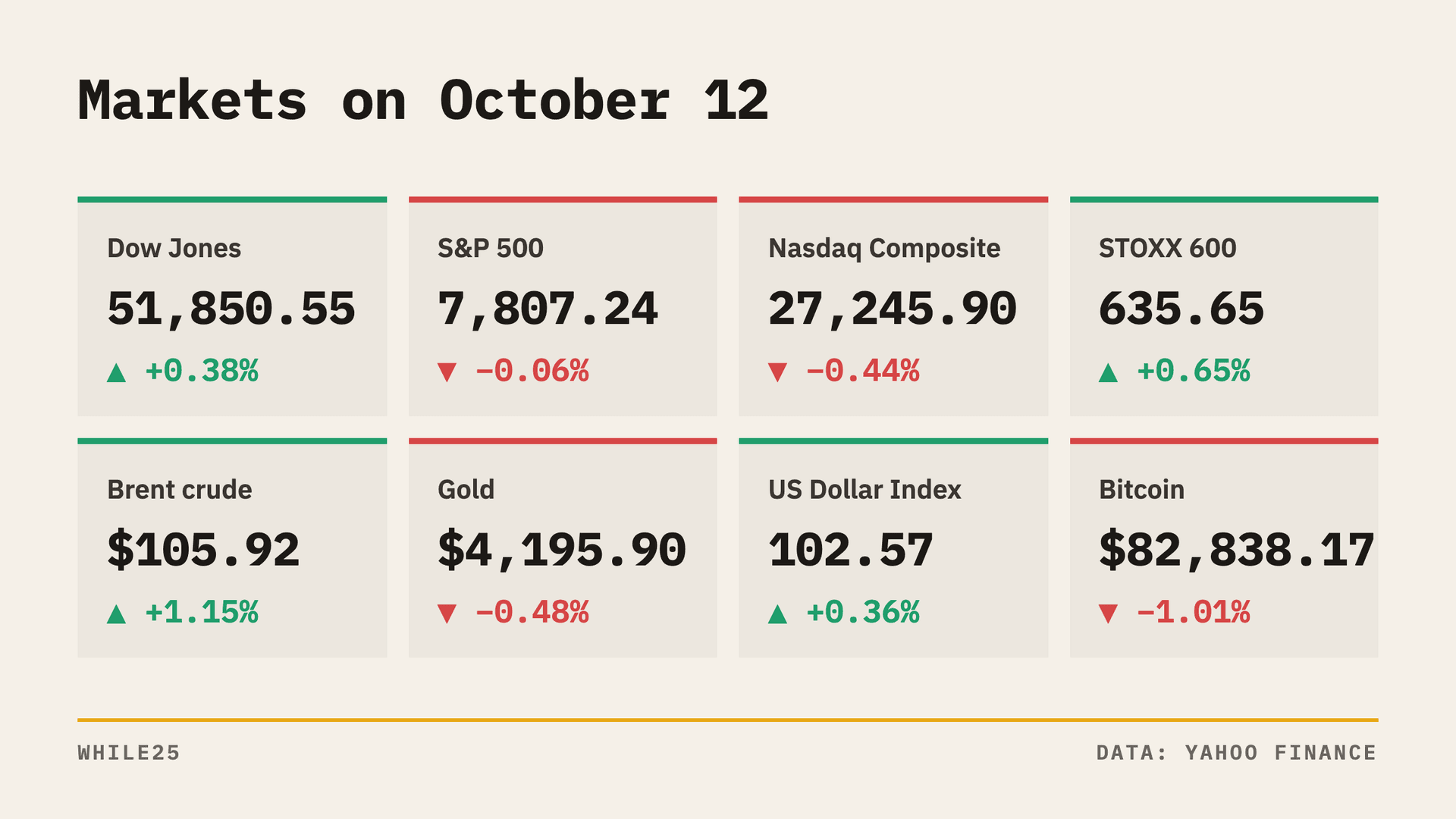
Brent crude, the main global price for oil, rose 1.15% to $105.92 a barrel on October 12. Traders gave Houthi strikes on Riyadh's main airport more weight than a new Russia-Ukraine energy truce. Investors bought shares of energy companies. The Dow Jones Industrial Average rose 0.38% to 51,850.55. The Dow is an index, a single number that tracks the stock prices of major US companies. A Chinese chipmaker made a claim about a new memory chip, and investors sold Micron Technology. Micron shares fell 3.9%. The Nasdaq Composite, an index full of tech companies, fell 0.44%. The S&P 500, an index of 500 large US companies, ended down 0.06% at 7,807.24, a tiny move.
Oil: a truce in the morning, attacks by the end of trading
Traders started the day with news that pointed to lower oil prices. On October 11, President Trump announced an energy truce between Russia and Ukraine. An energy truce is a pause in attacks on each side's energy sites. Trump wrote on Truth Social: "Both parties have agreed. Do not break it!" On October 9, he had announced a deal for Russia to release more than 300,000 tonnes of diesel. Another 1.5 million tonnes is due to follow.
Brent fell to about $103.04 a barrel after the truce announcement. The drop did not last. Ukrainian President Zelensky called the truce "news to me." He said Russia kept targeting Ukrainian energy sites with drones after the statement.
Traders turned their attention to Saudi Arabia. Houthi forces from Yemen have struck Riyadh's King Khalid International Airport four times in five days. In a Sunday attack, they killed one person and injured close to a dozen others. In an attack the day before, they killed 13 people. Lufthansa has cancelled all flights to Riyadh until October 16.
Traders gave those strikes more weight than the extra Russian supply. Traders buy and sell oil through futures. These are contracts to buy oil at a set price for delivery in a later month. Brent futures for December delivery rose above $106 for the first time since September 29. Brent finished the day at $105.92. WTI, the main US oil price, rose 1.43% to $93.16.
Investors expect oil drillers and refiners, which turn crude into fuel, to earn more when oil prices rise. Energy shares gained the most in the US stock market. XLE, the Energy Select Sector fund, holds large US energy stocks in one basket. It rose 1.43%. The communications fund, XLC, gained 0.97%. S&P 500 companies fall into 11 sectors, or industry groups. Nine of the 11 sectors finished higher. The Dow gained 195.60 points.
Tech: investors sell Micron on a Chinese memory claim
Tech stocks trailed the rest of the market. Investors started selling after news from China. ChangXin Memory Technologies, or CXMT, makes DRAM, the memory chips that hold data while a computer runs. Its chief executive spoke at a chip conference in Shanghai on October 9 and 10. A server is a large computer that runs websites and apps for many users. The CEO said CXMT would launch a server memory module by year-end. The module would use a new cell design called 4F².
A memory cell is the tiny unit that stores data on a chip. CXMT says the 4F² layout can shrink cell area by about 33% compared with 6F², the industry's standard layout. Smaller cells let a maker fit more memory on each chip. Samsung targets 2028 to start mass production of its own 4F² chips. On the companies' announced timelines, CXMT would be about two years ahead of Samsung.
Investors read that as a threat to the established memory makers. MarketBeat reported that investors fear CXMT could challenge Micron's pricing power and supply advantage. Pricing power is the ability to charge more without losing buyers. A supply advantage is an edge in how many chips a company can make. Micron shares fell 3.9%. They last traded at $989.04. The day before, they closed at $1,029.00. The stock sits about 16% below the record high it reached in June. Shares of SK Hynix and Samsung Electronics fell too.
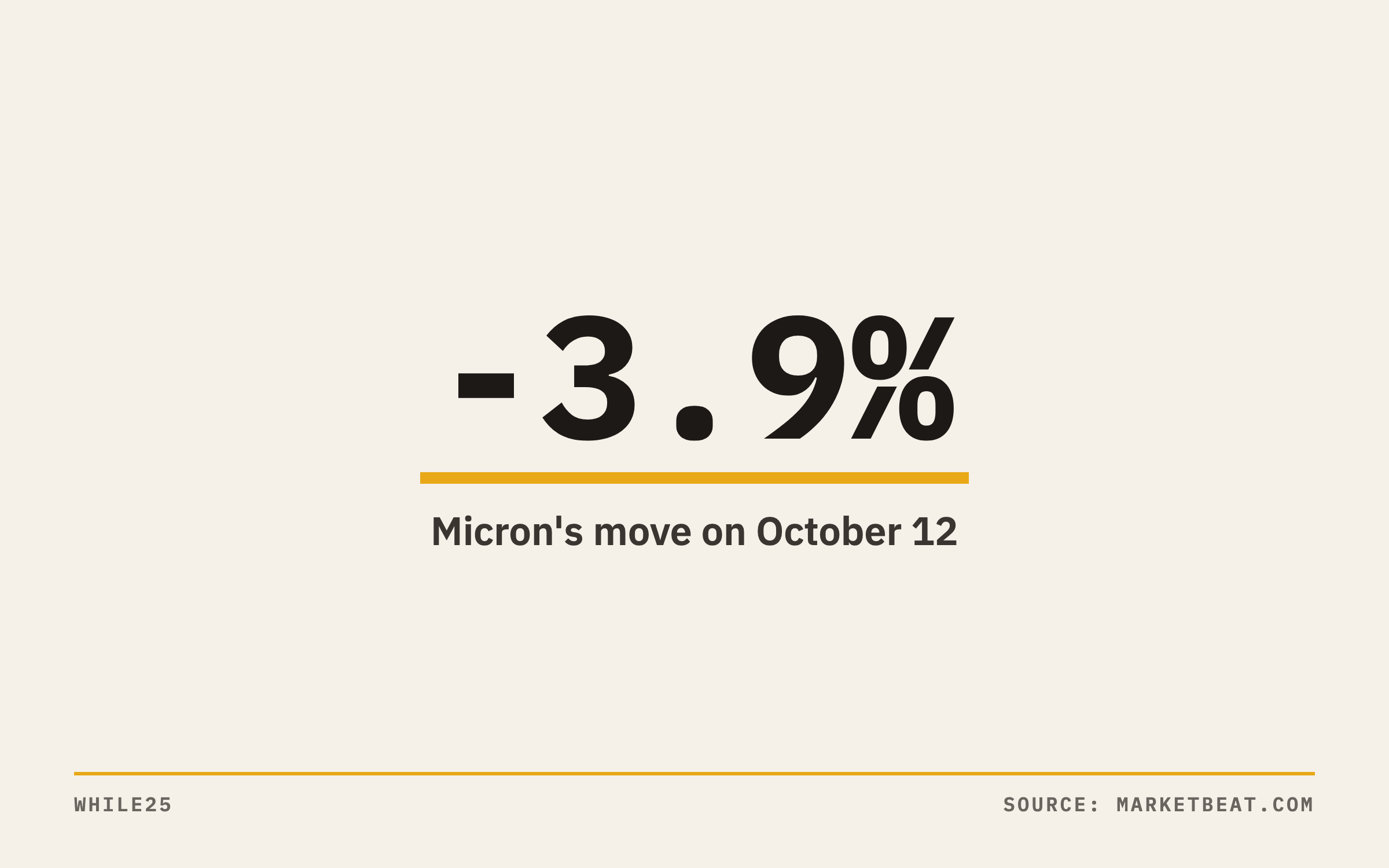 Micron shares fell 3.9% on October 12 after CXMT's memory-chip announcement
CXMT disclosed no technical specifications for the chip. Industry officials told Seoul Economic Daily it is "difficult to conclude that CXMT has pulled ahead on technology." They added that applying a new technology and running stable mass production "are separate issues."
Tech losses and energy gains cancelled out in the S&P 500. Hammerstone Markets summed up the trading day as "much ado about nothing." The Nasdaq, which includes many chip and software companies, fell 0.44% to 27,245.90. The Russell 2000, an index of smaller US companies, fell 0.45% to 2,794.48. The VIX, a gauge of how much traders expect stocks to swing, rose 2.49% to 15.21.
Europe: bank shares offset the oil hit
European stocks rose for a second straight day. The STOXX 600, an index of large European companies, finished up 0.65% at 635.65. Bank shares gained the most. The STOXX banking index rose 1.5%. Reuters reported that the surge in bank shares "helped absorb the hit from higher oil prices." Spain's IBEX index rose 1.33%.
Banks tend to earn more on loans when interest rates rise. This ties bank share prices to traders' forecasts for rates. The European Central Bank sets interest rates for the countries that use the euro. According to LSEG data, traders expect the bank to keep rates unchanged at its October meeting. They are betting on a quarter-point increase in December, a rise of a quarter of one percentage point.
London's FTSE 100 index gained 0.99% to 10,656.28. Germany's DAX index rose 0.76%. France's CAC 40 index added 0.38%. Shares of luxury group LVMH rose 1.18% ahead of its third-quarter sales report. In that report, LVMH posted organic sales growth below expectations. Organic growth is sales growth without the effects of currency moves and of companies LVMH bought. The shortfall came from weak demand for fashion and leather goods.
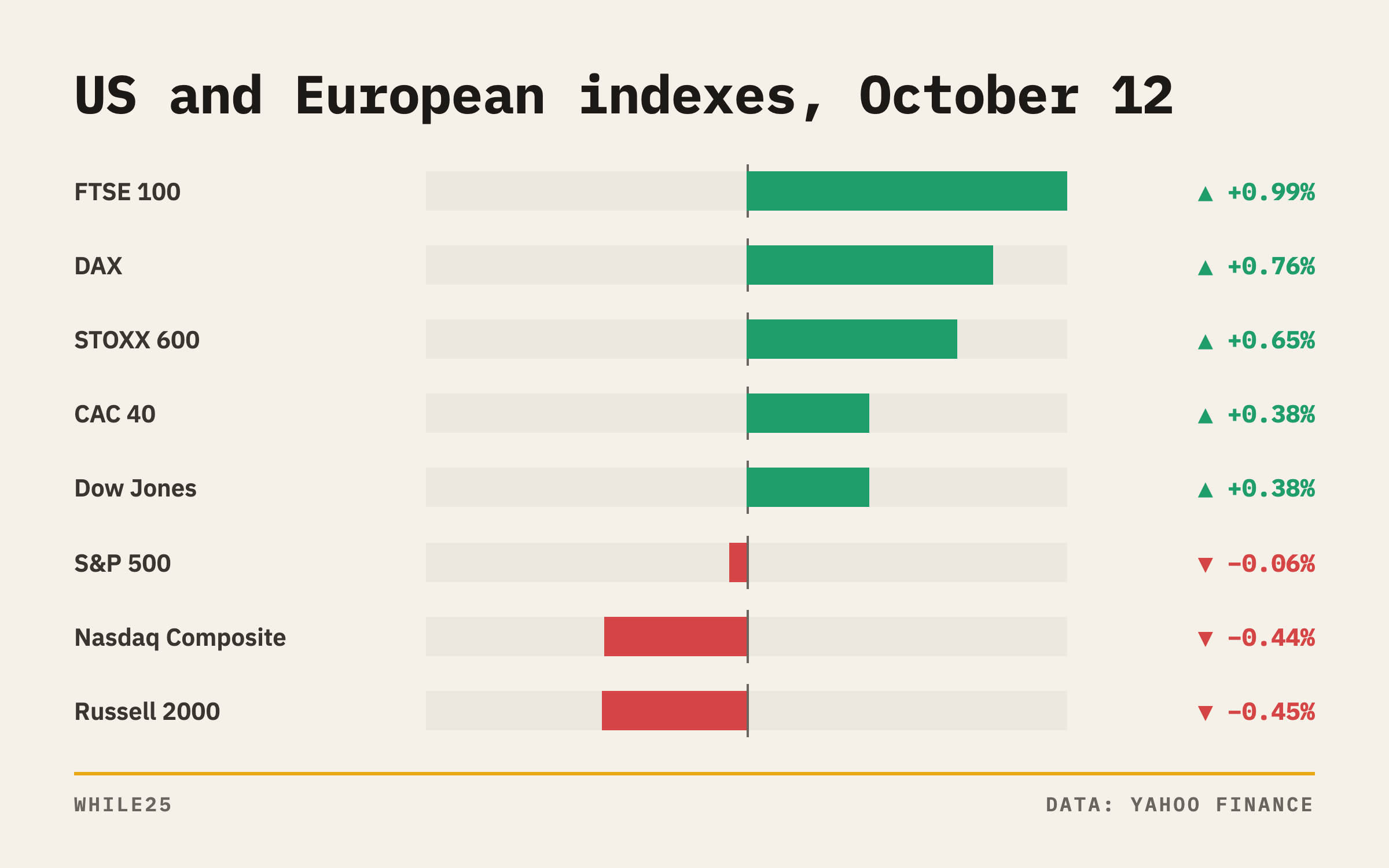 US and European stock indexes on October 12: European indexes and the Dow rose, while the Nasdaq and Russell 2000 fell
Asia: no new closing prices
We have no October 12 closing prices for the main Asian indexes. In the latest data we have, Hong Kong's Hang Seng index rose 1.79% on October 9. India's Nifty 50 gained 1.30% that day. Japan's Nikkei 225 slipped 0.02% that day. South Korea's KOSPI fell 2.62% on October 8. After the CXMT news, investors sold Korean memory makers Samsung and SK Hynix, among other stocks.
Bond market shut, dollar stronger
The US cash bond market closed for Columbus Day. Bonds are loans that governments and companies take from investors. In the cash bond market, investors buy and sell those bonds. The stock market stayed open. Bond traders rely on banks and on payment systems to settle large trades. Settling a trade means moving the money and the bonds between buyer and seller. Banks took the holiday, so SIFMA, the bond industry's trade group, recommended a full close.
The 10-year Treasury yield is the interest rate the US government pays to borrow for 10 years. It showed 5.24%, down 0.4 basis points. 100 basis points make one percentage point. Over the past month the yield has risen 27.9 basis points. The Federal Reserve, or Fed, is the US central bank. On September 16, the Fed raised its target range for short-term interest rates by 0.25 percentage points to 3.75%-4.00%. The target range is the band the Fed wants those rates to stay in. That was its first increase since July 2023.
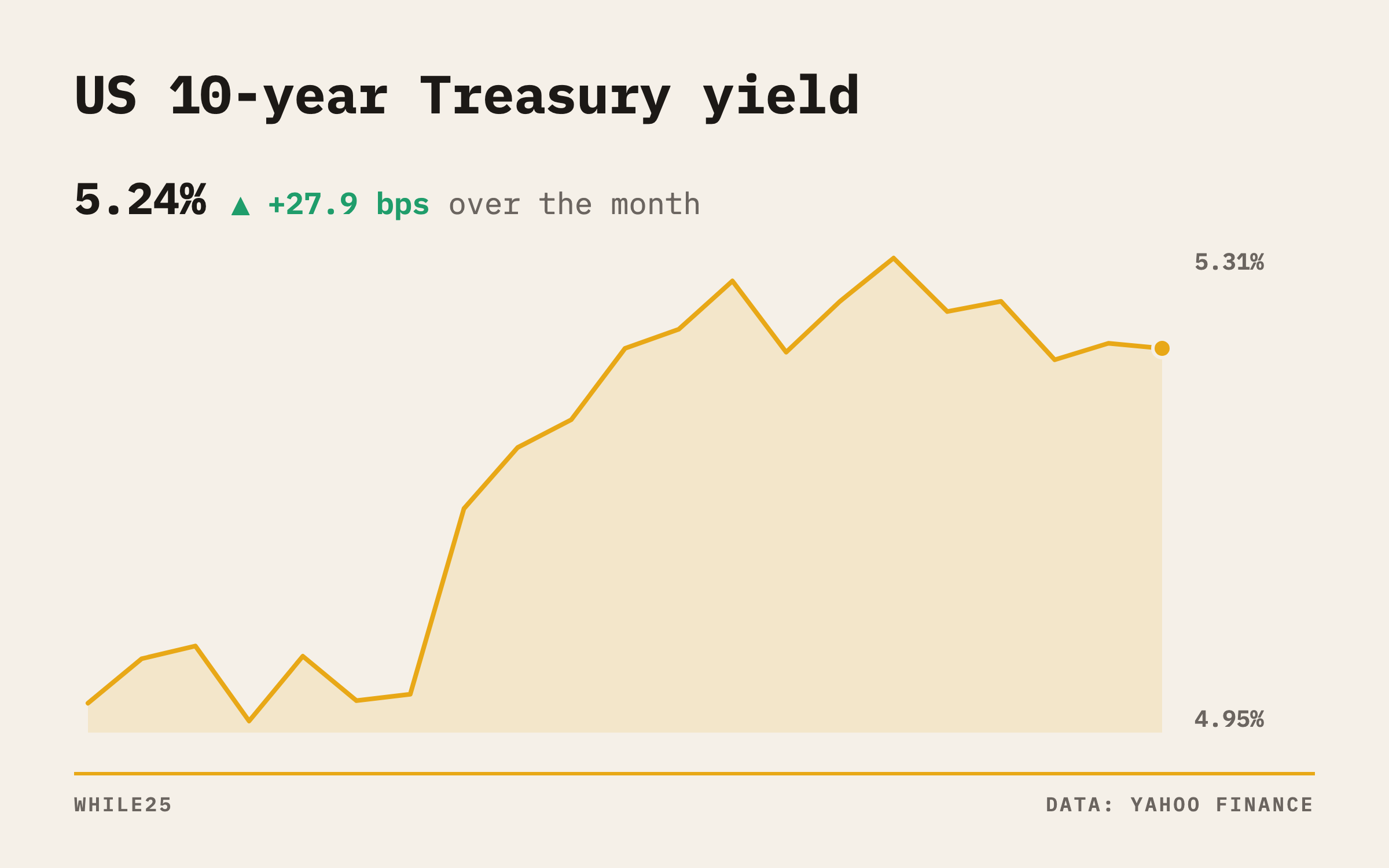 The US 10-year Treasury yield over the past month, ending at 5.24% on October 12
The dollar gained. The US Dollar Index tracks the dollar against a group of major currencies. It rose 0.36% to 102.575. The euro fell 0.49% to $1.1158. One dollar bought 158.6 yen. Gold slipped 0.48% to $4,195.90 an ounce. Bitcoin fell 1.01% to about $82,838.
The week ahead
The bond market reopens on October 13. Companies and the government release the week's first earnings reports and economic data the same day. Earnings reports show how much profit a company made.
- October 13: JPMorgan, Goldman Sachs, Citigroup and Wells Fargo report third-quarter results before US stock trading opens. The NFIB small-business index, a survey of small-business owners, comes out the same day.
- October 14: Inflation is how fast prices rise. The government releases the September consumer price index (CPI), the main US inflation gauge. The Fed publishes its Beige Book, a survey of business conditions across US regions. Bank of America, Morgan Stanley and BlackRock report results. ASML reports later in the week.
- October 15: The government releases producer prices, retail sales and weekly jobless claims. Producer prices are what businesses charge each other. Jobless claims are new filings for unemployment benefits. TSMC reports results.
- October 16: The government reports industrial production, a measure of factory output. The Fed Chair, the head of the central bank, is due to speak.
- October 27-28: The Fed holds its next policy meeting, where it decides on interest rates.
The S&P 500 moved 0.06% on October 12. Under that small move, energy funds and memory-chip stocks went opposite ways. An investor in a broad index fund, which holds a whole index, saw a quiet day. An investor heavy in energy or in chips had a different day from the one the headline number shows. Oil traders react to Gulf security news as much as to supply deals. Fed officials will read this week's bank results and inflation data before their October 27-28 rate decision. The 10-year yield is up 27.9 basis points in a month. That yield is the first place traders' reaction to those numbers will show.
Sources
- investrade.com
- marketbeat.com
- finance.yahoo.com
- en.sedaily.com
- aljazeera.com
- aljazeera.com
- marketscreener.com
- heygotrade.com
- admiralmarkets.com
- sifma.org
- tradefundrr.com
- en.iz.ru
Not investment advice.