
On October 6, the S&P 500, an index of large US companies, ended the trading day at a record 7,818.93. It rose 0.58%. An index combines the share prices of a group of companies into one number. A share is a small unit of ownership in a company.
On the same day, the Russell 2000, an index of smaller US companies, fell 0.59%.
Both indexes follow US stocks, another word for shares. On October 6 they moved in opposite directions. The reason lies in how the S&P 500 weighs its members. In this index, a bigger company counts for more. A few giant companies carry a large part of the total.
A record built on chip stocks
The S&P 500 gained 44.98 points on October 6, its first record high since August. A point is one unit of the index's level. The Nasdaq Composite, an index packed with technology companies, rose 0.45% to 27,599.79. It was the Nasdaq's second record finish in a row. The Dow Jones Industrial Average, an older index of large US companies, added 0.49%.
Chip makers, the companies that make computer chips, led the day. Yahoo Finance reported that Nvidia and AMD shares reached all-time highs. An all-time high is a stock's highest price on record. The two chip makers drove the gains in technology stocks, according to the same report. AMD CEO Lisa Su said "demand for compute continues to outrun supply." Compute means computing power.
Smaller companies missed out on the rise. The Russell 2000 ended the day at 2,830.30, down 16.84 points. This split has lasted longer than one trading day. Over the past month, the Russell 2000 has fallen 4.39%. The S&P 500 has gained 1.89% over the same month.
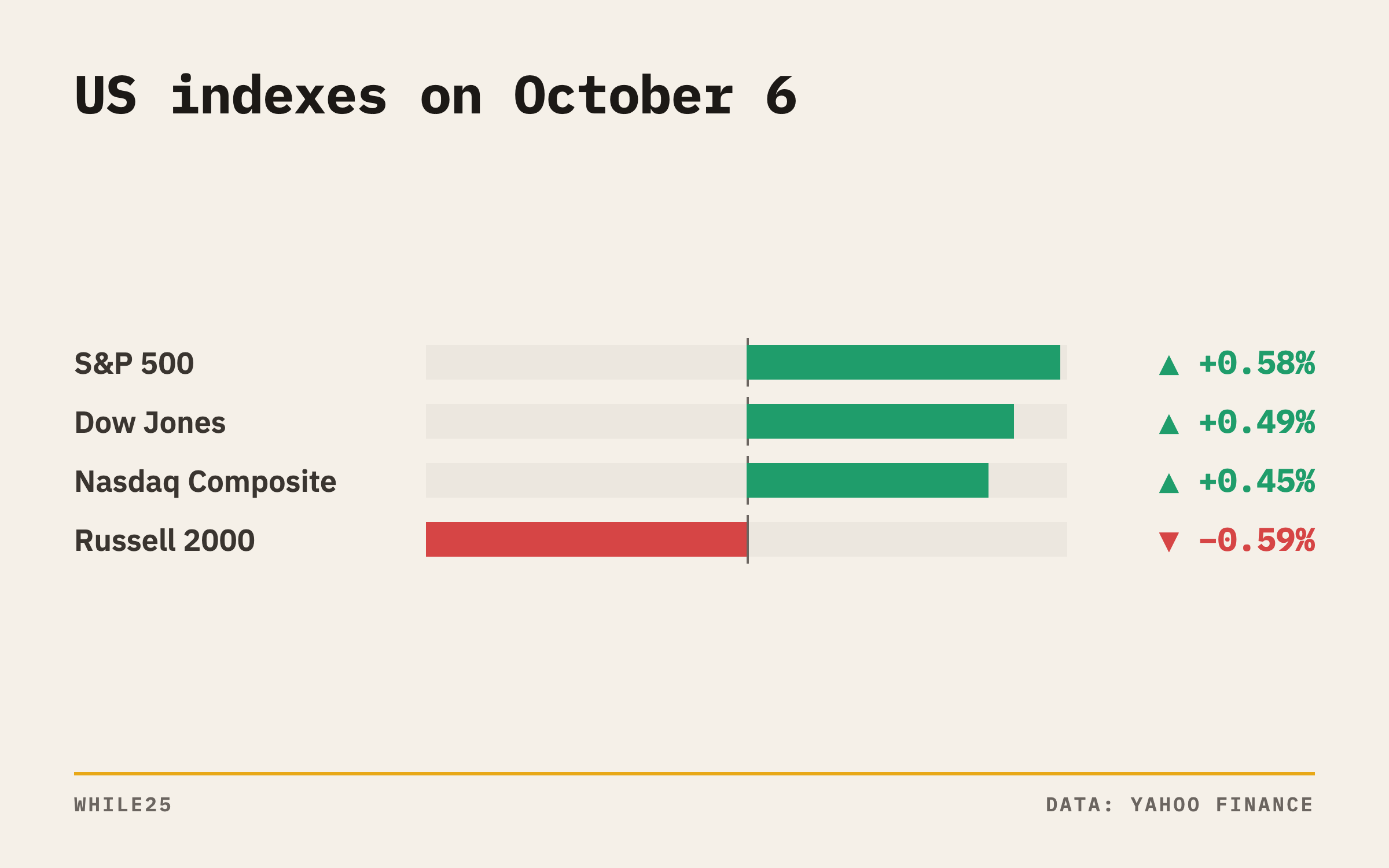 Day change on October 6: the S&P 500, Nasdaq and Dow rose while the Russell 2000 fell
Bigger companies count for more
Market cap, short for market capitalization, is a company's share price multiplied by its number of shares. It is the price investors put on the whole company. The S&P 500 is a market-cap-weighted index. Each company's slice of the index matches its market cap.
A company worth more gets a bigger slice. This works like a shareholder vote, where owners with bigger stakes get a bigger say. A gain in a giant moves the index more than the same percentage gain in a small member.
Nvidia, Apple and Microsoft hold the three biggest slices. Combined, they make up over 21% of the S&P 500, according to Yahoo Finance.
This weighting by size explains October 6. A strong day for Nvidia and other chip makers can lift the whole index. Many smaller members can fall on a day the index ends higher.
The math runs both ways. A bad day for the largest members can pull the S&P 500 down while most other members rise. In the headline number, the giants count first and the rest count second.
A fund pools money from many investors and invests it. Some funds track an equal-weight version of the S&P 500. In that version, each member gets the same slice. The smallest company counts as much as Nvidia. For this reason, the two versions can show different results on the same day.
The top 10 hold about 40%
The top of the index has grown heavier over the past decade. According to Firstrade, the 10 largest companies in the S&P 500 account for roughly 40% of its total weight. Ten years earlier, they held about 19%.
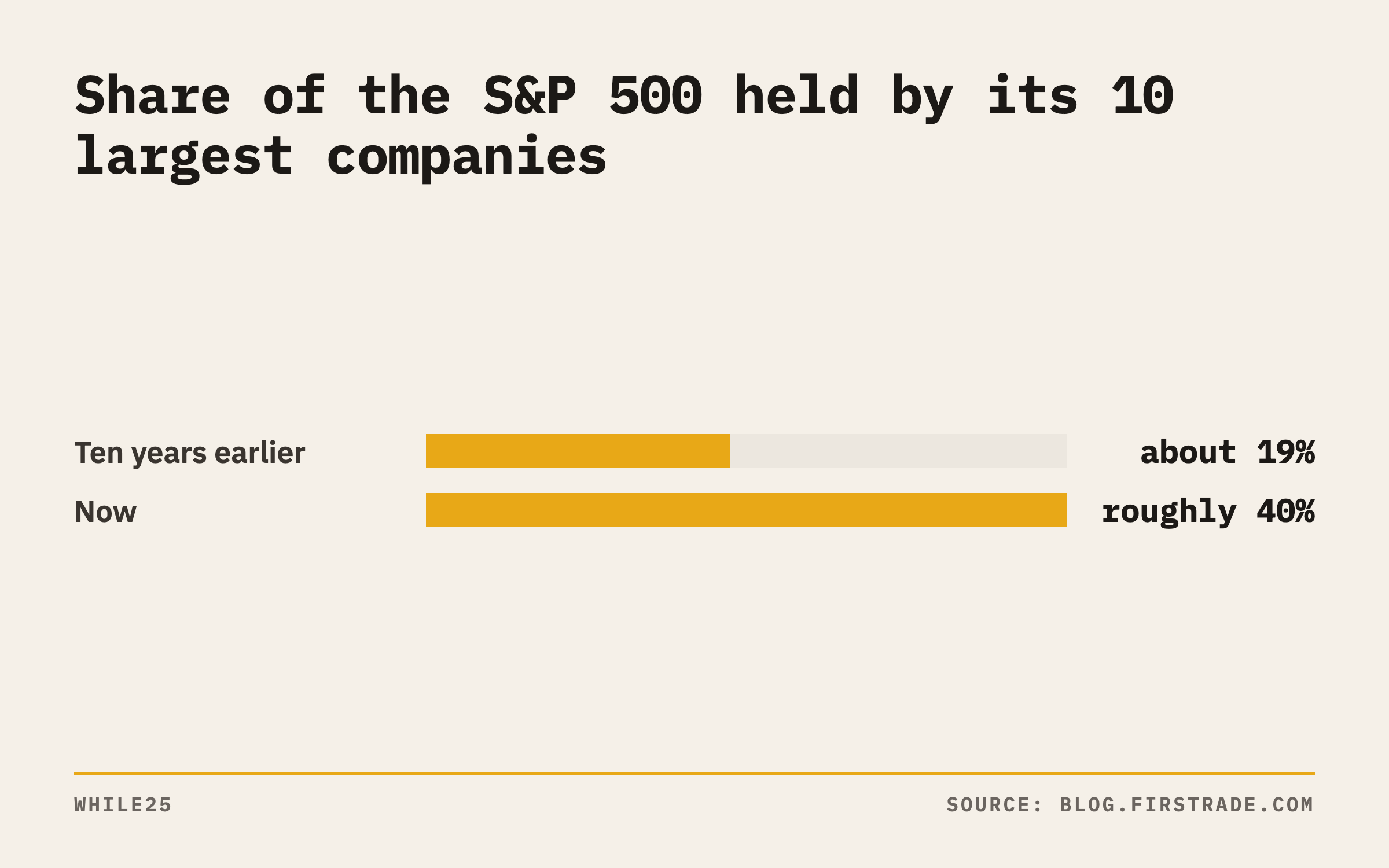 Share of the S&P 500 held by its 10 largest companies: about 19% ten years earlier, about 40% now
The top 10's size and profit have drifted apart. At the end of 2025, these companies held about 40% of the index's weight. They produced around 32% of its earnings, meaning the profits its companies report.
Investors pay more for each dollar of profit from the top 10 than for a dollar from the rest of the index. They may pay a higher price because they hope for faster growth. As a result, the index swings more on news about a handful of companies.
An earnings report is a company's update on its profits. One report from a giant can move the S&P 500 more than a report from a mid-sized member can. A chip maker's forecast or a phone maker's sales figures can steer the whole index on the day they come out.
Two indexes, two stories
The Russell 2000 sits on the other side of this math. It holds smaller US companies, so Nvidia, Apple and Microsoft are absent from it. No single giant can swing it the way Nvidia can swing the S&P 500.
On October 6, a reader who checked the S&P 500 saw a record. A reader who owned a small-company fund saw a loss. Both readers saw correct numbers for different parts of the same market.
The S&P 500 is the number most people hear on the evening news. It gives a clear picture of the largest companies. It gives a weaker picture of the typical US company. The distance between those two pictures has widened as the top 10 grew.
Your index fund and the top 10
An index fund is a fund that copies an index. An S&P 500 index fund buys the index's members in the same proportions as the index. If you own one, about 40% of your money sits in 10 companies. Over 21% sits in Nvidia, Apple and Microsoft.
The fund's name suggests a wide spread across US companies. The fund spreads its money by the index weights. Suppose you hold a large amount of the fund. As a result, you hold a large stake in a few technology companies, whether or not you bought their stocks yourself.
The same stocks can show up in several funds. A retirement account might hold an S&P 500 fund and a technology fund. Both can hold the same giants near the top of their lists. Your stake in those giants adds up across the funds.
Funds publish fact sheets, short documents from the fund company. A fact sheet lists the fund's largest holdings, meaning the investments it owns. It gives the share of money in each one. Most fund websites post the full list of holdings. Read the top lines of a fact sheet to see how much of your money sits in a few stocks. Line up the fact sheets of each fund you own to spot the names that repeat.
Fund weights describe what your fund measures, and they predict nothing about the giants' prices. On October 6, the largest members carried the S&P 500 to a record. Smaller companies in the Russell 2000 had a down day. Your portfolio is the full set of investments you own. Check its weights to learn which of those two days you had.
Sources
Not investment advice.