
On October 9, traders cut the wholesale price of diesel in New York Harbour by about 4.5%. The Financial Times reported a new price of $4.67 a gallon. Wholesale is the bulk price that refiners and traders pay for large lots. It comes before taxes and before the markup that fuel stations add.
That day, President Trump announced a deal with Vladimir Putin. Under the deal, Russia would supply diesel to US and global markets. The US Treasury issued General License 135 the same day. Under the license, American buyers may trade Russian diesel until April 7, 2027. Without it, those deals would break US sanctions, the government's bans on certain trade.
Pump prices for diesel remain high. AAA put the national average at nearly $6.28 a gallon on October 9. The record was $6.53, on September 22. A year earlier, the average was almost $3.68.
Traders read the new license as a reason to cut wholesale prices. European and British governments keep rules in place that may slow some of the fuel on its way to US ports.
The general license, in plain words
Sanctions are rules that bar Americans from doing business with certain countries, companies or goods. The Office of Foreign Assets Control, known as OFAC, writes those rules and makes people follow them. OFAC is part of the Treasury Department.
A license is a written exemption. With one, a person may make a deal that sanctions would ban. OFAC issues two kinds.
OFAC grants a specific license to one named company after that company applies. OFAC publishes a general license for anyone to read. Any person who meets its terms can use it without asking OFAC.
OFAC gives each general license a number. Many have an end date. OFAC can extend a general license, change its terms or cancel it. A trader who reads one starts with two things: the activity it covers and its deadline.
The terms of GL 135
Under GL 135, Americans may make deals "related to the sale, delivery, offloading, or importation" of Russian-origin diesel. OFAC issued it under the Russia sanctions regulations. A US buyer may purchase the fuel and arrange its shipment. The buyer may unload it at a port and bring it into the country.
OFAC's text names diesel made in Russia. Traders who handle other Russian fuels would need to check the exact wording before relying on the license.
The license runs until 12:01 a.m. Eastern time on April 7, 2027. After that minute, the exemption ends unless OFAC extends it.
Ship & Bunker reported that the Ending Importation of Russian Oil Act of 2022 remains in effect. Congress passed that law. Treasury writes its licenses under its own regulations. The 2022 law stays in force alongside the license. Importers, the firms that bring goods into the country, have two texts to read side by side: the license and the 2022 law.
The amounts in Trump's post
Trump set out the deliveries in stages in a social media post. He measured them in tonnes. A tonne is a metric ton, a unit of weight.
Trump wrote that 300,000 tonnes of diesel would come "immediately." Another 500,000 tonnes would follow in November.
Next would come 1 million tonnes "immediately thereafter." Up to 3 million tonnes would arrive later. Trump put the total at up to 4.8 million tonnes.
Russian and European fuel traders count diesel by weight. US sellers price it by the gallon, both wholesale and at the pump. A reader cannot compare the volumes with US prices at a glance.
Trump named a month for one stage: the second, in November. For the third and fourth stages, he used the phrases "immediately thereafter" and "later," with no dates attached.
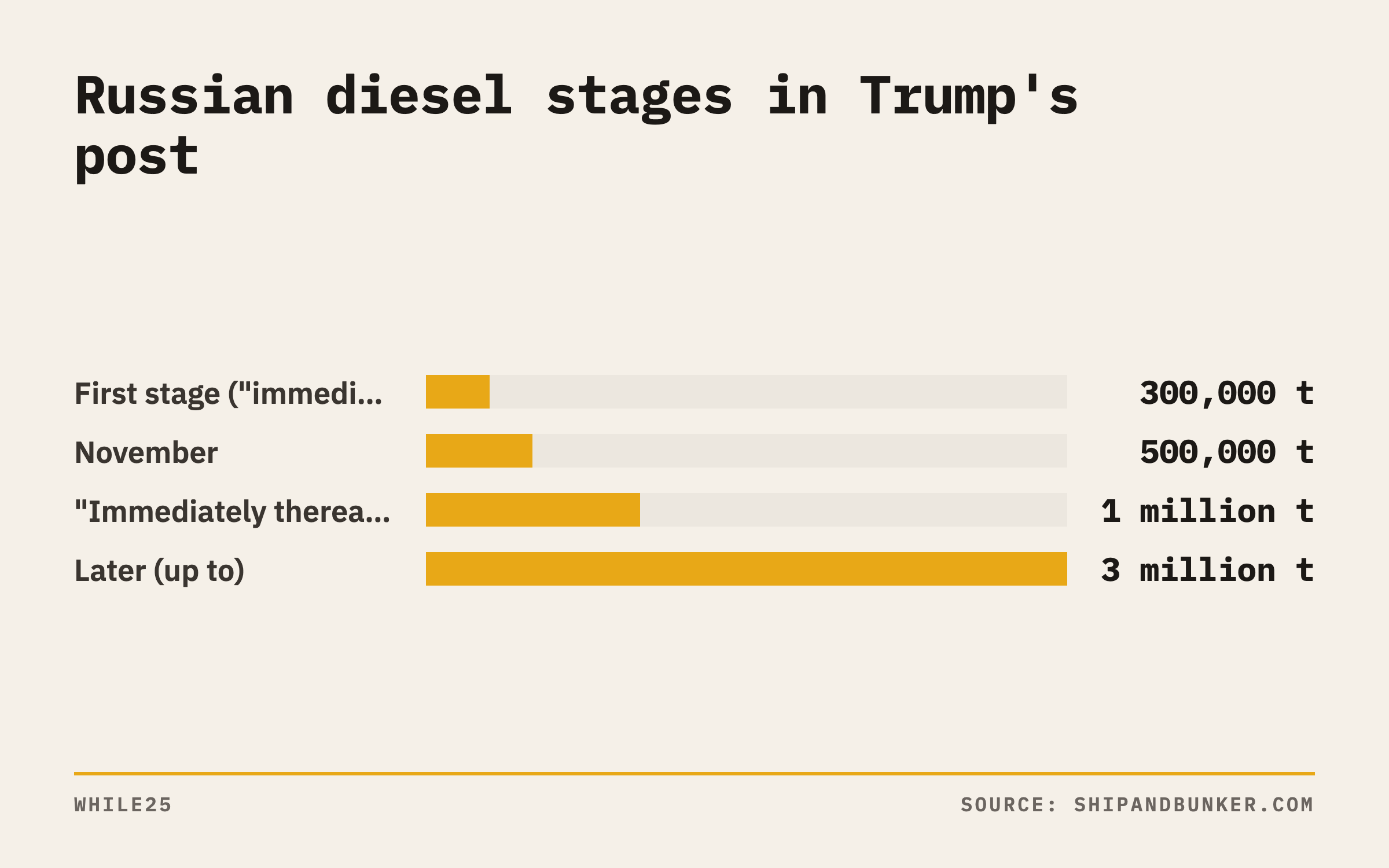 Bar chart of the four diesel delivery stages in Trump's October 9 post, from 300,000 tonnes up to 3 million tonnes, totaling up to 4.8 million tonnes
Europe's rules for shippers
Treasury's license applies to Americans. European and British companies answer to their own governments.
The EU and the UK have banned imports of Russian refined products since February 5, 2023. Refined products are fuels made from crude oil, the raw oil pumped from the ground. Diesel and gasoline are two examples. Under those bans, traders cannot bring Russian diesel into Europe or Britain.
The EU and the UK enforce a second rule, a price cap. A price cap is a ceiling on the sale price. EU and UK firms may carry Russian diesel to third countries, meaning countries outside their own borders. The price must be at or below $100 a barrel, the cap for "premium products." A barrel is the standard unit traders use for oil. Diesel falls in the premium group.
The United States counts as a third country under those rules. A European shipowner, insurer or broker can handle a Russian diesel cargo bound for New York. An insurer covers the cargo against loss. A broker is a go-between who arranges the deal. The contract price must sit at or below the cap. Above it, those firms must stay out.
To move, a cargo needs a tanker, a ship built to carry liquids, and an insurer. Many cargoes need a bank as well. Many of the firms that provide those services have their base in Europe or Britain. Each one answers to its own government's sanctions rules. With GL 135, Treasury cleared the US side of the trade. European and British governments left their rules for ships and insurers unchanged.
The price reaction
The New York Harbour price is a benchmark for the US East Coast. A benchmark is a reference price that traders use to set other prices. Traders cut that price about 4.5% on the announcement, to $4.67 a gallon, the Financial Times reported.
Traders made small moves in crude oil prices that day. Brent, the global benchmark for crude, stood at $104.72 a barrel at the close on October 9, up 0.42%. WTI, the main US crude benchmark, closed at $91.85, up 0.39%. Traders marked down diesel and left crude, its raw material, close to flat.
Fuel station owners pass wholesale price changes on to customers after a delay. They buy fuel in batches. They set new prices as fresh deliveries arrive. On October 9, AAA's national average of nearly $6.28 sat close to the September 22 record.
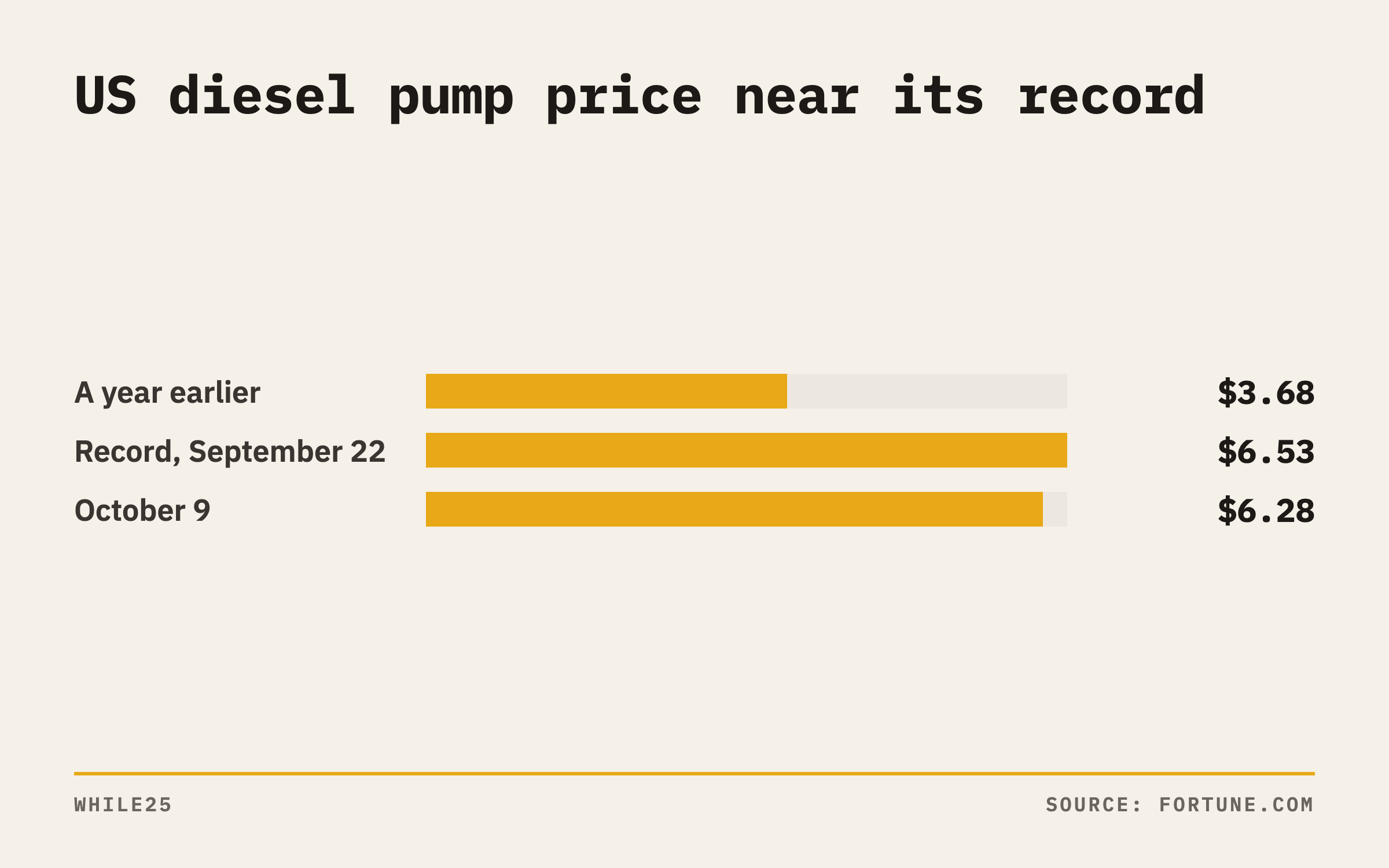 Bar chart of the US average diesel pump price per AAA: almost $3.68 a year earlier, the $6.53 record on September 22, and nearly $6.28 on October 9
Experts were cautious about the effect on prices. Clayton Seigle of the Center for Strategic and International Studies, a Washington research group, spoke to Fortune. "I don't think it'll be enough to materially lower prices in the United States or Europe," he said.
Reading this as an investor
Trucks, trains, cargo ships and farm machinery run on diesel. Shipping firms build its price into freight bills, the charges for moving goods by road, rail or sea. Carriers, the firms that move the goods, pass a pump price near $6.28 a gallon on to their customers. They add it to shipping costs and delivery surcharges. A surcharge is an extra fee on top of a base rate. Companies record those costs on their income statements, the reports that show sales, costs and profit.
Stock investors own shares, small slices of ownership in companies. For them, GL 135 is a government measure with an expiry date. OFAC can extend it, change it or let it expire. OFAC has no say over the EU and UK rules. Trump set out the fuel volumes in a social media post that named one month.
Readers can test the announcement against two dates. Trump's post named November for the 500,000-tonne stage. GL 135 ends at 12:01 a.m. Eastern on April 7, 2027, unless OFAC acts.
Wholesale traders marked diesel down about 4.5% on the day of the news. At the pump, a slower chain of buyers and sellers sets the price. On October 9, the pump average sat near the September 22 record of $6.53.
Sources
Not investment advice.