
Verizon's stock ended the trading day on October 9 down 8.75%. That was its worst day since July 2002. AT&T fell 9.81% the same day, its worst day since 2000. T-Mobile dropped 13.27%, its worst day since 2013. Each percentage measures the change in the price of one share, a small slice of ownership in the company. SpaceX is the rocket company that runs Starlink, a satellite internet service. The three drops came after SpaceX agreed to buy radio airwaves from a firm called Grain Management LLC.
Prices across the wider stock market rose that day. The S&P 500 is an index that tracks the stock prices of 500 large US companies. It gained 0.59% on October 9. Options are contracts that let a buyer trade a stock at a set price later. The VIX measures the price swings that options traders expect over the coming weeks. It fell 3.70% that day. Three of the largest US phone companies posted historic losses on a calm, rising day.
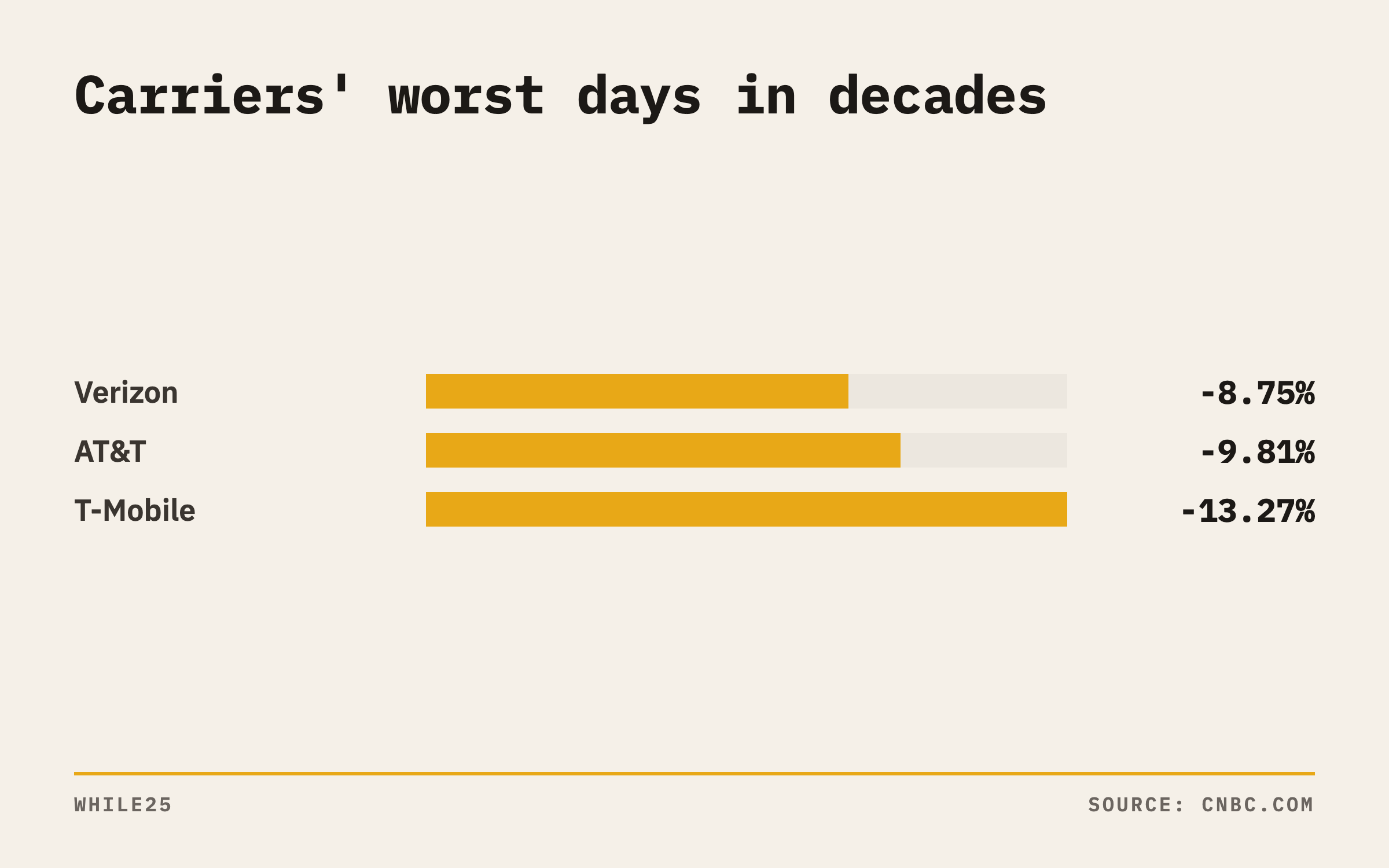 Bar chart of October 9 closing moves: Verizon down 8.75%, AT&T down 9.81%, T-Mobile down 13.27%
The deal SpaceX signed
SpaceX agreed to buy a slice of radio spectrum. Spectrum is the range of radio frequencies that carry phone calls, data and TV signals. The US government divides it into slices. It licenses each slice to a company. A company needs that license before it can broadcast on its slice.
The slice in this deal is up to 14 MHz of paired spectrum in the 800 MHz band. MHz stands for megahertz. It is a unit for how fast a radio wave vibrates. The "800 MHz band" names the spot where these airwaves sit on the radio dial. The "14 MHz" describes the width of the slice. A wider slice can carry more data at the same time.
"Paired" means the slice comes as two matching blocks. One block carries signals from the phone to the network. The other carries signals from the network back to the phone. Phone companies build their networks on pairs like this.
Grain holds these airwaves in a nationwide low-band portfolio, a collection of licenses in the low frequencies. SpaceX and Grain announced the deal on October 8. They did not disclose the price.
Low band, explained
A radio wave's frequency shapes the way it behaves. Low-band frequencies, such as the 800 MHz band, use long waves. Long waves pass through walls. They travel long distances before they fade.
Higher frequencies carry more data. But they fade faster. They struggle to get through concrete, glass and brick.
Phone companies build their networks around this trade-off. A carrier, the industry word for a phone company, uses higher frequencies for speed in crowded city blocks. It relies on low band to cover rural highways and the inside of homes and offices. A dead zone is a spot with no signal. A carrier without low band leaves dead zones in basements, elevators and back rooms.
The low-band spectrum in this deal can reach devices through walls and buildings. SpaceX sends its signal from space, so that reach matters to it. A satellite can reach a phone under open sky with ease. A phone inside an office tower is harder to reach.
The case for a new rival
SpaceX sells internet service through Starlink, using satellites. Shareholders in the phone companies, the people who own their stock, began to weigh a new question. They wondered whether SpaceX could sell phone service across the country.
Elon Musk, the chief executive of SpaceX, posted about the deal on X. He wrote: "This is the last critical piece of the spectrum puzzle needed for SpaceX to provide complete phone coverage in America."
Investors who own Verizon, AT&T and T-Mobile read that sentence as a threat from a new competitor. Those three companies sell monthly phone plans across the US. Coverage is the area where a carrier's signal works. Carriers compete on coverage more than on most other things. A customer picks a carrier in part because its signal works at home, at work and on the road.
A new nationwide network with indoor coverage would compete for those same customers. Investors set a stock price based on what they expect a company to earn in the years ahead. A new competitor can lower those expectations. Companies facing a new rival tend to cut prices to keep their customers. Shareholders sold all three carriers on October 9.
Drops this size are unusual for phone stocks. Investors treat phone carriers as steady, slow-moving holdings. Many own them for their regular dividends. A dividend is cash a company pays its shareholders out of its profits. Record daily drops reaching back to 2000, 2002 and 2013 are rare for this group.
Tower owners rose the same day
Shares of three other companies went the other way. Crown Castle, SBA Communications and American Tower rose 7% to 16% on October 9.
These companies own cell towers. Wireless networks rent space on those towers to hang their antennas. The carriers that fell on October 9 are among their tenants.
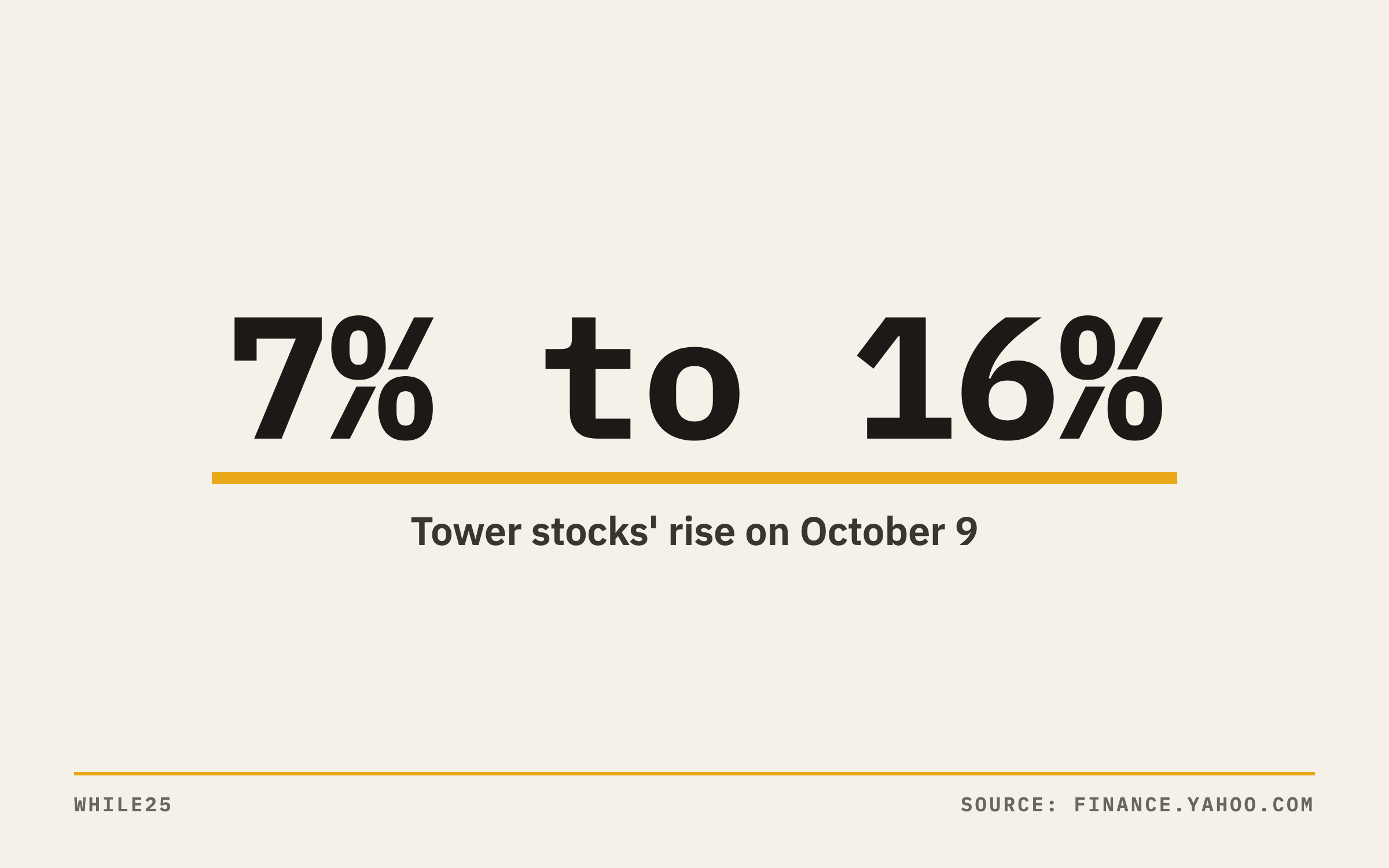 Stat card: Crown Castle, SBA Communications and American Tower rose 7% to 16% on October 9
Reporters at the cited outlets link the tower stocks' rise to the SpaceX deal. They give no single reason for it. Investors treated the carriers and their landlords as separate bets on the same news. A reader who expects a whole industry to move as one would have missed that split.
The FCC review
The Federal Communications Commission, or FCC, has to approve the deal. The FCC is the US agency that licenses airwaves and oversees phone networks. A company selling spectrum licenses needs the agency's consent before it hands them over.
Reporters at the cited outlets give no date for an FCC decision. They give no launch date for a SpaceX phone service. SpaceX and Grain have not disclosed the price. Those three gaps remain open as of October 12.
Your portfolio and this story
A portfolio is the set of investments a person owns. An index fund pools money from many investors and buys the stocks in an index. Its owners hold a small slice of each company. A fund that tracks the S&P 500 holds Verizon, AT&T and T-Mobile alongside hundreds of other companies. That index rose 0.59% on October 9. The three carriers posted historic drops the same day. Owners of a broad fund felt the shock spread thin across many holdings. An investor who owned a single carrier for its dividend took the full hit.
The second lesson concerns the word "safe." Telecom is short for telecommunications, the business of phone and data networks. Investors give telecom stocks that label because the phone business is slow to change. SpaceX comes from outside that industry. It signed one licensing deal. After that deal, all three carriers had their worst day in years. A steady dividend gave their owners no protection from a new competitor.
The tower owners show a final point. A sector is a group of companies in the same line of business. Companies in one sector can sit on opposite sides of one event. Investors can trace who pays whom and who rents from whom. That map explains why investors sold some of these stocks and bought others on the same afternoon.
Sources
Not investment advice.