
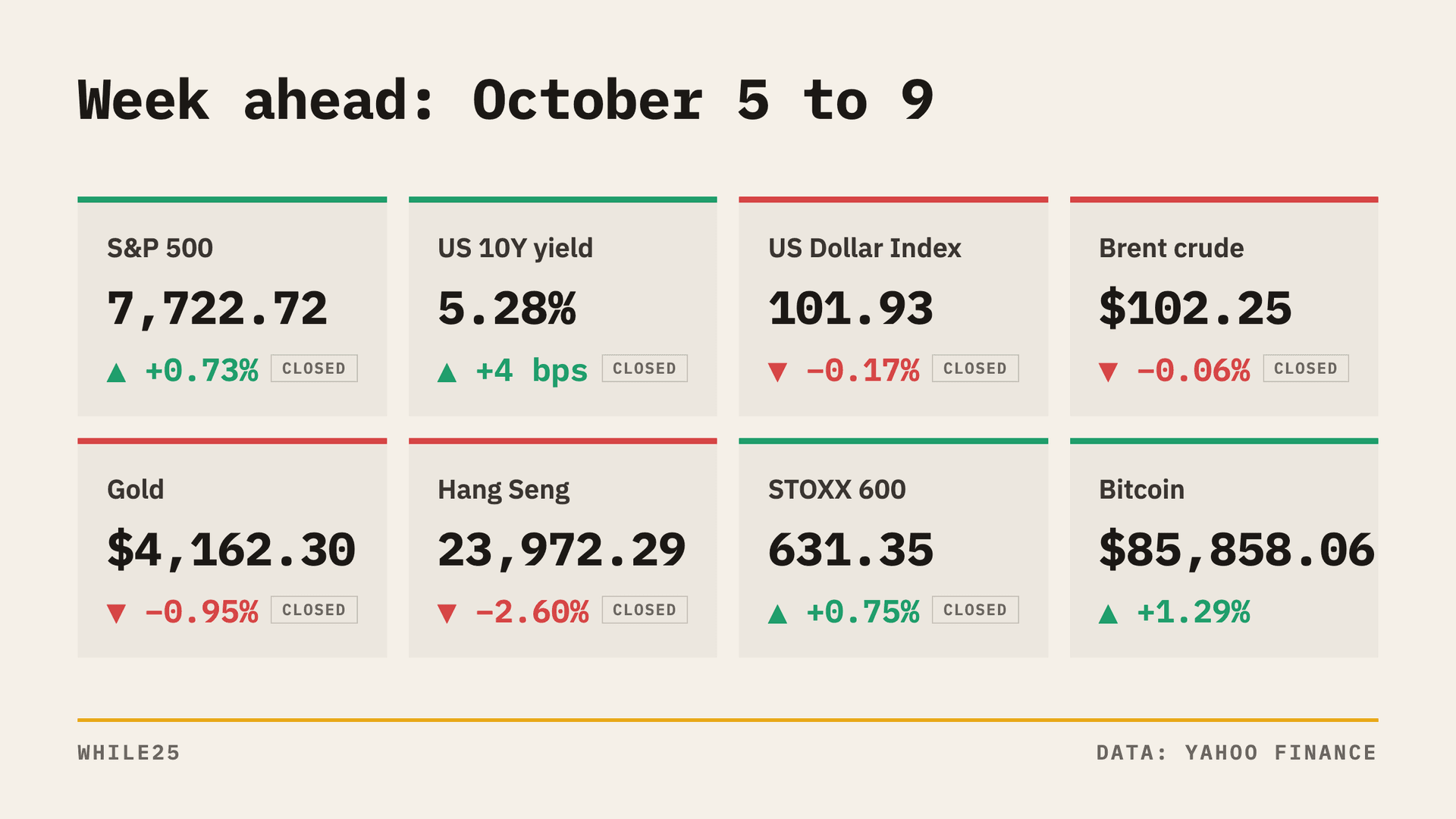
The Federal Reserve, the US central bank, publishes the minutes of its September meeting on October 7. The minutes are the written record of a Fed meeting. The Treasury sells $39 billion of 10-year notes the same day. A note is a loan that investors make to the US government for a set number of years.
The 10-year yield is the interest rate the US government pays to borrow for 10 years. It stood at 5.277% on October 2.
Lenders use that yield to set rates on mortgages and company loans. Investors use it to price stocks. The yield rose 48.1 basis points in a month. One hundred basis points make one percentage point.
The Fed has no rate decision scheduled for the week of October 5 to 9. Investors get the minutes, three Treasury debt sales and the first big earnings reports. In an earnings report, a company tells investors how much profit it made.
A weak jobs report after a rate hike
On September 16, the Fed raised its key rate by a quarter percentage point. The new range is 3.75% to 4.00%. Officials voted 12-0. A rate hike makes borrowing more expensive for households and companies.
On October 2, the Bureau of Labor Statistics reported that employers added 29,000 jobs in September. In an LSEG poll, economists had expected 90,000. The unemployment rate rose to 4.2%, above the 4.1% forecast. Pay growth cooled. Average hourly earnings rose 3%, below the 3.2% economists expected.
The government cut its earlier counts. In the new count, employers cut 10,000 jobs in July. They added 133,000 in August.
Futures are contracts that let traders bet on future interest rates. Futures traders moved toward betting on a pause. The CME FedWatch tool turns futures prices into odds for Fed moves. After the report, it showed a 79.5% chance the Fed holds rates in October. A day earlier, the chance stood at 75.6%.
The minutes cover the September debate in detail. In them, readers can see how officials weighed rising prices against slower hiring. Investors use the minutes to judge the Fed's view of the economy between meetings.
A bond market under strain
The 10-year yield traded around 4.0% before the war between the US and Iran began on February 28. It jumped more than 50 basis points in September. It then passed 5.3%. It closed at 5.277% on October 2.
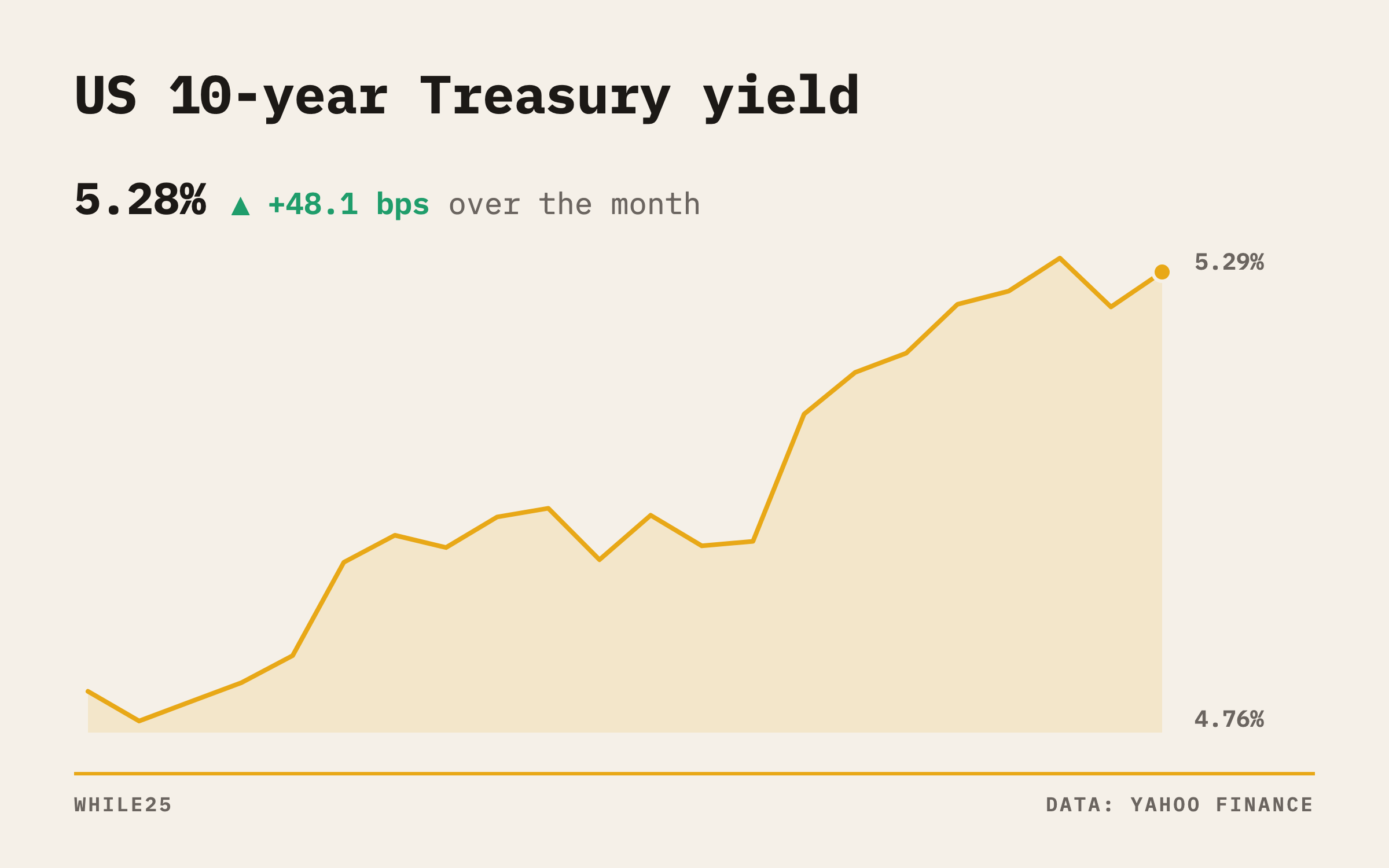 Line chart of the US 10-year Treasury yield over one month, rising to 5.277% on October 2
A higher yield means lenders charge the government more to borrow. Bond prices fall as yields rise. An older bond bought at a lower yield loses value once new bonds pay more.
The Treasury has to sell new debt into that market. An auction is a sale where investors bid for new government debt. Their bids set the yield. The Treasury sells $58 billion of 3-year notes on October 6. It sells $39 billion of 10-year notes on October 7. On October 8, it sells $22 billion of 30-year bonds, which work like notes with a longer term. The Treasury holds each sale at 1:00 p.m. ET.
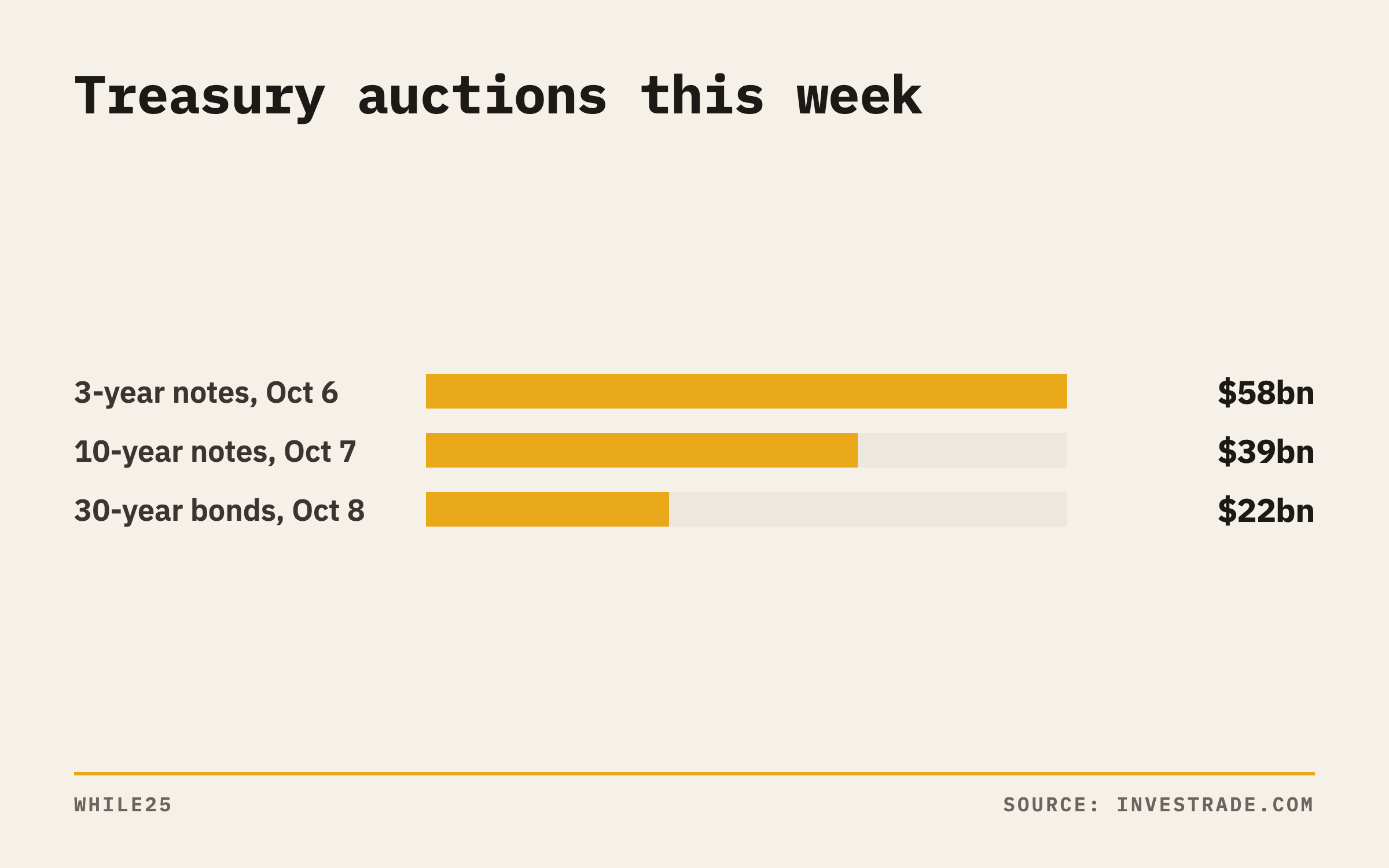 Bar chart of this week's Treasury auction sizes: $58 billion in 3-year notes, $39 billion in 10-year notes and $22 billion in 30-year bonds
The Treasury sold its last batch of 10-year notes at a yield of 4.83%. That sale drew a bid-to-cover ratio of 2.7. The ratio compares the bids received with the amount on offer. A higher ratio means more demand. The Treasury sold its last 30-year bonds at 5.31%, with a ratio of 2.6. If buyers bid weakly at a sale, yields can rise across the bond market. Strong bids can pull them down.
Traders in other markets have reacted to the yield. The dollar index measures the dollar against a basket of major currencies. It ended at 101.93. It rose 2.79% over the month.
Gold fell to $4,162.30, down 7.02% over the month. Gold pays no interest. Investors find it less attractive than bonds as yields climb. Bitcoin moved the other way. It traded at $85,858 on October 4, up 7.76% over the month.
High oil prices
Brent crude is the main global oil price. It closed at $102.25 a barrel on October 2. WTI, the main US oil price, closed at $91.11.
Ships carry roughly one-fifth of global crude and LNG supplies through the Strait of Hormuz. LNG is natural gas cooled into a liquid and shipped by sea. In practice, the strait has stayed shut since the fighting began on February 28.
OPEC+ is a group of oil-producing countries. On October 4, seven OPEC+ countries agreed to keep November production at September's required levels. In September, the group finished undoing 1.65 million barrels per day of voluntary output cuts. It keeps another 2 million barrels per day of cuts in place through year-end. The group meets next on November 1.
High fuel costs push up consumer prices. Central banks keep raising rates in part to fight that price pressure.
Stocks around the world
US stocks rose on October 2 but finished the week lower. The S&P 500, an index of 500 large US companies, gained 0.73% to 7,722.72. It ended five trading sessions down 0.27%. The Nasdaq Composite, another US index, rose 1.19%. The VIX, a gauge of how much traders expect stocks to swing, fell 6.59% to 15.31.
European stocks followed a similar path. The STOXX 600, an index of European companies, rose 0.75% on October 2. It lost 1.14% over five sessions. Germany's DAX index gained 1.17%.
Asian stocks fell hardest. Hong Kong's Hang Seng index fell 2.60% to 23,972.29. Reports tied the drop to two causes. The US 10-year yield sits at a more-than-two-decade high, and oil prices are rising. Japan's Nikkei 225 fell 0.94%. Mainland China's markets stay closed for Golden Week, a national holiday, through October 7.
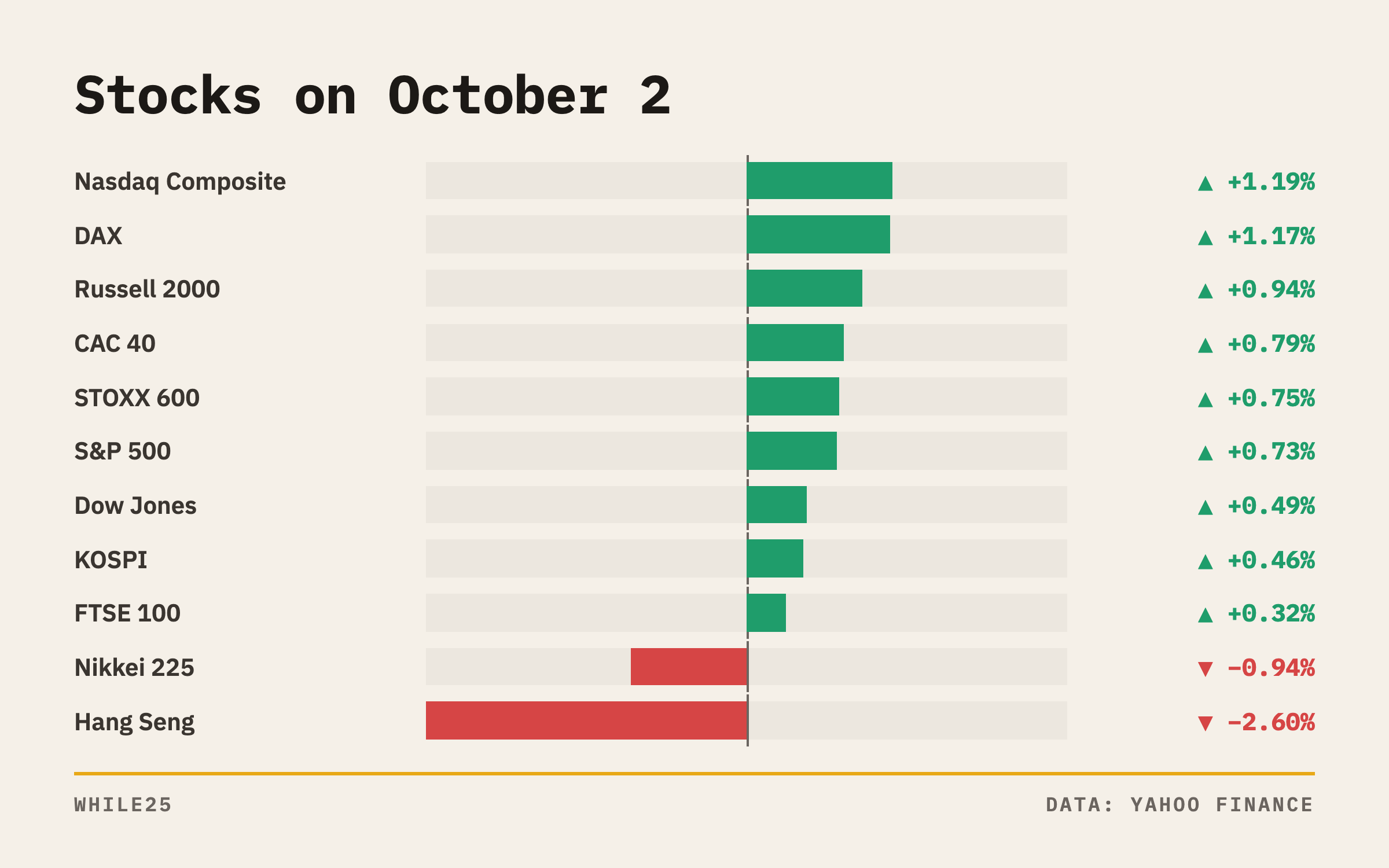 Horizontal bars of October 2 day changes for major stock indexes in the US, Europe and Asia, with the Hang Seng down the most
Other central banks are raising rates. The ECB, the central bank for the euro area, raised its three key rates by 25 basis points in September.
India's central bank decides on October 7. In a Business Standard poll, economists expect a 25-basis-point rise in the repo rate to 5.50%. The repo rate is the bank's main lending rate. The bank has held that rate at 5.25% in its last four reviews. Retail inflation measures how fast shop prices rise. In India, it rose to 4.82% in August.
The week, day by day
Monday, October 5. ISM publishes its September services index at 10:00 a.m. ET. The index surveys purchasing managers at service companies. Higher readings signal stronger activity. Forecasters expect 55.7, against 55.4 last time.
Tuesday, October 6. The government reports the US trade balance for August. The trade balance compares what the US sells abroad with what it buys. A deficit means the US buys more than it sells. Forecasters expect a deficit of $95.2 billion, against $88.6 billion the previous time. The Treasury sells $58 billion of 3-year notes. Constellation Brands reports earnings after the stock market closes.
Wednesday, October 7. The Reserve Bank of India announces its rate decision. Japan releases August wage data. The Treasury auctions $39 billion of 10-year notes at 1:00 p.m. ET. The Fed releases its September minutes at 18:00 GMT.
Thursday, October 8. PepsiCo reports before the stock market opens. Analysts expect profit of $2.30 a share. They expect revenue, or total sales, to grow 4.4% to $24.98 billion. The ECB publishes its account of the September meeting. Jobless claims count people who newly apply for unemployment benefits. Forecasters expect 200K weekly US jobless claims, against 197K the week before. The Treasury auctions $22 billion of 30-year bonds at 1:00 p.m. ET.
Friday, October 9. Delta Air Lines reports earnings. Analysts expect $1.94 a share. The University of Michigan publishes its preliminary consumer sentiment reading. The survey measures how upbeat consumers feel. Forecasters expect 47.6, against 48.1 last time. Canada releases its jobs report.
The link to your money
Lenders base rates on mortgages and car loans on the 10-year yield. Companies pay rates tied to it when they sell bonds. Savers can buy a government bond paying 5.277% in place of shares.
At this week's auctions, investors set what they charge to hold US debt at these levels. In the minutes, readers will see how Fed officials weighed weak hiring against oil-driven price pressure. Holders of long-term bond funds feel yield moves first. Those funds lose value when yields rise. Stock investors feel the moves in the price they pay for each dollar of company earnings.
Sources
- foxbusiness.com
- cnbc.com
- cmcmarkets.com
- fxempire.com
- investrade.com
- business-standard.com
- fxstreet.com
- pwcplus.de
- thenationalnews.com
- brecorder.com
- deseret.com
Not investment advice.