
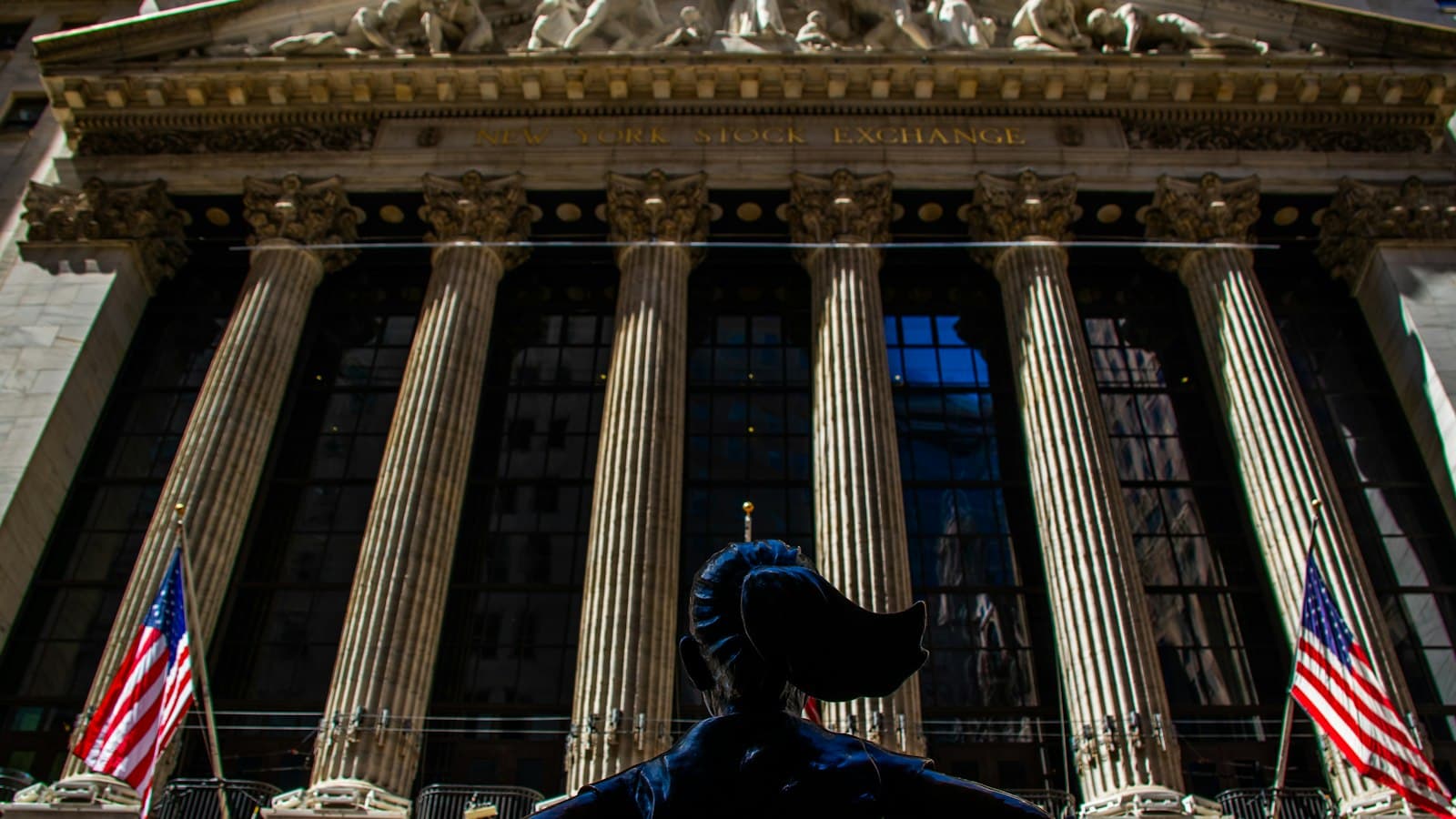
In the week ending October 30, big tech companies reported their quarterly results. These results show a company's sales and profits for the past three months. After the reports, investors doubted the payoff from the companies' AI spending.
A stock index tracks the prices of a group of stocks. The Nasdaq Composite, an index heavy in tech companies, fell 2.00%. The S&P 500, which tracks 500 large US companies, slipped 0.57%. The Dow, another index of large US companies, fell 0.85%.
Health care, consumer staples, small companies and European stocks gained. Consumer staples are the makers of everyday goods such as groceries. The Federal Reserve, the US central bank, kept its main interest rate unchanged. Two of its voting members wanted to raise it. Oil prices climbed after new attacks on tankers, the ships that carry oil. Gold fell to its lowest level since October 2025.
Investors question big tech's AI spending
Shares of Alphabet, Google's parent company, fell 12% on October 29. That was the company's worst one-day drop on record. The shares slipped another 1.7% on October 30. Intel shares fell 28.58% that day, to $65.76. Intel gave a weak forecast for the fourth quarter. The company pointed to slow PC sales.
Investors had the sharpest questions about Amazon. The company reported about $77 billion of capital spending in the third quarter. Capital spending is the money a company puts into long-lived assets such as data centers and equipment. A year earlier, Amazon spent $35 billion.
Free cash flow is the cash a company has left after running the business and paying for that equipment. Over the past 12 months, Amazon's free cash flow fell below zero. More cash went out than came in, by more than $42 billion.
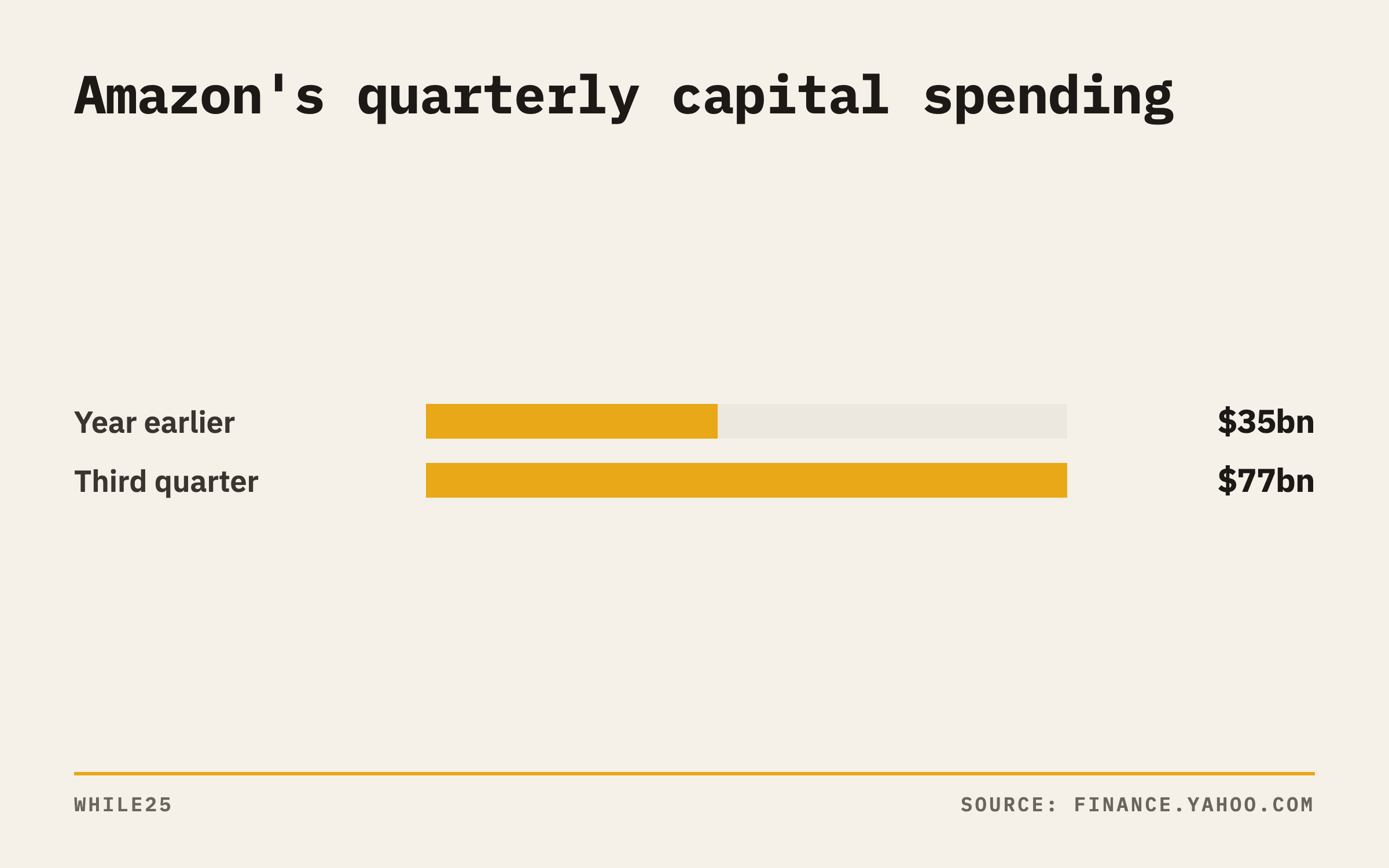 Bar chart showing Amazon's third-quarter capital spending at about $77 billion against $35 billion a year earlier
Amazon spends much of that money on chips. Investors responded by selling chip stocks, the shares of companies that make computer chips. The iShares Semiconductor ETF (SOXX) holds shares of chip makers. An ETF, or exchange-traded fund, is a basket of stocks that trades like a single share. SOXX fell 9.1% on October 30 and ended the week down 2.4%.
The Nasdaq dropped 2.86% that day, to 25,437. It was the index's worst trading day since June. The S&P 500 fell 1.82%, to 7,580.07. Over October, the Nasdaq lost 5.3%. That was its steepest monthly decline since March 2025.
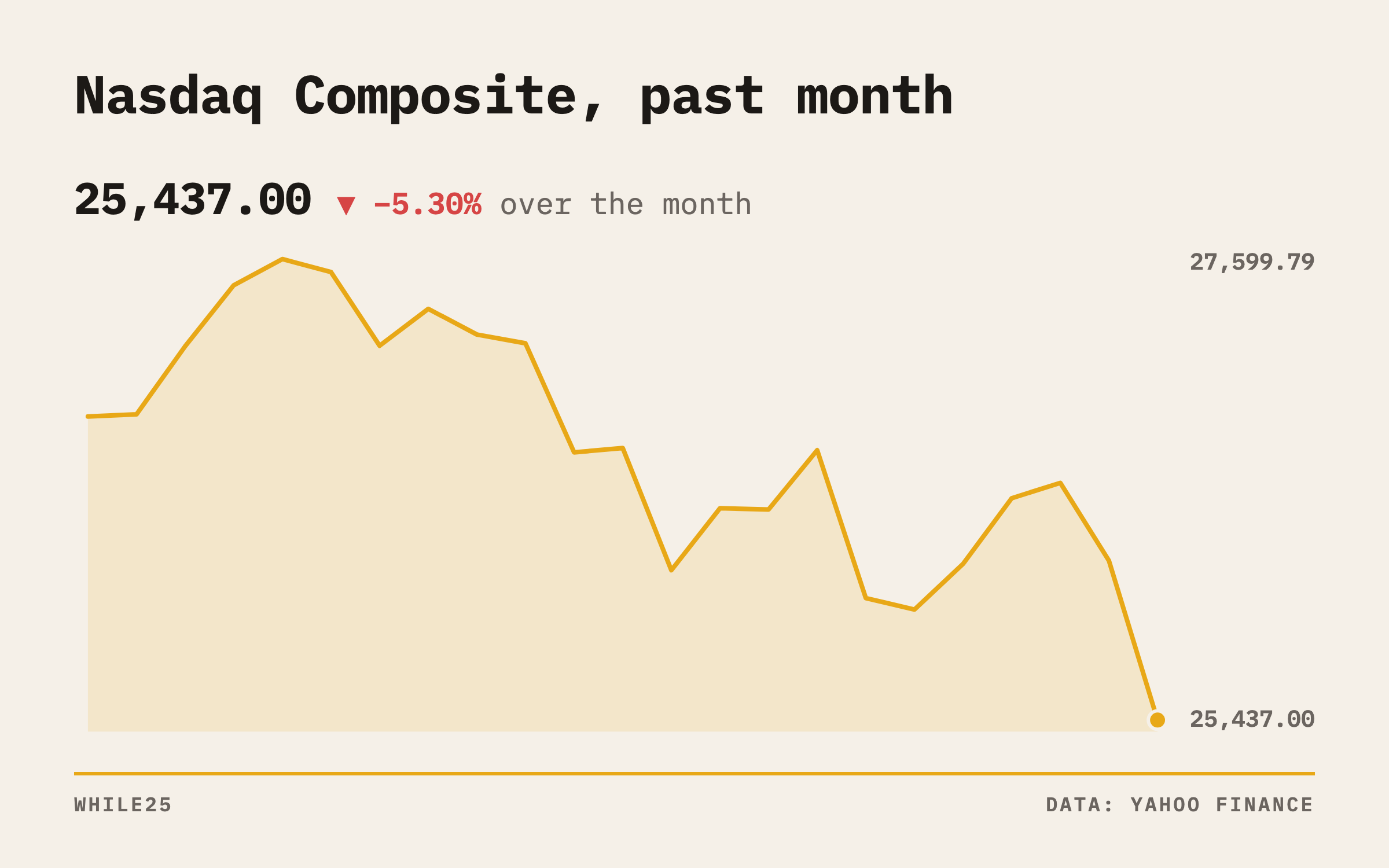 Line chart of the Nasdaq Composite over the past month, ending at its October 30 close
Investors move to safer stocks
Investors sold tech and bought other parts of the market. The S&P 500 sorts its companies into 11 industry groups, called sectors. Most of them rose for the week. Health care and consumer staples led the gains.
Investors call these defensive sectors, because their sales hold up in bad times. People keep buying medicine and groceries as the economy slows. Keith Lerner of Truist pointed out that tech and communication services were the only two sectors that fell in October. Communication services covers phone, media and internet companies.
Shares of smaller companies gained for the week. The Russell 2000, an index of smaller US companies, rose 1.29%. It fell 1.66% on October 30, the day after the Intel and Amazon results.
Central banks lean toward higher rates
On October 28, the Fed kept its benchmark rate at 3.75% to 4%. Banks use that rate as a guide for overnight loans to each other. Fed officials voted 10-2. Governor Lisa Cook and Cleveland Fed President Beth Hammack voted against the decision. Both wanted to raise the rate by a quarter of a percentage point.
Inflation is the pace at which prices rise. In its statement, the Fed said "Inflation remains elevated." The Fed upgraded its view of the economy. In September, it had called the economy "solid." This time, it described the economy as "expanding at a strong pace."
PCE is the Fed's preferred measure of the pace of consumer price rises. On October 29, the Bureau of Economic Analysis, a US government agency, put September PCE inflation at 3.6%. Core PCE leaves out food and energy prices. It came in at 3.1%. In a separate report, the agency said the economy grew at a 3.4% pace in the third quarter. Forecasters had expected 3.2%.
Traders changed their bets on future interest rates. They bet through futures, contracts that pay out based on where rates end up. Before the meeting, traders saw less than a 10% chance that the Fed would raise rates. That figure comes from CME FedWatch, a tool that turns futures prices into odds. By the end of the week, traders saw a strong chance of a rate rise in December.
Other central banks leaned the same way. The European Central Bank (ECB) sets interest rates for the countries that use the euro. On October 29, it kept its deposit rate at 2.5%. The ECB pays banks that rate on money they keep with it.
The ECB had raised the rate by 25 basis points in September. A basis point is one hundredth of a percentage point. That means 100 basis points make one percentage point.
Euro-area inflation reached 3.8% in September. That was its highest level since September 2023. Money markets are where banks and funds borrow and lend for short periods. Traders in these markets saw about a 67% chance of a December rate rise. ECB President Christine Lagarde said she will step down in February. That is about nine months before her term ends.
The Bank of Japan, Japan's central bank, kept its rate at 1.25%. Its board voted 8-1. Board member Hajime Takata voted to raise the rate to 1.5%.
Oil climbs as tanker attacks continue
On October 29, Iran's Guard Corps, a branch of its armed forces, said tankers had hit mines. It said the mines were on a southern route near the Strait of Hormuz. On October 30, UKMTO reported a new incident. UKMTO is the UK agency that tracks attacks on shipping. People on a small boat had attached explosives to a tanker.
Brent is the main global oil price. Traders buy and sell Brent through futures. For oil, a futures contract is a deal for oil delivered in a set month. Each contract expires, or stops trading, on a set date.
The December Brent contract expired at $117.64 on October 30, up 2.4% on the day. The January contract has become the main one. It ended the day at $113.43. WTI, the main US oil price, closed at $104.12. Brent rose 13.6% in October, and WTI rose 15.2%.
During the week, traders switched from one delivery month's contract to the next. Traders call this step a contract roll. Because of the roll, Brent and WTI lack a clean weekly change.
Investors pushed shares of Exxon and Chevron to record highs for a time. They liked the companies' strong refining margins. A refining margin is the gap between the cost of crude oil and the price of the fuel made from it.
Gold and bitcoin fall
Gold futures fell 3.29% on October 30 and 2.72% for the week, to $3,898.90 an ounce. Spot gold is the price for gold delivered right now. It fell below $4,000 and hit its lowest level since October 6, 2025. Silver fell to $48.95.
Gold tends to rise as the dollar and bond yields fall. A bond yield is the yearly return an investor earns from holding a bond. The dollar and yields both eased that day, yet gold fell. Kitco News quoted analysts who called the drop unusual.
Waleed Said of GivTrade argued that investors were selling gold to meet margin calls on other bets. A margin call is a broker's demand for more cash after a bet made with borrowed money loses. "Oil and the dollar are taking that role," he said. By "that role," he meant gold's role as a safe haven. A safe haven is an asset investors buy for safety in a crisis.
Bitcoin fell 3.50% for the week, to $77,208. Hackers stole an estimated $6.3 billion from Binance. Binance is a crypto exchange where people trade digital currencies. The hack was the largest crypto theft on record. Binance paused customer withdrawals.
Tether and Circle both issue stablecoins. A stablecoin is a token designed to hold a steady dollar value. Tether froze more than 1.567 billion of its USDT tokens tied to the hack. Circle worked with law enforcement to freeze another $800 million. Once a company freezes tokens, the holder cannot move them.
Bond yields, the dollar and expected swings
The 10-year Treasury yield is the interest rate the US government pays to borrow for 10 years. It ended the week at 4.929%, down 5.9 basis points. Over the past month, it fell 36.4 basis points.
The US Dollar Index measures the dollar against six major currencies. It ended at 101.88, up 0.07% for the week. The dollar rose 0.84% against the Japanese yen, to 157.804 yen. The euro slipped 0.34%, to $1.1183.
The VIX measures how much traders expect stocks to swing. A higher VIX means traders expect bigger swings. It jumped 12.91% on October 30, to 19.42.
Around the world
European stocks gained for the week. The STOXX 600, an index of companies across Europe, rose 1.73%. Germany's DAX index rose 2.53%, and France's CAC 40 rose 2.40%. Britain's FTSE 100 rose 0.37%. The STOXX 600 and the DAX fell on October 30 but kept their weekly gains.
In Asia, South Korea's KOSPI index fell 3.48% on October 30 but rose 3.25% for the week. Japan's Nikkei 225 dropped 2.12% that day and gained 0.95% for the week. Japanese chip stocks fell after the US results. Advantest lost 9.1%, Tokyo Electron 5.6% and SoftBank Group 6.7%.
Hong Kong's Hang Seng index rose 0.87% for the week. China's Shanghai Composite fell 2.48%. India's Nifty 50 rose 2.00%.
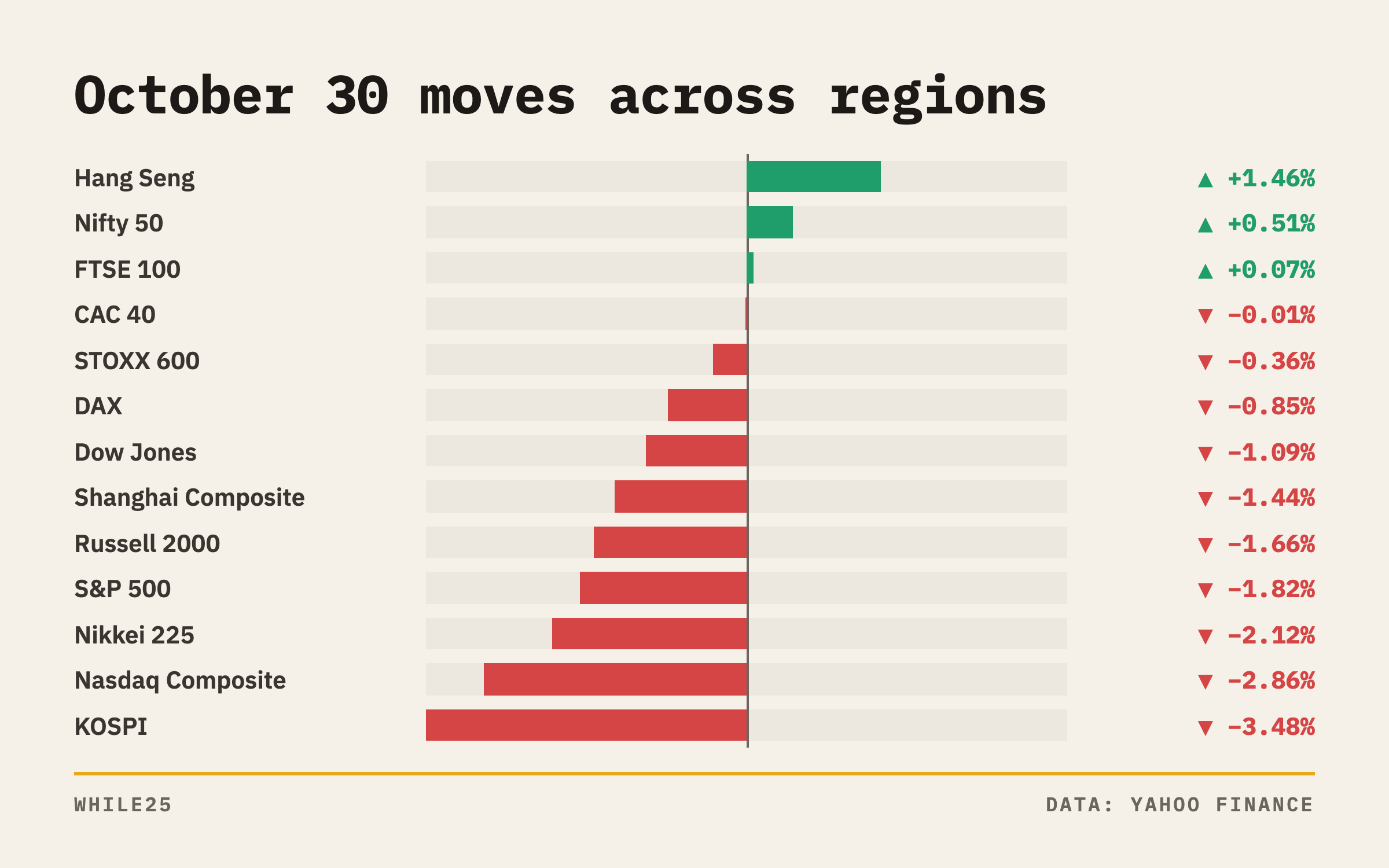 Horizontal bars showing October 30 day changes for major stock indexes in the US, Europe and Asia, sorted by move
The week ahead
- Sunday, November 1: Seven core members of OPEC+ meet online. OPEC+ is a group of oil-producing countries. The members will set December output targets, the amount of oil they aim to pump.
- Monday, November 2: The ISM Manufacturing index for October comes out at 10:00 a.m. ET. This index is a monthly survey of US factory activity. Apple and Palantir report quarterly results.
- Tuesday, November 3: The US holds midterm elections. The JOLTS report on September job openings comes out at 10:00 a.m. ET. AMD reports quarterly results.
- Wednesday, November 4: ADP, a payroll company, releases its employment survey at 8:15 a.m. ET. The ISM Services index, a similar survey of service businesses, follows at 10:00 a.m. ET. Qualcomm and Uber report results.
- Thursday, November 5: The Bank of England, Britain's central bank, announces its rate decision at 12:00 UK time. It publishes its Monetary Policy Report at the same time.
- Friday, November 6: The government releases the US October jobs report at 8:30 a.m. ET.
The week and your portfolio
A portfolio is the mix of investments a person owns. Investors with portfolios heavy in big tech felt the Nasdaq's 2.00% drop. Investors who held health care, consumer staples, small companies or European stocks gained.
An index fund buys the stocks in an index such as the S&P 500. Broad US index funds put a large share of their money in a handful of tech giants. As a result, their prices rise and fall with news about AI spending. The more you hold in those companies, the more the next round of results can move your account. That round starts with Apple on November 2 and AMD on November 3.
Sources
- cnbc.com
- cnbc.com
- finance.yahoo.com
- cnbc.com
- stocktitan.net
- investinglive.com
- financefeeds.com
- kitco.com
- cnbc.com
- finance.yahoo.com
- cnbc.com
- irishtimes.com
- invezz.com
- cambridgecurrencies.com
Not investment advice.