
US employers added 29,000 jobs in September, the Bureau of Labor Statistics reported on Friday, October 2. LSEG polled economists, and they had expected 90,000. The unemployment rate rose to 4.2%. Economists had forecast 4.1%.
The Federal Reserve, the US central bank, raised interest rates on September 16. That came before this report. Fed officials voted on an older, stronger picture of the job market. In this report, the labor agency drew a weaker one.
The headline count, in plain terms
The Bureau of Labor Statistics is the US government agency that counts jobs. The agency calls its main number payrolls. Payrolls measure the net change in how many people employers pay. A gain of 29,000 means employers added 29,000 more jobs than they cut in September.
The agency gets the unemployment rate from a separate survey of households. The rate counts people who have no job and are looking for one. The agency reports them as a share of everyone working or looking. In September that share rose to 4.2%.
Both numbers fit one pattern. Employers hired fewer people than forecasters expected. A larger share of job seekers failed to find work.
The agency rewrote the summer
In each jobs report, the agency updates the two months before it. The agency collects more survey responses over time. It uses them to correct its earlier counts. Economists call these corrections revisions.
This month, the agency lowered both months. The agency cut July by 31,000, from a gain of 21,000 to a loss of 10,000. It cut August by 29,000, from a gain of 162,000 to 133,000.
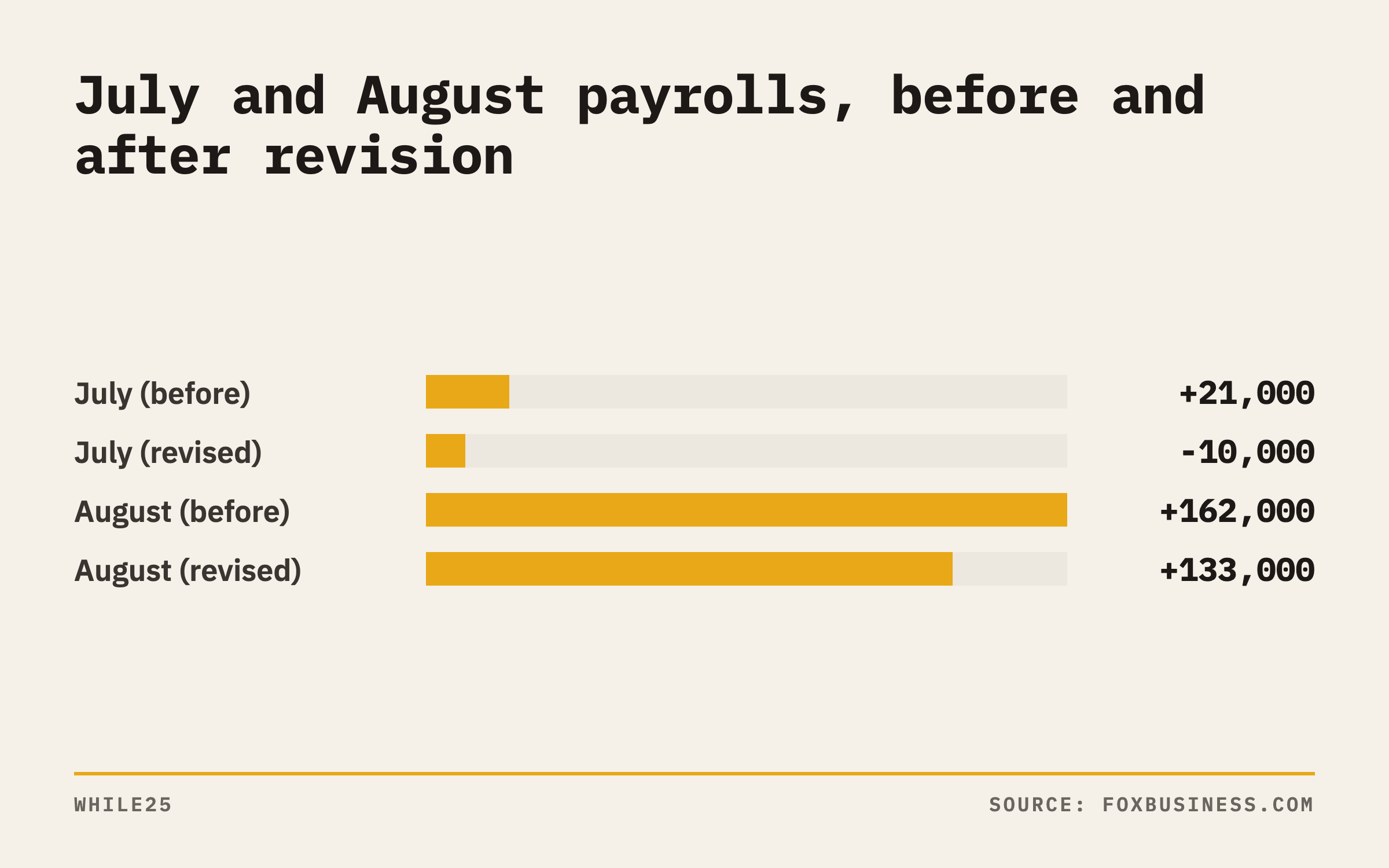 Bar chart: July payrolls revised from a gain of 21,000 to a loss of 10,000, and August revised from 162,000 to 133,000
The July change is the big one. The agency's original July count showed slow hiring. Its revised count shows employers cutting more jobs than they added. The revised summer includes a month of job losses.
The headline is the main number in a report. A single headline can mislead. A first estimate can look fine and shrink once more data arrives. Readers get a fuller view of hiring by reading the revised months next to the new headline.
Pay growth slowed
Average hourly earnings measure the pay per hour that employers report for their workers. The agency's measure rose 3% in September. Economists had expected a 3.2% increase.
Fed officials watch pay because wages feed into prices. Businesses that pay more for labor tend to charge more for services. Slower pay growth means less pressure on inflation, the general rise in prices.
The agency's September report held three readings on the job market. Hiring and pay growth both came in below forecasts. Unemployment came in above them.
The Fed raised rates before this data existed
The Federal Open Market Committee is the Fed group that sets interest rates. On September 16, it voted 12-0 to raise its key interest rate by a quarter percentage point. The key rate is the federal funds rate, the rate banks charge each other for overnight loans. The Fed sets a target range, a band it wants this rate to stay inside. The new range is 3.75% to 4.00%.
A higher federal funds rate makes borrowing cost more across the economy. Lenders tend to move rates on mortgages, car loans and business credit in step with it. Households and businesses may spend and hire less over time as credit costs more.
The committee voted before the September jobs report and before these revisions. At the time, the agency's published figures showed a July gain of 21,000 and an August gain of 162,000. The agency has lowered both.
Traders bet on a hold
A futures contract is an agreement to trade something at a set price on a future date. Traders use futures to bet on the Fed's next move. Some futures contracts track the federal funds rate. By setting prices on these contracts, traders reveal what they expect the Fed to do.
CME Group runs the exchange, or marketplace, where traders buy and sell those contracts. CME Group uses its FedWatch tool to turn futures prices into odds for each Fed meeting. After the report, FedWatch put the chance that the Fed holds rates steady in October at 79.5%. On the day before, the figure stood at 75.6%.
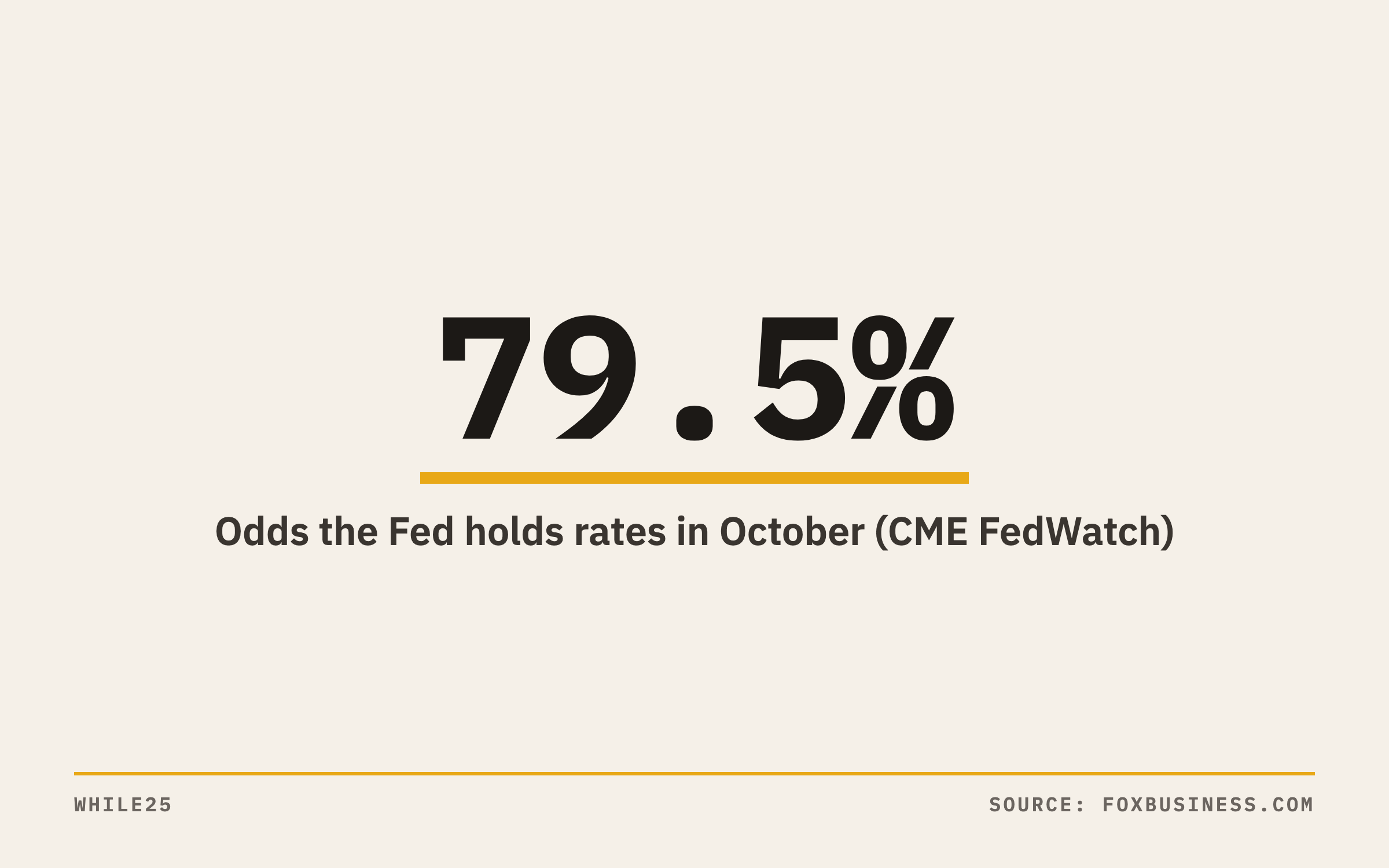 Big number: CME FedWatch put the odds of an October Fed hold at 79.5%
A hold would keep the federal funds rate at 3.75% to 4.00%. Traders leaned toward a hold before the report came out. They added to that bet once the weaker data arrived.
Stocks and bonds on October 2
A stock index tracks the share prices of a group of companies. Investors pushed stock indexes up on the day of the report. The S&P 500, an index of 500 large US companies, closed at 7,722.72, up 0.73%. The Nasdaq Composite, an index of stocks listed on the Nasdaq exchange, gained 1.19%. The Russell 2000, an index of smaller US companies, rose 0.94%.
The VIX is a gauge of how much traders expect stock prices to swing. It comes from options prices. Options are contracts that give the right to buy or sell a stock at a set price. The VIX fell 6.59% to 15.31. A lower reading means traders expected calmer trading.
Bond traders sent a different signal. A bond is a loan that investors make to a government or company. The 10-year yield is the interest rate the US government pays to borrow for 10 years. Traders measure small rate moves in basis points. One percentage point equals 100 basis points. The 10-year yield rose 4 basis points on October 2 to 5.277%. Over the past month, it has climbed 48.1 basis points.
The Fed sets the overnight rate. Buyers and sellers of government bonds set the 10-year yield. The two rates can move apart, and they did on October 2. Futures traders bet on a Fed pause while bond traders continued to push up long-term borrowing costs.
The Fed publishes minutes October 7
After each meeting, the Fed publishes minutes, a written summary of what committee members discussed. The Fed will release the September minutes on Wednesday, October 7, at 18:00 GMT.
Readers will find the discussion behind the 12-0 vote to raise rates. They will see how the committee talked about the job market in mid-September. At that point, the official count showed a July gain and 162,000 new jobs in August.
The committee met before the September jobs report came out. Its minutes hold the reasoning from that older set of facts. Since October 2, traders have worked from a weaker set.
Readers can use that gap. Those who place the minutes next to the new data can measure how far the inputs have shifted since the vote. Readers should weigh any mention of a strong job market against the revised July loss.
Reading this as an investor
Investors in stocks or bonds can take two lessons from the September report.
The first lesson concerns revisions. The agency can change a single month's headline by tens of thousands of jobs within weeks. The 29,000 figure is a first estimate. The agency will revise it in the next two reports.
The second lesson concerns rates. Investors' guesses about the Fed feed into the prices of stocks and bonds. On October 2, futures traders raised their bets on an October hold. Investors pushed stocks up that day, and bond traders lifted the 10-year yield to 5.277%. An investor who owns both stocks and bonds feels each of those moves. The moves can point in different directions.
Investors get one more input from the October 7 minutes. In them, investors can see the Fed's thinking from before the weak data came out. In the futures odds, they can see how traders have reacted to the data since October 2.
Sources
Not investment advice.