
The US Treasury is the government department that handles federal borrowing. On Wednesday, October 7, it will sell $39 billion of 10-year notes. On Thursday, October 8, it will sell $22 billion of 30-year bonds. Notes and bonds are government IOUs that pay interest. The Treasury closes bidding for both sales at 1:00 PM ET.
The sales follow a month in which traders pushed the 10-year yield past 5.3%. The 10-year yield is the interest rate the US government pays to borrow for 10 years.
That rate traded around 4.0% before the war started. In September it jumped more than 50 basis points. A basis point is a hundredth of a percentage point. On October 2 the 10-year yield closed at 5.277%. That put it up 48.1 basis points over the past month.
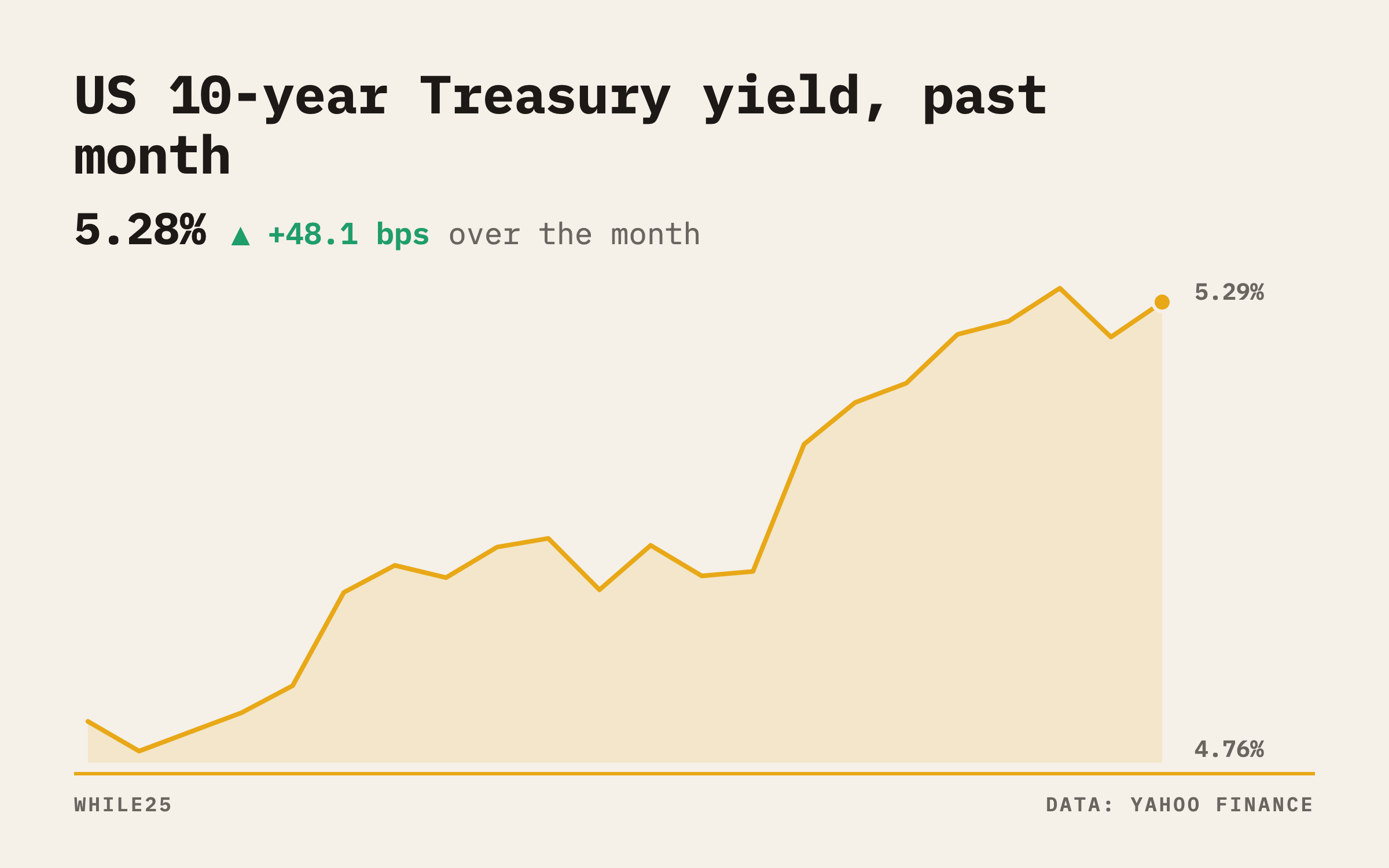 Line chart of the US 10-year Treasury yield over the past month, climbing to 5.277% on October 2
Higher yields raise a question about demand. Buyers may keep showing up for US government debt at these rates. They may also thin out. This week's auctions give the answer in public, with numbers any reader can check.
The government borrows by auction
The US government spends more than it collects in taxes. It borrows to cover the gap. To borrow, it sells Treasury securities. These are IOUs that pay interest and repay the loan on a set date.
Notes mature, or come due, in up to 10 years. Bonds run longer, out to 30 years. The Treasury lets buyers set the price by competing in an auction.
The Treasury publishes its calendar in advance. It has three sales set for the week of October 5. It sells $58 billion of 3-year notes on October 6. The 10-year and 30-year sales follow on the next two days.
Step 1: The Treasury announces the size
Days before each sale, the Treasury states how much it will borrow and when. It will borrow $39 billion in this week's 10-year sale. It will borrow $22 billion in the 30-year sale.
The Treasury fixes the size. The bidders decide the yield.
Step 2: Investors submit bids
Investors can bid in two ways.
A competitive bid names an amount and the lowest yield the bidder will accept. Large investors bid this way: banks, fund managers, pension funds and foreign central banks. A bid at a lower yield is a more eager bid. That buyer accepts less interest.
A non-competitive bid names an amount and nothing else. The bidder agrees to take whatever yield the auction sets. Smaller investors bid this way. They include individuals who buy through TreasuryDirect, the government's own website.
A group of large banks called primary dealers must bid at each auction. They act as a backstop. If outside buyers bid little, the dealers end up holding more of the sale.
Step 3: The Treasury ranks the bids
The Treasury closes the bidding window at 1:00 PM ET. It fills the non-competitive bids before the rest. After that, it lines up the competitive bids from the lowest yield to the highest.
The Treasury accepts bids moving up that line until it has sold the full amount. The last yield it needs to accept is the high yield, also called the stop-out yield. Traders say the auction "clears" at that yield, meaning it sells out there. Bidders who asked for a higher yield get nothing.
Step 4: One yield for each winner
Each winning bidder receives the same rate, the high yield. A buyer who bid a lower yield receives the higher one. Traders call this a single-price auction. Under this design, bidders can state their true limit without fear of overpaying.
The high yield sets the price. Bond prices and yields move in opposite directions. A higher yield means buyers paid less for the same stream of interest payments. A high clearing yield means the Treasury got a lower price for its debt.
Step 5: The Treasury publishes the results
Within minutes of the close, the Treasury posts the results. Traders scan a few numbers. The headline number is the bid-to-cover ratio.
Reading the bid-to-cover ratio
Bid-to-cover is the total dollar amount bid divided by the amount sold. It counts the dollars bid for each dollar sold. A ratio of 2.7 means bids came to 2.7 times the size of the sale.
Last month's 10-year auction cleared at a 4.83% yield with a bid-to-cover of 2.7. The prior 30-year sale cleared at 5.31% with a ratio of 2.6.
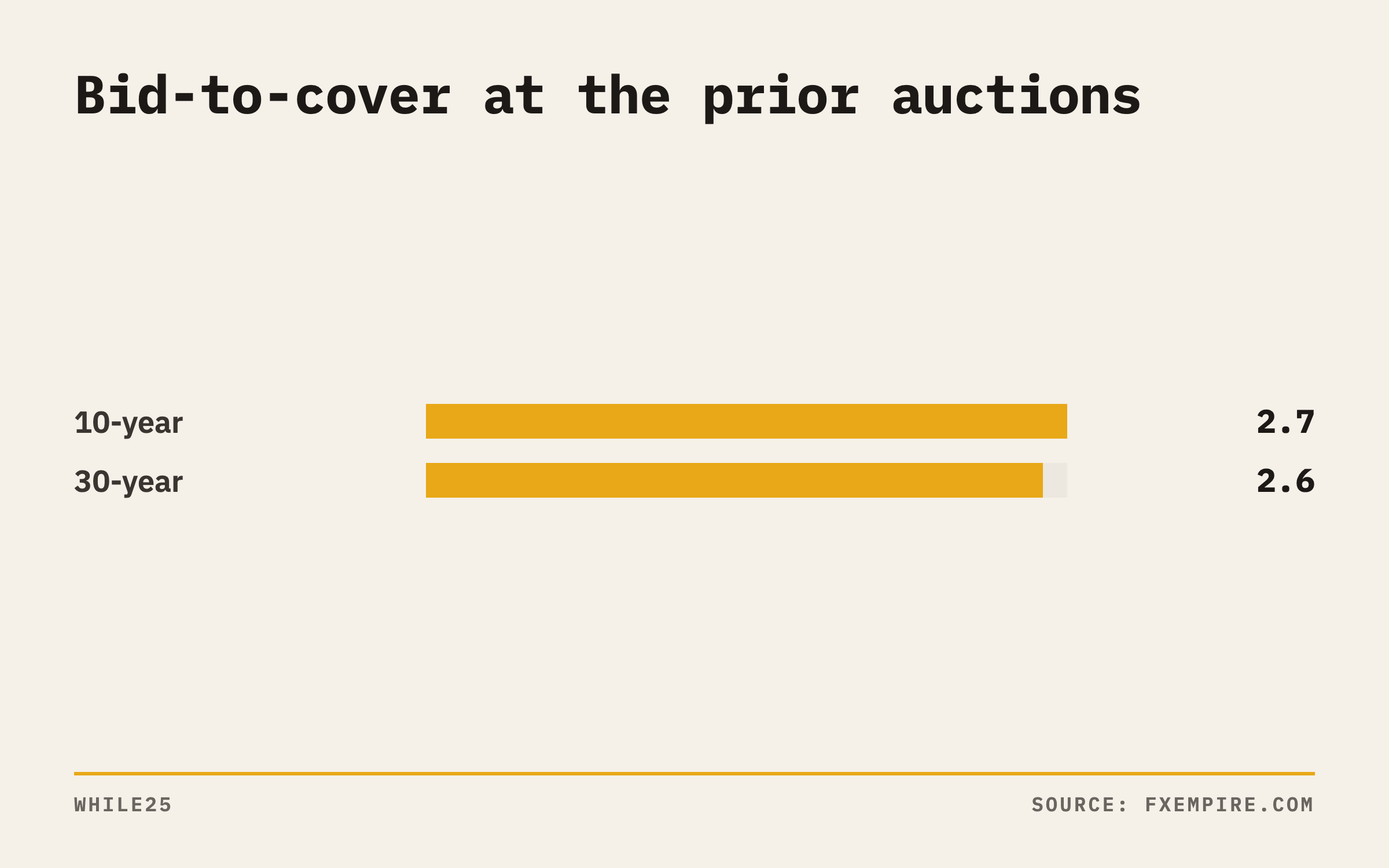 Bar chart of bid-to-cover ratios at the prior auctions: 2.7 for the 10-year and 2.6 for the 30-year
A higher ratio means investors offered more money for the same amount of debt. A lower ratio means fewer spare bids sat behind the winners. Traders judge a 10-year ratio against past 10-year sales. They judge a 30-year ratio against past 30-year sales.
The ratio has a blind spot. It counts all bids, including bids at yields above the clearing level. Those bids had no chance of winning. A sale can show a high ratio even if serious buyers were weak.
The other numbers traders read
Traders check the tail next. Before the auction, investors trade the new security in a "when-issued" market. Buyers there agree to deals ahead of delivery. Their trades set a pre-sale yield.
If the auction clears at a yield above that pre-sale level, traders call the gap a tail. A tail means the Treasury had to pay more than traders expected. If the auction clears below it, traders say it "stopped through." That points to strong demand.
Traders read the buyer mix last. The Treasury splits winning bids into three groups. Indirect bidders include foreign central banks and fund managers who bid through a dealer. Direct bidders buy for their own accounts. Primary dealers take the rest.
If dealers keep a large share, outside buyers stepped back. The dealers have to resell that debt to clients. Their selling can push yields higher in the days after a sale.
Reading this week's sales
The 10-year sale on October 7 comes after the 10-year yield closed at 5.277% on October 2. Last month's sale cleared at 4.83%. The 30-year sale on October 8 follows a prior result of 5.31%.
Traders will compare each new bid-to-cover with the prior 2.7 and 2.6. At 1:00 PM ET, they will check whether the high yield landed above or below the when-issued yield. They will look at the share left with dealers.
The 10-year sale shares a day with another release. The Federal Reserve, the US central bank, publishes the minutes of its September meeting on October 7 at 18:00 GMT. The minutes are the written record of the Fed's rate discussion.
The link to your portfolio
The 10-year yield serves as a base rate for the US economy. Other rates take it as their benchmark. Lenders look to it when they price mortgages. Stock investors weigh company earnings against the return on safe government debt.
Traders feed auction results into that rate. After a sale with a large tail and a thin ratio, traders can push yields up. After a sale that stops through, they can pull yields down.
A bond fund pools investor money to buy many bonds. For someone who holds one, a higher yield means a lower price for the bonds in it. For a saver, it means new Treasury purchases pay more. The same number cuts both ways depending on which side you hold.
An auction gives you a timed, public read on demand for US debt. The Treasury holds three this week, at 1:00 PM ET on October 6, 7 and 8. Once you know the steps, you can read each result yourself.
Sources
Not investment advice.