
Analysts expect JPMorgan Chase to report $26.96 billion of net interest income for the third quarter. A year earlier, the bank reported $23.97 billion. Net interest income is the interest a bank earns minus the interest it pays out. JPMorgan reports on October 13, alongside Citi, Goldman Sachs and Wells Fargo.
This figure is the main path from interest rates to a bank's profits. It has the most exposure to the two big rate moves of the past month.
The gap behind net interest income
A bank does two things with money. It borrows from depositors, who keep cash in checking and savings accounts. It lends that money out or buys bonds with it. A bond is an IOU that a government or company sells to borrow money.
The bank earns interest on its loans and bonds. It pays interest to its depositors. Net interest income is the gap between the two.
Bankers track a second measure, the net interest margin. It shows the same gap as a share of the loans and bonds the bank holds. A wider margin means the bank earns more on each dollar it lends than it pays to raise that dollar.
Revenue is all the money a company brings in before costs. For a large lender, this gap supplies much of it. Analysts expect JPMorgan's total third-quarter revenue of $52.21 billion. Net interest income makes up $26.96 billion of that estimate.
Two rate moves in one month
On September 16, the Federal Reserve raised its target for the federal funds rate. The Fed is the US central bank. The federal funds rate is the interest banks charge each other for overnight loans. The Fed lifted its target range by a quarter point, to 3.75% to 4.00%. A quarter point is one quarter of a percentage point.
Longer-term rates rose in the same stretch. A yield is the interest rate a borrower pays on a bond. The 10-year Treasury yield is the rate the US government pays to borrow for 10 years. It reached 5.33% in the week to October 9, its highest level since early 2002. The 30-year yield climbed to around 5.67%. That level was the highest for the 30-year since 2002.
The 10-year ended trading on October 9 at 5.24%. It rose 40.7 basis points over the past month. One hundred basis points make one percentage point.
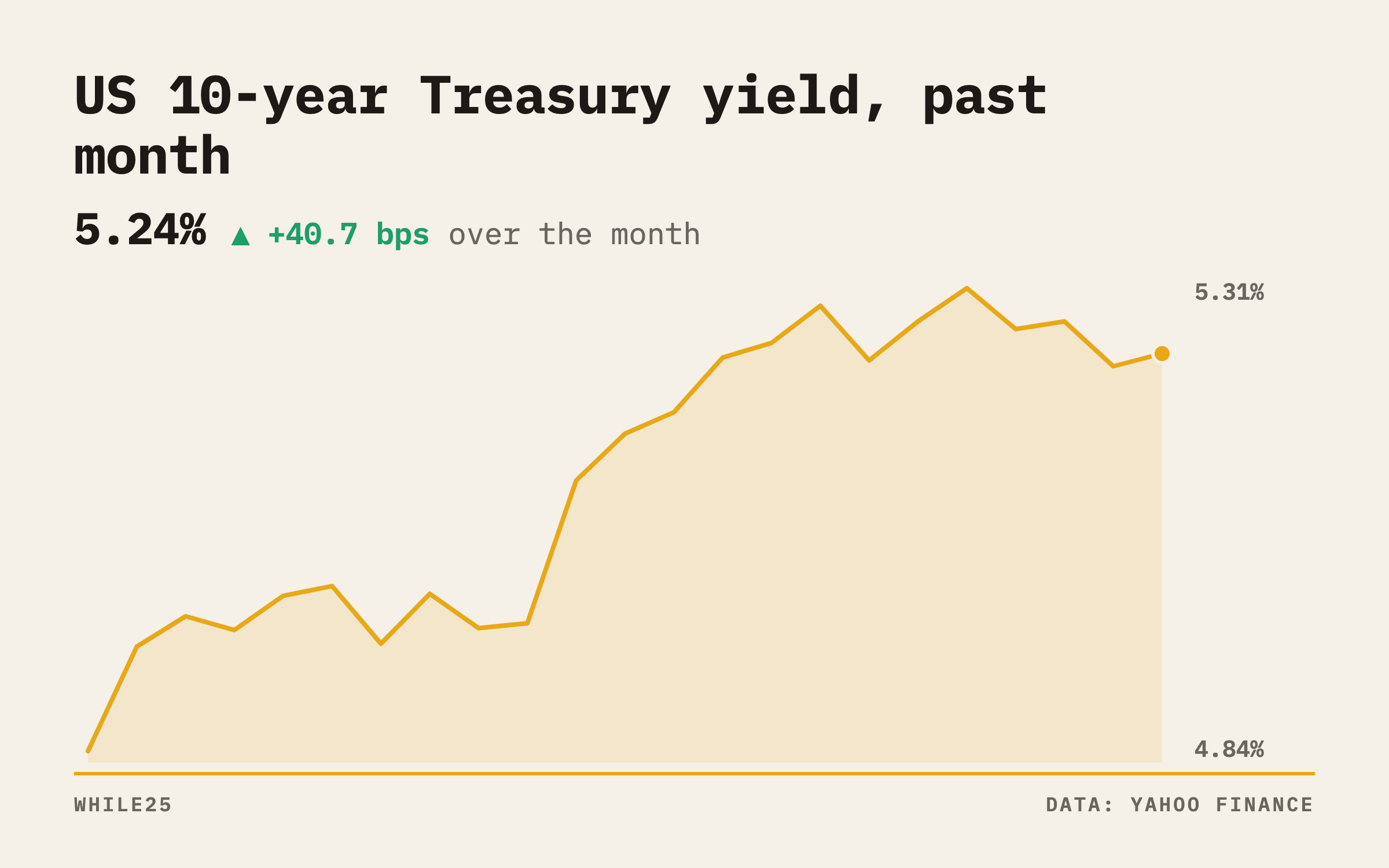 The US 10-year Treasury yield climbed over the past month to finish near its highest level since 2002
The two moves hit different parts of a bank. Banks price many loans off the Fed's rate. The rate banks pay for short-term money tracks it as well. Lenders set mortgage rates off the 10-year yield. The value of the bank's bonds moves with that yield.
The earning side: loan rates reset
Many bank loans carry floating rates, which reset as the Fed's rate moves. Credit cards, business credit lines and some commercial loans work this way. Banks start earning more on those loans once the Fed hikes.
Fixed-rate loans and bonds take longer to catch up. A borrower with a low-rate 30-year mortgage keeps paying that low rate until paying off the loan. A bond the bank bought years ago keeps paying its old coupon. The coupon is the fixed interest payment the issuer set on the day it sold the bond.
The bank earns more as old loans and bonds come due. It reinvests the cash at today's higher rates. For a bank with large holdings, that process takes years.
The paying side: deposit costs
Here the bank has a choice. It decides how much of a Fed hike to pass on to savers. Bankers call the share it passes on the "deposit beta." A low deposit beta means the bank keeps more of the hike as income.
Savers have options of their own. Money market funds and Treasury bills pay rates that track the Fed's. A Treasury bill is a short-term loan to the US government. A money market fund invests savers' cash in short-term debt such as Treasury bills. If a bank pays little on savings, customers can move their cash out. The bank must then raise its deposit rates or replace the cash with costlier borrowing.
The size of a bank's gain from a hike depends on its deposit costs. Early in a run of hikes, loan income tends to rise faster than deposit costs. Later in a run, savers push for better rates and deposit costs catch up. Net interest income can stall while rates stay high.
The bond problem
A bank's bonds lose value as yields rise. A new bond pays more interest. Buyers will pay less for an older bond that pays less.
Banks hold large portfolios of Treasuries and mortgage bonds. Treasuries are US government bonds. A mortgage bond bundles many home loans into one bond. Banks sort these holdings into two accounting buckets.
Banks value bonds labeled "available for sale" at market prices. The bank counts losses on them against its capital, the cushion it holds against bad times. Banks carry bonds labeled "held to maturity" at their purchase cost. The bank books no loss on them unless it sells.
A loss on a bond the bank still holds is a paper loss, also called an unrealized loss. It leaves net interest income untouched. The bank keeps collecting the coupons.
Paper losses limit the bank in another way. If depositors pull money and the bank has to sell bonds, it turns paper losses into real ones. Silicon Valley Bank failed after it sold bonds at a loss and depositors withdrew funds in a rush.
With the 10-year yield at its highest since early 2002, banks face two effects. New and reinvested bonds earn more, which lifts income over time. Existing holdings lose value, which shrinks capital now.
The yield curve
Banks borrow for short periods and lend for long ones. Depositors can take their money out any day. Mortgages and bonds run for years.
The yield curve is the line connecting interest rates across short and long borrowing periods. A bank earns most with a wide gap between long-term and short-term rates.
On October 9, the 2-year Treasury yield rose to 4.79%. The 10-year closed the same day at 5.24%. Long rates sat above short rates. With that slope, a bank can earn more on long-term loans and bonds than it pays for short-term money.
Reading JPMorgan's number
The consensus is the average of analysts' forecasts. For JPMorgan's third-quarter net interest income, the consensus is $26.96 billion. A year earlier the bank reported $23.97 billion. Analysts expect earnings of $5.94 per share, meaning profit for each share of stock.
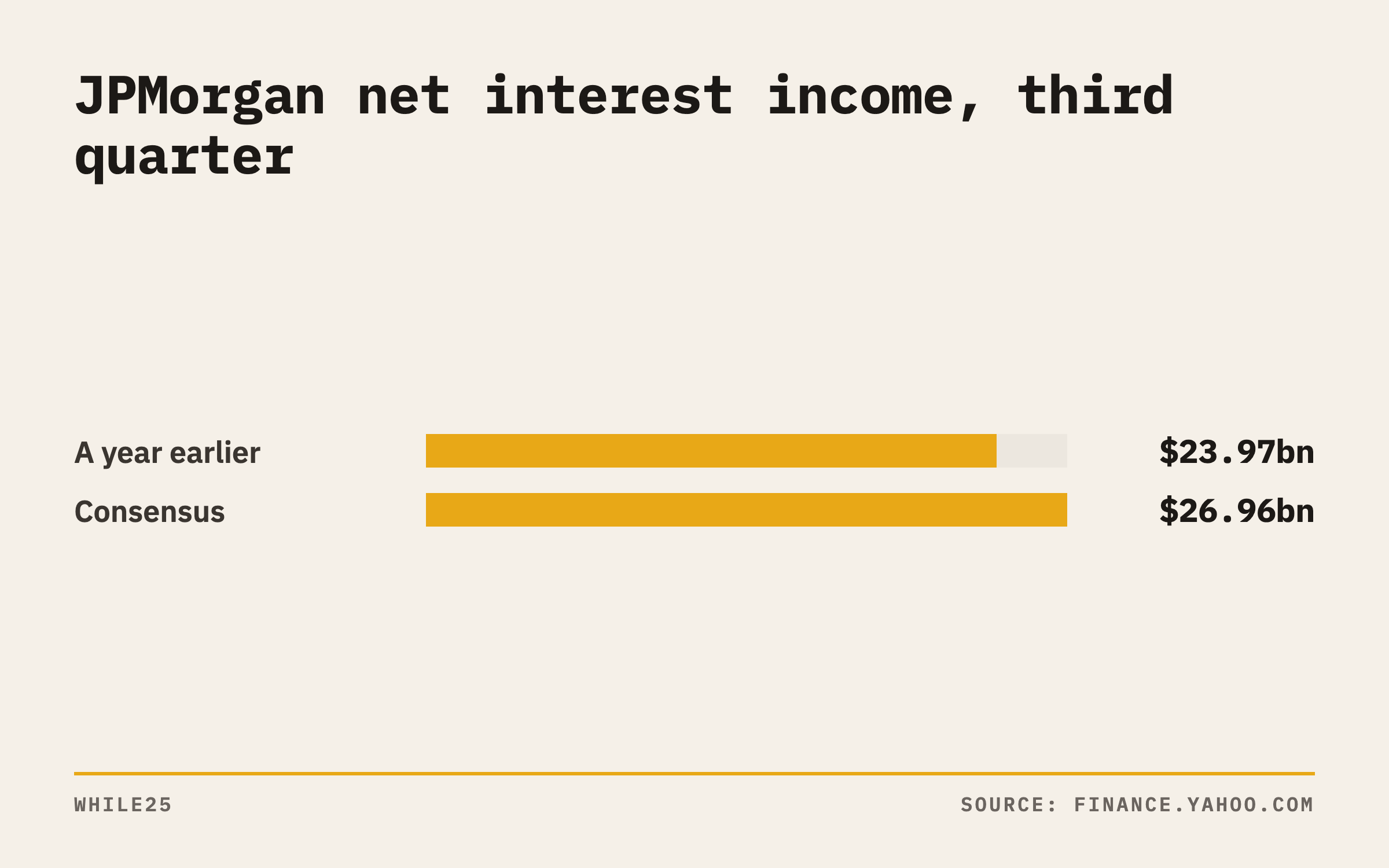 Analysts expect JPMorgan's third-quarter net interest income of $26.96 billion, up from $23.97 billion a year earlier
JPMorgan reports a second version, called "managed" net interest income. In it, the bank adjusts tax-free income so it compares with taxable income. Interest on some municipal bonds, which local governments issue, is one example of tax-free income. The consensus for that line is $26.84 billion, against $24.07 billion a year earlier.
Look past the headline figure to the pieces behind it. Start with the average rate the bank pays on interest-bearing deposits. If that rate rises, savers are pushing for better returns. Check average deposit balances next. If balances fall, customers may have moved cash elsewhere.
Most banks list unrealized bond losses in the capital section of their reports. Many banks publish an outlook for full-year net interest income. If a bank changes that outlook, it has updated its own estimate.
Goldman Sachs and Morgan Stanley earn more from trading and fees for advice. Net interest income weighs less in their results than at JPMorgan, Wells Fargo or Bank of America.
Dates to watch
JPMorgan, Citi, Goldman Sachs and Wells Fargo report on October 13. Bank of America, BlackRock, Morgan Stanley and State Street follow on October 14. The government releases the September consumer price index, its main inflation gauge, on October 14 as well. The Fed holds its next policy meeting, where it sets rates, on October 27 to 28.
For your portfolio
A broad US stock fund owns shares in the big banks. Those banks' profits tie back to the rates you see in the news. Banks earn more on floating-rate loans after a Fed hike. They keep more of that gain if they pay savers less.
With long-term yields higher, banks will earn more on new bonds. The bonds they hold today are worth less. Read net interest income next to deposit costs and bond losses. Together, the three show whether higher rates are helping a bank or straining it.
Sources
- finance.yahoo.com
- federalreserve.gov
- tradingview.com
- investrade.com
- bloomberg.com
- federalreserve.gov
Not investment advice.