
WTI crude, the main US price for raw oil, rose 2.75% to $92.91 a barrel on October 1. Reuters reported that Chinese refiners had suspended exports of oil products to destinations beyond Hong Kong and Macau. Refiners are the companies that turn crude oil into fuels such as gasoline and diesel. The halt runs until further notice.
Brent, the reference price for oil traded around the world, settled at $102.31 a barrel, up 4.37%. That price was for oil delivered in December. "Settled" means it was the official closing price for the day.
Chinese refiners made the cut while the world had little fuel to spare. Kpler is a firm that tracks oil cargoes. It estimates that diesel and gasoil stocks sit about 20 million barrels below their levels before the war began. Stocks here means fuel held in storage. Gasoil is the industry's name for diesel-type fuel used in trucks, ships and machines.
Russia, another large fuel seller, has banned diesel exports through October. Projectiles struck three Liberian-flagged tankers, meaning oil ships registered in Liberia. The ships were crossing the Strait of Hormuz, the narrow channel out of the Persian Gulf.
The halt and its holiday clock
The suspension began with China's National Day holiday on October 1. It covers gasoline, diesel and jet fuel. PetroChina is one of China's largest state-owned oil companies. It cancelled several gasoline and jet fuel shiploads scheduled for October.
Kpler puts a number on the gap inside China. It estimates that Chinese gasoline stocks sit about 9 million barrels short of a target. China's government set that target as the level needed before exports can restart. Diesel buyers in Asia, Africa and Latin America have lost one large seller.
The holiday ends on October 7. Oilprice.com reported that shipments could resume after that date. The restart depends on fuel stocks inside China and on refinery output. The next thing oil traders will look for is export permits, the approvals refiners need to ship fuel abroad. Until those permits arrive, Chinese fuel stays inside China, Hong Kong and Macau.
Crude can recover while fuel stays short
Crude oil and the fuel in a truck's tank are different products. Crude comes out of the ground. Refineries heat it and split it into gasoline, diesel and jet fuel. A trucker has no use for crude until a refinery turns it into diesel.
The past week brought good news for crude. Saudi Arabia restarted its East-West Pipeline, which carries crude across the country to the Red Sea. The kingdom resumed tanker loadings from Yanbu, a port on that coast, far from Hormuz. More crude can reach buyers as a result.
Diesel moves along a different path. Buyers of finished fuel, the kind ready to burn in an engine, lean on a small group of large refining exporters. Russia has shut its diesel exports for the month. China has shut most of its fuel exports. The two countries pulled finished fuel off the market at the same time.
Extra crude would take time to fill that hole. Refineries in other countries would have to raise output, and each plant has a ceiling on what it can process. The shortage sits in the middle of the supply chain, the chain of steps from oil well to fuel pump. It sits in refining and shipping, while raw crude supply improves.
Attacks at sea add to the strain. The Wall Street Journal reported that the US was deploying a third aircraft carrier and up to 10,000 additional troops to the Middle East. Tankers carrying crude and fuel through the Gulf sail through the zone where projectiles struck three ships.
Diesel is a factory cost
Diesel keeps goods moving. It powers freight trucks, farm equipment, construction machines and many cargo ships. Factories burn it in backup generators. They pay for it in the deliveries they send or receive. Businesses pay for a diesel price jump before shoppers see it on store shelves.
The Institute for Supply Management (ISM) surveys purchasing managers at US factories each month. Purchasing managers are the staff who buy a factory's materials and parts. For its prices index, ISM asks whether the prices they pay for inputs are rising or falling. Inputs are the materials, parts and energy a factory buys to make its goods. A reading above 50 means more managers report higher prices than lower ones.
In September the prices index registered 77.9. That was up 6.8 percentage points from August's 71.1. Quartz reported it was the highest reading since the start of the Iran war.
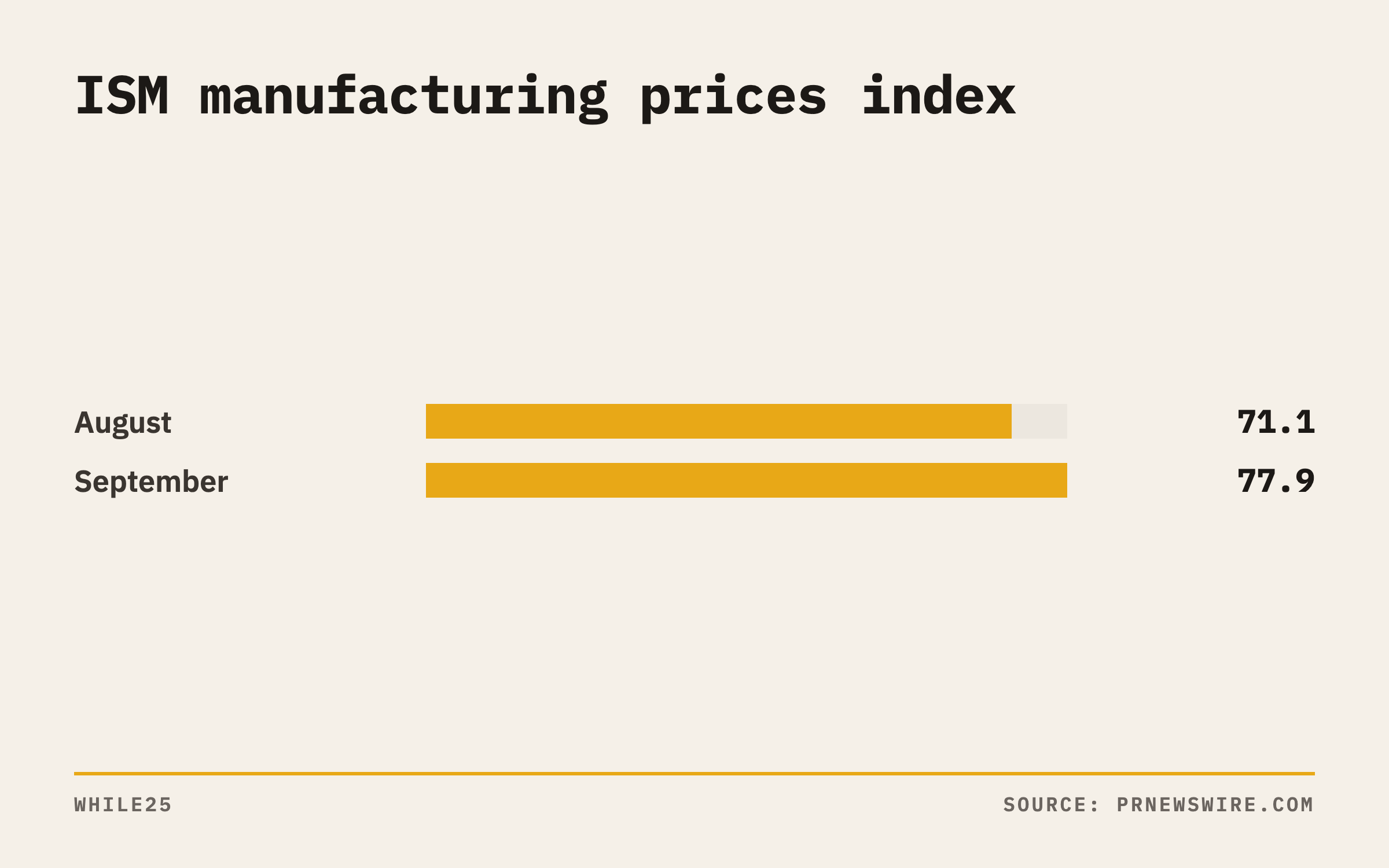 ISM manufacturing prices index rose from 71.1 in August to 77.9 in September
ISM's broader manufacturing PMI gauges overall factory activity. PMI stands for Purchasing Managers' Index. It registered 54.5 in September. August's reading was 54.6. Factories kept expanding and paid more for their inputs to do it.
ISM's survey covers September, before China's halt began on October 1. ISM's October survey will be the first to capture factory costs after China pulled its fuel from export markets.
From factory costs to bond yields
Companies pass higher input costs on to their customers, with a delay. A company that pays more for fuel and freight tends to raise its own prices over the following months. Freight is the cost of shipping goods. Those price rises show up as inflation, the general climb in prices across the economy.
Bond buyers track inflation. A bond is a loan to a government or company. It pays a fixed amount of interest. If prices climb at a faster pace, those fixed payments buy less. Investors respond by demanding higher interest rates to hold bonds.
A Treasury is a bond the US government sells to borrow money. The 10-year Treasury yield is the interest rate the government pays to borrow for 10 years. Banks use it as a base for many company loans and for mortgage rates, the interest on home loans. On October 1 it closed at 5.24%, down 5.6 basis points on the day. A basis point is a hundredth of a percentage point. It takes 100 basis points to make one percentage point.
That one-day drop came inside a larger climb. During trading on October 1, the yield reached 5.34%. Yahoo Finance described that as the highest level since 2002. Over the past month, the yield has risen 44.1 basis points.
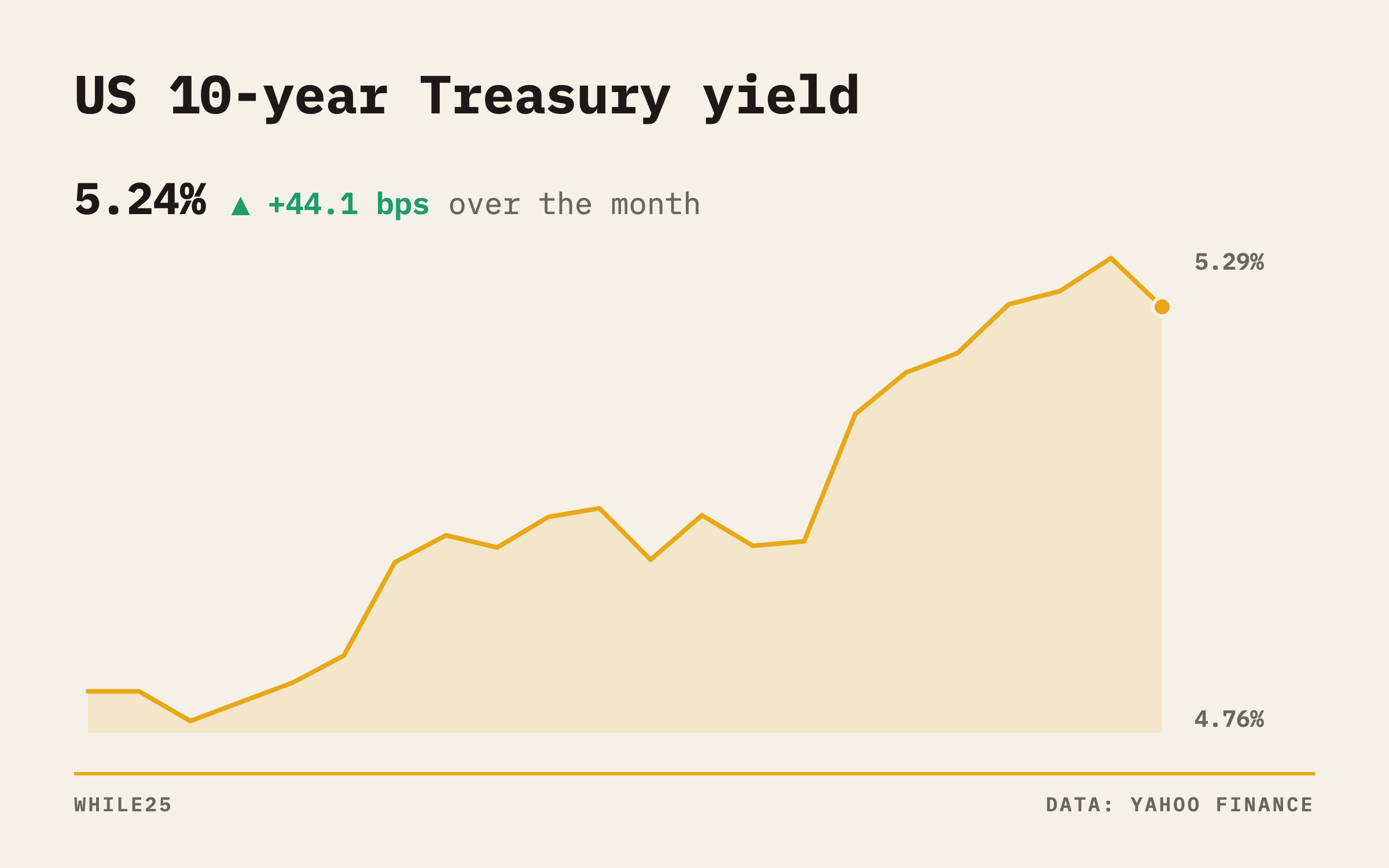 US 10-year Treasury yield over the past month, rising toward 5.24%
Bond investors weigh several things besides oil. They watch government borrowing, Federal Reserve policy and jobs data. The Federal Reserve is the US central bank, which sets short-term interest rates. Fuel costs make up part of inflation, and inflation is a main concern for bond owners.
Prices shifted in other markets on October 1. The US Dollar Index, which measures the dollar against six major currencies, rose 0.56%. An index tracks the combined prices of a group of assets. The S&P 500, an index of 500 large US companies, edged up 0.19%. In Europe, the STOXX 600, a broad index of European company shares, fell 1.30%.
Dates on the calendar
The US jobs report for September is due on October 2 at 8:30am ET (US Eastern Time). It will show how many jobs employers added during the month.
China's National Day holiday ends on October 7. Chinese refiners could restart fuel shipments after that date. The restart depends on fuel stocks inside China and on refinery output.
Russia's diesel export ban runs through the end of October.
The Federal Reserve announces its next interest rate decision on October 28 at 2:00 PM ET. Its meeting runs October 27 and 28.
Reading the chain
China's halt sits in refining, the stage between the oil well and the pump. News of recovering crude flows can run beside news of rising diesel costs. Both can hold true in the same week.
For a portfolio, meaning the mix of investments a person owns, the link runs through costs and interest rates. Companies pay more to make and move goods during a fuel shortage. Those costs add to inflation, and investors demand higher yields in response. Lenders and investors price bonds, mortgages and company shares off those yields. The next scheduled point for that chain to tighten or ease comes after October 7, when China decides on export permits.
Sources
- live.euronext.com
- oilprice.com
- prnewswire.com
- qz.com
- finance.yahoo.com
- financecalendar.com
- fedratecalc.com
Not investment advice.