
Micron Technology reported fiscal fourth-quarter revenue of $54.23 billion after the close on September 30. In the same quarter a year earlier, revenue was $11.32 billion. Micron guided the next quarter to $61.5 billion, with a non-GAAP gross margin of "approximately 86.25%", after reporting 87.0% for the quarter just ended.
Memory makers have sold chips priced like a commodity for decades. This quarter shows what happens when AI data centers want more memory than the industry can build. It also shows how much Micron is spending to build more, and why that spending matters to anyone holding Treasuries.
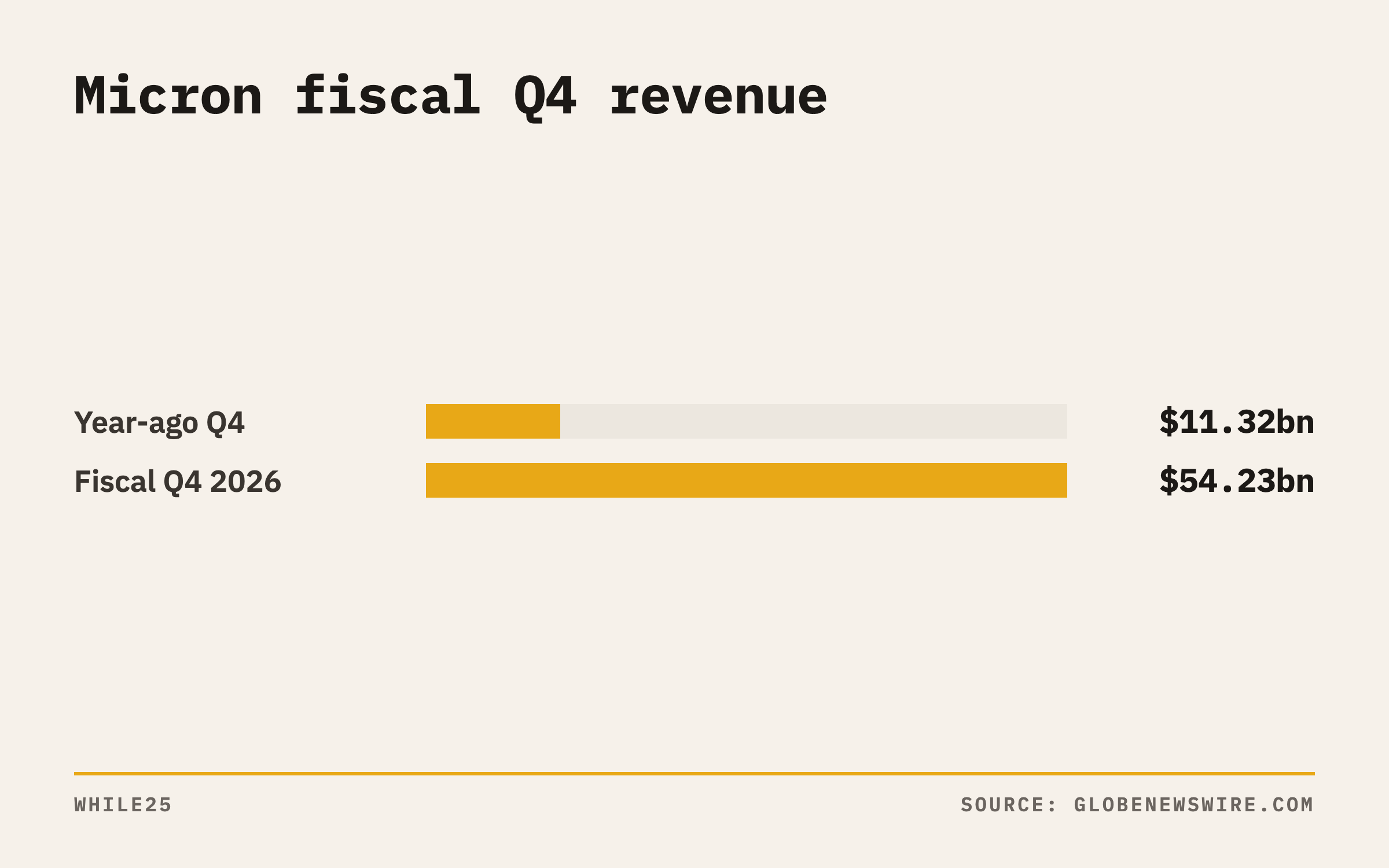 Bar chart comparing Micron's fiscal Q4 2026 revenue of $54.23 billion with $11.32 billion in the same quarter a year earlier
Revenue of $54.23 billion against $51.07 billion expected
CNBC reported that analysts expected $51.07 billion in revenue and adjusted earnings per share of $31.61. Micron delivered $54.23 billion and $33.42. On a GAAP basis, the standard accounting that includes stock compensation and one-off items, EPS came in at $32.87.
The guidance counted for more than the beat. For fiscal Q1 2027, Micron guided revenue to "$61.5 billion ± $1.5 billion" and non-GAAP EPS to "$38.15 ± $1.00". Analysts had pencilled in $57 billion of revenue and $35.40 of EPS, so the consensus revenue figure sits below the low end of Micron's range.
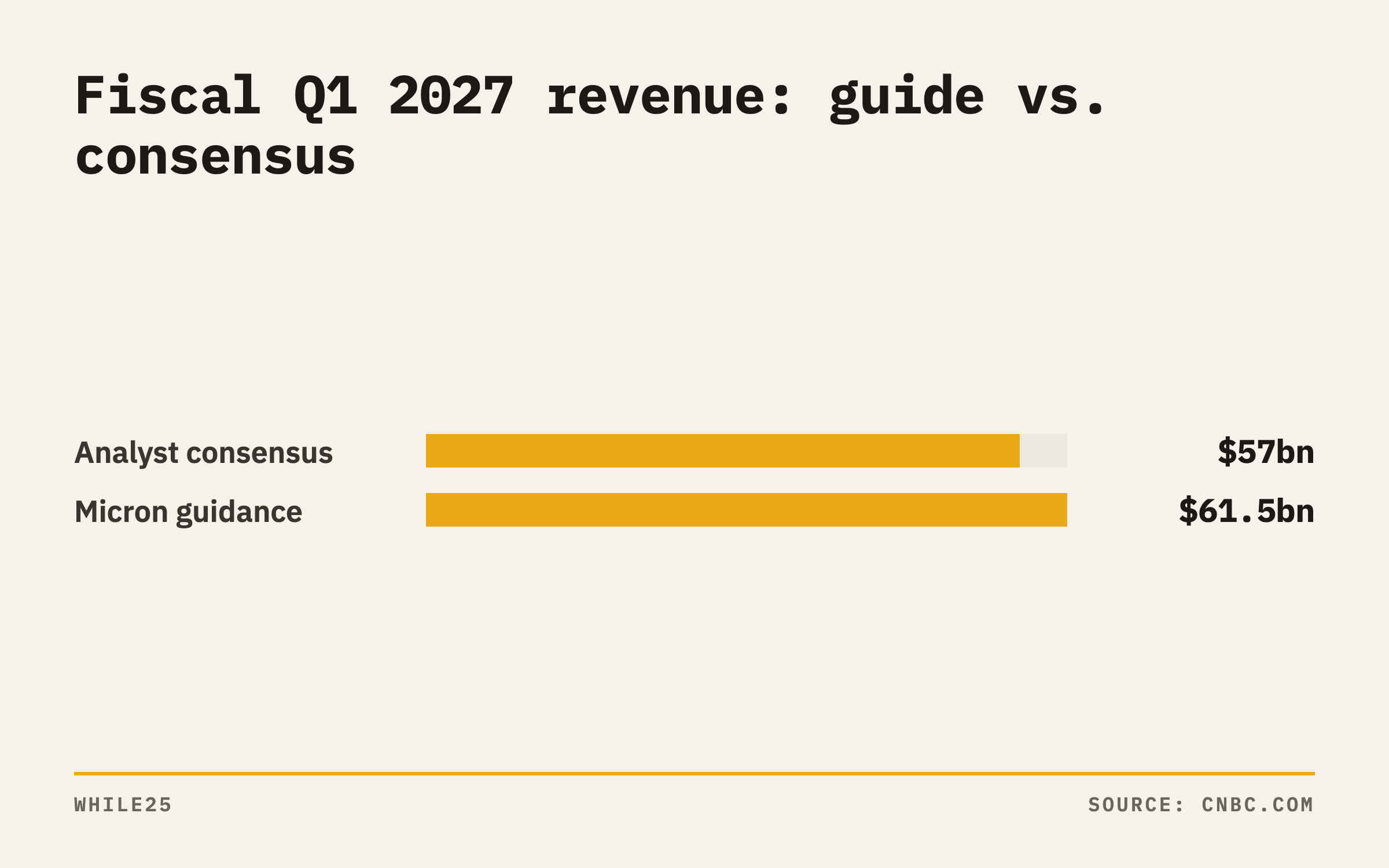 Bar chart comparing Micron's fiscal Q1 2027 revenue guidance of $61.5 billion with the $57 billion analyst consensus
A guide that clears consensus by that margin resets every sell-side model at once. The estimates that anchored the stock on the afternoon of September 30 had to be rebuilt around a higher revenue base before the next open.
DRAM produced $39.8 billion of the quarter
DRAM revenue rose 343% from a year ago to $39.8 billion, 73% of total sales. DRAM is the working memory that sits beside a processor and holds data while it computes. Most of the remainder of Micron's sales comes from NAND, the flash storage inside SSDs.
HBM, or high-bandwidth memory, is the DRAM product the AI build-out runs on. Manufacturers stack DRAM dies on top of each other, wire them together through the silicon, and package the stack next to a GPU or custom accelerator. The processor can then pull data at a bandwidth a standard memory module cannot match. Large models are limited by how fast data reaches the chip as much as by the chip's arithmetic, so every accelerator ships with HBM attached.
HBM also consumes wafer capacity. A stacked part uses more silicon per bit than conventional DRAM, so each wafer a manufacturer moves to HBM leaves fewer bits for PCs, phones and ordinary servers. That squeeze carries AI demand into prices across the whole DRAM line, including chips that never go near an AI server.
Micron's CEO put it this way in the results release: "AI is becoming Super Intelligence (SI), and memory enhances this intelligence."
An 87.0% gross margin is a pricing story
Gross margin is revenue minus the direct cost of making the product, expressed as a share of revenue. Micron reported 86.8% on a GAAP basis and 87.0% non-GAAP, a measure that strips out items such as stock-based compensation. Software companies report margins in that range. A manufacturer that runs its own fabs reaches that level when selling prices sit far above the cost of producing each bit.
Micron's guidance puts next-quarter non-GAAP gross margin at "approximately 86.25%" on the higher $61.5 billion revenue figure. Pricing across the period the guide covers is set well above cost.
Memory has a long record of cycles in which high prices pull in new capacity, and that new capacity later weighs on prices. The capex line shows how Micron is responding to this one.
$27.37 billion of capex, and where it lands
For fiscal 2026, Micron reported revenue of $133.19 billion against $37.38 billion the year before. Net capital expenditure for the year was $27.37 billion, with $10.77 billion of that in the fourth quarter. Net capex is spending on fabs and tools after the government incentives and partner contributions Micron counts against it.
That spending is the supply response this cycle produces. A new fab takes years to build, and tools installed now add bits over the quarters that follow. For anyone holding memory names, the capex line belongs next to the revenue line, because capacity funded today is the supply that meets demand later.
Bond desks list the same build-out as a reason yields are rising
The 10-year Treasury yield closed at 5.293% on September 30, up 3.8 bps on the day and 53.5 bps over the month. A September 29 market analysis listed the drivers of the bond selloff: expected Fed hikes plus "an energy crisis kicked off by the war in Iran, ballooning US government debt and budget deficits, and a historic investment cycle driven by the AI build-out."
The same piece reported that a recent Treasury auction drew its weakest bid-to-cover ratio in a year. Bid-to-cover is the value of bids received divided by the amount of debt sold. A lower ratio means thinner demand for the paper, and the Treasury has to offer a higher yield to clear it.
The link to Micron runs through capital. Companies committing tens of billions to fabs, data centers and power compete with the Treasury for the same pool of savings, and the growth they sustain makes rate cuts harder to justify. Micron's $27.37 billion is one company's share. Its customers, the cloud providers and chip designers buying HBM, spend on a larger scale, and their orders show up as Micron's revenue.
September 30: the Nasdaq rose while the Dow fell
Micron's numbers arrived after the bell, so they played no part in the regular session. The Nasdaq Composite closed up 0.24% while the Dow fell 0.86% and the S&P 500 slipped 0.25%. The VIX rose 1.87% to 16.34 as the 10-year pushed higher.
Tech held its ground on a day when rising long yields pressured the rest of the market. Micron's report landed on that split: a company booking record AI revenue, released on the same day bond desks named AI spending as one source of pressure on yields.
One cycle on both sides of the book
The memory cycle and the bond selloff share a cause. A portfolio that is long AI hardware and long duration holds two exposures to the same capital spending. The hardware side collects it as revenue, and bond desks cite that same spending as one of the pressures on the duration side. Reading Micron's guide next to the Treasury curve shows how much of a book depends on one driver.
Scheduled dates ahead: the Fed releases minutes of its September 15-16 meeting on October 7 at 2:00 p.m. The FOMC meets October 27-28, with a press conference on October 28 at 2:30 p.m. Micron's $0.15 quarterly dividend is payable on October 29.
Sources
Not investment advice.