
On Monday, October 12, US stocks traded a full session. The Dow Jones and the S&P 500 are indexes that track the share prices of large US companies. The Dow rose 0.38%. The S&P 500 slipped 0.06%.
The US bond market stayed shut. Bonds are loans that investors make to governments and companies. "Today was Columbus Day with banks and the bond market closed," the Hammerstone Markets recap noted. The recap listed the 10-Year Note, a US government bond, as closed for the holiday.
That day, two of the biggest US markets ran on different calendars. Separate groups set the holidays for each market, and those groups follow different rules. Those calendars decided which prices a trader could see on October 12.
Stock exchanges write their own calendar
A stock exchange is a marketplace where buyers and sellers trade company shares. Exchanges set their own holiday lists. The New York Stock Exchange and Nasdaq each publish the days they close. Columbus Day is absent from those lists.
On October 12, stock trading ran from the opening bell to the close. The exchanges matched orders to buy and sell all session. Traders moved prices on the news of the day.
Bond dealers follow SIFMA
The bond market works another way. Most US government bonds, called Treasuries, trade between banks and dealers on private networks. No exchange runs that trading. Dealers are firms that buy and sell bonds for their own accounts.
Those dealers have a trade group called SIFMA, the Securities Industry and Financial Markets Association. "SIFMA recommends a holiday schedule for financial markets," the group states on its website. Its 2026 US schedule lists Columbus Day, Monday, October 12, as a holiday. It shows no early close for the day. An early close is a shortened trading session.
SIFMA recommends dates. It has no power to shut a market. Dealers follow its schedule because banks close on those days, and banks complete bond trades.
Bonds follow the banks
Banks run the system that completes bond trades. A bond trade has two parts. First, the buyer and seller agree on a price. Then the trade settles, meaning cash moves to the seller and the bond moves to the buyer.
Bond trades tend to be large, and banks carry the money. An explainer from Tradefundrr states: "Bond trading depends heavily on banks and on the payment systems that settle large transactions." The same piece adds a second point. If the banking system takes the day off, "the bond market's trade association recommends that trading stop too."
Banks take their days off in step with the Federal Reserve. The Fed is the US central bank, the government's bank that manages the nation's money. Its 2026 list of observed holidays includes Columbus Day on October 12 and Veterans Day on November 11. SIFMA's schedule lists both dates.
The chain runs from the Fed to the dealers. The Fed observes a holiday, and banks stop moving large sums through their payment systems. Without those payments, banks cannot settle bond trades. In response, the dealers' group recommends no trading. Stock exchanges sit outside that chain and stay open.
The missing 10-year close
The holiday leaves its clearest mark on interest rates. The Tradefundrr explainer notes that on a bond holiday, "There is no active cash market in U.S. Treasuries that day." In the cash market, buyers and sellers trade the bonds themselves.
A bond's yield is the yearly return it pays, shown as an interest rate. The 10-year yield is the interest rate the US government pays to borrow for 10 years. Lenders use it as a reference for mortgages and company loans. Stock investors use it to judge what future profits are worth today. With the cash market shut, dealers set no fresh closing yield, the rate at the end of the session.
On a bond holiday, traders may see a number on their screens. In our market data, the 10-year yield stood at 5.24% for October 12. Hammerstone's recap listed the 10-Year Note as closed for the holiday. A trader reading the screen that day saw a figure without a full cash market behind it.
Dealers posted fresh prices once bond trading resumed on Tuesday, October 13. That leaves a gap of one session. Stock investors reacted to events on October 12. Treasury investors recorded their reaction the next day.
The news stocks priced without bonds
Investors had news to price on October 12. Oil rose "as attacks on Saudi Arabia's airports outweighed prospects of increased supply," according to the Hammerstone recap. Al Jazeera reported that Riyadh's King Khalid International Airport "has been struck four times in the past five days."
Brent crude is the global reference price for oil. It closed at $105.92 a barrel, up 1.15%. WTI, the US reference price, gained 1.43% to $93.16. Energy shares moved with oil.
S&P sorts companies into sectors, or industry groups. "Nine of the eleven S&P sectors finished higher, led by Energy (XLE +1.43%) and Communications (XLC +0.97%)," Hammerstone wrote. XLE is a fund that holds large US energy companies.
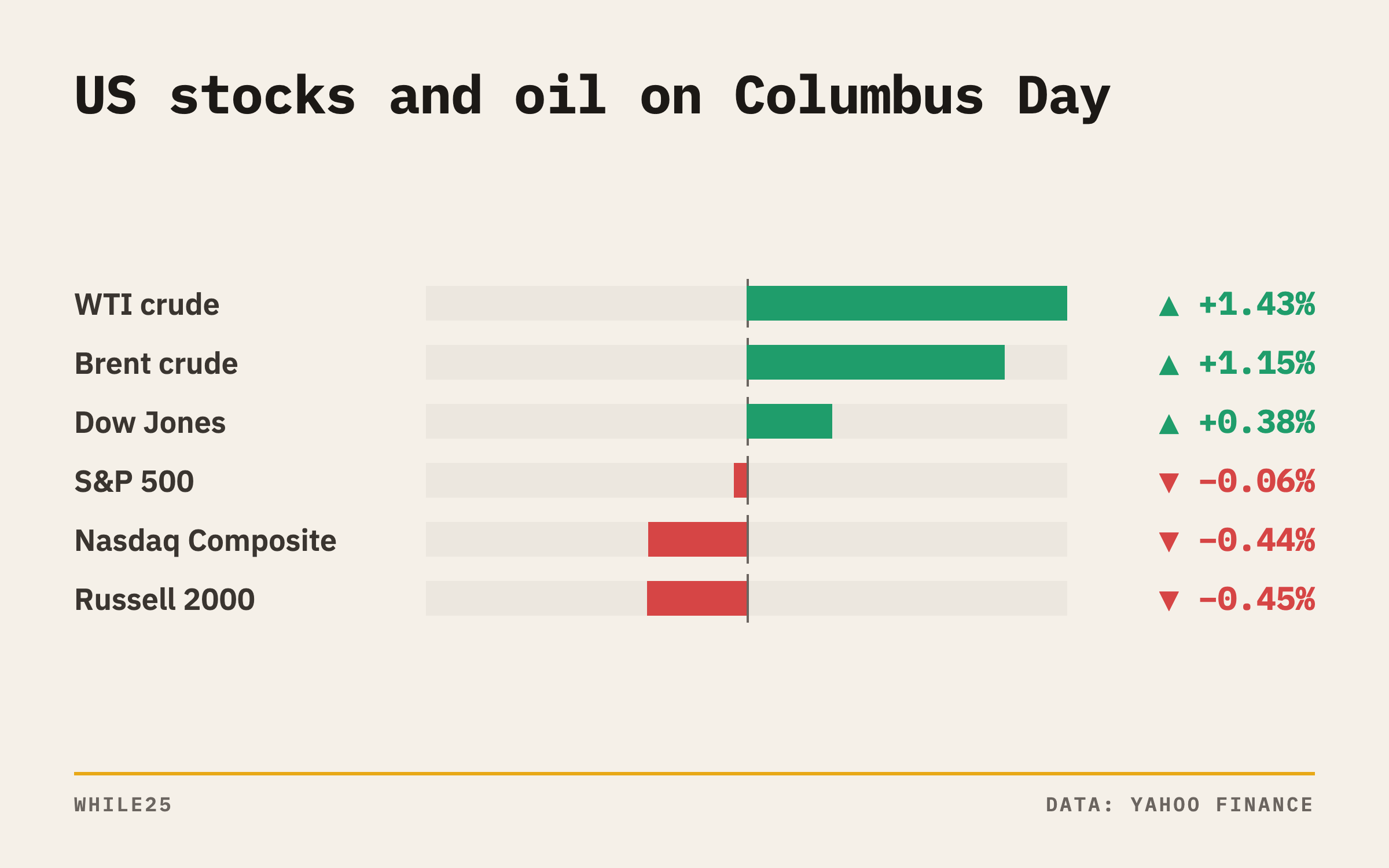 Day change on October 12: the Dow and oil rose while the S&P 500, Nasdaq and Russell 2000 slipped
Technology stocks moved the other way. Hammerstone wrote that they "lagged all day," meaning they trailed the wider market. Shares of Micron Technology, a US maker of memory chips, fell 3.9%. MarketBeat reported a previous close of $1,029.00 and a last trade at $989.04.
The trigger came from CXMT, a Chinese memory maker. Its full name is ChangXin Memory Technologies. Yahoo Finance reported that CXMT announced "significant progress" in a new memory-cell design. The design aims to pack more storage into each chip.
MarketBeat wrote that investors feared the design "could eventually challenge Micron's pricing power and supply advantage." Pricing power is a company's ability to raise prices without losing buyers.
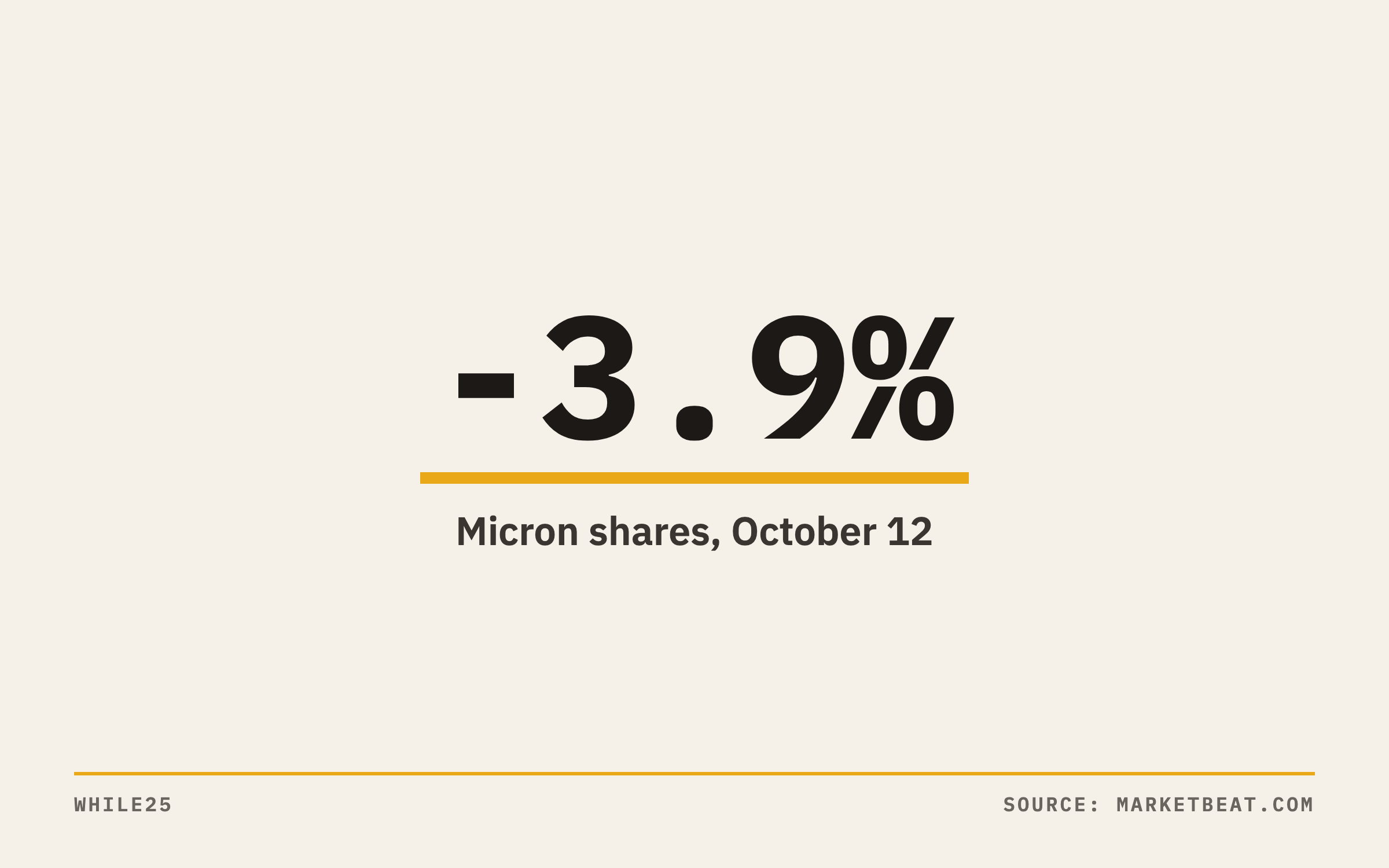 Micron shares fell 3.9% on October 12 after a report from Chinese memory maker CXMT
The Nasdaq Composite, an index packed with technology companies, fell 0.44%. The Russell 2000, an index of smaller US companies, lost 0.45%.
Both stories bear on interest rates. Higher oil prices can push up inflation, the pace at which prices rise. Bond investors weigh inflation when they decide the yield they demand. On October 12, stock traders could act on that link in real time. Treasury traders had no active cash market in which to do the same.
Reading a split day
On a split day, stocks trade and the bond market stays shut. Readers of market data need to adjust in two ways.
First, a yield change shown for a bond holiday may not reflect a full day of trading. Comparing it with the same day's stock move can give a false picture. The stock number came from a full session. The yield number lacked one.
Second, bond investors react in the next session. If news breaks on the holiday, Treasury dealers give their first full response the following morning. On October 13, dealers returned to a busy day. JPMorgan, Goldman Sachs, Citigroup and Wells Fargo planned to report results before the opening bell that Tuesday.
The gap affects the daily value of an account that holds both stocks and bonds. A stock fund gets a fresh price from a live session. A bond holding gets its next fresh price once the banks reopen.
The next split: November 11
The next split day falls on Wednesday, November 11, Veterans Day. SIFMA's 2026 schedule lists it as a bond-market holiday with no early close. The Fed lists it among its observed holidays. Stock exchanges follow their own calendar, so the same pattern will repeat. Stocks will trade, while banks and the cash Treasury market close.
On November 11, stock traders will set fresh prices through the session. Treasury dealers will post a fresh 10-year yield once the banks reopen. A trader who knows which market is open can read each number for what it is.
Sources
- investrade.com
- sifma.org
- federalreserve.gov
- tradefundrr.com
- marketbeat.com
- finance.yahoo.com
- aljazeera.com
- heygotrade.com
Not investment advice.