
On October 1, France's 10-year government bond yield touched 4.989%. That is close to 5%, the highest since 2002. A government bond is a loan that investors make to a government. A bond yield is the yearly return a buyer locks in. For a government, it is the price of borrowing money.
The same week, the gap between French and German 10-year yields reached nearly 160 basis points. A basis point is one hundredth of a percentage point. That means 100 basis points make one percentage point. The euro zone is the group of countries that use the euro. The gap was its widest since the euro zone's sovereign debt crisis in 2011, a period of stress over government debt.
Investors' worries have spread past the bond market. On October 5, the CAC 40 fell to a 7-month low. The CAC 40 is France's main stock index, a measure of share prices. The euro touched $1.116, its weakest level since May 2025.
The gap over Germany
Germany's government bonds are called bunds. Investors treat them as the euro zone's safe benchmark, the standard they measure other bonds against. France and Germany share a currency and a central bank. The extra yield investors demand on French debt is the price they put on risks specific to France.
Two numbers sit behind that price. The first is France's budget deficit, at 5.4% of GDP in 2026. A deficit is the shortfall between what a government spends and what it collects in taxes. GDP is the total value of goods and services an economy produces in a year.
The second number is public debt, the total the government owes. France's public debt stands at 119.3% of GDP. Forecasters project it will reach 121.7% in 2027. Prime Minister Sébastien Lecornu presented the draft 2027 budget on October 1. A draft budget is the government's plan for spending and taxes. Lecornu presented it the same day the 10-year yield touched 4.989%.
Investors weigh politics as a second layer. France holds elections in April 2027. Market reports on October 5 linked the fall in French stocks to two things. One was the outlook for the government's budget. The other was political uncertainty ahead of that vote.
The interest bill
France locks in the interest payment on each bond on the day it sells the bond. Higher yields today leave the payments on old bonds unchanged. The pressure builds as old bonds come due, meaning their term ends and France must repay them. France repays them by selling new bonds. The new bonds carry today's higher rates.
StoneX projects that interest costs on French government debt will reach about €91 billion in 2027. Each euro of interest goes to lenders. It leaves less room for schools, roads or defence.
A bigger interest bill can widen the deficit. A wider deficit means more borrowing at higher rates. Bond investors watch for that loop. They price it in the gap between French and German yields.
The ECB backstop and its conditions
The European Central Bank, or ECB, sets interest rates for the countries that use the euro. It keeps a crisis tool, a backstop, called the Transmission Protection Instrument, or TPI. The tool lets the ECB buy a country's bonds to pull its yields back down. The ECB's aim is to keep one interest rate policy working the same way across the euro area.
The TPI has a trigger. The rise in a country's yields must be "unwarranted" by that country's own fundamentals. Unwarranted means not justified. Fundamentals here means its budget, its debt and the health of its economy.
Picture two cases. In the first, investors dump a country's bonds in a panic that its numbers do not justify. The ECB can step in. In the second, investors sell because the country's budget numbers have worsened. The ECB treats that selling as a response to fundamentals. It did not design the tool for that case.
That test is harder for France to pass. France is in the EU's Excessive Deficit Procedure. That is a formal process for countries whose deficit exceeds 3% of GDP. Under it, the EU sets a path the country must follow to bring its deficit down. Before using the TPI, the ECB checks whether a country follows the EU's budget rules.
Bond investors know the ECB has a tool. They know France has to show its budget is on track before the ECB can use it. They set the price of French bonds with both facts in view.
From bonds to the euro
Investors' worries about a large euro member's budget weigh on the currency the whole bloc shares. Investing.com reported that on October 5 the euro fell as much as 0.8% to $1.116. It later traded 0.36% lower at $1.1211. The euro is coming off its fourth straight weekly fall against the dollar. Over those four weeks it dropped 3.1%.
The dollar gained as the euro fell. The dollar index measures the dollar against a basket of major currencies. It rose 0.28% to 102.19 after reaching 102.53. That peak was its highest since April 10, 2025.
US interest rates give investors a second reason to hold dollars. The US 10-year yield, the rate the US government pays to borrow for 10 years, closed at 5.311% on October 5. Higher US yields mean savers earn more on dollars. That draws money toward the dollar.
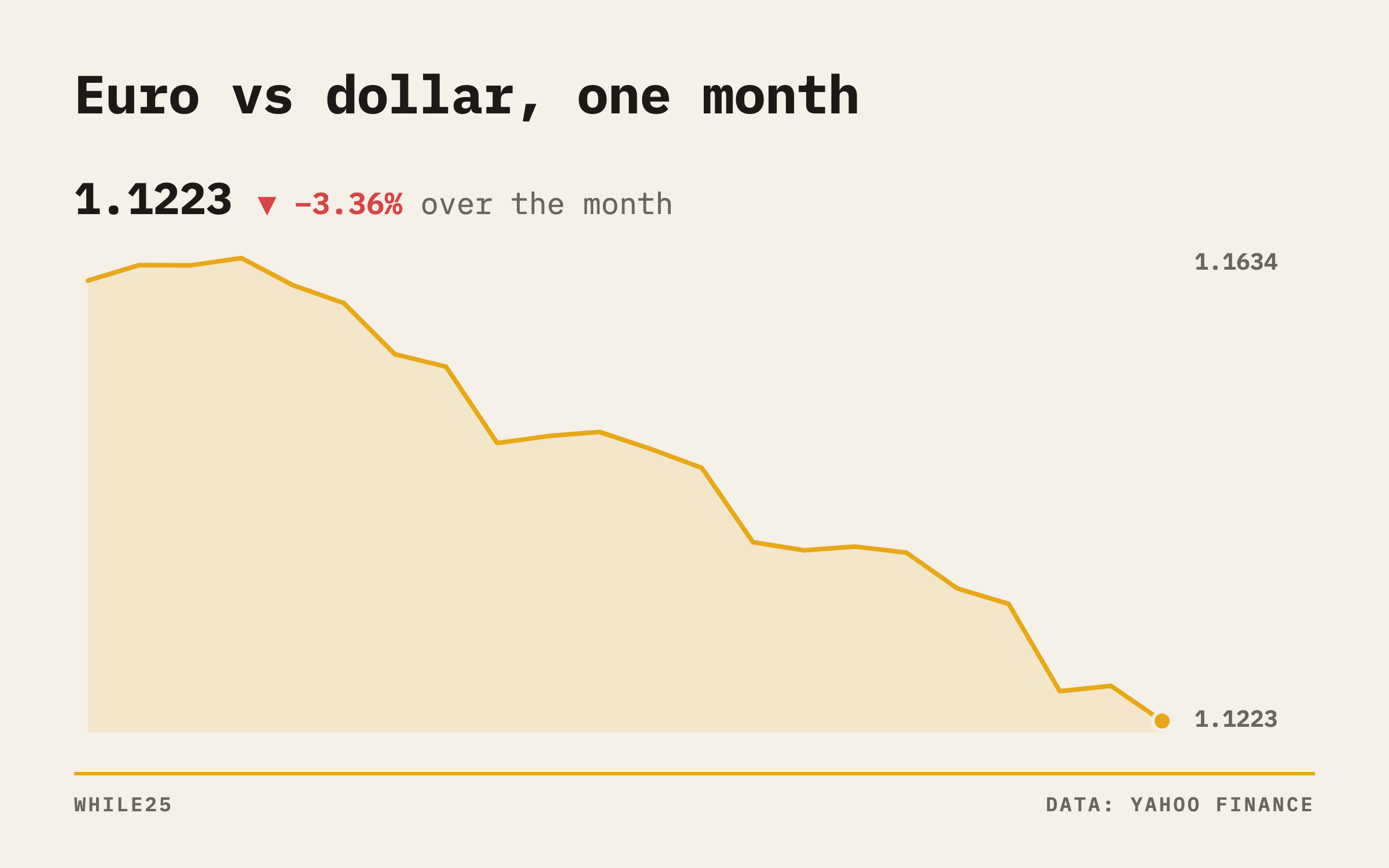 EUR/USD over the past month, showing the euro's slide against the dollar into early October
From bonds to French stocks
The CAC 40 fell 0.80% to 7,834.10 on October 5. Over five trading days, or sessions, it lost 3.03%. Over one month it lost 5.68%.
Germany's main stock index, the DAX, rose 0.09% on the same day. The STOXX 600, a broad index of European stocks, gained 0.36%. Britain's main index, the FTSE 100, added 0.34%.
Germany shares the euro and the ECB with France. Yet German stocks closed higher. Investors sold French assets in particular.
French government debt now offers a 5% yield. That gives investors a lower-risk place to park money. French stocks have to compete with that return. Lenders tend to raise the rates French companies and households pay as government borrowing costs rise.
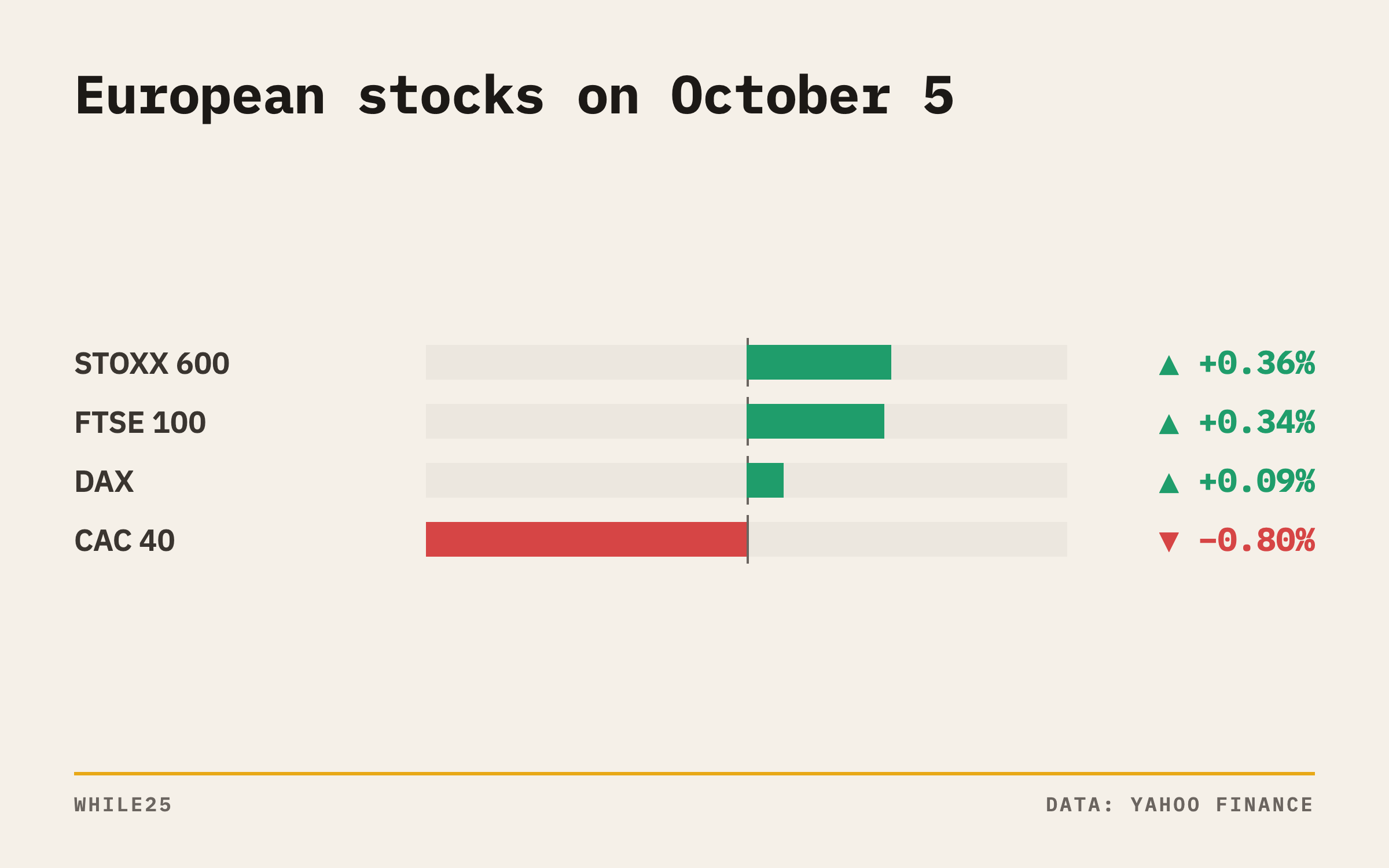 Day change for European stock indexes on October 5: the CAC 40 fell while the DAX, STOXX 600 and FTSE 100 rose
Spain added to political risk in Europe. Spanish Prime Minister Pedro Sánchez called a snap election for November 29. A snap election is a vote called earlier than planned. Investors in euro assets now have a second national vote to weigh.
For your portfolio
Many US investors own European stocks through funds priced in dollars. Those holdings carry two risks: the share price and the euro. If the euro falls, shares priced in euros are worth fewer dollars. That holds even if the share price stays flat.
Investors can use the France-Germany yield gap to gauge stress specific to France. Germany makes a clean comparison because it shares France's currency and central bank. A wider gap means investors want more pay for French risk. A narrower gap means they want less.
The ECB backstop exists, and it comes with conditions. The ECB ties those conditions to France's budget path. That gives weight to budget news and the deficit figures behind it.
Two dates sit on the calendar. Spain votes on November 29. France holds elections in April 2027. Until then, the yield gap, the euro and the CAC 40 will show how investors price France's budget.
Sources
Not investment advice.