
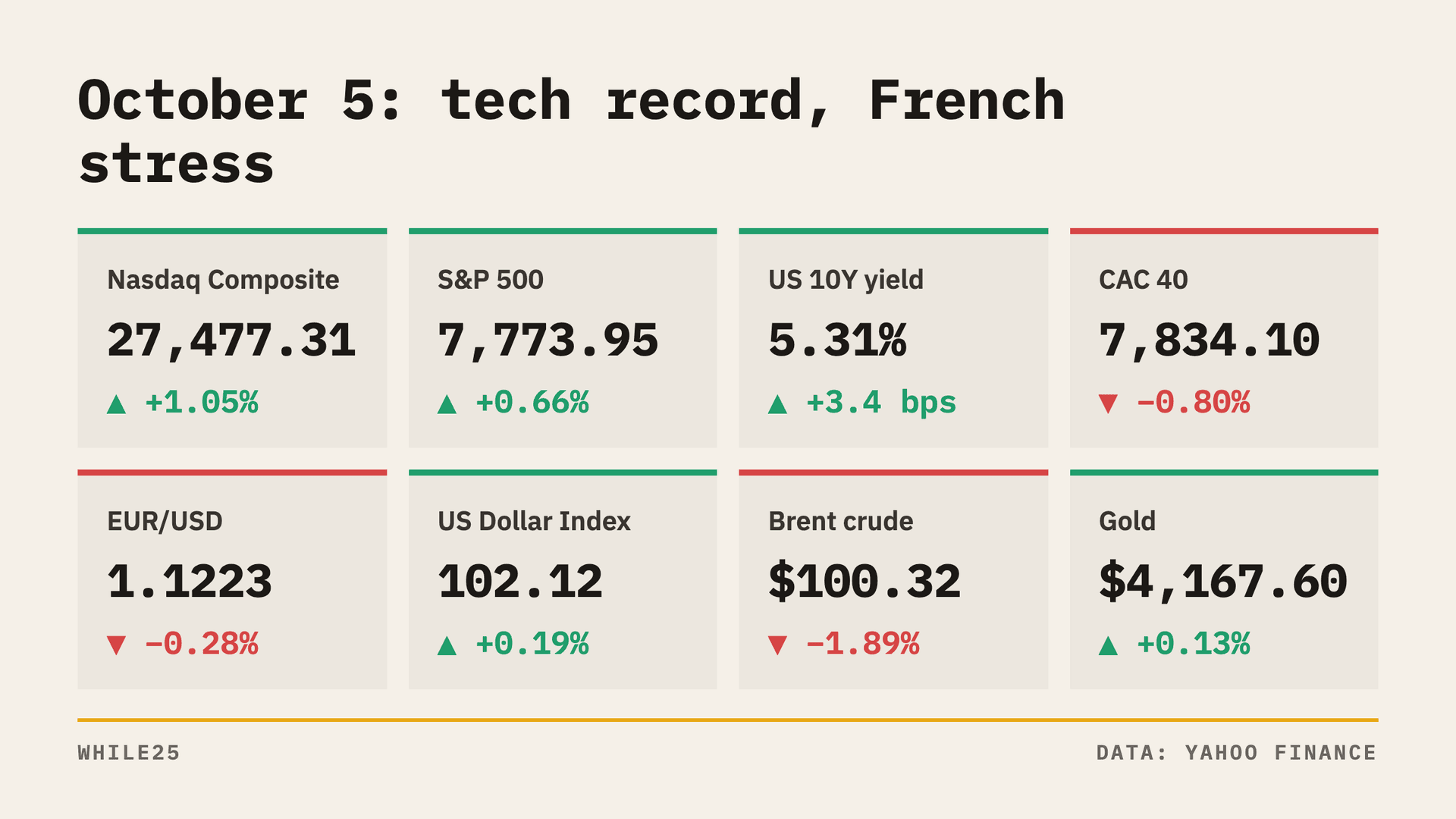
The Nasdaq Composite closed at a record 27,477.31 on October 5, up 1.05%. The Nasdaq is an index, a single number that tracks a basket of stocks, and it leans toward tech. Most of the gain came from the largest tech companies tied to artificial intelligence (AI). Investors kept buying as the 10-year Treasury yield climbed to 5.311%. That yield is the interest rate the US government pays to borrow for 10 years.
Paris had a different day. Investors worried about French government debt and sold French stocks. The CAC 40, France's main stock index, fell 0.80% to a 7-month low. Currency traders sold the euro over the same worries. It fell to its weakest level since May 2025.
Tech buyers looked past higher yields
A handful of large AI companies did most of the lifting. SpaceX jumped more than 7%. Nvidia and Tesla rose 2% each. Meta gained close to 2%, and Microsoft rose more than 1%. Nvidia hit an all-time high, trading near $237 a share.
The rest of the market rose at a slower pace. The S&P 500, an index of 500 large US companies, gained 0.66% to 7,773.95. The Russell 2000, an index of smaller US companies, rose 0.50%. The Dow, which follows a small group of big US companies, added 0.18%.
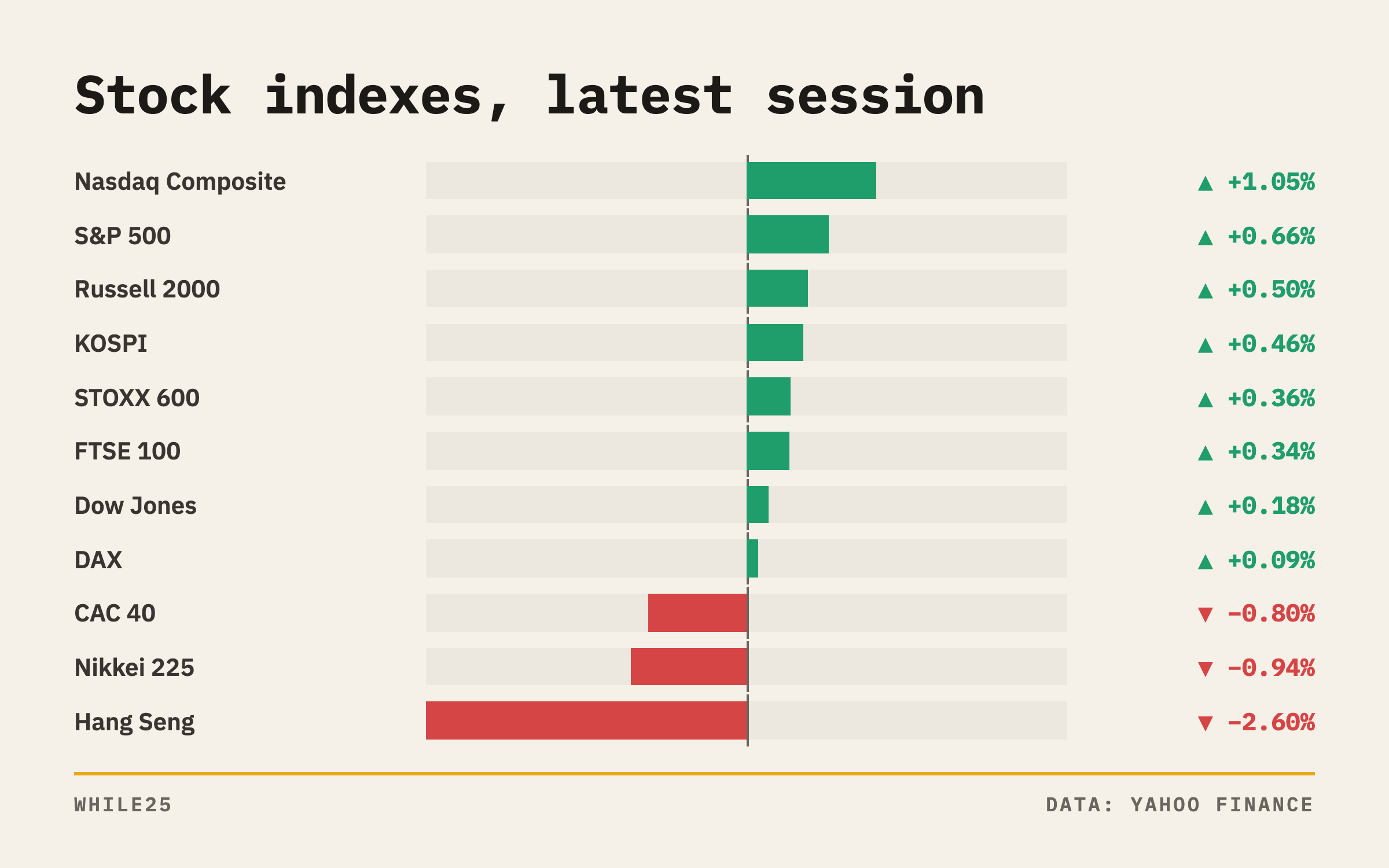 Day moves for major stock indexes: the Nasdaq led and the CAC 40 fell; Asian indexes show their October 2 session
Bond yields climbed during the rally. A bond is a loan that investors make to a government or company. The 10-year yield rose 3.4 basis points on the day. Traders count yield moves in basis points, and 100 basis points make one percentage point. Over the past month, the yield is up 50.5 basis points.
Investors tend to pay less for tech stocks when yields rise. If a safe bond pays more, investors value profits far in the future less today. Tech buyers set that worry aside on October 5.
Part of the rise in yields traces back to the Federal Reserve, the US central bank. At its September 15-16 meeting, the Fed raised its target range for short-term interest rates by 25 basis points to 3.75%-4.00%. It was the Fed's first rate increase since 2023.
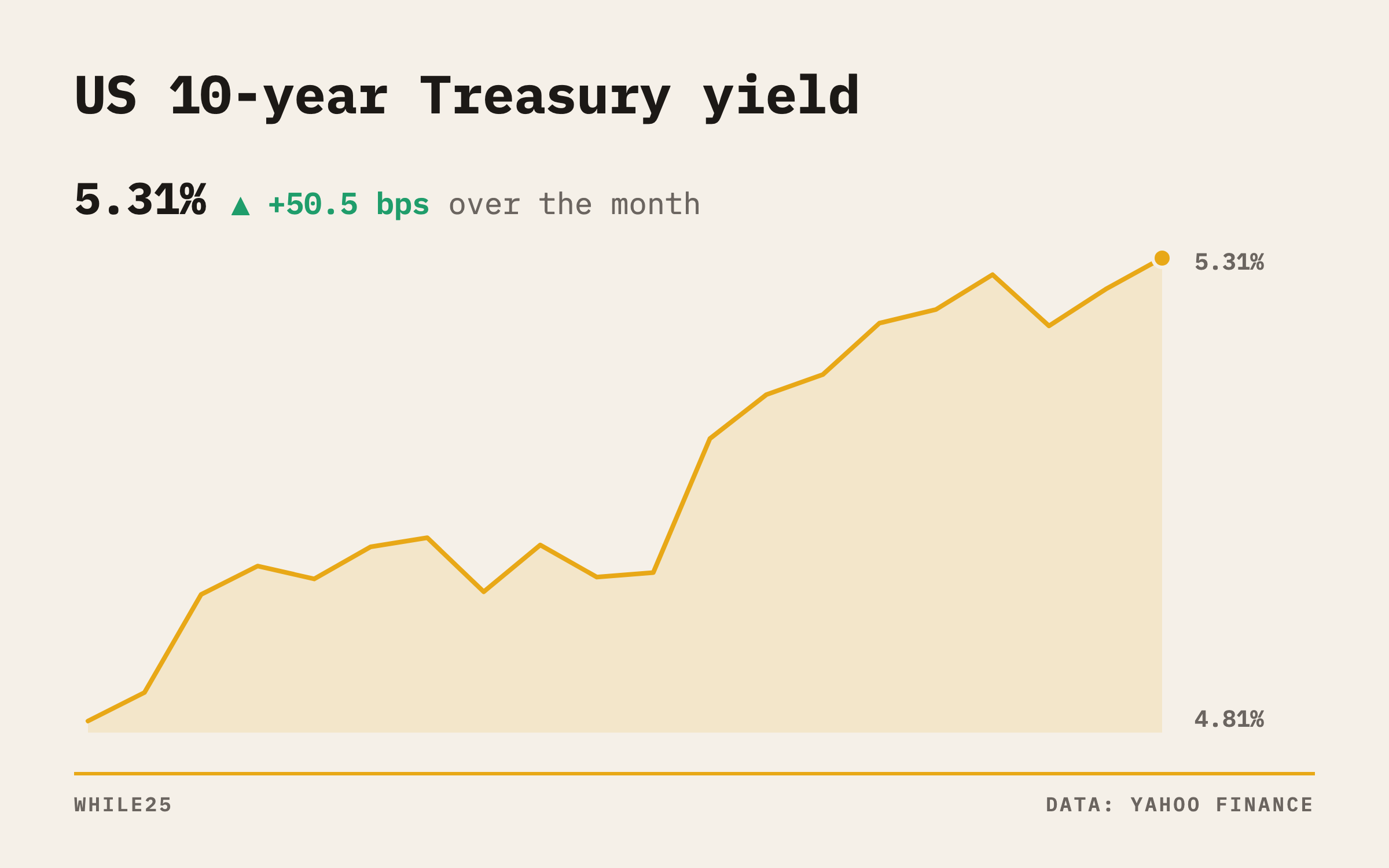 The US 10-year Treasury yield over the past month, climbing to 5.311% on October 5
Service firms slowed, and their costs kept rising
The Institute for Supply Management (ISM) surveys purchasing managers at US service companies each month. Purchasing managers are the staff who buy a company's supplies. ISM's services index fell to 54.9 in September from 55.4 in August. ISM reads that level as growth, at a slower pace than in August.
The survey's prices index tracks what firms pay for supplies. It rose to 74 from 72.6. It came in above 70 for the sixth time in seven months. The employment index, which tracks jobs, rose to 50.1 from 47.8. ISM counts that as expansion for the first time in three months.
Bond traders watch the prices index with care. The Fed counts rising costs at service companies among the pressures it weighs when setting rates. Bond investors build the Fed's rate decisions into the yields they demand on Treasury bonds.
France's debt worries spread to the euro
France was the center of stress in Europe's bond market. On October 1, France's 10-year yield touched 4.989% for a short time. That was close to 5% for the first time since 2002.
On Friday, October 2, the gap between French and German government bond yields widened to near 160 basis points. That gap shows how much more France pays to borrow than Germany. It was the widest gap since the euro zone debt crisis of 2011. The euro zone is the group of countries that use the euro. After October 2, the gap eased to about 136 basis points.
The pressure traces back to France's budget. The deficit, the gap between what the government spends and what it collects, is 5.4% of GDP in 2026. GDP is the value of everything a country produces in a year. Public debt, the total the government owes, stands at 119.3% of GDP. Prime Minister Sébastien Lecornu presented the draft 2027 budget on October 1. Projections put interest costs on French government debt at about €91 billion in 2027.
The European Central Bank (ECB), the euro zone's central bank, has a tool for buying the bonds of a country whose yields jump. The ECB calls it the Transmission Protection Instrument. The ECB limits the tool to cases where the rise in yields is "unwarranted" by that country's own finances. The EU has placed France under its Excessive Deficit Procedure for running a deficit above 3% of GDP. That procedure is a set of EU rules for governments that overspend.
Investors in Paris sold. The CAC 40 closed at 7,834.10 and is down 5.68% over the past month. The rest of Europe held up. Germany's main index, the DAX, rose 0.09%. Britain's FTSE 100 gained 0.34%. The STOXX 600, a broad index of European companies, added 0.36%.
Spain's prime minister, Pedro Sánchez, set a new political date. He called a snap election, an early vote, for November 29.
Currency traders joined the selling. The euro fell as low as $1.116 during the day, its weakest since May 2025. It closed at $1.1223, down 0.28%. Before October 5, the euro had fallen against the dollar for four weeks in a row. The US Dollar Index, which tracks the dollar against six major currencies, rose 0.19% to 102.124.
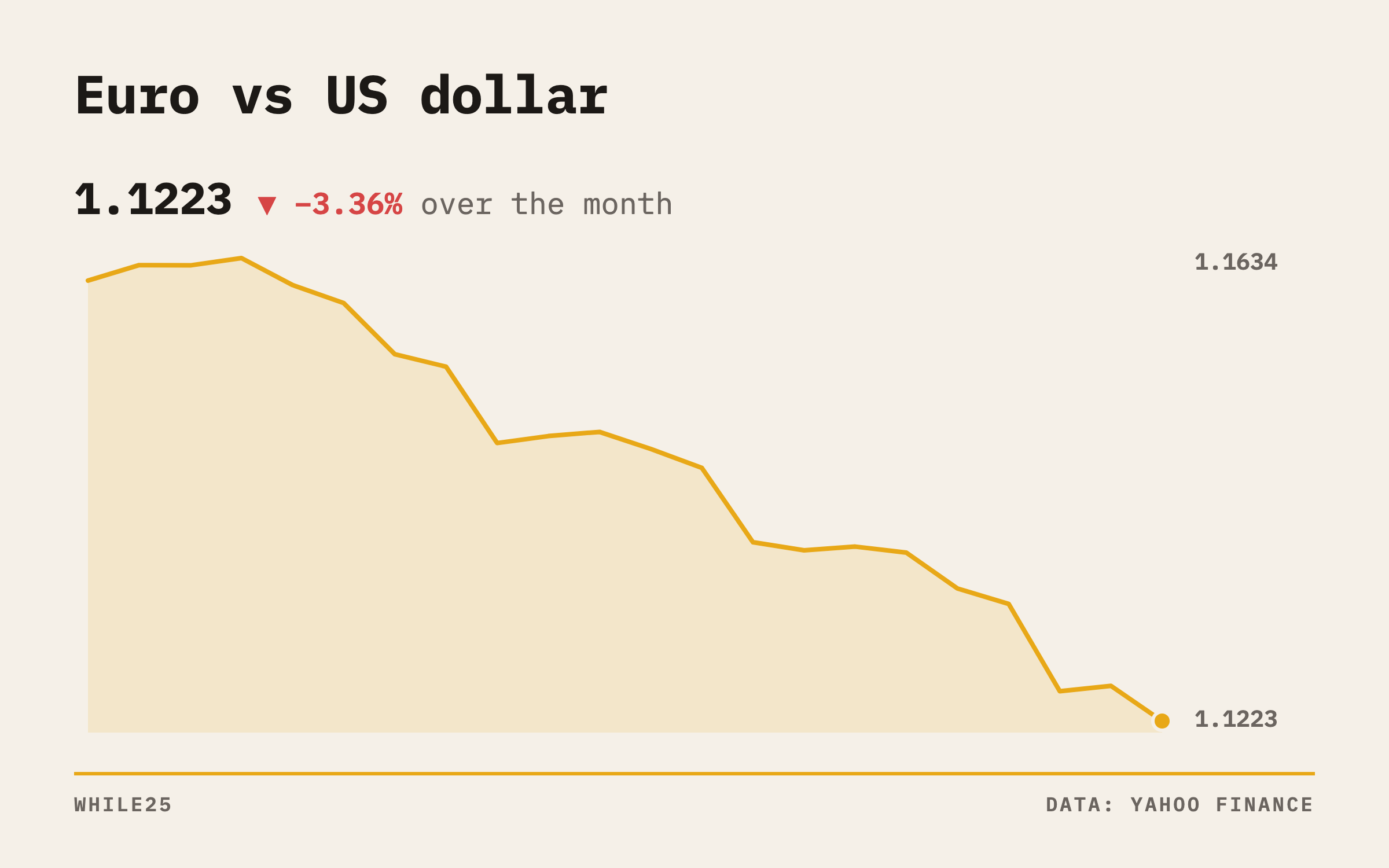 The euro against the US dollar over the past month, sliding to 1.1223 on October 5
Saudi Aramco cut prices, and oil fell
Brent crude, the main global reference price for oil, fell 1.89% to $100.32 a barrel. WTI, the main US reference price, fell 1.99% to $89.30. Oil fell after a pricing decision by Saudi Aramco, Saudi Arabia's national oil company.
Each month, Aramco publishes an official selling price for each type of crude oil and each region. For Asian buyers, Aramco sets that price above or below the average of Oman and Dubai crude. For November, Aramco cut its Arab Light price for Asia by $3 from October. Arab Light is one of Aramco's crude types. The cut puts it $5 a barrel below the Oman/Dubai average. That is the deepest discount since June 2020. Respondents to industry surveys had expected increases of $3 to $5.
Aramco moved the other way for Europe. After resuming exports from Yanbu, its Red Sea port, Aramco raised prices for northwest Europe and the Mediterranean by $3. It left US prices unchanged. Oil traders gave the cheaper Asian barrel more weight than concern about intensified fighting in Yemen.
Asia's last sessions came before October 5
Asia's most recent trading day was October 2. Hong Kong's main index, the Hang Seng, fell 2.60% that day to 23,972.29. Bank shares fell the most. HSBC fell 5.4%, and AIA Group and Standard Chartered each dropped 6%. Investors sold amid concern over possible new UK bank taxes and high global bond yields.
Japan's Nikkei 225 index slipped 0.94%. South Korea's KOSPI index rose 0.46%. Mainland China's markets stayed closed for the Golden Week holiday.
Gold, bitcoin and the fear gauge
Gold rose 0.13% to $4,167.60 an ounce. It is down 6.11% over the past month. Bitcoin, a digital currency, slipped 0.79% to $85,793.94. The VIX measures how much investors expect stocks to swing. It rose to 15.52. The dollar gained 0.12% against the yen, Japan's currency, to 157.924.
Dates to watch
- October 6: the US Treasury sells 3-year notes at auction. Notes are loans to the government that it repays after a set term.
- October 7: the Treasury sells more of an existing 10-year note. At 2:00 pm ET, the Fed releases minutes of its September 15-16 meeting. Minutes are the written record of the meeting.
- October 8: the Treasury sells more of an existing 30-year bond.
- November 29: Spain holds its snap general election.
Two lessons for a portfolio
October 5 showed two forces at work. In New York, buyers paid up for a small group of AI-linked giants. A fund that tracks the Nasdaq rose with those stocks. Those few names drive much of its daily move, so the fund carries their weight.
In Europe, French bond yields and the euro showed the stress before stocks did. A US investor holding French stocks lost twice on the day: once from the CAC 40 and once from the weaker euro. French stocks trade in euros, so a weaker euro converts into fewer dollars.
This week's Treasury auctions and the Fed minutes are the scheduled tests. Buyers will show what price they want for US debt at these yields.
Sources
- finance.yahoo.com
- cnbc.com
- prnewswire.com
- investing.com
- techtimes.com
- pantheregroup.com
- investinglive.com
- bloomberg.com
- home.treasury.gov
- admiralmarkets.com
- stonex.com
- chinadailyhk.com
- businesstoday.com.my
Not investment advice.