
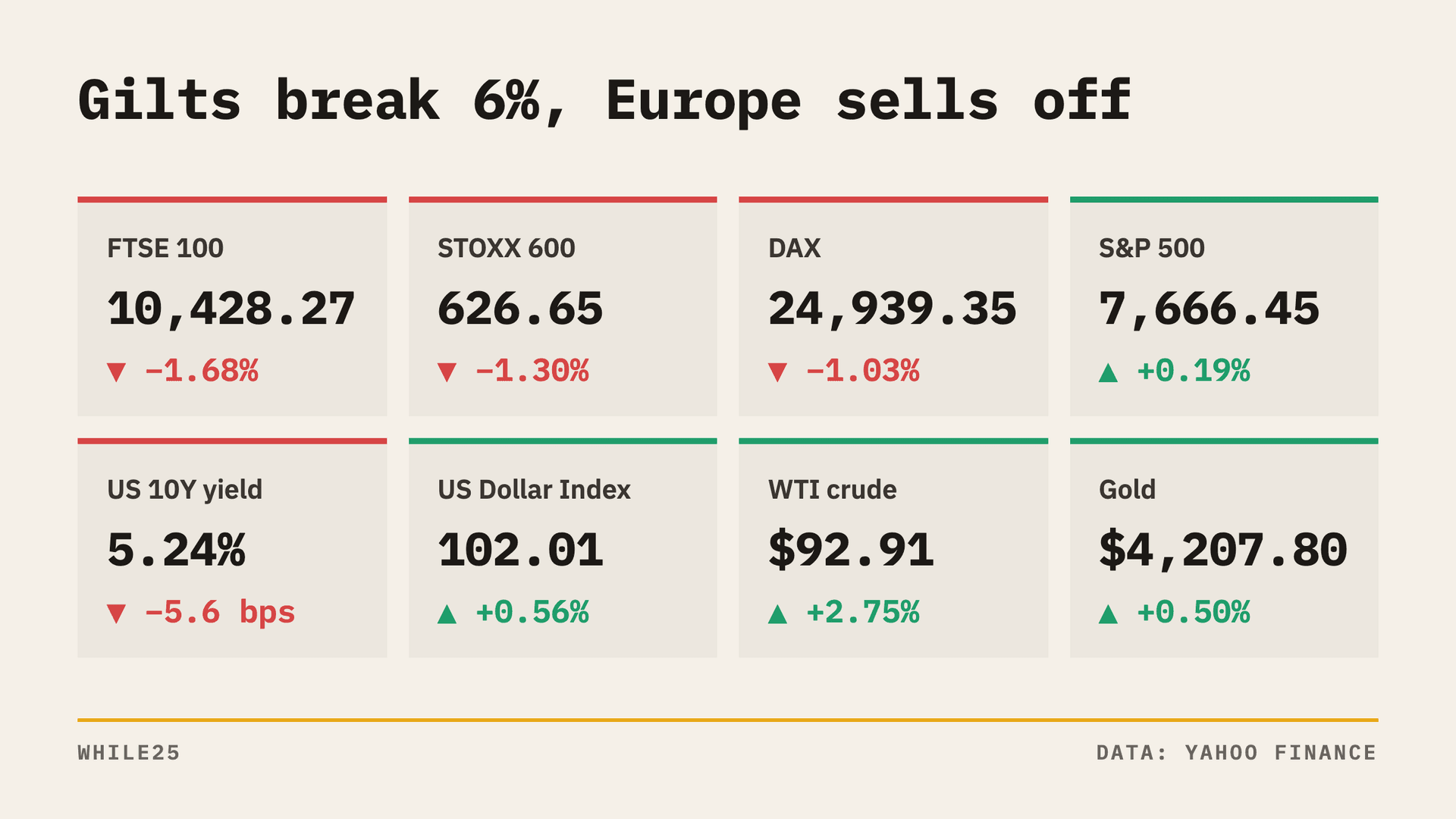
Britain's 30-year borrowing cost rose above 6% on October 1 for the first time since 1998. This rate is the 30-year gilt yield. A gilt is a UK government bond, a loan that investors make to the government. The yield is the interest the UK government pays to borrow for 30 years. It eased to around 5.97% by the London close.
The FTSE 100, an index of 100 of the largest companies listed in London, fell 1.68% to 10,428. That was its steepest daily drop since May.
Investors sold long-term government bonds in Europe and the US. Britain took the hardest hit. Inside Britain, bank shares took the most damage. In New York, the 10-year Treasury yield touched its highest level since 2002. That yield is the rate the US government pays to borrow for 10 years. US stocks finished a little higher after the yield fell back.
Chinese refiners, the companies that turn crude oil into fuel, halted fuel exports. That sent a second shock through oil prices.
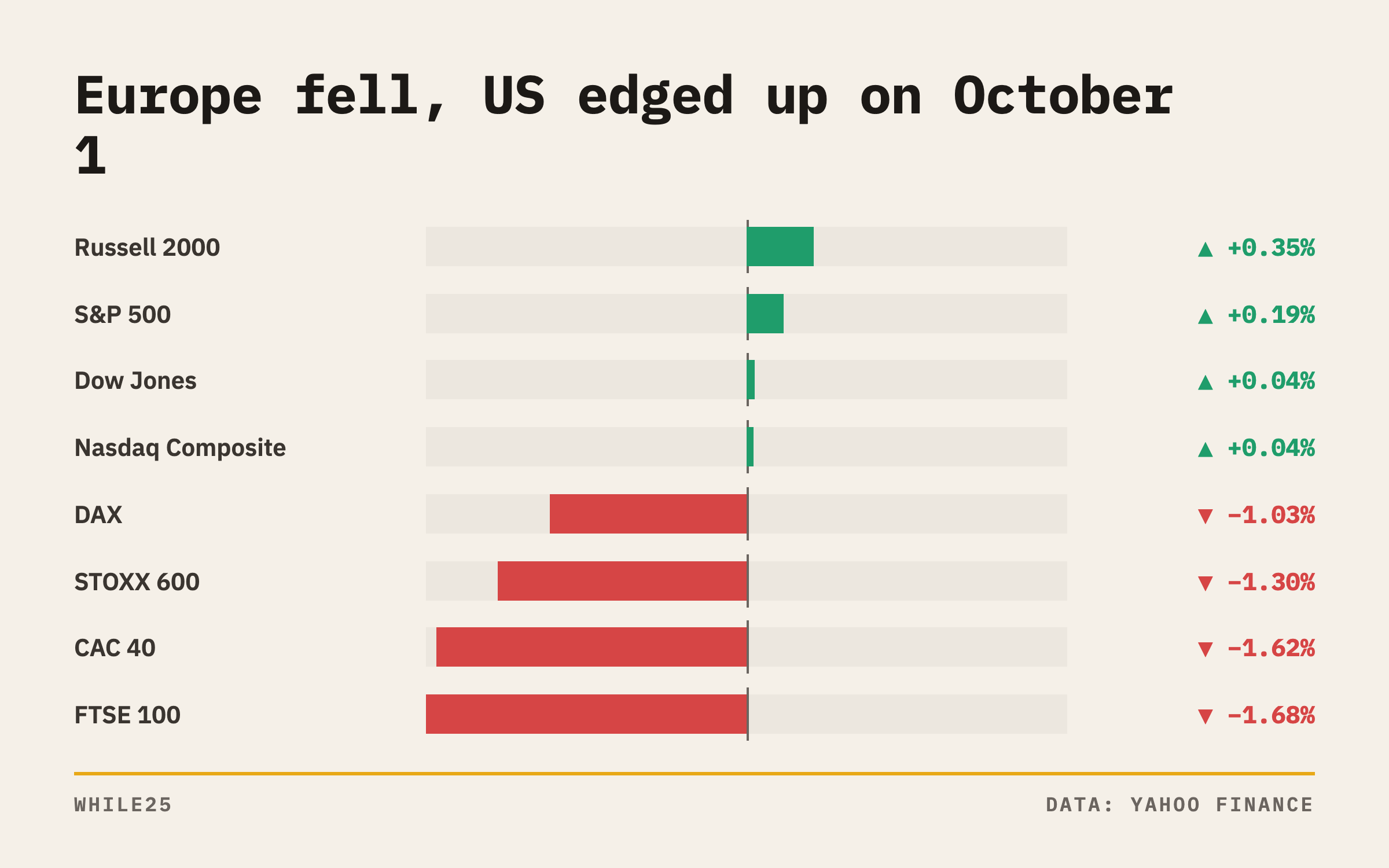 Day change for major European and US stock indexes on October 1: European indexes fell between 1% and 1.7% while US indexes ended slightly higher
Gilts break 6% and UK banks fall
A bond's yield rises when its price falls. A higher yield means the government pays more to borrow. UK lenders price mortgages and company loans off these rates. Households and businesses pay more when these rates climb.
Investors sold shorter-term gilts as well. The 10-year gilt yield rose above 5.50% during the day. That was its highest level since 2007.
UK bank shares fell next. NatWest lost 5.2%, Lloyds 4.4%, HSBC 4.3% and Barclays about 4%. The FTSE 350 banks index tracks the banks in a wider group of 350 UK companies. It fell 4.1%, its largest one-day drop since May 5.
Yields were one reason for the fall. Sky News reported that Chancellor John Healey had summoned heads of major banks to a meeting. The Chancellor is the UK's finance minister. The meeting comes before the October 28 Autumn Budget, the government's plan for taxes and spending. Investors read the report as a sign of new taxes on banks. The Treasury, the UK finance ministry, declined to comment.
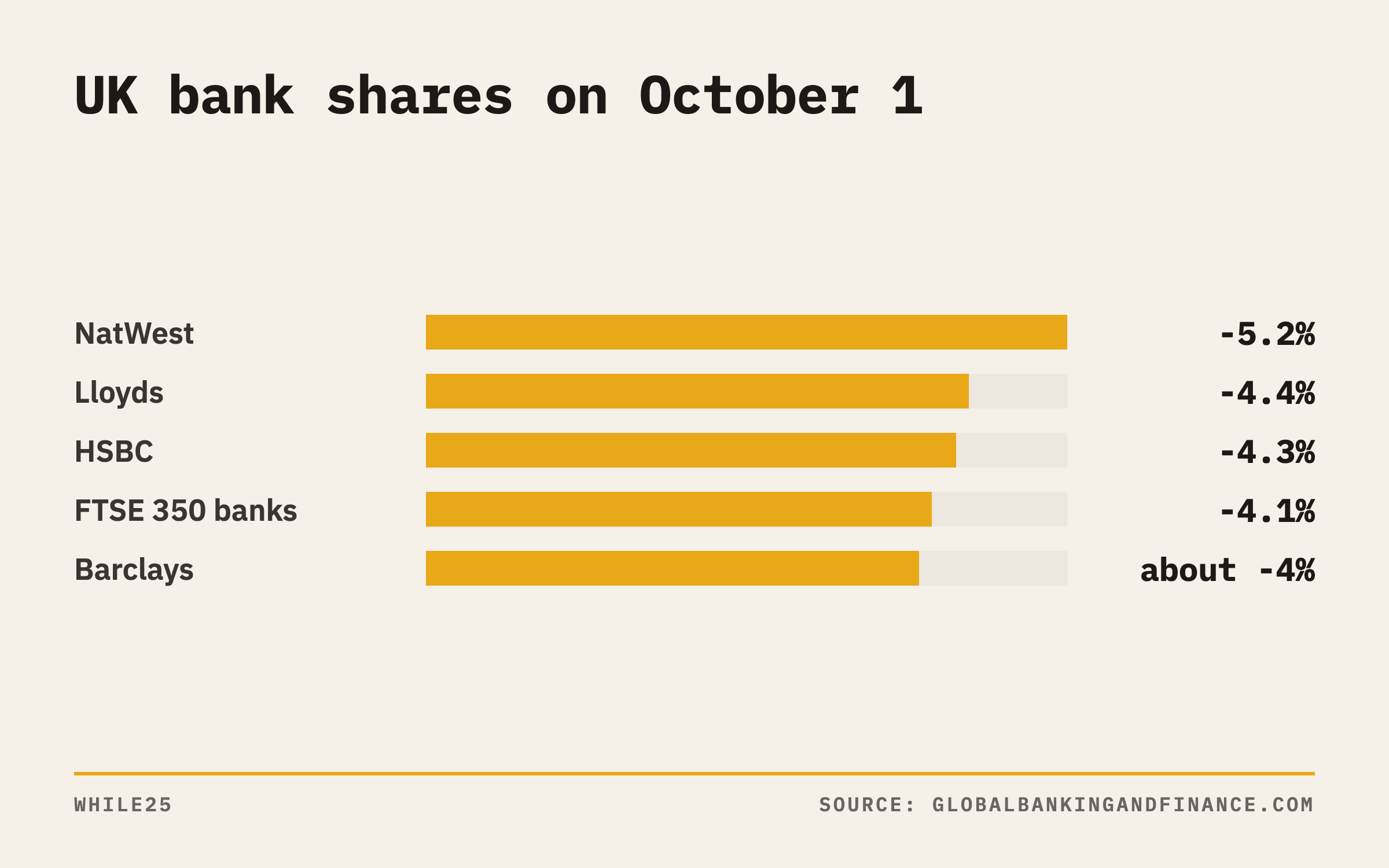 UK bank share moves on October 1: NatWest fell 5.2%, Lloyds 4.4%, HSBC 4.3%, the FTSE 350 banks index 4.1% and Barclays about 4%
A Bank of England rate-setter pointed toward higher borrowing costs. Catherine Mann sits on the Monetary Policy Committee, the group that sets UK interest rates. She said "current real financial conditions remain insufficiently tight." Here "real" means after inflation, and "tight" means costly to borrow. She suggested Bank Rate would need to increase. Bank Rate is the central bank's main interest rate.
The last sharp jump in long-term gilt yields came in 2022. The government announced a growth plan on September 23 that year. The 30-year gilt yield rose by 200 basis points between August 31 and September 27, 2022. A basis point is a small unit for yields. 100 basis points make one percentage point.
Pension funds that had borrowed to boost their bond holdings faced losses. They faced demands for more cash as well. The Bank of England stepped in on September 28, 2022. It bought 19.3 billion GBP of gilts and ended the program on October 14.
Europe: borrowing costs at multi-year highs
Investors sold bonds across the continent. Germany's 10-year Bund yield reached 3.6526%, its highest level since June 2009. A Bund is a German government bond. Its yield is the benchmark for borrowing in the euro area. The yield later edged back 5.9 basis points.
France's 10-year yield jumped to its highest since 2002. German inflation, the pace of price rises, came in a little above forecasts for September.
Investors sold European stocks with the bonds. The STOXX 600, an index of large European companies, closed 1.3% lower. That was its biggest one-day drop in three weeks. European bank shares fell 3.7%, their sharpest fall since March 3. The CAC 40, the main Paris index, lost 1.62%. Germany's main index, the DAX, lost 1.03%.
Capgemini, the French IT services group, was the standout gainer. Its shares rose 7.3% and led the STOXX 600. European tech shares gained 0.5% as a group.
US: yields peak, then stocks recover
The US 10-year Treasury yield reached 5.34% during the day. That was its highest level since 2002. It fell back to close at 5.24%. In the market data, the day's drop was 5.6 basis points.
The longer trend points up. The same yield has risen 44.1 basis points over the past month. One source calls the quarter that ended on September 30 the bond market's worst in decades. A quarter is a three-month period.
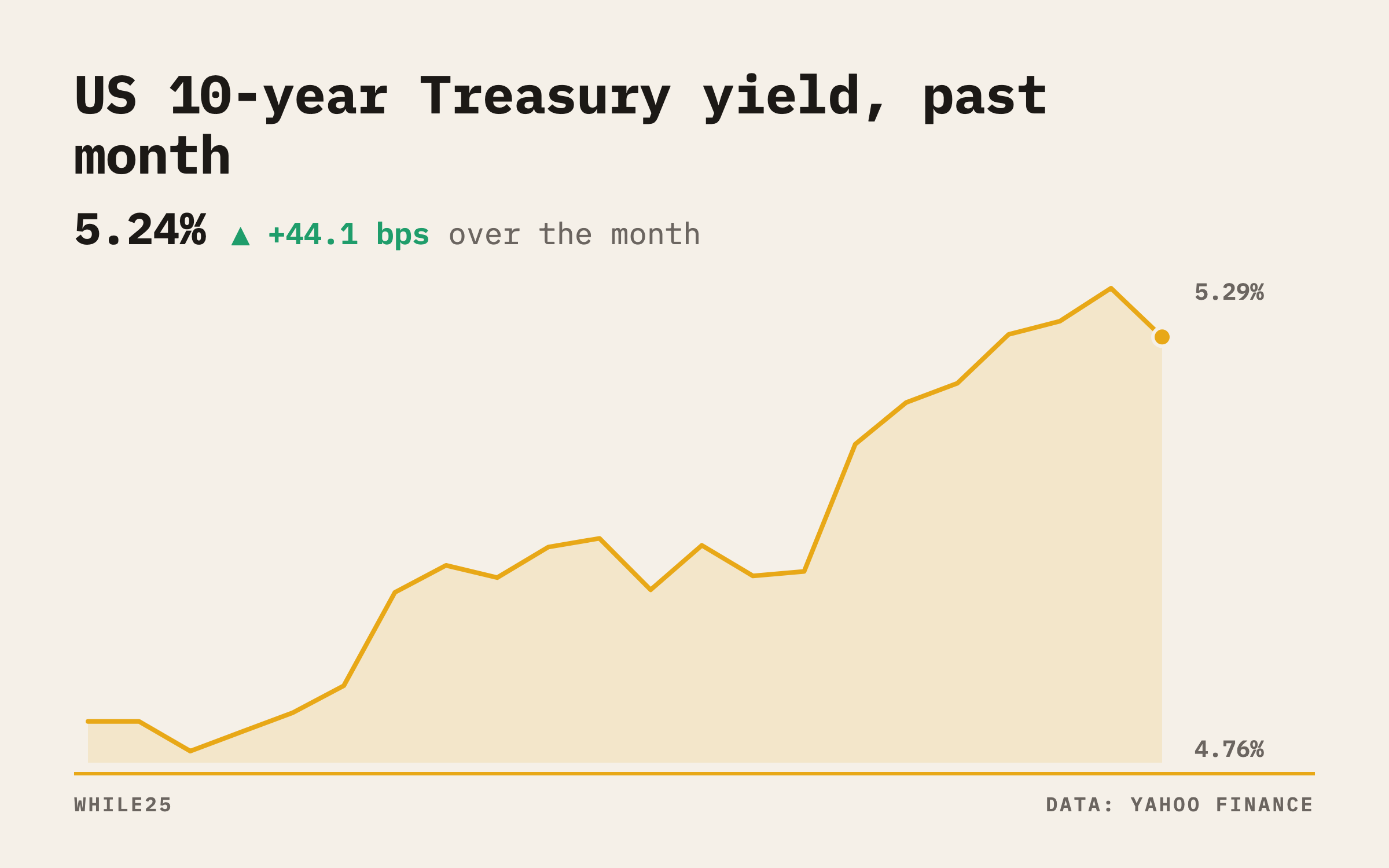 US 10-year Treasury yield over the past month, rising to its highest level since 2002 before easing on October 1
US stocks clawed back early losses as yields fell. The S&P 500, an index of 500 large US companies, rose 0.19%. The Russell 2000 index of smaller companies gained 0.35%. The Dow and the Nasdaq, two other major US stock indexes, each added 0.04%. The VIX, a gauge of expected swings in US stocks, rose 0.31% to 16.39.
Purchasing managers at US factories reported busy plants and higher costs. The ISM manufacturing index, a monthly survey of these managers, printed 54.5 for September. Its prices-paid gauge tracks what factories pay for their inputs. That gauge jumped to 77.9 from 71.1 in August. It is the highest reading since the Iran war began.
Weekly jobless claims count new filings for unemployment benefits. They fell to 197,000, a fourth straight weekly drop.
Investors moved money toward the dollar. The dollar index, which tracks the dollar against major currencies, rose 0.56% to 102.015. The euro fell 0.68% to $1.125. The dollar rose 0.32% to 158.059 Japanese yen. Gold gained 0.50% to $4,207.80. Bitcoin rose 1.20% to $84,559.75.
Oil: China halts fuel exports
Fuel is a clear source of the rise in factory prices. Reuters reported that Chinese refiners suspended exports of oil products beyond Hong Kong and Macau until further notice. PetroChina, a Chinese oil company, cancelled several gasoline and jet fuel cargoes planned for October. Russia's ban on diesel exports runs through October.
Brent is the main global benchmark for crude oil prices. Its contract for December delivery settled up 4.37% at $102.31 a barrel. The settlement price is the official end-of-day price. US crude, known as WTI, rose 2.75% to $92.91.
Kpler, a commodity data firm, estimates stored supplies of diesel and gasoil at about 20 million barrels below pre-war levels. Gasoil is a fuel similar to diesel.
Fuel costs feed into inflation. Bond investors weigh inflation when they price yields. This is the link between the oil shock and the selling in gilts and Treasuries.
Asia: Japan higher, China closed
Exchanges in mainland China and Hong Kong stayed closed for holidays on October 1. The latest Asian closing prices are from September 30. That day, Japan's main stock index, the Nikkei 225, rose 1.94% to 66,753.72. That was its highest close since August 19. Chipmakers Tokyo Electron and Advantest led the gains.
The Bank of Japan's tankan, a survey of business confidence, came out on October 1. Its reading for big manufacturers rose to 24 from 22. That is the highest in eight years. The market forecast was 25.
Dates to watch
- October 2, 8:30am ET: the US September jobs report. It covers payrolls, the count of jobs employers added, along with the unemployment rate and wages.
- Week of October 5: UK bank chiefs meet Chancellor John Healey ahead of the Budget.
- October 7: China's National Day holiday ends. Chinese refiners could restart fuel shipments after that, depending on fuel supplies at home and refinery output.
- October 28, 2:00pm ET: the Federal Reserve's rate decision and press conference. The Federal Reserve is the US central bank.
- October 28: the UK Autumn Budget.
For your portfolio
Lenders across an economy price loans off long-term bond yields. On October 1, those yields moved most in Britain. UK bank shares fell with them and with the bank-tax headlines. Investors who hold UK banks or long-term gilts face both forces until the October 28 Budget.
In the US, the same link showed from the other side. Stocks turned up once the 10-year yield turned down. Investors who follow the bond market gain context for stock moves in both countries.
Sources
- finance.yahoo.com
- uk.finance.yahoo.com
- finance.yahoo.com
- share-talk.com
- globalbankingandfinance.com
- live.euronext.com
- oilprice.com
- prnewswire.com
- qz.com
- financecalendar.com
- fedratecalc.com
- finance.biggo.com
- wtop.com
- chicagofed.org
Not investment advice.