
Saudi Aramco is Saudi Arabia's state oil company. It cut the November price of its Arab Light crude oil for Asian buyers by $3 a barrel. That put Arab Light at $5 below the Oman/Dubai benchmark average. A benchmark is a widely traded price that buyers and sellers use as a reference. The new price is Aramco's deepest discount since June 2020.
On October 5, Brent crude fell 1.89% to $100.32 a barrel. Brent is the main global oil price. WTI, the main US oil price, fell 1.99% to $89.30.
The cut surprised traders. Industry surveys had forecast a rise of $3 to $5 in Asian prices. World oil prices fell after one regional change because of the way Saudi Arabia sells its crude.
The monthly price sheet
Aramco sells several types of crude oil, called grades. Arab Light is its benchmark grade, its main reference oil. Arab Medium and Arab Heavy are thicker oils. Refiners are plants that turn crude oil into gasoline, diesel and jet fuel. They get a different mix of fuels from each grade.
Each month Aramco publishes an official selling price, or OSP, for each grade and each region it sells to. The OSP is a premium or a discount to a regional benchmark. A premium means the buyer pays more than the benchmark. A discount means the buyer pays less.
For Asian sales, the benchmark is the average of two Middle East crude prices, Oman and Dubai. Aramco prices sales to Europe and the US against other regional benchmarks.
Take the November sheet. Arab Light for Asia sits $5 below the Oman/Dubai average. A refiner in Asia loading a November cargo pays the average of those two prices over the loading period, minus $5. The cargo's dollar price moves with the benchmark from day to day. The $5 discount stays fixed for the month.
The price follows the market each day. Aramco resets its gap to the benchmark once a month. Traders watch that monthly reset.
The November sheet, region by region
Aramco cut Arab Light for Asia by $3 from its October level. It cut Arab Medium and Arab Heavy for Asia by $5 each.
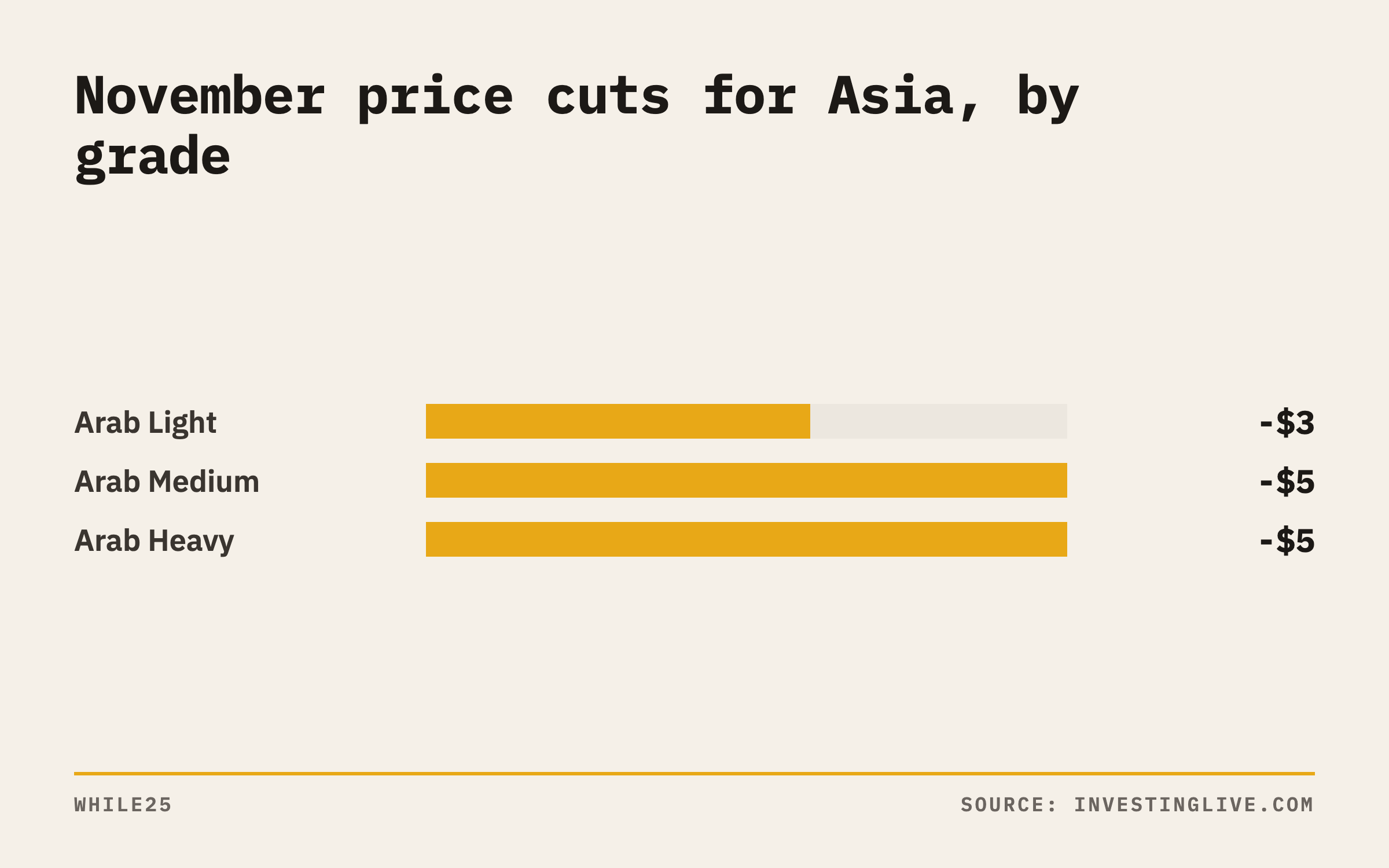 Bar chart showing Aramco's November price cuts for Asia: Arab Light down $3, Arab Medium and Arab Heavy down $5 each
Aramco moved European prices the other way. It raised prices for northwest Europe and the Mediterranean by $3 across all grades. Aramco made the increase after it restarted exports from Yanbu, its port on the Red Sea. It left prices for US buyers unchanged.
The split follows the shipping routes. Cargoes bound for Asia leave Saudi ports on the Persian Gulf. They sail through the Strait of Hormuz, a narrow channel between Iran and Oman. Cargoes loaded at Yanbu reach Europe without passing through Hormuz.
In an analysis, InvestingLive says the split reflects a real cost on the Hormuz route. By that reading, Aramco is compensating Asian buyers for freight and security risk. Red Sea cargoes avoid both. Freight is the cost of renting a tanker to carry the oil. Security risk is the chance of an attack or a blocked route. Insurers charge more to cover that risk.
Reading the sheet as a refiner
Many Asian refiners buy Saudi crude on long-term contracts. Each month they tell Aramco how many barrels they want for the next loading month. They use the OSP to make that choice.
A refiner reads the sheet in two ways. In the first, it compares the new price with the old one. After a $3 cut, November Arab Light costs less against the benchmark than October Arab Light did. In the second, it compares Saudi crude with rival grades from other producers. Next to a deeper Saudi discount, those rival grades look more expensive.
Traders weigh the surprise as much as the cut. Surveys had pointed to increases of $3 to $5. Those forecasts tracked rising Middle East benchmarks. Aramco cut prices against those forecasts. Traders read that gap as fresh information about supply and demand in Asia. Here, that means how much oil is on offer and how much buyers want.
Traders learn little from a sheet that matches the surveys. If Aramco goes the opposite way, traders have to reprice oil, which means changing what they will pay.
The path from Asia to Brent
Brent is based on crude from the North Sea. Oman and Dubai are based on oil from the Middle East. Traders deal in each benchmark on its own. Refiners link them. An Asian refinery can choose between a Middle East cargo and one priced off Brent.
With cheaper Saudi barrels on offer, Asian refiners have less reason to buy crude priced off Brent and shipped from more distant sources. Fewer buyers for those cargoes push down Brent itself. Through their buying choices, refiners spread a price cut in one region to others.
Bloomberg reported that oil prices dropped after Saudi Arabia cut its Asia prices. In the same report, Bloomberg said Saudi flows, or oil shipments, are expanding. Aramco is lowering its price while it ships more oil. That combination points to more Saudi oil looking for buyers.
Traders gave the cut more weight than news pushing prices the other way. Fighting in Yemen intensified and raised concern about shipping near the Red Sea. According to Bloomberg, traders pushed oil prices up on that concern. Prices swung to a loss as traders weighed the Saudi cut against it.
On October 5, Brent ended at $100.32, down $1.93. WTI ended at $89.30, down $1.81.
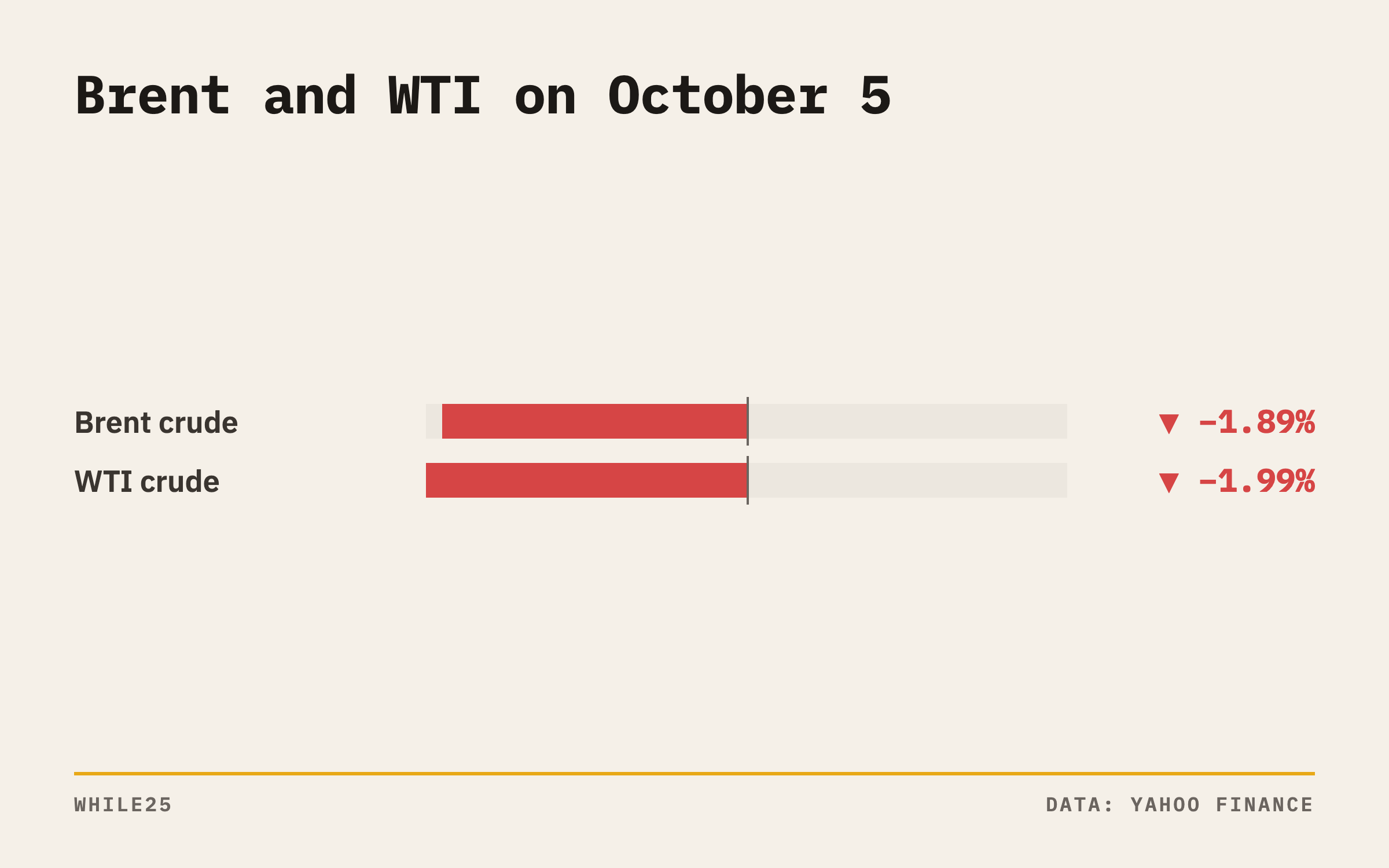 Day change for Brent and WTI crude on October 5, both down close to 2%
The link to your money
Oil prices reach households through gasoline, airfares and the cost of shipping goods. They feed into inflation, the pace at which prices rise. Central banks use inflation figures to set interest rates. Moves in Brent affect energy stocks, airline stocks and bonds. Bonds are loans that investors make to governments and companies.
The OSP is one of the clearest scheduled signals in the oil market. Aramco publishes it at the start of each month. News reports focus on Arab Light for Asia, because Asia is Aramco's largest market.
Readers can learn the most from two parts of the sheet. The first is the change compared with industry surveys. The second is the gap between regions. The November sheet showed both. Aramco cut Asian prices where surveys expected a rise. It moved Asia and Europe in opposite directions by the same $3.
A reader who tracks Brent alone sees the price move and misses the cause. The Saudi price sheet shows that cause. On October 5, traders gave more weight to one line on that sheet, Arab Light for Asia, than to a war in Yemen.
Sources
Not investment advice.