
On October 8, the Financial Times reported that OpenAI "recently told investors that its annualized revenue was nearing $50 billion". Annualized revenue is a yearly sales pace based on one recent month of sales. Media outlets had reported a figure of $70 billion.
On the same day, the Nasdaq Composite fell 1.25%. A share is a small slice of ownership in a company. A stock index is a single number that tracks the share prices of many companies. The Nasdaq Composite is a stock index that leans toward technology companies. October 8 was its worst day since mid-August.
OpenAI ran the same business on October 8 as it had the day before. Investors learned of a lower number than the one they had been using to measure it. People reached the two figures by counting sales in different ways. A company can measure its sales in more than one legitimate way. Different methods lead to different totals.
Icons for scales, coins and a chip, representing gross, net and run-rate revenue
Annualized revenue shows today's pace
Revenue is the money a company takes in from sales, before it pays any costs. A listed company is one whose shares trade on a stock exchange, a marketplace where people buy and sell shares. Most listed companies report revenue for each three-month period, called a quarter. They also report it for the full year. Many young, fast-growing companies quote a different number: annualized revenue, also called run-rate revenue.
The method has two steps. Take the sales from one recent month. Multiply that month's sales by the number of months in a year. The result shows today's sales pace as a yearly total.
A car's speedometer works the same way. It shows your speed at this moment. A run rate shows a company's sales speed at this moment. A fast-growing company shows a run rate above the sales it recorded over the past year. A company with slowing sales can show a run rate below them.
OpenAI's shares do not trade on a stock exchange, so OpenAI is a private company. Private companies need not publish audited results. Audited results are financial reports that an outside firm has checked. The public learns about OpenAI's revenue from two places: what the company tells investors, and press reports. As a result, reporters and investors can quote different numbers at the same time.
Two routes to $70 billion
The FT reported that OpenAI's annualized revenue "topped out at roughly $50 billion as of September". A source told CNN that "the $70 billion figure did not come from OpenAI". Reporters covering the story offered two explanations for the higher number.
The first explanation is a chain of estimates. Investors citing $70 billion started from an estimate that OpenAI's August sales reached $40 billion. They added a 70% growth figure that OpenAI had given them. The investors built the $70 billion total themselves from these pieces.
The second explanation concerns which money a company counts as its own. CNN reported that the $70 billion figure may come from a comparison with Anthropic, another company that builds AI models. Gross revenue counts the whole payment from a customer. Net revenue counts the part the company keeps. Anthropic includes gross revenue from cloud providers in its figure. A cloud provider is a company that rents out computing power and software over the internet. OpenAI bases its figure on net revenue.
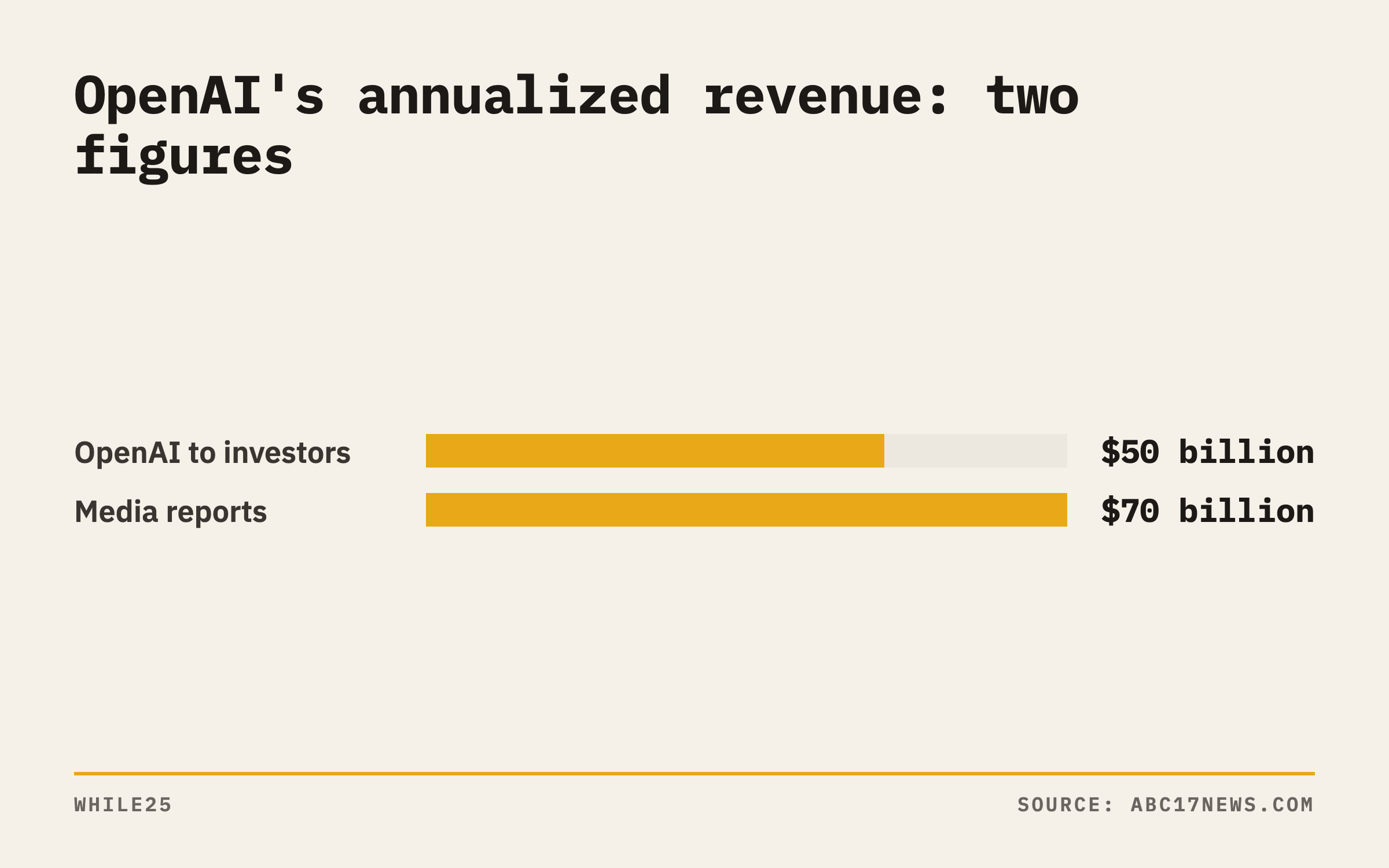 Bar chart comparing the $50 billion annualized revenue OpenAI reported to investors with the $70 billion figure previously reported by media
Gross revenue and net revenue
Picture a business customer who buys access to an AI model through a cloud provider. The customer pays the cloud provider. The cloud provider keeps a cut. It passes the rest to the company that built the model.
Gross revenue counts the full amount the customer paid, including the cloud provider's cut. Net revenue counts the part the model's maker keeps. From one sale, the maker can report a larger gross number or a smaller net number.
Under accounting rules, a company may use either method. The right method depends on which company controls the product and carries the risk of the sale. Travel booking sites and app stores face the same question about the money that passes through their hands.
A reader runs into trouble by placing a gross figure next to a net figure as if they measured the same thing. Bloomberg and Reuters reported in August that Anthropic is on track to generate annualized revenue of more than $65 billion. OpenAI and Anthropic use different methods to calculate annualized revenue. A reader who sets the two figures side by side compares a whole payment with the slice one seller keeps.
The money chain behind chip stocks
OpenAI is private, yet its revenue matters to listed companies. Building and running AI models takes large amounts of computing power. That power comes from chips, the processors that do the calculations. The chips sit in data centers, buildings packed with computers called servers and with cooling equipment.
OpenAI uses money from its sales to help pay for that equipment. Customers pay OpenAI. OpenAI spends on chips and on space and computing power in data centers. Chipmakers and cloud companies record that spending as their own revenue. Investors use OpenAI's revenue as a base. From that base, they judge how much money can reach the companies below OpenAI in the chain. A smaller OpenAI figure means a smaller base.
On October 8, after the report, Nvidia shares fell 2.9%. Nvidia sells graphics chips that companies use to train and run AI models. Intel shares fell 5.3%. Oracle shares fell 5.5%. Oracle builds data centers and rents out their computing power. The S&P 500, an index of large US companies, fell 0.5%.
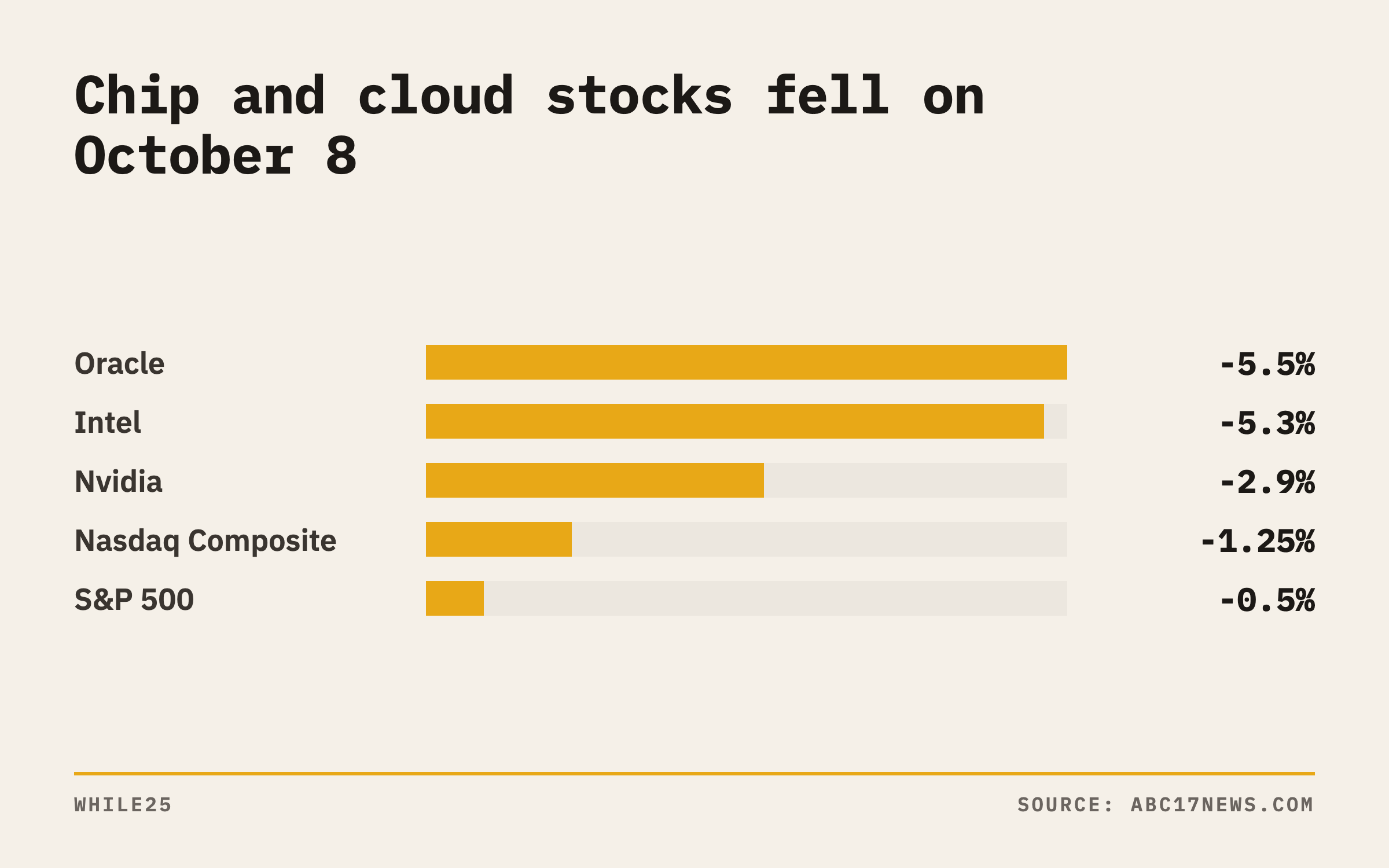 Bar chart of October 8 declines: Oracle down 5.5%, Intel down 5.3%, Nvidia down 2.9%, Nasdaq Composite down 1.25%, S&P 500 down 0.5%
Investors concentrated their selling in technology shares. The Dow Jones Industrial Average, an index with fewer chip and software companies, rose 0.10% the same day. The Russell 2000, an index of smaller US companies, rose 0.03%. Investors sold shares of the companies closest to AI spending. They left much of the rest of the market alone.
Reading revenue headlines
Each revenue figure comes with a method. The method can matter as much as the number. A run rate stretches one month's pace across a year. A gross figure includes money that passes through to partners. A figure from someone outside the company may rest on estimates stacked on top of each other.
A reader can sort most of these cases with two questions. Did the company give the number, or did someone else build it? Does the number count the whole payment, or the part the company keeps? The answers explain the $50 billion and $70 billion figures for one company in the same season.
These questions matter to investors who own no shares in a private AI company. A fund pools money from many investors to buy shares. An index fund buys the shares in an index so that it matches the index's results. A fund that tracks the S&P 500 or the Nasdaq Composite owns Nvidia, Intel and Oracle. Investors moved those shares on October 8 because of a figure from a company that does not publish audited accounts. A reader who knows the method behind that figure can judge the next headline with more care.
Sources
Not investment advice.