
On October 1 the UK 30-year gilt yield climbed above 6% for the first time since 1998. A gilt is a bond the UK government sells to borrow money. Its yield is the yearly return a buyer locks in at today's price. By the London close, the end of the trading day, the yield had eased to around 5.97%. The 10-year gilt yield rose above 5.50% during the day, its highest level since 2007.
UK bank shares fell the same day. The FTSE 350 banks index tracks the bank shares among the 350 largest companies listed in London. It dropped 4.1%, its largest one-day fall since May 5. The FTSE 100, which tracks the 100 largest London-listed companies, closed down 1.68% at 10,428.
Long gilts, the ones that pay interest for decades, last drew this much attention in the autumn of 2022. That year long-term yields rose within weeks. Some investors had to sell, and each round of selling led to more. Traders watch this part of the bond market with care because of 2022. From that year they learned how a move in one government bond can reach pension pots and bank shares.
Bond prices and yields move in opposite directions
A bond pays a fixed stream of interest. If new bonds pay more, buyers lose appetite for older bonds that pay less. Holders who want to sell those older bonds must cut their price. Prices and yields sit on opposite ends of a seesaw. A rising yield means a falling price.
Long bonds swing the most. A 30-year gilt pays interest for three decades. A higher yield lowers today's value of each of those future payments. The more payments a bond has left, the bigger the drop in its price. A headline about a rising 30-year yield describes painful losses for the people who hold those bonds.
The 2022 chain of forced selling
On September 23, 2022, the UK chancellor announced the government's new growth plan. Market participants came to call it the mini-budget. The 30-year gilt yield rose by 200 basis points from August 31 to September 27, 2022. A basis point is one hundredth of a percentage point. That means 100 basis points make one percentage point.
UK pension funds bore the damage. Many defined-benefit schemes, the kind that promise a set income in retirement, used a method called liability-driven investment, or LDI. A liability is money a fund owes. Under LDI, a fund holds assets whose value moves in step with the pensions it owes. Some funds borrowed money to get more of that protection from less cash. Borrowing to invest is called leverage.
Lenders set a condition for leverage. The firms on the other side of these trades ask for collateral. Collateral is cash or bonds set aside to cover possible losses. If a position, meaning an investment the fund holds, loses value, these firms ask for more. That demand is a margin call.
Gilt prices fell, and pension funds using leveraged LDI lost money. Prime brokers and clearing houses responded with margin calls. A prime broker is a bank that lends to large investors and trades for them. A clearing house stands between buyer and seller and guarantees the trade.
The funds needed cash in a hurry, so they sold the assets that were easiest to sell. Gilts sat near the top of that list. The funds then caught themselves in a loop. Each sale pushed gilt prices down and yields up. Higher yields meant bigger losses on the borrowed positions. Lenders answered bigger losses with more margin calls, and the funds sold more. The funds had to accept whatever price buyers offered.
On September 28, 2022, the Bank of England announced a temporary program to buy gilts. The Bank made 19.3 billion GBP of purchases and ended the program on October 14, 2022. The Bank's buying gave pension funds time to raise cash without dumping bonds into a falling market.
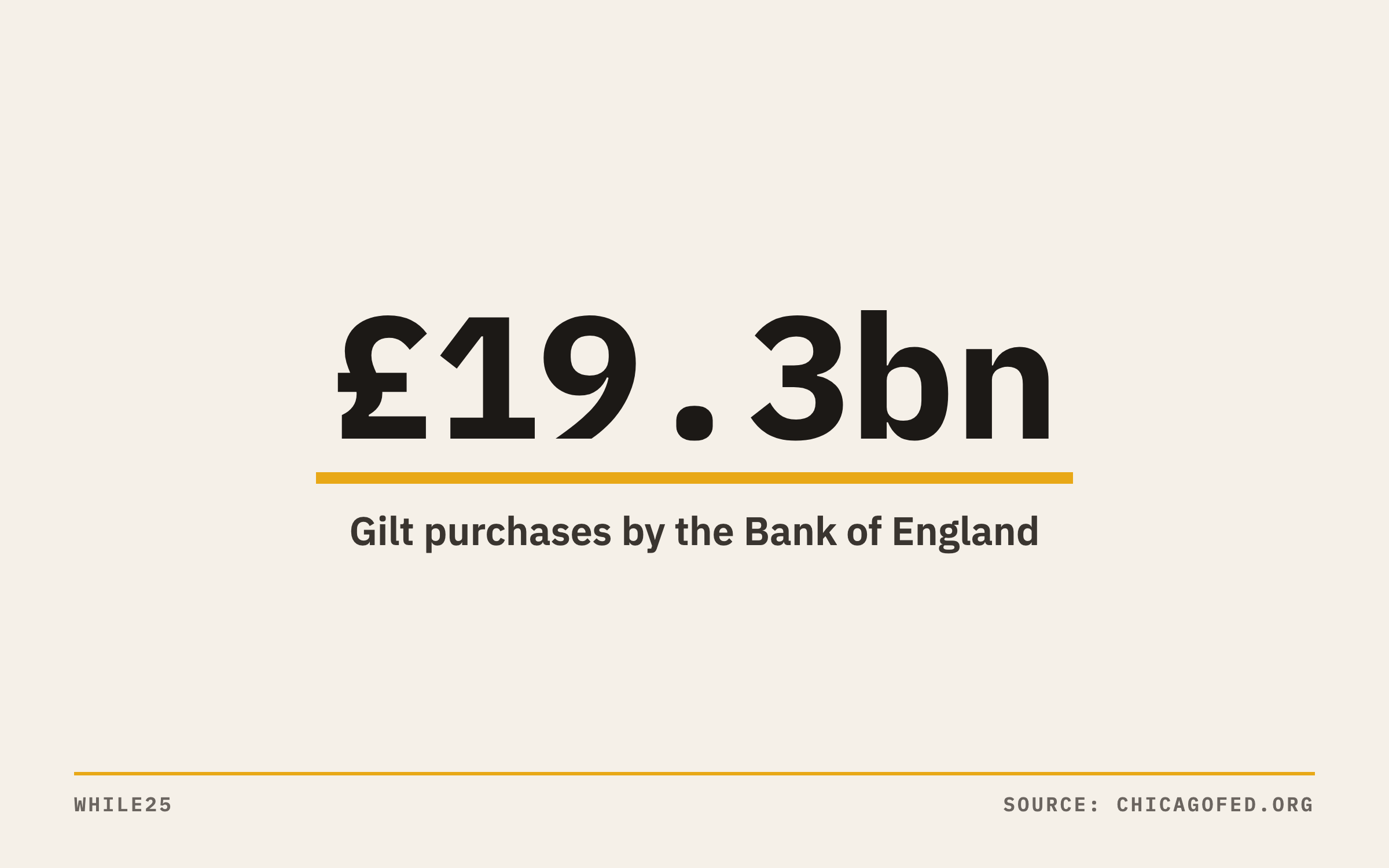 The Bank of England made £19.3 billion of gilt purchases in its temporary 2022 program
Setting October 1 beside 2022
Both episodes involve the same bond, and in both its yield rose. The details differ, and the details decide how far a sell-off, or wave of selling, spreads.
In 2022, the government set off the move with one policy announcement. The 200 basis point rise came over a few weeks, and leveraged funds had to find cash within days. For a fund that has borrowed, the speed of a price drop sets a deadline. Such a fund can ride out a slow decline. In a sudden drop, its lenders demand cash at once.
The reports from October 1 cover a yield level, a high for the 10-year yield and a fall in bank shares. They do not mention margin calls at pension funds or emergency buying by the Bank of England. Investors in 2026 face a level last seen in 1998. Investors in 2022 faced a rise so fast that it broke the borrowing setup behind some pension funds. Each fact belongs to its own day. Readers should not treat the 2022 record as a forecast for this one.
From long yields to bank shares
The bank sell-off on October 1 was broad. NatWest shares fell 5.2%, Lloyds 4.4%, HSBC 4.3% and Barclays about 4%.
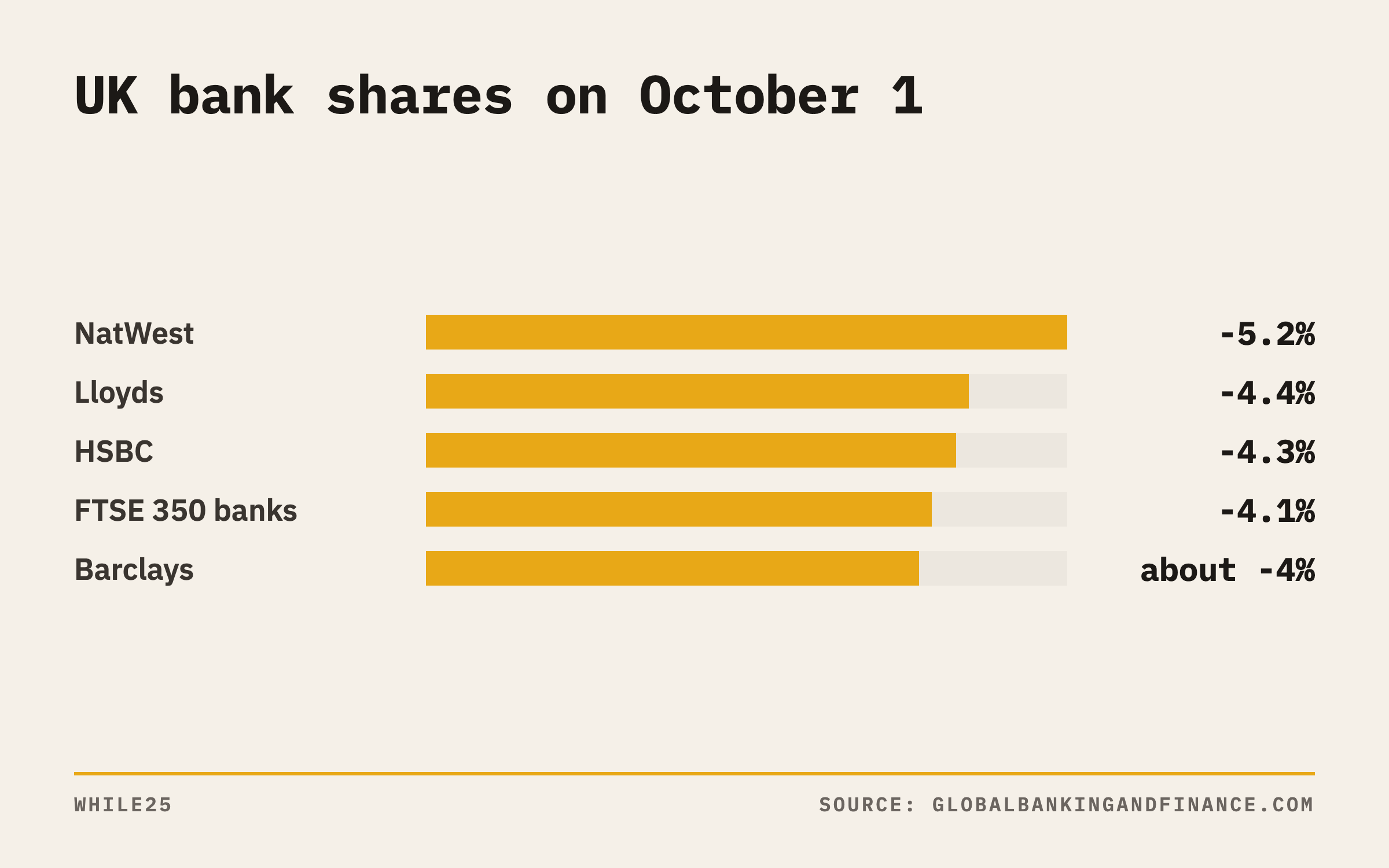 UK bank shares fell between about 4% and 5.2% on October 1, with the FTSE 350 banks index down 4.1%
Two threads tied gilts to banks that day. The first runs through the UK budget. Sky News reported that heads of major banks will meet finance minister John Healey before the October 28 Autumn Budget. The Autumn Budget is the government's main statement on taxes and spending. Investors began to expect possible new taxes on banks. The Treasury declined to comment.
Gilt yields shape that budget. Higher yields mean the government pays more to borrow. It then spends more of its revenue on interest. That leaves less room for other spending or tax cuts. Shareholders watch that squeeze with care in any sector that could face new taxes.
The second thread runs through the banks' own books. Banks hold government bonds as safe assets they can sell at short notice. A rise in yields lowers the market value of those holdings. Gilt yields set a floor under the interest rates that households and companies pay. That includes fixed-rate mortgages, home loans whose rate stays the same for a set period. Higher borrowing costs can change how much people borrow and how many borrowers fail to repay.
From long yields to pensions
Pension funds use long-term interest rates to value what they owe. A defined-benefit scheme owes payments stretching decades into the future. Higher long yields lower the value of those promises on paper. That effect can help a scheme's funding position, the balance between what it holds and what it owes.
In 2022 the risk sat in the hedge, the LDI holdings meant to match what funds owe. Funds that borrowed to build that hedge needed cash as soon as gilt prices fell. The same rise in yields helped them on paper and drained their cash in practice.
Savers in defined-contribution plans meet long gilts another way. In these plans, the size of each pot depends on investment returns. Many plans move savers toward bonds as retirement nears. A rise in long yields lowers the price of those bonds. Savers close to retirement with gilt funds in their plan see that move in their balance.
Dates on the calendar
The October 28 Autumn Budget is the next scheduled UK fiscal event, meaning a set date for tax and spending decisions. Sky News reported that bank heads will meet John Healey before that date. Gilt traders will see the government's tax and borrowing plans on October 28.
For a reader with money in pensions, banks or bonds, the 30-year gilt works like a price tag on time for the UK economy. It shows the cost of borrowing for three decades. A rise in that price leads investors to revalue gilts, pension liabilities and bank shares together.
The 2022 episode holds one lesson about leverage. For a fund that has borrowed, a fast drop in bond prices can turn a paper loss into a demand for cash. Its lenders can force it to sell into a falling market.
Sources
Not investment advice.