
Webull is a broker, a company that lets people buy and sell stocks. Its own shares fell 19.09% on October 7. A share is a small piece of ownership in a company. Webull's shares closed the trading day at $5.89.
The drop followed a report from the House Select Committee on China. This committee is a panel of US lawmakers that studies risks tied to China. The report said 62% of Webull's employees live in China. It urged a federal panel called CFIUS to open a formal review of the company.
Trading was heavy. Investors traded 81 million shares that day. That count is called volume. It ran about 459% above Webull's average over the prior three months.
Webull rejected the report. The company said it contains "significant inaccuracies and unsupported conclusions." Webull said its US operations are based in Florida and New York. It said it keeps customer data within US borders.
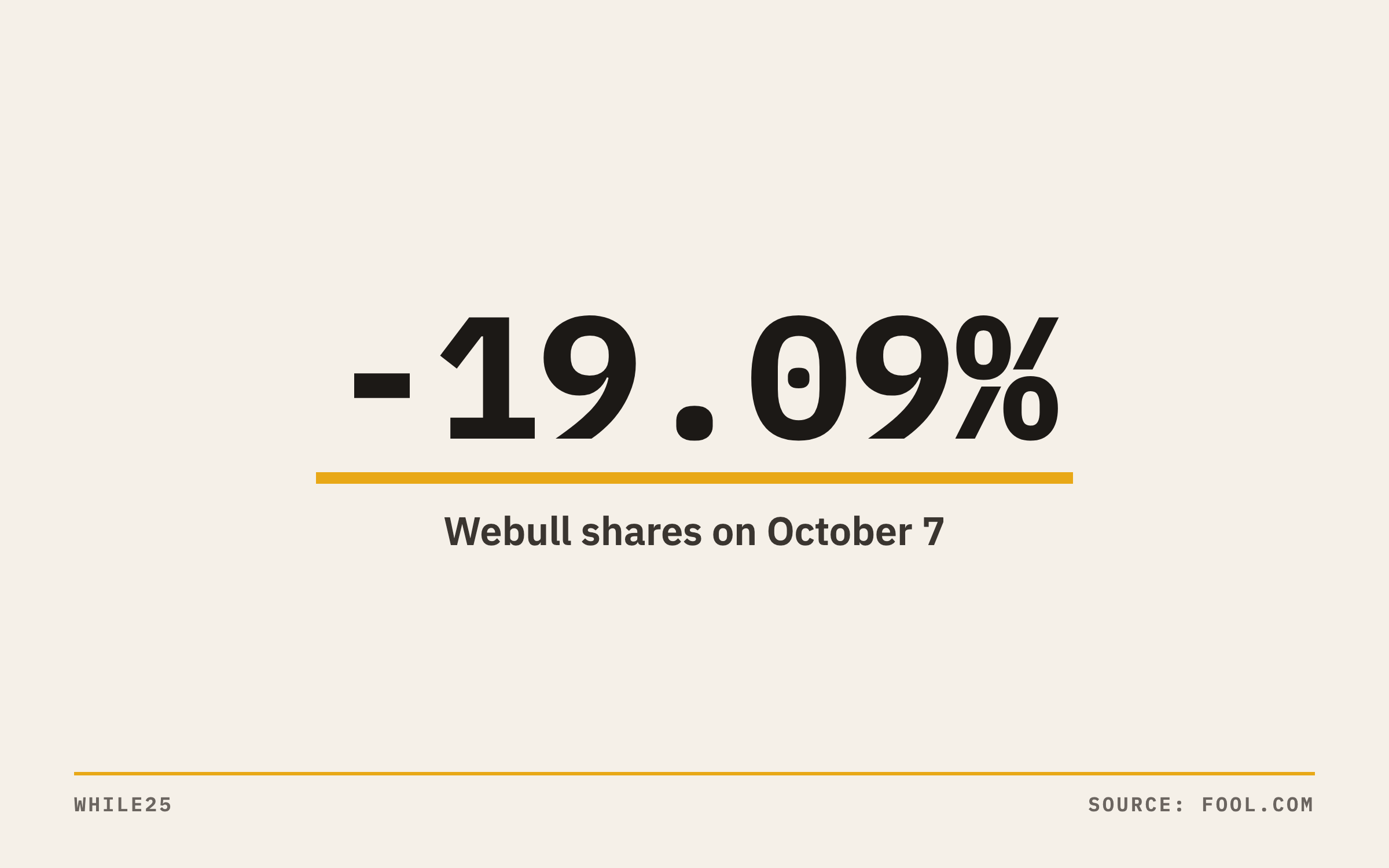 Webull shares fell 19.09% on October 7, 2026
The committee's findings
The House committee raised national security concerns about Webull's ties to China. Its main figure was the share of staff based there. According to the report, 62% of Webull's employees reside in China.
The committee asked CFIUS to examine two parts of the business. The first is Webull's operational structure. That means how the company is organized and which teams run which tasks. The second is its data security practices. That means how the company stores and protects customer information.
A broker holds sensitive records. A customer account carries a name, an address, a tax ID, linked bank details and a record of trades. A tax ID is the number a person uses to file taxes. The committee's request focused on two things. One is how Webull handles that information. The other is where its staff sit.
The role of CFIUS
CFIUS stands for the Committee on Foreign Investment in the United States. It is a group of federal agencies. The Treasury Secretary, the cabinet member who runs the US Treasury Department, chairs it. CFIUS reviews cases in which foreign investors gain control of, or certain rights in, US businesses. It decides whether that investment creates a national security risk.
Personal data has become a large part of its work. CFIUS gives extra scrutiny to companies that hold sensitive data on Americans. A brokerage with US customer accounts fits that description.
A review can end in a few ways. CFIUS can clear a company with no changes. It can require a mitigation agreement. That is a binding contract with conditions the company must follow. Those conditions can cover where the company stores data and who may access it.
In serious cases, CFIUS can send the matter to the president. The president has the power to block a deal. The president can order a foreign investor to sell its stake, meaning its ownership share.
The House report is a request. A committee of Congress lacks the power to open a CFIUS case on its own. CFIUS decides which matters it takes up. It keeps most of its cases out of public view.
The price drop
A share price shows what buyers will pay today for a company's future profits. Investors find it hard to put a price on the outcomes of a possible review. Those outcomes range from new costs for data controls to limits on how the company operates. On October 7, more people wanted to sell than to buy at higher prices. The stock closed 19.09% lower.
Volume shows how many investors acted at once. At about 459% above the three-month average, investors traded many more shares than on a normal day. Heavy volume on a big drop means many holders sold on the same day.
Other brokers fell
Two larger brokers declined on October 7. Robinhood Markets fell 2.22%. Interactive Brokers Group fell 3.14%.
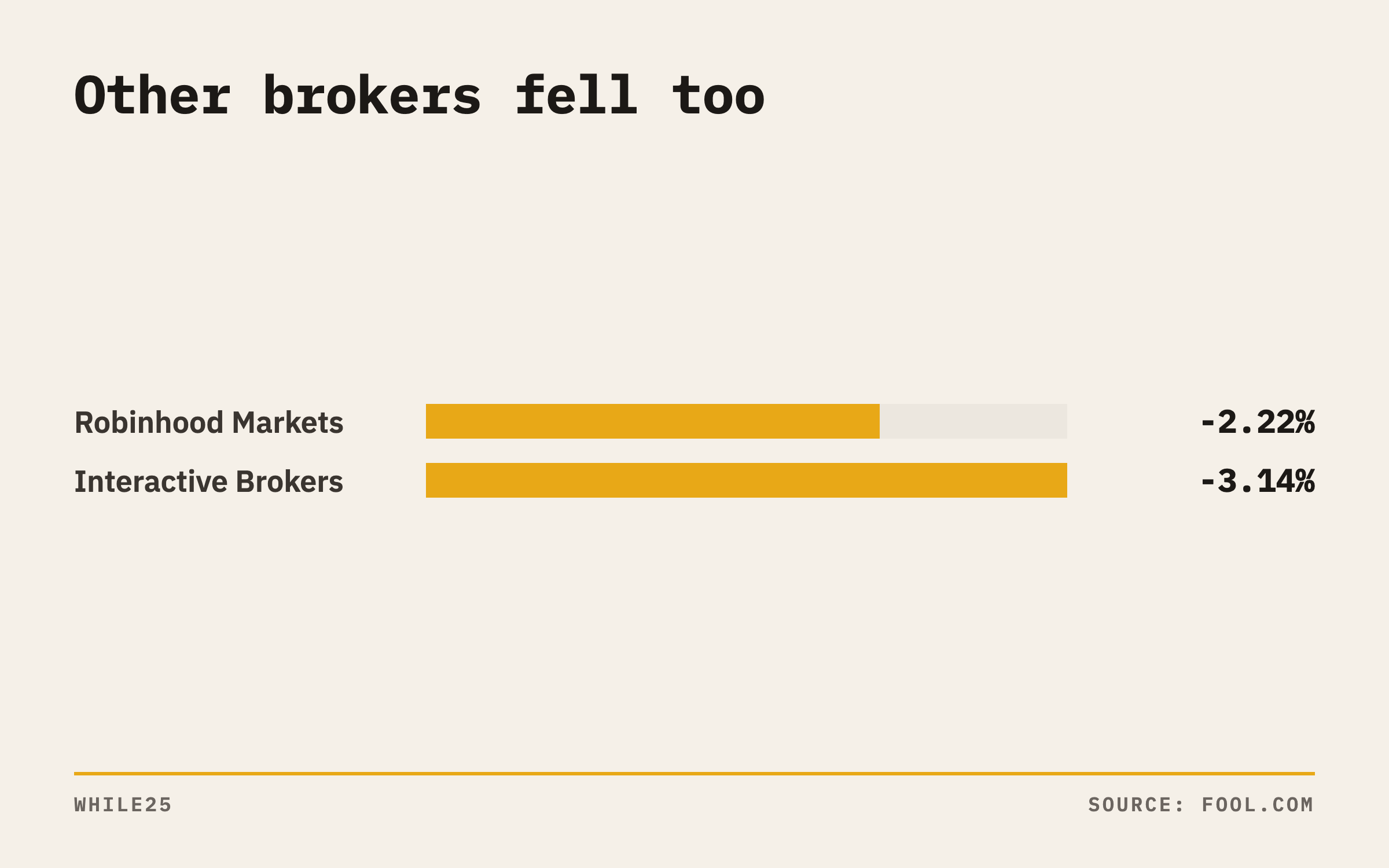 Robinhood fell 2.22% and Interactive Brokers fell 3.14% on October 7
An index tracks the prices of a group of stocks as one number. The broad indexes fell by smaller amounts. The S&P 500, an index of 500 large US companies, slipped 0.22%. The Nasdaq Composite leans toward technology stocks. It fell 0.22%. The Russell 2000, an index of smaller US companies, fell 1.31%.
Investors faced other pressure the same day. The 30-year Treasury yield reached 5.72%, its highest level since 2002. This yield is the interest rate the US government pays to borrow for 30 years. Brent crude is the main global price for oil. It closed at $100.95 a barrel. Investors in Europe sold stocks in the face of higher borrowing costs and oil prices. The STOXX 600, an index of 600 European companies, fell 1.00%.
The sources for this post do not tie the Robinhood and Interactive Brokers moves to a single cause. Both fell more than the S&P 500 on the day the Webull report circulated. Investors tend to reprice a group of similar companies when one member faces a new risk. That means they change what they will pay for the whole group. The pattern shows up in many industries, from banks to chipmakers.
Webull's response
Webull answered on the two areas the committee named. On structure, it pointed to US operations based in Florida and New York. On data, it said customer data stays within US borders. The company described the report as containing "significant inaccuracies and unsupported conclusions."
The two sides give different accounts of the same company. The committee points to where employees live. Webull points to where its US operations and customer data sit. CFIUS would weigh those facts if it opens a review.
Your portfolio
A portfolio is the set of investments a person owns.
Webull the stock and Webull the broker are separate things. Investors trade the stock on what they expect about future profits and risks. The broker holds customer accounts. The SEC, the main US markets regulator, sets rules for brokers. Under those rules, US brokers must keep customer cash and securities apart from the firm's own money. Securities are investments such as stocks and bonds. A falling share price does not by itself change what sits in a customer's account.
Government action can move stock prices. Investors call this policy risk. After a report from Washington, investors cut Webull's market value by nearly a fifth in one day. Market value is the total worth of all a company's shares. The size of a move like this depends on how much of a company's value rests on the issue. For Webull, the questions center on staff location and data handling.
Owners of broker stocks saw on October 7 how news about one firm can spread to similar firms. Robinhood and Interactive Brokers both fell more than the S&P 500. Investors can check how much of their portfolio sits in one industry. That figure helps explain why one day can hit several of their investments at once.
Dates to watch
Interest rates matter for broker stocks. Brokers earn interest on the cash customers leave in their accounts.
The September Consumer Price Index comes out on October 14 at 8:30 a.m. Eastern Time. It is the main US inflation report. Inflation is the rise in prices across the economy.
The Federal Reserve, the US central bank, holds its next policy meeting October 27 to 28. At these meetings, Fed officials decide on interest rates.
Any public step by CFIUS on Webull would come on its own timeline. CFIUS has published no date for one.
Sources
Not investment advice.